
CINE-221 · Lesson 11 of 12 · 25 min
Weather and effects lighting
Many scenes require light that moves or changes: the flicker of a fire, the glow of a television, the sweep of passing headlights, the flash of lightning, police lights flashing red and blue, rain glinting in a streetlight. These effects bring scenes to life and are essential to their realism, but they must be convincing; an effect that looks mechanical or repetitive breaks the illusion. This lesson covers rain and backlight, lightning, fire and candle effects, television and screen effects, car interiors and passing lights, police and emergency lights, gunfire and explosions, programming effects with modern control systems, and coordinating effects with special effects and stunts.
Rain and backlight
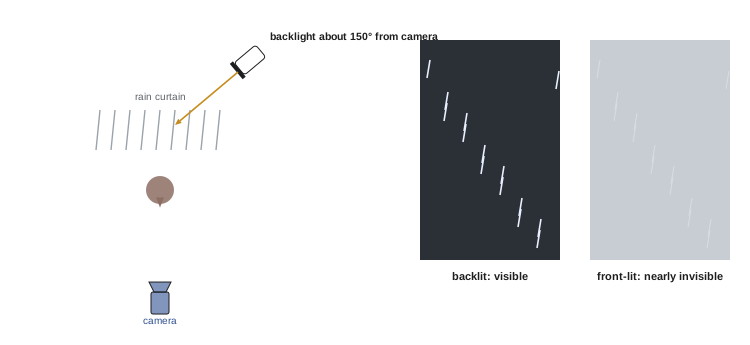
Rain is almost invisible on camera when lit from the front; it appears only when backlit, as each drop catches and refracts light toward the camera. Filmed rain, produced by special effects teams with rain towers, rain bars and hoses, is therefore usually lit from behind with hard sources, such as HMIs or powerful LEDs, positioned above and behind the falling water at a steep angle, often 120° to 160° from the camera. Darker backgrounds make backlit rain more visible. Real rain is too fine to read on camera, so effects rain uses larger drops. Rain also wets surfaces, creating reflections (Lesson 8), and darkens costumes and sets. Lighting must be protected from water, and electrical safety around rain effects is critical: all distribution should be protected by ground fault protection, connectors kept off the ground and covered, and fixtures rated or shielded for wet conditions.
Lightning
Lightning effects are brief, intense flashes, often followed by flickers, with a cool, bluish-white colour. Traditional lightning effects used special lightning strike units (carbon arc or xenon-based), banks of photofloods or flash heads triggered by hand; modern productions often use powerful LED fixtures and dedicated lightning effect units that can produce very short, intense pulses with programmable patterns. Convincing lightning varies in timing and intensity, often with multiple pulses of different strengths, sometimes illuminating a scene from a direction suggesting a window or the open sky. It should be timed with thunder in the sound design, usually with a delay. Because lightning flashes can be very fast, they may need to be synchronized with the camera's shutter so that the flash falls entirely within a frame, rather than appearing in only part of a frame with rolling shutters.
Fire and candle effects
Firelight is warm, around 1,800 to 2,200 K, and flickers irregularly in both intensity and position as flames move. Fire effects can be created by:
- Dimmer flicker: warm tungsten or LED sources on dimmers, flickered by hand or by programmed effects, ideally with several sources flickering out of phase.
- Moving light: waving flags or strips of fabric in front of a light, or moving the light itself, so that shadows shift as flames would.
- Dedicated fire-effect LEDs: fixtures with built-in fire programmes, combining colour and intensity changes from multiple emitters.
- Real flames: candles, fireplaces and bonfires, supplemented by effects lights.
The key to convincing fire is irregularity and multiple sources: real fire contains many flames of different sizes, so its light varies in a complex way. Colour variations from deep orange to yellow add realism. Firelight usually comes from low in the frame, lighting faces from below. Safety with real flames requires fire safety personnel, extinguishers and careful control near costumes, hair and set materials.
| Effect | Typical colour | Key technique |
|---|---|---|
| Fireplace or campfire | 1,800–2,200 K | Several warm sources flickering irregularly, low angle |
| Candle | About 1,800–2,000 K | Small warm source near the candle, subtle flicker |
| Television | Cool, varied colours | Programmed changes in colour and level, soft source |
| Lightning | Cool bluish white | Short intense pulses, irregular timing, synced to shutter |
| Police lights | Red and blue | Alternating saturated flashes, rotating or strobing |
| Passing headlights | Warm or cool white | Moving sources or sweeping flags |
Television and screen effects
A television or monitor lights the faces of people watching it with soft, cool, constantly changing light, varying in brightness and colour with the images. Real screens may be too dim, flicker on camera, or produce unflattering light. The effect is created with a soft source near the screen's position, such as an LED panel with diffusion, programmed to vary in colour and intensity randomly or according to the content, or controlled live by an operator. Some systems take a video feed and translate it into colour changes, so that the light on faces matches what is on screen. The effect should be subtle: large, rapid changes look artificial. The same approach applies to phone and laptop screens, cinema screens and video walls.
Car interiors and passing lights
Scenes inside moving cars at night are lit by dashboard glow, streetlights passing overhead, headlights of other cars and signs. Shooting on real roads with a camera car or process trailer, the cinematographer may rig small LEDs inside the car for faces and use the passing world for movement. On stages or in volumes, the car is stationary and movement is suggested by lights: sources passing overhead on a track or fired in sequence to suggest streetlights, sweeping headlights from behind, flags moved in front of lights to suggest passing objects, and video or LED walls showing the moving exterior and lighting the car (CINE-302). The rhythm of passing lights should match the apparent speed and environment: regularly spaced streetlights on a highway, irregular lights in a city.
Worked problem
Timing passing streetlights
A night car scene is shot on a stage. The car is supposed to travel at 60 km/h along a road with streetlights every 40 m. How often should a streetlight effect pass over the car?
Show solution
- Convert speed: 60 km/h = 60,000 m ÷ 3,600 s ≈ 16.7 m/s.
- Time between streetlights: 40 m ÷ 16.7 m/s ≈ 2.4 s.
- Programme a soft, warm or cool source to sweep or chase across the car roof every 2.4 s, with slight variations in timing and intensity.
- Add occasional headlights from behind or oncoming traffic at irregular intervals.
Answer: About every 2.4 seconds, with slight variations, plus irregular headlight passes.
Police and emergency lights
Emergency lights are saturated red, blue, amber or white sources that flash or rotate in patterns. On camera, real emergency light bars may flicker or clip, and their colours may be too saturated to read; filmed effects are often created with RGB LED fixtures programmed to flash red and blue alternately, or with moving lights. Saturated colours can clip in one channel and lose detail (CINE-202), so their level must be checked on a monitor and scopes. Rotating patterns sweep light across faces and walls; strobing patterns flash. The effect should match the type of vehicle and jurisdiction; the colours and patterns used by emergency vehicles vary by province and state and change over time. Research references for the setting.
Gunfire, explosions and other effects
Muzzle flashes, explosions, sparks and electrical arcs produce brief, intense light that illuminates faces and surroundings. In modern productions, muzzle flashes are often added digitally, but the light they cast on faces and walls is usually created on set with short flashes from LED fixtures or flash units synchronized to the actor's actions, which visual effects then match. Explosions are lit by the effect itself and by large warm sources that flicker and fade, timed with the special effects team. Electrical arcs and sparks may be simulated with cool, flickering sources. These effects require careful coordination with stunt, special effects and safety personnel.
Programming effects with control systems
Modern lighting control makes complex effects repeatable. Lighting consoles and apps can store effect programmes for fire, TV, lightning, police lights and passing cars, triggered on cue by the dimmer board operator, and adjusted in speed, intensity and colour. DMX and wireless control link fixtures across the set (CINE-220). Effects can be synchronized with camera shutters, sound playback or timecode. Many LED fixtures include built-in effects, but custom programming usually looks more convincing, because built-in effects tend to be regular. The dimmer board operator, a key member of the electric department on many productions, rehearses effects with the director and actors so that timing feels natural.
Coordinating with special effects and stunts
Lighting effects often accompany physical effects: rain, wind, smoke, fire, breaking glass and explosions created by the special effects department, and stunts performed by stunt teams. Coordination among the cinematographer, gaffer, special effects supervisor, stunt coordinator, first assistant director and safety officer ensures that effects work together and safely: rain does not fall on unprotected electrics; lights near fire effects are rated and positioned safely; flashing effects that could trigger photosensitive seizures are disclosed; and actors are protected from heat, water and noise. Safety meetings before effects scenes are standard practice.
Wind, smoke and haze
Wind and atmospheric effects interact with light. Wind machines move hair, costumes, foliage and smoke, catching light and adding life to a scene; backlit hair moving in wind is a classic cinematic image. Smoke and haze, produced by hazers and smoke machines, make light beams visible, add depth and soften backgrounds; their density must be kept consistent between takes, which is difficult outdoors or in spaces with moving air. Different hazing fluids produce different textures and persistence, and some are restricted in certain venues or require ventilation. Fog effects at ground level, produced with chilled fog, create eerie, low-lying mist, lit from behind or the side for maximum visibility.
Explosive and pyrotechnic light safety
When pyrotechnics are used, their light can be intense and sudden, and their heat, debris and noise pose hazards. Only licensed pyrotechnicians should handle them, and lighting crews must keep equipment and personnel at safe distances. Lights near pyrotechnics should be protected, and the electric department must coordinate cable routes and power with the special effects team. Cameras may be placed in protective housings. Safety briefings before each effects take ensure that everyone knows the plan.
Photosensitivity and flashing effects
Rapid flashing light, such as lightning, strobes, police lights and gunfire flashes, can trigger seizures in people with photosensitive epilepsy, both among cast and crew on set and among audiences watching the finished film. Productions should warn cast and crew before using strobing effects, and broadcasters and streaming services apply guidelines limiting the frequency and intensity of flashes, commonly based on avoiding more than three flashes per second over large areas of the screen, with automated testing tools used in quality control. Planning effects within these guidelines avoids costly changes in post-production.
Practicing effects
Effects lighting improves with rehearsal. Programming and testing a fire effect, a TV glow or a lightning pattern before the shoot day, recording it on camera and reviewing it with the director, allows adjustments in speed, intensity and colour. Building a small library of effect programmes that have worked well on previous productions saves time and gives a starting point for new scenes.
Effects on LED volumes
On LED volume stages, where the background is displayed on large LED walls (CINE-302), many effects can be created directly by the walls: passing lights, fire glow, lightning, sunsets and city lights, which also light the actors and set. Additional film fixtures add stronger effects and harder light that the walls cannot produce. Coordinating the content on the walls with the practical lighting ensures that effects on faces match the background images. Because the walls display moving images, lighting effects can be synchronized with the content precisely, a significant advantage over traditional methods.
Matching effects to story
Effects should serve the drama rather than call attention to themselves. A flickering fire can suggest warmth or menace depending on how it is used; passing headlights can punctuate a moment of realization; lightning can reveal a figure in the dark. Timing effects to performance and editing rhythm, and keeping them subtle unless the scene calls for spectacle, makes them part of the storytelling.
Common mistakes
MistakeFront-lighting rain.
InsteadBacklight rain with hard sources against dark backgrounds.
MistakeRegular, mechanical flicker.
InsteadUse irregular, multi-source effects.
MistakeLightning flashes that tear across frames.
InsteadSynchronize flashes with the shutter.
MistakeSaturated police lights clipping.
InsteadCheck levels and channels on scopes.
MistakeWet electrics near rain effects.
InsteadUse ground fault protection and protect connectors.
Summary and key terms
- Rain reads only when backlit, usually at 120–160° from camera.
- Lightning uses short, irregular, intense cool pulses synced to the shutter.
- Fire needs warm, irregular, multi-source flicker from low angles.
- Screen glow uses soft, subtly changing colour and level.
- Car scenes use passing lights timed to speed and environment.
- Emergency lights need saturated colours controlled on scopes.
- Programmed effects and coordination with special effects keep scenes safe and convincing.
- Rain tower
- Rig that produces artificial rain.
- Backlit rain
- Rain lit from behind so drops are visible.
- Lightning effect
- Short intense flashes imitating lightning.
- Fire flicker
- Irregular warm intensity changes imitating flames.
- TV effect
- Changing soft light imitating a screen.
- Process trailer
- Trailer carrying a car for driving scenes.
- Chase
- Sequential firing of lights to suggest movement.
- Muzzle flash
- Brief light from a firearm discharge.
- Dimmer board operator
- Crew member who operates lighting control.
- Ground fault protection
- Device that cuts power when current leaks to ground.
Practice problems
Work each problem on paper first, then reveal the answer to check.
Why must rain be backlit?
Show answer
Drops refract light toward the camera only from behind.
Typical backlight angle for rain?
Show answer
About 120–160° from camera.
Colour of lightning effects?
Show answer
Cool bluish white.
Why sync lightning to the shutter?
Show answer
So flashes fill whole frames.
Name two fire effect techniques.
Show answer
Dimmer flicker, moving flags, fire LEDs, real flames.
Why use several sources for fire?
Show answer
Real fire has many flames, so light varies complexly.
How is TV glow created?
Show answer
A soft source with changing colour and level.
Streetlight interval at 72 km/h with lights every 50 m?
Show answer
About 2.5 s.
What risk do saturated police lights pose?
Show answer
Single-channel clipping.
Name one safety measure for rain effects.
Show answer
Ground fault protection and protected connectors.
Lesson quiz · 5 questions
Score 60% or more to complete this lesson.
Create a free account to save your progress, take quizzes and earn a certificate.