
CINE-210 · Lesson 1 of 12 · 25 min
How lenses form images
The lens is the cinematographer's most expressive tool. The camera body records the image, but the lens decides what that image looks like: how wide or narrow the view, how deep or shallow the focus, how faces and spaces are shaped, how highlights flare and how the out-of-focus background melts. Cinematographers often speak of choosing lenses the way painters choose brushes, and many keep favourite sets for decades while camera bodies come and go. This course covers lenses and optics for cinema: the physics of image formation, focal length and field of view, apertures and T-stops, depth of field, prime and zoom lenses, anamorphic optics, lens character, coverage, filtration, focus pulling and lens testing. This first lesson lays the foundations: what a lens does, refraction and focus, the thin lens model, focal length, image distance and magnification, real lens construction, and the vocabulary used on set.
What a lens does
Light from every point in a scene travels outward in all directions. A pinhole lets through only a narrow bundle of rays from each point, producing a sharp but very dim image. A lens gathers a much wider cone of light from each point and bends it so that the rays converge again at a single point behind the lens, forming a bright, sharp image. The plane where this happens for a given subject distance is the image plane, where the sensor or film sits. Points at other distances come to focus slightly in front of or behind the sensor, and appear as small blurred discs rather than points: the basis of depth of field and focus (Lessons 4 and 11).
Refraction
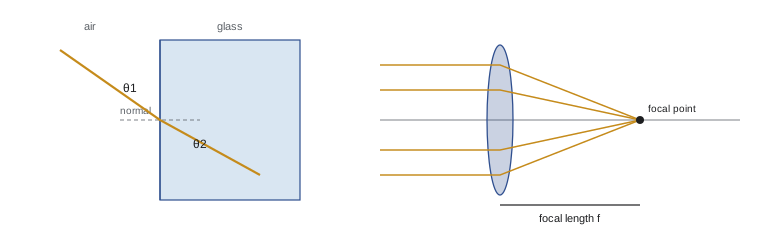
Lenses work by refraction: light slows down when it passes from air into glass and bends at the boundary unless it strikes at right angles. The amount of bending depends on the angle of incidence and on the refractive index of the glass, a measure of how much it slows light, typically about 1.5 to 1.9 for optical glass. Snell's law describes the relationship:
Here \(n_1\) and \(n_2\) are the refractive indices of the two materials and \(\theta_1\) and \(\theta_2\) the angles of the ray to the surface normal. A convex lens, thicker in the middle than at the edges, bends rays toward the axis and brings them to a focus; a concave lens, thinner in the middle, spreads them apart. Because the refractive index varies slightly with wavelength, different colours bend by different amounts, which causes chromatic aberration (Lesson 8) and is why lens designers combine glasses with different properties.
The thin lens model
For understanding focus and magnification, it helps to treat a lens as a single thin element. Parallel rays from a very distant subject converge at the focal point, a distance \(f\), the focal length, behind the lens. For a subject at a finite distance \(u\) in front of the lens, the image forms at a distance \(v\) behind it, given by the thin lens equation:
As the subject comes closer, \(u\) decreases and \(v\) increases: the image forms farther behind the lens. This is why focusing on close subjects requires moving the lens, or groups of elements inside it, forward away from the sensor. At infinity focus, \(v = f\). Real cinema lenses contain many elements, but they behave like a thin lens located at a point called the rear principal plane, and focal length is measured from there.
Worked problem
How far does the lens move to focus?
A 50 mm lens is focused on an actor 2 m (2000 mm) away. How far behind the lens does the image form, and how much farther is this than at infinity focus? What about at 0.5 m?
Show solution
- Use \(1/v = 1/f - 1/u = 1/50 - 1/2000 = 0.02 - 0.0005 = 0.0195\).
- So \(v \approx 51.3\) mm, about 1.3 mm farther than at infinity (50 mm).
- At 0.5 m: \(1/v = 1/50 - 1/500 = 0.018\), so \(v \approx 55.6\) mm, 5.6 mm farther.
Answer: About 1.3 mm of extension at 2 m and 5.6 mm at 0.5 m, which is why close focus requires much more focus travel.
Magnification
Magnification is the ratio of the image size to the subject size, equal to the ratio of image distance to subject distance:
At normal shooting distances, magnification is small: a 50 mm lens filming an actor 2 m away gives \(m \approx 0.026\), so a face 25 cm tall forms an image about 6.4 mm tall on the sensor. Magnification increases as the subject comes closer or the focal length increases. Macro lenses reach magnifications of 0.5 (1:2) or 1 (1:1, life size) and are used for insert shots of eyes, insects, jewellery and small objects. Magnification determines how large the subject appears in the frame and, together with aperture, how deep the depth of field is (Lesson 4).
Real lens construction
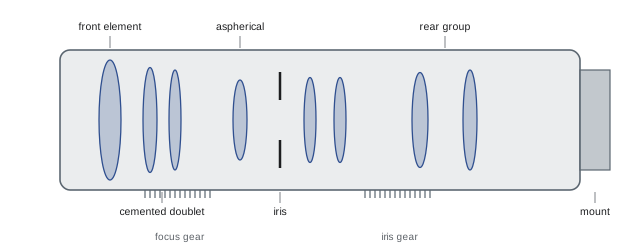
A real cinema lens contains anywhere from about six to more than twenty glass elements, arranged in groups, inside a precision metal housing. Multiple elements are needed to correct the aberrations a single element would produce: spherical aberration, chromatic aberration, astigmatism, field curvature, coma and distortion (Lesson 8). Modern designs use special glasses with low dispersion, high refractive index or unusual dispersion characteristics, and aspherical elements, whose surfaces are not sections of a sphere, to correct aberrations with fewer elements. Multi-layer anti-reflection coatings on each glass surface reduce reflections that would otherwise cause flare and loss of contrast. The housing includes the iris diaphragm, focus mechanism, gear rings for follow focus and lens motors, the mount, and often electronic contacts for lens data.
Cinema lenses and stills lenses
Cinema lenses and stills lenses share optical principles but differ in design priorities. Cinema lenses typically have:
- Geared focus, iris and zoom rings with a standard 0.8 module gear pitch, so that follow focus units and lens motors can drive them precisely.
- Long focus throws, often 270 to 300 degrees of rotation, with large, clear distance markings on both sides of the barrel, so that focus pullers can make fine adjustments and mark positions.
- Calibrated T-stops rather than f-stops, and iris rings without click stops for smooth exposure changes during shots.
- Consistent physical size, front diameter and gear positions across a set, so that matte boxes and motors do not need repositioning when changing lenses.
- Matched colour and contrast across a set, so that cutting between focal lengths does not reveal differences.
- Minimal focus breathing and robust mechanics for years of rental use.
Stills lenses are smaller, lighter and cheaper, often with autofocus, short focus throws and electronically controlled apertures. Many productions adapt stills lenses for their character or budget, sometimes "cine-modded" with added gears and declicked apertures, but they are harder to pull focus with consistently.
| Feature | Cinema lens | Stills lens |
|---|---|---|
| Focus throw | Long, about 270–300° | Short, often under 120° |
| Aperture marking | T-stops, stepless | f-stops, often clicked or electronic |
| Gears | Standard 0.8 module | Usually none |
| Markings | Large, both sides, in feet and metres | Small or electronic |
| Set consistency | Matched size, colour and gears | Varies |
| Cost | Very high, usually rented | Lower, usually owned |
Lens mounts and flange focal distance
Each lens is designed for a specific flange focal distance, the distance from the mount's reference surface to the image plane, and must be mounted at exactly that distance to focus correctly; CINE-201 described the main mounts, such as PL, LPL and E-mount. Even small errors in flange distance, a few hundredths of a millimetre, shift focus markings so that a lens set to 2 m focuses at a different distance, and prevent infinity focus. Camera assistants check flange focal distance with depth gauges or collimators, and shim mounts to correct it (Lesson 12). Lens adapters allow lenses designed for long flange distances to be used on cameras with shorter ones, by filling the difference with a precisely machined spacer.
The language of lenses on set
Lens vocabulary is part of everyday communication on set. Lenses are referred to by focal length ("put on the 32"), set ("the Supremes", "the Cookes") and character ("the vintage glass"). A "longer" lens has a greater focal length and a narrower view; a "wider" lens a shorter one. "Stop" refers to the T-stop setting, as in "we're at a 2.8". "Wide open" means the maximum aperture. "Pulling focus" means changing focus during a shot. The "witness marks" are the focus distance markings on the barrel. Knowing this language, and the mechanics behind it, lets camera teams work quickly and precisely.
How lens choice shapes storytelling
Every lens decision carries meaning. Wide lenses close to actors place viewers in the space with them, exaggerating depth and movement; long lenses from a distance observe, compressing space and isolating faces. Shallow depth of field directs attention and suggests intimacy or subjectivity; deep focus shows relationships between characters and their environment, as in Gregg Toland's celebrated work on Citizen Kane (1941). Vintage lenses with soft contrast and flare evoke memory and warmth; modern, clinical lenses suit sharp realism. The rest of this course develops the technical understanding needed to make these choices deliberately.
Principal planes, nodal points and entrance pupils
Real lenses are described by several reference points that matter in practice. The front and rear principal planes are where a thick lens system can be treated as if it bent all light, and focal length is measured from the rear principal plane. In many telephoto designs, the rear principal plane lies in front of the lens, so the lens is physically shorter than its focal length; in retrofocus wide-angle designs, used to leave room behind the lens for mirrors or sensor stacks, it lies behind the rear element, so the lens sits farther from the sensor than its focal length. The entrance pupil, the apparent position and size of the aperture as seen from the front, is the point around which the camera should rotate to avoid parallax in panoramas and VFX nodal pans; it is often called the no-parallax point, and lens manufacturers and rental houses publish its position for each lens.
Telephoto and retrofocus designs
Long lenses are usually telephoto designs: a positive front group and a negative rear group shorten the physical length of the lens compared with its focal length, making long lenses manageable on a camera. Wide-angle lenses for cinema and SLR-type cameras are usually retrofocus or inverted telephoto designs: a negative front group and a positive rear group allow a short focal length with a long back focus distance, leaving room for the camera's mirror, filter stack or mount. Short-flange mirrorless cameras allow more compact wide-angle designs, which is one reason why modern full-frame and large-format lenses have evolved quickly.
Units and distance scales
Focus scales on cinema lenses are usually engraved in both feet and metres, on opposite sides of the barrel or in separate rings, reflecting the international nature of film production. In Canada and the United States, many crews still work in feet and inches, especially in long-established camera departments, while metric measurements are common elsewhere; focus pullers must be comfortable with both. Lens data systems and distance devices can display either unit. Mixing units is a classic cause of focus errors, so productions agree on one unit and set every device accordingly.
Common mistakes
MistakeThinking the camera body defines the look.
InsteadRecognize that lenses shape much of the image's character.
MistakeMeasuring focal length from the front of the lens.
InsteadIt is measured from the rear principal plane.
MistakeAssuming focus travel is the same at all distances.
InsteadClose focus needs far more extension.
MistakeIgnoring flange focal distance errors.
InsteadCheck and shim mounts so markings are accurate.
MistakeUsing stills lenses without considering focus pulling.
InsteadAccount for short throws and lack of gears.
Summary and key terms
- A lens gathers light from each point and refocuses it to a point at the image plane.
- Refraction, described by Snell's law, bends light at glass surfaces.
- The thin lens equation relates focal length, subject distance and image distance.
- Magnification is small at normal distances and large in macro work.
- Real lenses use many elements, special glasses and coatings to correct aberrations.
- Cinema lenses offer geared rings, long throws, T-stops and matched sets.
- Lens choice shapes how audiences experience space and character.
- Refraction
- Bending of light passing between materials.
- Refractive index
- Measure of how much a material slows light.
- Focal length
- Distance from the principal plane to focus at infinity.
- Image plane
- Plane where the image is sharply focused.
- Thin lens equation
- 1/f = 1/u + 1/v.
- Magnification
- Ratio of image size to subject size.
- Aspherical element
- Lens element with a non-spherical surface.
- Coating
- Thin layers reducing reflections on glass.
- Focus throw
- Rotation of the focus ring from closest focus to infinity.
- Flange focal distance
- Distance from mount to image plane.
Practice problems
Work each problem on paper first, then reveal the answer to check.
Why does a pinhole give a dim image?
Show answer
It admits only a narrow bundle of rays from each point.
Typical refractive index of optical glass?
Show answer
About 1.5 to 1.9.
Image distance for a 100 mm lens focused at 5 m?
Show answer
About 102 mm.
Why must the lens move forward for close focus?
Show answer
The image forms farther behind the lens.
Magnification of a 50 mm lens at 2 m?
Show answer
About 0.026.
What is a 1:1 magnification called?
Show answer
Life size.
Why do lenses contain many elements?
Show answer
To correct aberrations.
What gear pitch do cinema lenses use?
Show answer
0.8 module.
Why are cinema iris rings stepless?
Show answer
For smooth exposure changes during shots.
What happens if flange distance is wrong?
Show answer
Focus marks are inaccurate and infinity may be lost.
Lesson quiz · 5 questions
Score 60% or more to complete this lesson.
Create a free account to save your progress, take quizzes and earn a certificate.