
CHEM-103 · Lesson 2 of 12 · 27 min
Atoms, the periodic table and chemical bonding
Lesson 1 treated atoms and molecules as units to be counted. Why do they combine in the ratios they do, and why do the substances they form behave so differently? Why is steel strong and ductile while glass is strong and brittle, why does water boil at 100 °C while methane, a similar-sized molecule, boils at −162 °C, and why does salt dissolve in water but wax does not? The answers lie in the structure of atoms and the way their outer electrons form chemical bonds. This lesson describes the structure of the atom, the arrangement of electrons that gives the periodic table its shape, the trends in atomic properties across it, the three main types of chemical bond (ionic, covalent and metallic), molecular shape and polarity, and the weaker forces between molecules that control boiling points, solubility and much of the behaviour of engineering materials.
The structure of the atom
An atom has a tiny, dense nucleus of protons (positive) and neutrons (neutral), surrounded by electrons (negative) that occupy most of its volume. The number of protons, the atomic number Z, defines the element; a neutral atom has Z electrons. Atoms of the same element with different numbers of neutrons are isotopes: carbon-12 and carbon-14, uranium-235 and uranium-238. The atomic masses in the periodic table are averages over the natural mixture of isotopes, which is why chlorine's is 35.45 rather than a whole number.
Electrons occupy energy levels (shells), labelled n = 1, 2, 3 and so on, each divided into subshells (s, p, d, f) holding up to 2, 6, 10 and 14 electrons. Electrons fill the lowest available levels first. The electrons in the outermost shell, the valence electrons, take part in bonding and decide an element's chemistry. Sodium (Z = 11) has the configuration 1s² 2s² 2p⁶ 3s¹: one valence electron that it readily loses. Chlorine (Z = 17), 1s² 2s² 2p⁶ 3s² 3p⁵, needs one more electron to complete its outer shell.
The periodic table
Arranging the elements by atomic number, with a new row (period) each time a new shell begins, places elements with the same number of valence electrons in the same column (group), and they behave alike. Group 1, the alkali metals, all have one valence electron and react vigorously; group 17, the halogens, all lack one; group 18, the noble gases, have full shells and are almost inert, which is why argon is used to shield welds. The transition metals in the middle, including iron, copper, nickel, chromium and titanium, fill d subshells and form the structural and functional metals of engineering.
Several properties change systematically across the table:
- Atomic radius decreases from left to right across a period (the growing nuclear charge pulls the electrons in) and increases down a group (more shells).
- Ionization energy, the energy to remove an electron, increases across a period and decreases down a group. Metals, on the left, lose electrons easily; non-metals, on the right, hold them tightly.
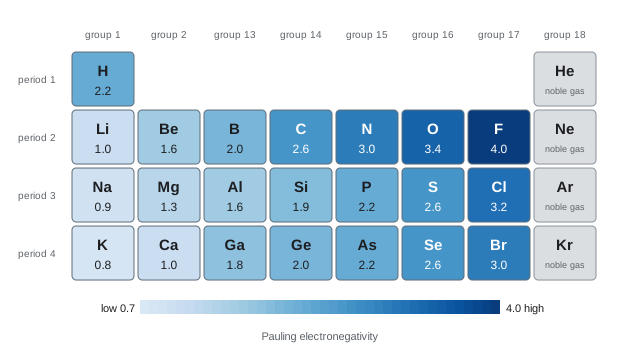
- Electronegativity, an atom's pull on the electrons in a bond, follows the same trend: fluorine is the most electronegative element (4.0 on the Pauling scale), oxygen 3.4, carbon 2.6, hydrogen 2.2, sodium 0.9.
These trends predict which elements form which kinds of bonds, how reactive metals are (and so how readily they corrode, Lesson 9), and why oxygen and fluorine compounds are so stable.
Ionic bonds
When a metal with low ionization energy meets a non-metal with high electronegativity, electrons transfer: sodium gives its electron to chlorine, forming Na⁺ and Cl⁻ ions with full outer shells. The oppositely charged ions attract strongly (Coulomb's law, PHYS-131) and pack into a crystal lattice. Ionic compounds are typically hard, brittle and high-melting (sodium chloride melts at 801 °C); they conduct electricity when molten or dissolved, because the ions can then move, but not as solids. The charges determine the formula: Ca²⁺ and Cl⁻ give CaCl₂; Al³⁺ and O²⁻ give Al₂O₃ (alumina, a hard ceramic). As a rule of thumb, bonds between atoms differing in electronegativity by more than about 1.7 to 2 are mainly ionic.
Common ions and naming compounds
Many ions that engineers meet are polyatomic: small covalently bonded groups that carry an overall charge and behave as a unit in ionic compounds. Recognizing them makes formulas readable and calculations in later lessons straightforward:
| Ion | Formula | Where you meet it |
|---|---|---|
| Hydroxide | OH⁻ | Bases, lime (Ca(OH)₂), concrete pore water |
| Carbonate | CO₃²⁻ | Limestone (CaCO₃), scale in boilers and kettles |
| Bicarbonate | HCO₃⁻ | Alkalinity of natural water, baking soda |
| Sulphate | SO₄²⁻ | Gypsum (CaSO₄·2H₂O), alum, sulphate attack on concrete |
| Nitrate | NO₃⁻ | Fertilizers, explosives, groundwater contamination |
| Phosphate | PO₄³⁻ | Fertilizers, detergents, algae blooms, LFP batteries |
| Ammonium | NH₄⁺ | Fertilizers (ammonium nitrate), cold packs |
Ionic compounds are named cation first, then anion: sodium chloride, calcium carbonate, aluminium sulphate. Metals that form more than one ion show the charge in Roman numerals: iron(II) oxide, FeO, and iron(III) oxide, Fe₂O₃, the main component of rust and of hematite ore. Molecular compounds of two non-metals use Greek prefixes for the number of atoms: carbon monoxide (CO), carbon dioxide (CO₂), sulphur trioxide (SO₃), dinitrogen oxide (N₂O). The formula of any ionic compound follows from balancing charges, so that the compound is electrically neutral overall.
Covalent bonds
Between non-metals, neither atom can take electrons from the other, so they share pairs of electrons in covalent bonds. Hydrogen shares its single electron with another hydrogen to form H₂; carbon, with four valence electrons, forms four bonds, as in methane (CH₄). Atoms can share two or three pairs, forming double and triple bonds, which are shorter and stronger: the triple bond in N₂ (945 kJ/mol) makes nitrogen gas very unreactive, which is why making ammonia for fertilizer requires high pressure, high temperature and a catalyst (Lesson 8).
When the atoms differ in electronegativity, the shared electrons sit closer to the more electronegative one, making a polar covalent bond with partial charges, written δ+ and δ−. In water, oxygen pulls electrons from both hydrogens. Covalent solids can be molecular (soft, low-melting, made of discrete molecules, like wax or ice) or network solids, in which covalent bonds extend through the whole crystal, giving the extreme hardness and high melting points of diamond, silicon carbide and quartz.
Worked problem
Classifying bonds
Using electronegativities (Na 0.9, Cl 3.2, C 2.6, H 2.2, O 3.4, Si 1.9), classify the bonds in NaCl, CH₄, H₂O and SiO₂.
Show solution
- NaCl: difference 2.3, ionic.
- C–H in CH₄: difference 0.4, essentially non-polar covalent.
- O–H in H₂O: difference 1.2, polar covalent.
- Si–O in SiO₂: difference 1.5, strongly polar covalent, forming a network solid (quartz, glass).
Answer: Ionic, non-polar covalent, polar covalent and polar covalent network. Bond type explains properties: methane is a gas, water a liquid with unusual properties, quartz a hard, high-melting solid, and salt a brittle, water-soluble crystal.
Metallic bonds
In metals, the valence electrons are not tied to particular atoms but move freely through a lattice of positive ions, a "sea" of delocalized electrons. This explains the characteristic properties of metals. The mobile electrons carry current and heat, so metals are good electrical and thermal conductors (PHYS-131). The bonding is not directional, so planes of atoms can slide past one another without breaking the solid apart, which makes metals ductile and malleable: steel can be rolled, drawn and bent, and it deforms visibly before it breaks, a crucial safety property in structures. Alloying, mixing in other elements such as carbon in steel or tin in bronze, disrupts this sliding and makes metals stronger but less ductile (Lesson 10).
Molecular shape and polarity
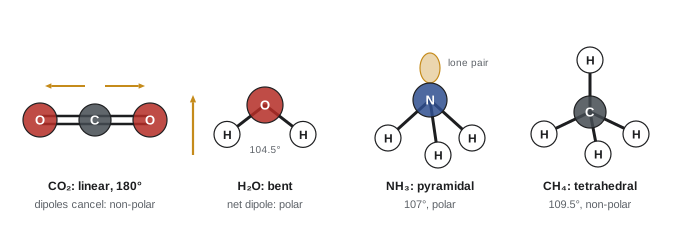
The shape of a molecule follows from the repulsion of its electron pairs, which arrange themselves as far apart as possible (the VSEPR model). Four pairs around a central atom point to the corners of a tetrahedron, about 109.5° apart: methane is tetrahedral; ammonia, with one non-bonding pair, is pyramidal; water, with two, is bent, at 104.5°. Two pairs give a straight line, as in CO₂.
Shape decides whether polar bonds add up to a polar molecule. In CO₂ the two polar C=O bonds point in opposite directions and cancel, so the molecule is non-polar. In bent water they do not cancel, so water is strongly polar, with a negative oxygen end and positive hydrogen end. Polarity has large practical consequences: it is why water dissolves salts and polar substances but not oils, why microwave ovens heat water-containing food, and why CO₂, although non-polar, absorbs infrared radiation when it bends and stretches, making it a greenhouse gas (Lesson 11).
Intermolecular forces
Bonds within molecules are strong; the forces between molecules are much weaker, but they decide whether a substance is a gas, a liquid or a solid at room temperature, how much energy it takes to boil it, and what it dissolves in. In increasing strength:
- London dispersion forces act between all molecules, from momentary fluctuations in electron distribution. They grow with molecular size: methane (CH₄) boils at −162 °C, octane (C₈H₁₈, in gasoline) at 126 °C, and long-chain waxes are solids.
- Dipole-dipole forces attract polar molecules to one another.
- Hydrogen bonds, a strong special case, form when hydrogen bonded to N, O or F is attracted to a lone pair on another such atom. They give water its unusually high boiling point, large specific heat and latent heat (Lesson 5), its surface tension, and the fact that ice is less dense than liquid water, so it floats, expands as it freezes and cracks rocks, pipes and concrete.
Worked problem
Why water is unusual
Methane (CH₄, molar mass 16) and water (H₂O, molar mass 18) have similar molecular sizes. Methane boils at −162 °C and water at 100 °C. Explain the difference.
Show solution
- Methane is non-polar; only weak dispersion forces hold its molecules together.
- Water is polar and forms up to four hydrogen bonds per molecule.
- Separating water molecules into the vapour therefore takes far more energy: water's heat of vaporization is 40.7 kJ/mol, methane's only 8.2 kJ/mol.
Answer: Hydrogen bonding raises water's boiling point by more than 260 °C compared with a non-polar molecule of the same size. Without it, water would be a gas at room temperature, and much of engineering, from steam power to concrete curing to cooling towers, would not work as it does.
The rule "like dissolves like" follows: polar and ionic substances dissolve in polar solvents such as water; non-polar substances such as oils, greases and many polymers dissolve in non-polar solvents. Detergents and surfactants have a polar head and a non-polar tail, which lets them carry grease into water, the basis of cleaning, of some oil spill treatments and of the air-entraining admixtures that protect concrete from frost damage.
Common mistakes
MistakeAssuming all atoms of an element have the same mass.
InsteadIsotopes differ in neutrons; tabulated atomic masses are averages.
MistakeTreating bond type as all-or-nothing.
InsteadBonds range from non-polar covalent through polar covalent to ionic as electronegativity difference grows.
MistakeConcluding a molecule is polar because it has polar bonds.
InsteadCheck the shape: symmetric molecules such as CO₂ are non-polar overall.
MistakeConfusing intramolecular bonds with intermolecular forces.
InsteadBoiling breaks the weak forces between molecules, not the bonds within them.
MistakeExpecting ionic solids to conduct electricity.
InsteadIons conduct only when free to move, when molten or dissolved.
Summary and key terms
- Atoms have a nucleus of protons and neutrons; Z defines the element; isotopes differ in neutrons.
- Valence electrons in the outer shell decide chemistry; groups share valence configurations.
- Atomic radius falls and ionization energy and electronegativity rise across a period.
- Ionic bonds transfer electrons between metals and non-metals; covalent bonds share electron pairs.
- Metallic bonds have delocalized electrons, giving conductivity and ductility.
- VSEPR predicts molecular shape; shape decides whether bond polarities cancel.
- Dispersion, dipole-dipole and hydrogen-bonding forces control boiling points and solubility.
- Atomic number
- The number of protons in an atom's nucleus.
- Isotope
- Atoms of one element with different numbers of neutrons.
- Valence electrons
- Electrons in the outermost shell, which take part in bonding.
- Electronegativity
- An atom's attraction for the electrons in a bond.
- Ionic bond
- Attraction between ions formed by electron transfer.
- Covalent bond
- A bond formed by sharing electron pairs.
- Polar covalent bond
- A covalent bond with unequal sharing and partial charges.
- Metallic bond
- Bonding by delocalized electrons among metal ions.
- VSEPR model
- Predicting molecular shape from the repulsion of electron pairs.
- Hydrogen bond
- A strong intermolecular attraction involving H bonded to N, O or F.
Practice problems
Work each problem on paper first, then reveal the answer to check.
How many protons, neutrons and electrons does a neutral ⁵⁶Fe atom (Z = 26) have?
Show answer
26, 30 and 26.
Write the electron configuration of magnesium (Z = 12) and state its valence electrons.
Show answer
1s² 2s² 2p⁶ 3s²; two.
Which has the larger atomic radius, Na or Cl? K or Na?
Show answer
Na (same period, further left); K (further down the group).
Predict the formula of the compound of Mg²⁺ and N³⁻.
Show answer
Mg₃N₂.
Classify the bond in HF (H 2.2, F 4.0).
Show answer
Strongly polar covalent (difference 1.8, near the ionic boundary).
Is CCl₄ polar? Why?
Show answer
No: its four polar C–Cl bonds are arranged tetrahedrally and cancel.
Predict the shape of BF₃ (three bonding pairs, no lone pairs on B).
Show answer
Trigonal planar, 120°, non-polar.
Which boils higher, ethanol (C₂H₅OH) or propane (C₃H₈)? Why?
Show answer
Ethanol, because of hydrogen bonding (78 °C versus −42 °C).
Why is steel ductile but glass brittle?
Show answer
Non-directional metallic bonds let planes slip; glass's directional covalent network breaks instead.
Why does ice float?
Show answer
Hydrogen bonding holds ice in an open lattice less dense than liquid water.
Lesson quiz · 5 questions
Score 60% or more to complete this lesson.
Create a free account to save your progress, take quizzes and earn a certificate.