
CHEM-103 · Lesson 11 of 12 · 28 min
Environmental and energy chemistry
Engineers design the power plants, vehicles, factories, water systems and buildings that shape the environment, and most environmental problems are chemical at heart. Combustion supplies most of the world's energy and produces carbon dioxide, carbon monoxide, nitrogen oxides, sulfur dioxide and fine particles. Those emissions change the atmosphere: they form smog and acid rain, and greenhouse gases are warming the climate. Water must be treated before it is safe to drink and after it is used. This lesson applies the chemistry of the earlier lessons (stoichiometry, gases, thermochemistry, rates, equilibrium and electrochemistry) to combustion and emissions, air pollution and its control, the greenhouse effect and climate, the ozone layer, water chemistry and treatment, and the chemistry of low-carbon energy.
Combustion
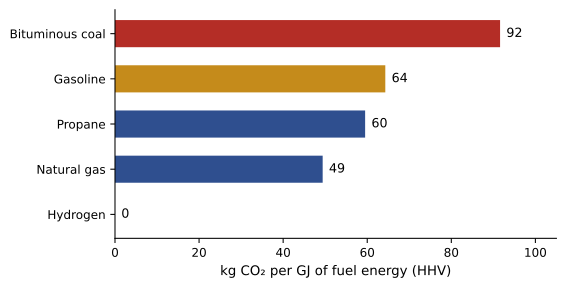
Lesson 1 balanced the equation for burning propane, and Lesson 5 found its heat of combustion. For any hydrocarbon fuel, complete combustion converts all the carbon to CO₂ and all the hydrogen to water. Every carbon atom in the fuel ends up in one CO₂ molecule, so the CO₂ produced follows directly from the fuel's carbon content: 44.01/12.01 = 3.66 kg of CO₂ for every kilogram of carbon burned. Dividing by the heating value gives the emission factor per unit of energy, the number used in carbon accounting and emissions regulations.
C, O2 = 12.011, 31.998
CO2 = C + O2                       # 44.009 g/mol

# fuel: (carbon mass fraction, higher heating value MJ/kg)
fuels = {
    "Natural gas (CH4)": (12.011 / 16.043, 55.5),
    "Propane (C3H8)":    (36.033 / 44.097, 50.3),
    "Gasoline (C8H18)":  (96.088 / 114.23, 47.9),
    "Bituminous coal":   (0.75, 30.0),
    "Hydrogen (H2)":     (0.0, 141.8),
}
print("Fuel                kg CO2/kg fuel   kg CO2/GJ")
factor = {}
for name, (cf, hhv) in fuels.items():
    per_kg = cf * CO2 / C          # every carbon atom ends up in one CO2
    per_GJ = per_kg / hhv * 1000
    factor[name] = per_GJ
    print(f"{name:20s} {per_kg:10.2f} {per_GJ:13.1f}")

# Electricity: one kWh is 0.0036 GJ of output; divide by plant efficiency (HHV basis)
for name, eff in [("Natural gas (CH4)", 0.50), ("Bituminous coal", 0.36)]:
    kg_kwh = factor[name] * 0.0036 / eff
print(f"{name} plant at {eff:.0%}: {kg_kwh:.2f} kg CO2 per kWh")Fuel kg CO2/kg fuel kg CO2/GJ Natural gas (CH4) 2.74 49.4 Propane (C3H8) 2.99 59.5 Gasoline (C8H18) 3.08 64.3 Bituminous coal 2.75 91.6 Hydrogen (H2) 0.00 0.0 Natural gas (CH4) plant at 50%: 0.36 kg CO2 per kWh Bituminous coal plant at 36%: 0.92 kg CO2 per kWh
Natural gas emits about half as much CO₂ per unit of energy as coal, because much of its energy comes from burning hydrogen to water; combined with the higher efficiency of combined-cycle plants, gas-fired electricity emits roughly 40 % as much CO₂ as coal-fired. Hydrogen emits none where it is used, but how it was made decides its true footprint, as the last section shows. Wood and other biomass release CO₂ too, but it was absorbed from the air as the plants grew, so their net effect depends on regrowth and land management.
If there is not enough oxygen, combustion is incomplete, producing carbon monoxide and soot. CO is colourless, odourless and binds to hemoglobin about 200 times more strongly than oxygen; a few hundred ppm causes headaches, and a few thousand can kill within an hour. Faulty furnaces, blocked chimneys, generators run indoors and vehicles in closed garages kill people every winter, which is why building codes require CO alarms near sleeping areas in homes with fuel-burning appliances or attached garages. Burners therefore run with some excess air, typically 10 to 20 % for gas, and technicians check the flue gas for O₂ and CO (Lesson 3).
Air pollutants and their control
Besides CO₂ and CO, combustion produces several regulated pollutants:
- Nitrogen oxides (NO and NO₂, together NOₓ) form when nitrogen and oxygen from the air combine in hot flames. The reaction has a high activation energy (Lesson 7), so NOₓ formation rises steeply above about 1,500 °C. Low-NOₓ burners stage the air or fuel and recirculate flue gas to keep peak temperatures down; diesel engines and power plants inject ammonia or urea over a catalyst to reduce NOₓ to N₂ (selective catalytic reduction).
- Sulfur dioxide (SO₂) comes from sulfur in coal, heavy oil and some natural gas. It forms sulfuric acid in the air and falls as acid rain, which damaged lakes and forests in eastern Canada and the northeastern United States in the 1970s and 1980s until emissions were cut.
- Fine particulate matter (PM₂.₅, particles under 2.5 µm) penetrates deep into the lungs and is linked to heart and lung disease; it comes from combustion, wildfire smoke, road dust and reactions of gaseous pollutants. Fabric filters (baghouses) and electrostatic precipitators (PHYS-131) remove over 99 % of particles from industrial stacks.
- Volatile organic compounds (VOCs) evaporate from fuels, solvents, paints and adhesives. In sunlight, VOCs and NOₓ react to form ground-level ozone, the main ingredient of summer smog, which irritates lungs and damages crops.
Worked problem
Scrubbing SO₂ from a coal-fired boiler
A boiler burns 100 t/h of coal containing 2.0 % sulfur by mass. Find the SO₂ produced and the limestone needed to capture 95 % of it by CaCO₃ + SO₂ + ½O₂ → CaSO₄ + CO₂.
Show solution
- Sulfur burned: 0.020 × 100 = 2.0 t/h = 62.4 kmol/h (2000/32.06).
- S + O₂ → SO₂: 62.4 kmol/h of SO₂ = 62.4 × 64.07 = 4.0 t/h.
- Captured: 0.95 × 62.4 = 59.3 kmol/h, needing 59.3 kmol/h of CaCO₃ = 5.9 t/h of limestone (in practice about 5 to 10 % more).
- Product: 59.3 kmol/h of CaSO₄, which crystallizes as gypsum, CaSO₄·2H₂O: 59.3 × 172.2 = 10.2 t/h.
Answer: About 4 t/h of SO₂ would be released unscrubbed; the scrubber consumes about 6 t/h of limestone and produces about 10 t/h of gypsum, much of which becomes wallboard. Note the trade-off: the scrubber releases CO₂ from the limestone as it captures SO₂.
The greenhouse effect and climate
The Sun's visible and near-infrared light passes through the atmosphere and warms the surface, which radiates the energy back as longer-wavelength infrared. Molecules such as water vapour, CO₂, methane and nitrous oxide absorb that infrared, because their vibrations, the bending and asymmetric stretching of their bonds, change their dipole (Lesson 2), and re-emit it in all directions, including back down. N₂ and O₂, symmetric two-atom molecules, do not absorb infrared. This natural greenhouse effect keeps Earth's average surface temperature near 15 °C instead of about −18 °C.
Burning fossil fuels, cutting forests and making cement (Lesson 10) have raised the CO₂ concentration from about 280 ppm before industrialization to about 425 ppm in the mid-2020s, higher than at any time in at least 800 000 years, as shown by air bubbles trapped in Antarctic ice. Methane has risen from about 0.7 to over 1.9 ppm, from agriculture, landfills, wetlands and leaks from oil and gas systems. Per kilogram, methane traps about 28 times as much heat as CO₂ over a century, so stopping leaks is one of the cheapest climate measures available. The extra heat trapped has warmed the planet by about 1.2 to 1.3 °C, with consequences for sea level, extreme heat, wildfire, permafrost and precipitation that engineers must now design for.
About a quarter of the CO₂ emitted dissolves in the oceans (Henry's law, Lesson 4), where it forms carbonic acid: CO₂ + H₂O ⇌ H₂CO₃ ⇌ H⁺ + HCO₃⁻. Surface ocean pH has fallen from about 8.2 to 8.1, a 25 % increase in [H⁺] (Lesson 8), which makes it harder for shellfish and corals to build calcium carbonate shells.
The ozone layer
High in the stratosphere, ozone (O₃) absorbs most of the Sun's harmful ultraviolet radiation. Chlorofluorocarbons (CFCs), once used as refrigerants, foam blowing agents and aerosol propellants, are so unreactive that they survive for decades and drift into the stratosphere, where UV light splits off chlorine atoms. Each chlorine atom then acts as a catalyst (Lesson 7), destroying thousands of ozone molecules through the cycle Cl + O₃ → ClO + O₂, followed by ClO + O → Cl + O₂. The Montreal Protocol of 1987 phased out CFCs; their replacements, hydrofluorocarbons (HFCs), do not harm ozone but are powerful greenhouse gases and are now being phased down in turn, which is why refrigeration and heat pump systems are switching to refrigerants such as R-32, R-454B, CO₂, ammonia and propane. The ozone layer is slowly recovering.
Water chemistry and treatment
Natural water carries dissolved minerals, organic matter and microorganisms. Two chemical properties matter in almost every water system:
- Hardness is the concentration of calcium and magnesium ions, usually expressed as the equivalent mass of CaCO₃ in mg/L. Water above about 180 mg/L is classed as very hard. When hard water containing bicarbonate is heated, CaCO₃ precipitates as scale (Lesson 8), clogging pipes, insulating heat exchangers and boiler tubes, and wasting energy. It also reacts with soap to form scum.
- Alkalinity is the water's capacity to neutralize acid, mostly from bicarbonate and carbonate. It buffers pH (Lesson 8) during treatment.
Worked problem
Hardness of a well water
A well water contains 60 mg/L Ca²⁺ and 18 mg/L Mg²⁺. Express its hardness as mg/L CaCO₃.
Show solution
- Each Ca²⁺ or Mg²⁺ is equivalent to one CaCO₃ (molar mass 100.09).
- Calcium: 60 × 100.09/40.08 = 150 mg/L as CaCO₃.
- Magnesium: 18 × 100.09/24.31 = 74 mg/L as CaCO₃.
- Total hardness: 224 mg/L as CaCO₃.
Answer: About 224 mg/L as CaCO₃, very hard. A household would likely install an ion-exchange softener, which swaps Ca²⁺ and Mg²⁺ for Na⁺; a municipal plant might soften by adding lime and soda ash to precipitate CaCO₃ and Mg(OH)₂. Boiler feedwater needs much more thorough treatment, often reverse osmosis (Lesson 4) followed by ion exchange.
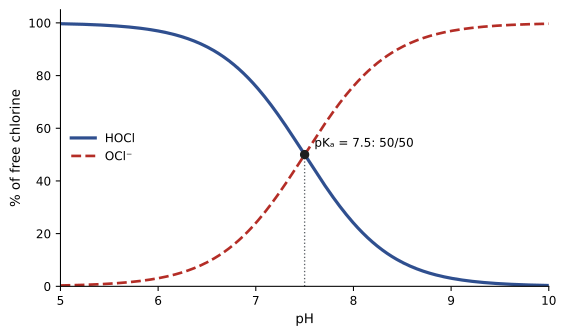
A conventional drinking-water plant treating river or lake water works through a chemical sequence. Coagulation: aluminium sulphate (alum) or ferric chloride is added, and its metal ions neutralize the negative charges on fine clay and organic particles; the precipitating hydroxide, Al(OH)₃, sweeps them together into flocs. Sedimentation and filtration then remove the flocs. Disinfection kills remaining microorganisms, most often with chlorine, which forms hypochlorous acid in water: Cl₂ + H₂O → HOCl + H⁺ + Cl⁻. HOCl is a weak acid (pKₐ 7.5), and it is roughly a hundred times more effective as a disinfectant than its anion OCl⁻, so operators keep the pH below about 8. A chlorine residual must remain throughout the distribution system (Lesson 7).
Wastewater treatment relies on microorganisms to consume dissolved organic matter. Its strength is measured as biochemical oxygen demand (BOD), the oxygen bacteria use in breaking it down over five days; raw sewage typically has 200 to 300 mg/L. Discharging untreated waste would strip a river of its dissolved oxygen (Lesson 4), so plants aerate the wastewater to let bacteria do the work under control, and many remove nitrogen and phosphorus, which would otherwise fertilize algae blooms in lakes.
Chemistry for low-carbon energy
Reducing emissions is largely a chemistry problem, and engineers will work on it throughout their careers:
- Hydrogen can be made by steam methane reforming, CH₄ + 2H₂O → CO₂ + 4H₂ overall, which releases at least 5.5 kg of CO₂ per kilogram of H₂ from the chemistry alone, unless that CO₂ is captured ("blue" hydrogen). Electrolysis of water with renewable or nuclear electricity ("green" hydrogen) avoids that but needs about 50 to 55 kWh per kilogram (Lesson 9). Hydrogen can feed fuel cells (Lesson 6), make ammonia and steel, and store energy.
- Lithium-ion batteries store energy by moving lithium ions between a graphite anode and a metal oxide cathode, such as lithium nickel manganese cobalt oxide or lithium iron phosphate (LFP); the choice trades energy density against cost, life and fire safety (Lessons 7 and 9).
- Carbon capture absorbs CO₂ from flue gas in amine solutions, which bind it reversibly; heating the solution releases pure CO₂ for compression and storage underground, as at Saskatchewan's Boundary Dam power station and Alberta's Quest project.
- Low-carbon materials include blended cements, recycled steel made in electric arc furnaces, and steel reduced with hydrogen instead of coke.
Common mistakes
MistakeThinking CO₂ emissions depend on how well the fuel burns.
InsteadComplete combustion converts all carbon to CO₂; emissions follow from the carbon content.
MistakeConfusing stratospheric ozone depletion with climate change.
InsteadThey are different problems with different causes, though some chemicals contribute to both.
MistakeTreating ground-level ozone as beneficial.
InsteadOzone protects us in the stratosphere but is a harmful pollutant at ground level.
MistakeAssuming hydrogen is always zero-carbon.
InsteadIts footprint depends on how it is produced.
MistakeReporting hardness as mg/L of the ions without saying so.
InsteadHardness is conventionally expressed as mg/L of CaCO₃.
Summary and key terms
- CO₂ from combustion follows from fuel carbon content: 3.66 kg CO₂ per kg of carbon.
- Natural gas emits about half the CO₂ per unit energy of coal.
- Incomplete combustion produces deadly CO; NOₓ forms in hot flames; SO₂ comes from fuel sulfur.
- Scrubbers, catalysts, filters and precipitators control air pollutants.
- Greenhouse gases absorb infrared because their vibrations change their dipole; CO₂ has risen from 280 to about 425 ppm.
- Chlorine from CFCs catalytically destroys stratospheric ozone.
- Water treatment relies on coagulation, filtration, disinfection with pH-dependent HOCl, and softening.
- Emission factor
- Mass of a pollutant emitted per unit of fuel or energy.
- Incomplete combustion
- Burning with too little oxygen, producing CO and soot.
- NOₓ
- Nitric oxide and nitrogen dioxide, formed in high-temperature combustion.
- Acid rain
- Precipitation acidified by sulfuric and nitric acids from SO₂ and NOₓ.
- Greenhouse gas
- A gas that absorbs and re-emits infrared radiation.
- Ocean acidification
- The fall in ocean pH as it absorbs atmospheric CO₂.
- Hardness
- Calcium and magnesium content of water, expressed as mg/L CaCO₃.
- Coagulation
- Destabilizing fine particles with metal salts so they clump into flocs.
- Biochemical oxygen demand
- Oxygen consumed by bacteria breaking down organic matter.
- Steam methane reforming
- Making hydrogen from natural gas and steam, releasing CO₂.
Practice problems
Work each problem on paper first, then reveal the answer to check.
How much CO₂ comes from burning 1 kg of pure carbon?
Show answer
44.01/12.01 = 3.66 kg.
Using the code output, how much CO₂ does a furnace emit using 100 GJ of natural gas per year?
Show answer
100 × 49.4 = 4940 kg, about 4.9 t.
A car burns 1,200 L of gasoline (density 0.74 kg/L) a year. Estimate its CO₂ using 3.08 kg CO₂/kg.
Show answer
1200 × 0.74 × 3.08 ≈ 2.7 t.
Why does NOₓ formation rise sharply with flame temperature?
Show answer
The reaction has a high activation energy, so its rate rises exponentially with temperature.
How much SO₂ forms from burning 1 t of oil containing 1 % sulfur?
Show answer
10 kg S × 64.07/32.06 = 20 kg SO₂.
Why do N₂ and O₂ not act as greenhouse gases?
Show answer
Their symmetric vibrations do not change their dipole, so they do not absorb infrared.
Ocean pH falls from 8.2 to 8.1. By what factor does [H⁺] change?
Show answer
10^0.1 = 1.26, a 26 % increase.
Water has 40 mg/L Ca²⁺ and no Mg²⁺. Find its hardness as CaCO₃.
Show answer
40 × 100.09/40.08 = 100 mg/L.
What fraction of free chlorine is HOCl at pH 8.5 (pKₐ 7.5)?
Show answer
1/(1 + 10¹) ≈ 9 %.
Find the minimum CO₂ per kg of H₂ from CH₄ + 2H₂O → CO₂ + 4H₂.
Show answer
44.01/(4 × 2.016) = 5.46 kg.
Lesson quiz · 5 questions
Score 60% or more to complete this lesson.
Create a free account to save your progress, take quizzes and earn a certificate.