
CHE-480 · Lesson 9 of 12 · 22 min
Solid and hazardous waste
Most of the solids that leave the Sarnia plant are products: about 18 t/h of DDGS and a smaller stream of corn oil. But a list of other materials leaves too, in drums, bags, roll-off bins and tanker trucks: laboratory solvents, used oil, spent carbon, worn filter bags, scrap metal, ceramic media from the oxidizer, sludge from the wastewater system, and off-specification product. Each needs a classification, a container, a label, a record, a licensed carrier and a legal destination. Wren calls waste the area where a small plant gets into the most trouble for the least reason, because every drum is an opportunity to make a paperwork mistake that the regulator will treat as an environmental offence. The expansion adds the ethyl acetate line and the anaerobic reactor, both of which will make new wastes. Theo is asked to rebuild the waste inventory for the expanded plant.
What waste law covers
Waste law starts with a definition: a material is waste when it is discarded, or intended to be discarded. A by-product sold for a genuine use, such as DDGS sold as feed, is not a waste; the same material dumped in a ditch would be. Within waste, the law separates non-hazardous solid waste, which goes to municipal or industrial landfills, from hazardous waste, which can only be stored, transported, treated and disposed of under strict controls from the moment it is generated to its final destruction or disposal. This cradle-to-grave principle is the core of modern hazardous waste law. In Canada it is set out in Part V of the Environmental Protection Act and Regulation 347, which define hazardous and liquid industrial waste and require generators to register their waste streams and ship them with manifests.
Is it hazardous?
A waste is hazardous in Ontario if it falls into one of the classes in Regulation 347: it may be listed by its source or its specific chemical identity, or it may have a hazardous characteristic. The characteristic classes include ignitable waste (a liquid with a flash point below 61 °C, or a solid that burns readily), corrosive waste (pH at or below 2.0 or at or above 12.5), reactive waste, and leachate toxic waste, which releases contaminants above set limits in a standard leaching test. A liquid that is not hazardous but is still an industrial liquid waste, such as wash water or oily water shipped off site, is also controlled. The generator is responsible for classifying each waste, and when in doubt has it tested by an accredited laboratory.
Theo goes through the plant's list with Dev. Laboratory solvent waste, a mixture of methanol, acetonitrile and acetone from the chromatographs, is ignitable. The ethyl acetate column heavies from the new line, a mixture of ethyl acetate, higher esters and acetic acid, are ignitable too. Spent activated carbon from the ethyl acetate vent beds is classified as ignitable until tested, because it holds solvent. Used lubricating oil is managed separately under the used oil rules. The anaerobic sludge, the DAF float that is not returned to the stillage, the spent ceramic media and the worn filter bags are non-hazardous, though Dev will test the ceramic media once for leachable metals, since it has spent years in a hot, salty gas. Off-specification DDGS and spilled corn are not waste at all if they are sold as feed, which they are.
# Waste inventory for the expanded plant: classification, monthly quantities and disposal cost
wastes = [  # name, kg per month, hazardous?, route, cost per tonne (illustrative)
 ('Spent activated carbon (ethyl acetate beds)', 5100, True,  'reactivation off site', 900),
 ('Ethyl acetate column heavies',               2600, True,  'fuel blending',         450),
 ('Used lubricating and hydraulic oil',          600, False, 'recycling',              60),
 ('Laboratory solvent waste',                     45, True,  'incineration',         2500),
 ('Wastewater sludge (anaerobic plus DAF)',     9000, False, 'land application',       35),
 ('Spent RTO ceramic media',                    1500, False, 'landfill',              120),
 ('Off-spec DDGS and spills',                  40000, False, 'feed sale',             -80),
 ('Corn screenings and fines',                 60000, False, 'feed sale',             -60),
 ('Filter bags and scrap metal',                 800, False, 'recycling and landfill', 90),
]
haz = sum(k for _, k, h, _, _ in wastes if h)
print(f"hazardous waste generated: {haz:,} kg per month")
for name, kg, h, route, cost in wastes:
    print(f"  {'H' if h else ' '} {name:44s}{kg:7,d} kg/mo  {route:22s}{kg*12/1000*cost/1000:7.1f} k/yr")
net = sum(kg * 12 / 1000 * c for _, kg, _, _, c in wastes) / 1000
print(f"net annual cost {net:.0f} thousand (negative lines are revenue)")
# switching the ethyl acetate vents from carbon to the RTO removes the largest hazardous stream
print(f"hazardous waste without spent carbon: {haz-5100:,} kg per month")
# ... and sending most column heavies back to the beer well leaves about 900 kg/month of them
print(f"... and with heavies cut to 900 kg/month: {haz-5100-2600+900:,} kg per month")hazardous waste generated: 7,745 kg per month
H Spent activated carbon (ethyl acetate beds) 5,100 kg/mo reactivation off site 55.1 k/yr
H Ethyl acetate column heavies 2,600 kg/mo fuel blending 14.0 k/yr
Used lubricating and hydraulic oil 600 kg/mo recycling 0.4 k/yr
H Laboratory solvent waste 45 kg/mo incineration 1.4 k/yr
Wastewater sludge (anaerobic plus DAF) 9,000 kg/mo land application 3.8 k/yr
Spent RTO ceramic media 1,500 kg/mo landfill 2.2 k/yr
Off-spec DDGS and spills 40,000 kg/mo feed sale -38.4 k/yr
Corn screenings and fines 60,000 kg/mo feed sale -43.2 k/yr
Filter bags and scrap metal 800 kg/mo recycling and landfill 0.9 k/yr
net annual cost -4 thousand (negative lines are revenue)
hazardous waste without spent carbon: 2,645 kg per month
... and with heavies cut to 900 kg/month: 945 kg per monthGenerator status
An Ontario generator of subject waste must register as a generator and register each waste stream before shipping it, and every shipment travels with a manifest that the generator, the carrier and the receiver complete, so the regulator can trace it from the plant to its destination. Registration and manifests are now handled through the province's electronic registry. Annual fees and reporting follow from the quantities registered. Small quantities, such as the plant's laboratory waste, still need registration, and the plant cannot ship any subject waste without a registered waste number for it. Wren's experience is that the most common error is a new waste stream that someone starts shipping before it has been registered, and the expansion will create several.
The inventory shows about 7,700 kg of hazardous waste a month for the expanded plant, and two streams dominate: about 5,100 kg of spent carbon from the ethyl acetate vents and about 2,600 kg of ethyl acetate column heavies. Together they are almost all of it. Without them, the plant's hazardous waste would be under 1,000 kg a month.
Applying the hierarchy
The waste hierarchy is the same as the pollution prevention hierarchy of Lesson 1: prevent, reuse, recycle, recover energy, treat, and dispose. Applied to the two big streams it gives two clear answers. The spent carbon is avoidable: Lesson 4 proposed routing the ethyl acetate vents to the RTO, with the carbon beds as a standby. That removes the largest hazardous stream at a stroke. The column heavies can be partly reused: the light end of the heavies, mostly ethyl acetate and ethanol, can be returned to the beer well, where the fermentation and distillation will recover the ethanol and the esters will leave with the fusel oil cut, which the plant already sells as a fuel. The CHE-446 design team estimates that about 900 kg a month of truly heavy material would remain, to go for fuel blending at a licensed cement kiln. Nadia raises the question of whether esters returned to the beer well affect the yeast; Dev will run a laboratory fermentation with spiked beer to check.
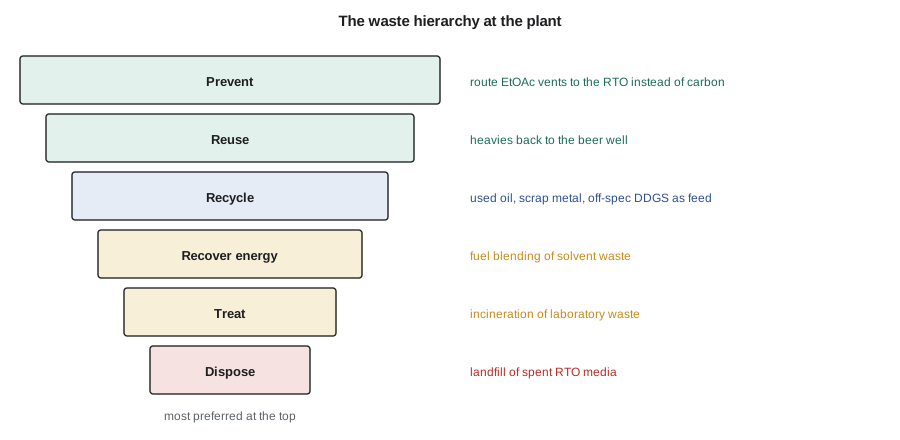
With both changes, the plant's hazardous waste falls to about 950 kg a month. Theo's first reaction is relief that the plant drops below 1,000 kg. Wren's is caution: a month with a tank cleanout or a laboratory clear-out could exceed it, so the plant should keep the systems, training and contingency plan of a larger generator anyway, and simply benefit from the lower fees and lower risk.
Worked problem
Monthly generation
In one month the plant ships 45 kg of laboratory solvent, 900 kg of column heavies and, during a tank cleanout, 400 kg of ignitable tank bottoms. What is its hazardous waste generation that month?
Show solution
- Add every hazardous waste generated in the month, including one-off streams.
- \(45 + 900 + 400 = 1\,345\) kg.
Answer: About 1,345 kg, above 1,000 kg for that month, which is why the plant keeps the systems of a larger generator.
Storage, labelling and containers
Most waste violations are found in the storage area, not on paper. Containers must be compatible with their contents, closed except when waste is being added, in good condition, labelled with the words that identify them as hazardous waste and their contents and hazards, and dated when accumulation starts. Ignitable wastes need storage away from ignition sources, with grounding and bonding when they are transferred. Incompatible wastes, such as acids and caustics or oxidizers and organics, must be separated. Storage areas need secondary containment, spill kits and weekly inspection. Priya adds the occupational side: the people who handle the waste need training on its hazards, the right gloves and respiratory protection for the solvents, and safety data for every stream.
Non-hazardous industrial waste and land application
Most of the plant's waste by mass is non-hazardous, and the largest new stream will be sludge from the anaerobic reactor and the DAF: about 9 t a month of dewatered solids. It is rich in organic matter, nitrogen and phosphorus, and the usual route at ethanol plants and food plants is land application on farmland, where it replaces some fertilizer. Land application is regulated: the sludge must be characterized for nutrients, metals and pathogens, applied at agronomic rates set by a nutrient management plan, kept away from watercourses and wells, and not spread on frozen or saturated ground. The plant also has to plan for the months when land cannot be used, with storage or an alternative outlet. Wren's view is that land application of a clean, well-characterized sludge is recycling in the true sense: the nitrogen and phosphorus that came off the farm in the corn go back to it.
Other waste streams
Several smaller streams deserve attention. Used oil goes to a licensed recycler and must never be mixed with solvents, because a mixture can become a hazardous waste. Spent RTO media, a few tonnes every several years, goes to an industrial landfill after testing. Worn filter bags carry DDGS dust and go to landfill or, if clean, to energy recovery. Scrap metal from maintenance goes to a recycler. Fluorescent tubes, batteries and electronic waste follow their own, lighter rules, often called universal waste. The laboratory produces a small amount of mixed waste that is incinerated, because nothing else can handle the mixture safely. Off-specification product and spilled corn are sold as feed, which is why their lines in the code show revenue.
| Stream | Hazardous? | Route | Change with the expansion |
|---|---|---|---|
| Spent carbon (EtOAc vents) | Ignitable until tested | Reactivation off site | Avoided by venting to the RTO |
| EtOAc column heavies | Ignitable | Fuel blending | Cut to about 900 kg/month by recycle |
| Laboratory solvents | Ignitable | Incineration | Unchanged |
| Anaerobic and DAF sludge | No | Land application | New |
| Used oil | Managed as used oil | Recycling | Small increase |
| Spent RTO media | No (after testing) | Industrial landfill | More media in the larger RTO |
Liability and the waste audit
A generator remains responsible for its waste after it leaves the site. If a carrier dumps it illegally, or a treatment facility fails, the generator can be pursued for the cleanup. That is why responsible generators audit the facilities that take their waste: they visit them, check their permits and their compliance history, and keep the audit on file. Wren audits each of the plant's hazardous waste receivers every three years, and Theo will join her at the cement kiln that will take the column heavies. A cheap receiver with a poor record is the most expensive choice a generator can make.
Theo's revised inventory goes into the compliance plan with three actions: route the ethyl acetate vents to the RTO, recycle most of the column heavies, and register the new streams before the line starts. The net cost of waste, after the feed sales, is close to zero, and the hazardous fraction is less than an eighth of what the original design would have produced.
Common mistakes
MistakeShipping a new waste stream before it is classified and registered.
InsteadClassify, register and set up manifests before the first shipment.
MistakeTreating a sold by-product as a waste, or a dumped one as a product.
InsteadStatus depends on genuine use; DDGS sold as feed is a product, dumped DDGS is waste.
MistakeMixing used oil with solvents.
InsteadMixtures can turn a recyclable oil into a hazardous waste.
MistakeAssuming responsibility ends at the gate.
InsteadGenerators remain liable; audit the carriers and receivers.
MistakeChoosing the cheapest disposal route without the hierarchy.
InsteadPrevention and recycling often remove the waste and the liability together.
Summary and key terms
- Waste is material that is discarded; genuine by-products such as DDGS are not waste.
- Hazardous waste is listed or has a characteristic such as ignitability, corrosivity, reactivity or toxicity.
- Generators classify, register or count, store, label and manifest hazardous waste from cradle to grave.
- The hierarchy removed the plant's two largest hazardous streams: vents to the RTO and heavies recycled.
- Non-hazardous sludge can be land applied under a nutrient management plan.
- Generators remain liable after shipment, so they audit the facilities that receive their waste.
- Cradle to grave
- Control of hazardous waste from generation to final disposal.
- Manifest
- A shipping document that tracks a waste from generator to receiver.
- Ignitable waste
- Waste that burns readily, such as a liquid with a low flash point.
- Corrosive waste
- Waste with pH at or below 2 or at or above 12.5.
- Land application
- Spreading sludge or other organic residuals on farmland at agronomic rates.
- Universal waste
- Common hazardous items such as batteries and lamps managed under simplified rules.
Practice problems
Work each problem on paper first, then reveal the answer to check.
Is DDGS sold as cattle feed a waste?
Show answer
No; it is a product with a genuine use.
A waste has pH 12.8. Which characteristic does it show?
Show answer
Corrosivity.
Which two streams dominated the plant's hazardous waste?
Show answer
Spent carbon from the ethyl acetate vents and the column heavies.
Why should used oil be kept separate from solvents?
Show answer
Mixing can make the oil a hazardous waste and spoil its recycling.
Why does the plant keep large-generator systems even if it falls below the threshold?
Show answer
Occasional events can push a month over the threshold.
What does a generator check when auditing a waste receiver?
Show answer
Its permits, compliance history and operations.
Lesson quiz · 5 questions
Score 60% or more to complete this lesson.
Create a free account to save your progress, take quizzes and earn a certificate.