
CHE-480 · Lesson 7 of 12 · 23 min
Biological wastewater treatment: anaerobic, activated sludge and MBR
After the expansion, the plant's equalized discharge is expected to be about 1,100 m³/d at about 1,700 mg/L of COD: close to 1,900 kg of COD a day, most of it sugars, organic acids, ethanol and glycerol that microorganisms would happily eat. Malik's question is simple. The surcharge will rise with the load; would it be cheaper for the plant to treat its own wastewater? Wren's question is broader: if the plant treats it, should it do so in a way that recovers energy? Theo, who learned fermentation kinetics in CHE-390, is about to discover that a wastewater treatment plant is a bioreactor that runs on a feed nobody chose.
The biology of treatment
Biological treatment uses mixed communities of microorganisms to convert dissolved organic matter into gases, new cells and water. Two broad routes exist. In aerobic treatment, bacteria oxidize the organics with dissolved oxygen supplied by aeration, much as yeast respires in a propagator: the products are carbon dioxide, water and a large amount of new biomass. In anaerobic treatment, with no oxygen, a chain of organisms breaks the organics down in steps: hydrolysis of large molecules, fermentation to organic acids, conversion to acetate and hydrogen, and finally methanogenesis, in which archaea turn acetate and hydrogen into methane and carbon dioxide. The products are biogas and a small amount of new biomass.
The two routes differ in their energy balance, and that difference drives the design choice. Aerobic organisms extract most of the energy in the organics, so they grow fast and produce a lot of sludge, typically 0.3 to 0.5 kg of volatile suspended solids per kg of COD removed, and they need oxygen, which costs electricity. Anaerobic organisms extract little energy, so they grow slowly and make only about 0.05 kg of solids per kg COD; most of the energy stays in the methane, which can be burned. A COD balance makes this exact. Every kilogram of COD removed ends either as oxygen consumed (aerobic), as methane (anaerobic) or as new cells, at 1.42 kg COD per kg of cell mass.
One kilogram of COD converted to methane gives 0.35 Nm³ of methane at 0 °C, because one mole of methane (22.4 L) needs two moles of oxygen (64 g) to burn.
Kinetics and solids retention time
The growth of the organisms follows the same Monod kinetics as the yeast in CHE-390, with a decay term for the cells that die and are consumed. In a continuous treatment reactor the key operating variable is the solids retention time (SRT), the average time the biomass stays in the system. If the SRT is shorter than the minimum the organisms need to replace themselves, they wash out:
Aerobic heterotrophs grow fast and need a minimum SRT of well under a day; methanogens grow slowly and, at 35 °C, need several days. Real plants run at several times the minimum for stability: 5 to 15 days for activated sludge, often longer for anaerobic reactors. Because the hydraulic retention time of a wastewater plant is usually hours, not days, every practical design must keep the biomass in the reactor longer than the water. Activated sludge does it by settling and recycling the sludge; membrane bioreactors by filtering it; granular anaerobic reactors by growing biomass in dense granules that do not wash out.
Activated sludge
The activated sludge process, invented in Manchester in 1914, is the most common biological treatment in the world. Wastewater flows into an aeration tank, where air or oxygen keeps a suspension of microbial flocs, the mixed liquor, aerobic and mixed. The mixed liquor flows to a clarifier, where the flocs settle; clear effluent overflows, and most of the settled sludge is returned to the aeration tank. A small stream is wasted to control the SRT. Its strengths are robustness and a long history; its weaknesses are the energy for aeration, often half the electricity of a municipal plant, the large volume of waste sludge, and a clarifier whose performance depends on sludge that settles well. Food and fermentation wastewaters rich in sugars are prone to filamentous bulking, in which thread-like organisms make a sludge that will not settle.
Membrane bioreactors
A membrane bioreactor (MBR) replaces the clarifier with microfiltration or ultrafiltration membranes, either submerged in the aeration tank or in a separate tank. The membranes hold back all the biomass, so the mixed liquor can be run at three or four times the solids concentration of conventional activated sludge, the tanks are smaller, and the effluent is free of suspended solids and most bacteria, ready for reuse after further polishing. The costs are the membranes, which foul and must be cleaned and replaced, and the extra air used to scour them. MBRs suit sites with little space or a need for reuse-quality water, which is one reason Lesson 8 returns to them.
Anaerobic treatment: UASB and EGSB
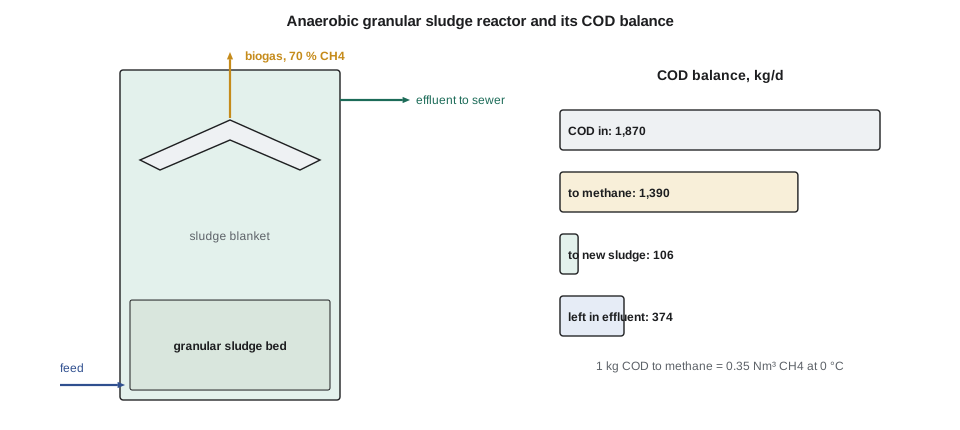
The breakthrough that made anaerobic treatment practical for industrial wastewater came in the Netherlands in the 1970s, when Lettinga and his colleagues developed the upflow anaerobic sludge blanket (UASB) reactor. Wastewater is fed at the bottom of a tank and flows upward through a bed of granular sludge: dense, millimetre-sized aggregates of bacteria and archaea that settle rapidly. Biogas forms in the bed and rises; a three-phase separator at the top of the reactor collects the gas, lets the water overflow, and returns any carried-up granules to the bed. Expanded granular sludge bed (EGSB) reactors and internal circulation reactors are taller and faster versions with higher upflow velocities. They now treat wastewater at thousands of breweries, distilleries, starch plants and ethanol plants around the world.
UASB and EGSB reactors are designed mainly on the organic loading rate (OLR), the kilograms of COD fed per cubic metre of reactor per day, and checked on the upflow velocity. Typical OLRs for soluble, readily degradable wastewater at 30 to 37 °C are 5 to 15 kg COD/(m³·d) for UASB and 15 to 30 for EGSB. The upflow velocity must be high enough to mix the bed but low enough not to wash out the granules: about 0.5 to 1.5 m/h for UASB. Temperature matters a great deal; the plant's warm discharge is an advantage.
# Anaerobic pretreatment (UASB/EGSB) versus aerobic treatment for the expanded plant's sewer stream
Q, S0 = 1100.0, 1700.0              # m3/d and mg/L COD after equalization (expanded plant)
cod_in = Q * S0 / 1000              # kg COD/d
# --- anaerobic granular sludge reactor
OLR, vup, rem = 8.0, 1.0, 0.80      # kg COD/(m3 d), upflow velocity m/h, COD removal
V = cod_in / OLR; A = Q / 24 / vup; H = V / A
removed = cod_in * rem
Yan = 0.05                          # kg VSS per kg COD removed, anaerobic
ch4 = (removed - 1.42 * Yan * removed) * 0.35      # Nm3 CH4/d (0.35 Nm3 per kg COD at 0 C)
biogas = ch4 / 0.70
MW = ch4 * 35.8 / 86400             # MW of methane energy (35.8 MJ/Nm3)
print(f"COD in {cod_in:.0f} kg/d; reactor {V:.0f} m3, area {A:.0f} m2, height {H:.1f} m, HRT {24*V/Q:.1f} h")
print(f"COD removed {removed:.0f} kg/d; methane {ch4:.0f} Nm3/d, biogas {biogas:.0f} Nm3/d, {MW:.2f} MW")
print(f"effluent COD {S0*(1-rem):.0f} mg/L; anaerobic sludge {Yan*removed:.0f} kg VSS/d")
# --- aerobic activated sludge doing the same COD removal
Yobs = 0.30                         # kg VSS per kg COD removed (observed, with decay)
Px = Yobs * removed
O2 = removed - 1.42 * Px            # kg O2/d
kWh = O2 / 1.5                      # 1.5 kg O2 per kWh of blower power, field value
print(f"aerobic: oxygen {O2:.0f} kg/d, blowers about {kWh/24:.0f} kW, sludge {Px:.0f} kg VSS/d")
# minimum solids retention time from Monod kinetics, 1/SRT = mu_max S/(Ks+S) - kd at S = S0
for name, mu, Ks, kd in (('aerobic heterotrophs', 6.0, 20.0, 0.12), ('methanogens (35 C)', 0.35, 300.0, 0.03)):
    srt = 1 / (mu * S0 / (Ks + S0) - kd)
print(f"{name}: minimum SRT {srt:.1f} d")COD in 1870 kg/d; reactor 234 m3, area 46 m2, height 5.1 m, HRT 5.1 h COD removed 1496 kg/d; methane 486 Nm3/d, biogas 695 Nm3/d, 0.20 MW effluent COD 340 mg/L; anaerobic sludge 75 kg VSS/d aerobic: oxygen 859 kg/d, blowers about 24 kW, sludge 449 kg VSS/d aerobic heterotrophs: minimum SRT 0.2 d methanogens (35 C): minimum SRT 3.7 d
At an OLR of 8 kg COD/(m³·d), the reactor needs about 234 m³, with a cross-section of about 46 m² to keep the upflow velocity at 1 m/h, giving a height of about 5 m. Removing 80 % of the COD, it would produce about 490 Nm³ of methane a day, about 0.2 MW of fuel for the boilers, and only about 75 kg/d of new sludge. Its effluent, at about 340 mg/L COD, would carry about 140 mg/L of BOD, below the surcharge threshold. Treating the same load aerobically would take about 860 kg of oxygen a day, about 24 kW of blowers, and produce about 450 kg/d of sludge to dewater and dispose of. The anaerobic route turns a cost into a small fuel source and a much smaller sludge stream.
Worked problem
Methane from COD removal
A brewery's UASB removes 4,000 kg/d of COD, and 6 % of the removed COD goes to new cells. How much methane does it make, and what is its energy content at 35.8 MJ/Nm³?
Show solution
- COD to methane \(= 4\,000 \times (1 - 0.06) = 3\,760\) kg/d.
- Methane \(= 3\,760 \times 0.35 = 1\,316\) Nm³/d.
- Energy \(= 1\,316 \times 35.8 = 47\,100\) MJ/d, or about 0.55 MW.
Answer: About 1,320 Nm³/d of methane, about 0.55 MW.
Biogas and its uses
Biogas from anaerobic reactors is typically 60 to 80 % methane, the rest carbon dioxide with water vapour and some hydrogen sulfide from the reduction of sulfate. The plant's wastewater carries sulfate from the sulfuric acid and the corn, so its biogas may contain 0.5 to 2 % hydrogen sulfide. That matters for three reasons: hydrogen sulfide is toxic, it corrodes boilers and engines, and when burned it becomes sulfur dioxide. The usual treatment is a biological desulfurization scrubber or iron sponge before the gas is used. The cleaned gas can be burned in the plant boilers alongside natural gas, which is the simplest use, or upgraded to renewable natural gas. Either way it replaces fossil natural gas and lowers the plant's carbon intensity a little. Any gas that cannot be used is flared, because methane released unburned has a global warming potential many times that of carbon dioxide.
Anaerobic plus aerobic
Anaerobic reactors rarely produce an effluent clean enough for a river: they leave a few hundred milligrams per litre of COD, ammonia and some sulfide. Where the plant discharges to a city sewer, as at Sarnia, that is often good enough, since the city plant provides the aerobic polishing. Where the plant must discharge directly, or wants to reuse the water, an aerobic stage follows: an activated sludge or MBR polishing step after the anaerobic reactor, which then needs only a fraction of the aeration energy and makes a fraction of the sludge that aerobic treatment alone would. This anaerobic-aerobic sequence is the standard design for high-strength food and fermentation wastewater.
Operating risks
Anaerobic reactors are less forgiving than aerobic ones. Methanogens are sensitive to pH below about 6.5, to sudden temperature changes, to oxygen, and to inhibitors such as high ammonia, sulfide and some cleaning chemicals. If the acid-forming organisms outrun the methanogens, volatile fatty acids accumulate, the pH falls, and the reactor sours, which can take weeks to recover. The defences are equalization, which the plant is adding anyway; control of pH and alkalinity, measured daily by the ratio of volatile fatty acids to alkalinity; keeping strong disinfectants and peroxide-based cleaning agents out of the feed; and a seed supply of granules from another plant in case of upset. Nadia adds two process safety items: the biogas system is a flammable gas system, with its own hazardous area classification, flame arresters and flare, and hydrogen sulfide in the gas and in any enclosed space around the reactor needs fixed detection. Priya adds confined-space entry procedures for the tanks.
| Option | Energy | Sludge | Footprint | Effluent | Fit at the plant |
|---|---|---|---|---|---|
| Activated sludge only | Uses about 24 kW | High (about 450 kg/d) | Large | Good | Possible, costly to run |
| MBR only | Uses more than activated sludge | High | Small | Excellent, reuse-ready | If water reuse is a goal |
| UASB/EGSB to sewer | Makes about 0.2 MW | Low (about 75 kg/d) | Small | Fair | Best for sewer discharge |
| UASB + MBR polishing | Net producer | Low to moderate | Moderate | Excellent | If reuse or direct discharge |
Theo's recommendation, which Wren endorses, is a covered anaerobic reactor of the EGSB type after the equalization tank, with biogas cleaned and burned in the new boilers, the headspace vented to the biotrickling filter of Lesson 4, and the effluent sent to the city sewer. The reactor removes most of the surcharge, cuts the load on the city plant, and makes a little fuel. An MBR polishing step is kept as a later option, to be justified by the water reuse study of Lesson 8.
Common mistakes
MistakeComparing aerobic and anaerobic treatment on removal efficiency alone.
InsteadCompare the energy balance and sludge production; anaerobic removes COD as fuel with far less sludge.
MistakeRunning a reactor with SRT equal to HRT for slow-growing organisms.
InsteadMethanogens need days; retain biomass by granules, settling or membranes.
MistakeAssuming biogas is pure methane.
InsteadIt carries carbon dioxide, water and hydrogen sulfide; clean it before use.
MistakeSending cleaning chemicals straight to the anaerobic reactor.
InsteadStrong oxidants and slugs of acid or caustic inhibit methanogens; equalize and segregate.
MistakeVenting unused biogas.
InsteadUnburned methane is a strong greenhouse gas; flare what cannot be used.
Summary and key terms
- Aerobic treatment oxidizes organics with oxygen and makes much sludge; anaerobic treatment makes methane and little sludge.
- A COD balance links removal to oxygen used or methane made and to new cells at 1.42 kg COD/kg.
- The solids retention time must exceed the minimum for the slowest organisms; designs retain biomass by settling, membranes or granules.
- Activated sludge is robust but energy- and sludge-intensive; MBRs give reuse-quality effluent in a small footprint.
- UASB and EGSB reactors are sized on organic loading rate and upflow velocity and suit warm, soluble, high-strength waste.
- Biogas must be cleaned of hydrogen sulfide and used or flared; anaerobic reactors need pH, alkalinity and inhibitor control.
- Solids retention time (SRT)
- Average time biomass stays in a treatment system.
- Organic loading rate (OLR)
- COD fed per unit reactor volume per day.
- Granular sludge
- Dense aggregates of anaerobic microorganisms that settle quickly.
- Methanogenesis
- Conversion of acetate and hydrogen to methane by archaea.
- Mixed liquor
- The suspension of microorganisms in an activated sludge aeration tank.
- Filamentous bulking
- Poor settling of activated sludge caused by thread-like organisms.
Practice problems
Work each problem on paper first, then reveal the answer to check.
How much methane is made from 1,000 kg of COD converted to methane?
Show answer
350 Nm³ at 0 °C.
A UASB treats 2,400 kg COD/d at an OLR of 10. What volume is needed?
Show answer
240 m³.
Why does aerobic treatment make more sludge than anaerobic?
Show answer
Aerobic organisms capture more energy from the organics and grow faster.
Why do anaerobic reactors use granular sludge?
Show answer
Granules settle quickly, so biomass stays far longer than the water.
What can cause an anaerobic reactor to sour?
Show answer
Acid formers outrunning methanogens: overload, low pH, inhibitors or temperature shocks.
Why must the plant's biogas be cleaned before use?
Show answer
It contains hydrogen sulfide from sulfate reduction, which is toxic and corrosive.
Lesson quiz · 5 questions
Score 60% or more to complete this lesson.
Create a free account to save your progress, take quizzes and earn a certificate.