
CHE-480 · Lesson 6 of 12 · 22 min
Industrial wastewater characterization and pretreatment
Every month Wren signs a report to the city: the volume the plant sent to the sewer each day, and the results of the composite samples Dev's laboratory analysed for biochemical oxygen demand, suspended solids, pH and a short list of other parameters. The plant does not discharge to the St. Clair River directly; its wastewater goes to the city's water pollution control plant, which treats it with the city's domestic sewage. The relationship is governed by the City of Sarnia's sewer-use bylaw. For three years the plant has paid a surcharge on its organic load, and twice in the last year the pH of a sample has dropped below the bylaw minimum during the cleaning of a fermenter. The expansion will add flow and load. Wren wants Theo to understand the wastewater before anyone designs anything to treat it.
Where the water goes in a dry-grind plant
A dry-grind ethanol plant is designed to discharge very little process water. The thin stillage from the centrifuges is partly returned to the cook as backset and partly evaporated to syrup; the evaporator condensate is reused to make the mash; and the water in the wet cake and syrup leaves as vapour in the dryer exhaust. So the wastewater is not the process stream itself but the streams around it: blowdown from the cooling tower, which purges the dissolved solids that build up as water evaporates; blowdown from the boilers; reject from the reverse osmosis and softening units that treat the incoming water; wash water from cleaning-in-place of fermenters, heat exchangers and evaporators; excess process condensate when the water balance does not close; and stormwater from paved areas, which at Sarnia goes to a separate system. The utility streams are large and fairly clean; the cleaning streams are small, strong and irregular.
Measuring what is in the water
Industrial wastewater is described by a handful of aggregate parameters and a longer list of specific substances. Wren's list for the plant includes the following.
| Parameter | What it measures | Typical range at the plant |
|---|---|---|
| BOD5 | Oxygen used by microbes in 5 days at 20 °C: biodegradable organics | 50 to 3,000 mg/L by stream |
| COD | Oxygen equivalent of organics oxidized by hot dichromate: nearly all organics | 100 to 6,000 mg/L by stream |
| TSS | Suspended solids caught on a filter | 10 to 500 mg/L |
| TDS | Dissolved salts | 1,000 to 5,000 mg/L in blowdown |
| pH | Acidity or alkalinity | 2 to 12.5 during cleaning |
| Total phosphorus, TKN | Nutrients | Moderate; high in CIP and condensate |
| Sulfate | From sulfuric acid and corn sulfur | Up to several hundred mg/L |
| Temperature | Heat load on the sewer and treatment plant | Up to 50 °C |
The two oxygen demand tests answer different questions. Chemical oxygen demand (COD) measures almost all the organic matter in about two hours. Biochemical oxygen demand over five days (BOD5) measures only what microorganisms can use in that time, and it is what a biological treatment plant and a receiving stream respond to. For ethanol plant wastewater, which contains sugars, organic acids, ethanol, glycerol and yeast cells, the ratio of BOD5 to COD is high, often 0.5 to 0.7, which says the waste is readily biodegradable. Low BOD to COD ratios point to compounds that resist biological treatment.
Flow and load are what matter
A concentration means little without a flow. What a treatment plant or a sewer sees is the load: flow times concentration, in kilograms per day. A small, strong stream such as the caustic wash of a fermenter can carry more organic load than a large, weak stream such as cooling tower blowdown. Loads also vary in time. The plant's discharge has a steady base of utility blowdown, peaks when a fermenter is washed each morning, and another peak when the evaporators are boiled out in the evening. Theo's first task is to put numbers on that pattern from the plant's flow records and Dev's grab samples.
# Sewer discharge: hourly flow and COD profile, equalization volume, loads and surcharge
steady = 14 + 2 + 6                  # m3/h: cooling tower blowdown, boiler blowdown, RO reject
cod_steady = 120                     # mg/L in the steady streams
flow, cod = [], []
for h in range(24):
    q, load = steady, steady * cod_steady
    if 6 <= h < 9:  q += 40; load += 40 * 2500     # caustic CIP of a fermenter
    if 18 <= h < 20: q += 30; load += 30 * 4000    # evaporator boil-out
    q += 8; load += 8 * 3500                        # excess process condensate
    flow.append(q); cod.append(load / q)
Qavg = sum(flow) / 24
cum = 0.0; lo = hi = 0.0
for q in flow:
    cum += q - Qavg; lo = min(lo, cum); hi = max(hi, cum)
V = (hi - lo) * 1.2                  # 20 % allowance for mixing and dead volume
fw = sum(q * c for q, c in zip(flow, cod)) / sum(flow)
print(f"average flow {Qavg:.1f} m3/h ({Qavg*24:.0f} m3/d), peak {max(flow):.0f} m3/h")
print(f"equalization volume {V:.0f} m3")
print(f"peak hourly COD {max(cod):.0f} mg/L; flow-weighted COD {fw:.0f} mg/L")
cod_kg = fw * Qavg * 24 / 1000; bod_kg = 0.6 * cod_kg
print(f"COD load {cod_kg:.0f} kg/d, BOD (0.6 x COD) {bod_kg:.0f} kg/d")
limit, rate = 300.0, 0.65            # BOD surcharge threshold mg/L, charge per kg above it
excess = max(0.0, bod_kg - limit * Qavg * 24 / 1000)
print(f"BOD above {limit:.0f} mg/L: {excess:.0f} kg/d, surcharge {excess*rate*365/1000:.0f} thousand per year")
# neutralizing the caustic CIP: 40 m3/h x 3 h at pH 12.3
mol_oh = 10 ** (12.3 - 14) * 120 * 1000
acid_kg = mol_oh / 2 * 98.08 / 1000
print(f"acid to neutralize one CIP batch: {acid_kg:.0f} kg H2SO4 (93 %: {acid_kg/0.93:.0f} kg)")average flow 37.5 m3/h (900 m3/d), peak 70 m3/h equalization volume 117 m3 peak hourly COD 2511 mg/L; flow-weighted COD 1417 mg/L COD load 1275 kg/d, BOD (0.6 x COD) 765 kg/d BOD above 300 mg/L: 495 kg/d, surcharge 117 thousand per year acid to neutralize one CIP batch: 117 kg H2SO4 (93 %: 126 kg)
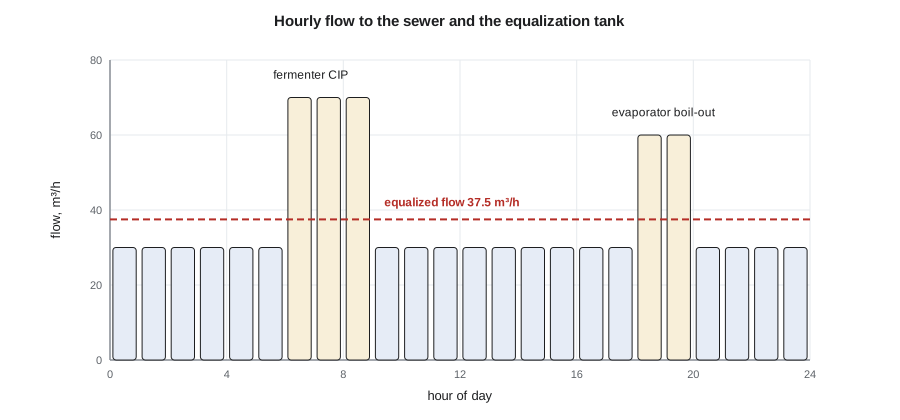
The average flow is about 900 m³/d, but it varies from 30 to 70 m³/h through the day, and its COD varies from about 1,000 to about 2,500 mg/L. The flow-weighted COD is about 1,400 mg/L, and the load about 1,300 kg/d of COD. Taking BOD as 0.6 times COD, the plant sends about 760 kg/d of BOD to the sewer, of which about 500 kg/d is above the surcharge threshold of 300 mg/L. That is the source of the surcharge Malik has been paying, which on the illustrative rate is over a hundred thousand dollars a year.
What the sewer rules say
A municipal sewer-use bylaw does three things. It prohibits some discharges outright: flammable or explosive liquids, materials that would block the sewer, and, in the sanitary sewer, anything that could interfere with the treatment plant or pass through it untreated. It sets limits for specific parameters: a pH range, a maximum temperature, limits for metals, oils and greases, phenols and other substances. And for the conventional pollutants that the treatment plant is designed to remove, BOD, suspended solids, phosphorus and nitrogen, it allows higher concentrations under an agreement with the city in return for a surcharge based on the extra load. the bylaw at Sarnia follows this pattern, and the plant's agreement with the city sets its surcharge rates and its sampling program. A discharger that breaks the bylaw can face orders and fines, and a serious spill to the sewer that harms the treatment plant or the river can also bring charges under the Ontario Water Resources Act or the federal Fisheries Act.
Cities treat food and fermentation industries carefully because their wastes are strong and variable. A slug of high-strength waste can overload the aeration capacity of a treatment plant and produce an effluent that breaks the city's own permit. A slug of acid or caustic can upset the biology. And a sewer carrying warm, sugary waste can grow bacteria that produce hydrogen sulfide, which corrodes concrete pipes and is lethal to workers in manholes. Good relations with the city's pretreatment staff are worth as much as any limit, and Wren meets them every quarter.
Pretreatment: what the plant can do
Pretreatment means treatment by the discharger before the sewer. Its purpose is to meet the sewer limits, to protect the sewer and the city plant, and often to reduce surcharges. The usual steps, in order, are source control, equalization, neutralization, removal of solids and oil, and, where the organic load justifies it, biological treatment. The first and cheapest is source control: find the strongest streams and keep them out of the sewer. At Sarnia the strongest streams are the evaporator boil-out and the excess process condensate, which both carry ethanol, organic acids and glycerol. Much of the condensate could be returned to the cook if the water balance had room for it, and the expansion's larger cook water demand creates that room.
Equalization
An equalization tank smooths the flow and the concentration. It receives the variable discharge and pumps out a steady flow, so the sewer and any downstream treatment see averages, not peaks. The volume is set from the cumulative inflow curve: plot the cumulative inflow over a day against the cumulative outflow at the average rate, and the tank must hold the largest difference between them. The code finds about 117 m³ including a 20 % allowance. A tank of about 150 m³, mixed to keep solids suspended and to blend the peaks, would let the plant send a nearly steady flow at nearly constant strength. Equalization does not reduce the daily load, but it removes the slugs that worry the city and makes downstream treatment much easier to design and operate.
Worked problem
Equalization volume from a simple pattern
A plant discharges 20 m³/h for 20 hours and 60 m³/h for 4 hours each day. What equalization volume is needed for a constant outflow?
Show solution
- Daily volume \(= 20 \times 20 + 60 \times 4 = 640\) m³; average \(= 640/24 = 26.7\) m³/h.
- During the 4-hour peak the tank fills at \(60 - 26.7 = 33.3\) m³/h, so it stores \(4 \times 33.3 = 133\) m³.
- The tank then drains at \(6.7\) m³/h for 20 hours, which returns \(133\) m³, so the cycle closes.
Answer: About 133 m³, plus an allowance for mixing and dead volume.
Neutralization
Cleaning-in-place at an ethanol plant uses hot caustic soda, often around 1 to 2 % for fermenters and stronger for evaporator boil-outs, followed by rinses and sometimes an acid wash. The spent caustic has a pH above 12, and the acid wash a pH near 2. If they reach the sewer separately and unmixed, they violate the pH limits. In an equalization tank they partly neutralize each other; the remainder is adjusted with sulfuric acid or caustic under pH control. The code estimates about 120 kg of sulfuric acid to neutralize the residual hydroxide in one 120 m³ caustic wash at pH 12.3, though the real demand is larger because the wash also carries carbonate and organic acids that buffer it. Dev titrates a sample of each batch to find the true demand. Two-stage pH control with a well-mixed tank is the norm, because the titration curve of a strong base near neutral is so steep that a single stage overshoots.
Solids, oil and grease
Suspended solids in the plant's wastewater are mostly yeast cells and fine grain particles from cleaning. Corn oil, which the plant recovers and sells, can reach the drains in small amounts. Both can be removed by dissolved air flotation (DAF): the water is saturated with air under pressure and released into a tank, where fine bubbles attach to particles and oil droplets and float them to the surface to be skimmed. Coagulants and polymers improve capture. At Sarnia a small DAF ahead of the equalization tank would take out most of the solids and oil and send the float back to the stillage, where it becomes DDGS rather than a surcharge.
Monitoring and sampling
Sampling is where many compliance programs go wrong. A grab sample shows the composition at one moment; a composite sample, made by an automatic sampler that takes a portion every few minutes in proportion to flow, shows the average over a day. Limits on daily loads need flow-proportional composites; pH and temperature need continuous measurement or grab samples, because they can swing quickly. Samples must be preserved and analysed within set holding times by an accredited laboratory using approved methods. Wren's plan for the expansion adds a flow meter and an online pH probe at the final discharge point, an automatic composite sampler, and an alarm that closes the discharge valve and diverts to the equalization tank if the pH leaves the permitted range.
By the end of the week, Theo has a picture of the plant's wastewater as a set of streams, each with a flow, a load and a schedule, rather than as one sample in a monthly report. He also has a list of what pretreatment could do: return more condensate to the cook, equalize, neutralize under control, remove solids and oil, and consider biological treatment for what remains. The organic load is still high enough to pay a surcharge after equalization. Lesson 7 asks whether the plant should treat it itself, and turn it into energy.
Common mistakes
MistakeJudging a stream by its concentration alone.
InsteadLoad is flow times concentration; small strong streams can dominate.
MistakeUsing a grab sample to report a daily load.
InsteadUse flow-proportional composites for loads; grabs for pH and temperature.
MistakeTreating BOD and COD as the same thing.
InsteadCOD measures nearly all organics; BOD only the biodegradable part. Their ratio says how treatable the waste is.
MistakeExpecting equalization to cut the daily load.
InsteadEqualization smooths peaks but removes no load; it makes treatment easier.
MistakeNeutralizing in one stage with a fast acid pump.
InsteadThe titration curve is steep near neutral; use two stages and a well-mixed tank.
Summary and key terms
- A dry-grind plant recycles its process water; its wastewater is utility blowdown, cleaning water and excess condensate.
- COD measures nearly all organics, BOD5 the biodegradable part; ethanol plant waste has a high BOD to COD ratio.
- Loads, not concentrations, drive surcharges and treatment design; they vary through the day.
- Sewer rules prohibit some discharges, limit others, and surcharge conventional pollutants above domestic strength.
- Pretreatment starts with source control, then equalization, neutralization and solids and oil removal.
- Flow-proportional composites, accredited analysis and online pH protect the compliance record.
- BOD5
- Five-day biochemical oxygen demand: oxygen used by microbes to degrade organics in 5 days at 20 °C.
- COD
- Chemical oxygen demand: oxygen equivalent of organics oxidized by hot acid dichromate.
- Load
- Flow multiplied by concentration, usually in kg/d.
- Equalization
- Holding a variable discharge in a tank to release it at a steady rate and strength.
- Dissolved air flotation (DAF)
- Removing solids and oil by floating them with fine air bubbles.
- Composite sample
- A sample made of many portions collected over time, often in proportion to flow.
Practice problems
Work each problem on paper first, then reveal the answer to check.
A stream of 5 m³/h at 4,000 mg/L COD and one of 40 m³/h at 150 mg/L COD: which carries more load?
Show answer
The first: 480 kg/d against 144 kg/d.
What does a BOD5/COD ratio of 0.65 suggest?
Show answer
The waste is readily biodegradable.
Why can a warm sugary sewer be dangerous for workers?
Show answer
Bacteria in it can produce hydrogen sulfide.
How does equalization help a downstream biological plant?
Show answer
It gives a steady flow and strength, so the biology is not shocked by peaks.
Why is two-stage pH control used for caustic washes?
Show answer
The titration curve is very steep near neutral, so one stage overshoots.
Name one way to reduce the plant's BOD surcharge without treatment.
Show answer
Return more process condensate to the cook instead of the sewer.
Lesson quiz · 5 questions
Score 60% or more to complete this lesson.
Create a free account to save your progress, take quizzes and earn a certificate.