
CHE-480 · Lesson 5 of 12 · 23 min
Combustion emissions: NOx, SOx and CO control
The expansion needs more steam: the larger beer column, the extra evaporator effect and the ethyl acetate line together add about a fifth to the plant's steam demand. The engineering team has chosen to replace the two oldest package boilers with two new natural-gas boilers totalling 70 MW of fuel input. Wren's job is to choose the burners and any add-on control, and to write the emission limits the plant can live with for twenty years. Theo, who spent the last year at a refinery surrounded by fired heaters with selective catalytic reduction, has opinions. Wren asks him to start from the chemistry.
How combustion makes pollutants
Natural gas is mostly methane, and its complete combustion gives carbon dioxide and water. Real flames are never complete or perfectly mixed, and they run hot, so they also make small amounts of carbon monoxide, unburned hydrocarbons, nitrogen oxides and, if the fuel contains sulfur, sulfur dioxide. Each has a different cause and a different cure, and the cures often pull against each other: the conditions that cut nitrogen oxides, such as lower flame temperature and less excess air, tend to raise carbon monoxide.
Stoichiometry and excess air
Every combustion calculation starts from the stoichiometry. For methane, \(\mathrm{CH_4 + 2\,O_2 \to CO_2 + 2\,H_2O}\), and air supplies 3.78 mol of nitrogen with each mole of oxygen. Burners run with excess air so that every fuel molecule finds oxygen; package boilers usually run at 10 to 20 % excess air, which leaves about 2 to 3.5 % oxygen in the dry flue gas. The flue gas flow, which sets the size of any downstream control equipment and converts concentrations into mass rates, comes straight from this balance.
Correcting to a reference oxygen
A concentration measured in a stack depends on how much air was mixed with the combustion products. A burner running with more excess air shows a lower nitrogen oxide reading for the same mass emission, simply by dilution. To compare units fairly, regulations state limits at a reference oxygen content, usually 3 % for boilers and heaters burning gas, 15 % for gas turbines. The correction is:
with oxygen in percent on a dry basis. Converting ppm by volume to mass concentration at the normal condition of 0 °C and 101.325 kPa uses a molar volume of 22.414 L/mol, and nitrogen oxides are always reported as nitrogen dioxide (M = 46.0), whatever mix of NO and NO2 is actually present.
# Natural gas boiler: flue gas, oxygen correction and NOx mass rates for control options
import math
LHV_CH4 = 50.0                       # MJ/kg methane (lower heating value, rounded)
fuel_MW = 70.0                       # two boilers, fuel input
nCH4 = fuel_MW * 1000 / LHV_CH4 / 16.04       # mol/s
O2_dry = 3.0                                  # % O2 in dry flue gas
# CH4 + 2 O2 -> CO2 + 2 H2O ; air is 20.9 % O2. Dry products per mol CH4 at excess air ex:
def dry_flue(ex):
    o2 = 2 * (1 + ex); n2 = o2 * 79.1 / 20.9
    return 1 + 2 * ex + n2, 2 * ex                        # mol dry gas, mol O2 left
ex = 0.0
while True:
    tot, o2 = dry_flue(ex)
    if 100 * o2 / tot >= O2_dry: break
    ex += 0.0005
V = nCH4 * tot * 0.022414                    # Nm3/s dry (0 C, 101.325 kPa)
print(f"methane {nCH4:.0f} mol/s, excess air {100*ex:.1f} %, dry flue gas {V:.1f} Nm3/s at {O2_dry:.0f} % O2")
def correct(ppm, o2_meas, o2_ref=3.0):       # correct a measured ppm to a reference O2
    return ppm * (20.9 - o2_ref) / (20.9 - o2_meas)
print(f"25 ppm measured at 5.5 % O2 = {correct(25, 5.5):.1f} ppm at 3 % O2")
GJ_per_yr = fuel_MW * 8400 * 3.6
for name, ppm in (('conventional burners', 80), ('low-NOx burners + FGR', 30), ('ultra-low-NOx burners', 9), ('SCR after low-NOx burners', 5)):
    mg = ppm * 46.01 / 22.414                # mg/Nm3 as NO2
    kgh = mg * V * 3.6 / 1000
    print(f"{name:27s}{ppm:4d} ppm  {mg:6.1f} mg/Nm3  {kgh:5.2f} kg/h  {kgh*8400/1000:5.1f} t/yr  {kgh*8400*1000/GJ_per_yr:5.1f} g/GJ")
# Zeldovich: thermal NO formation rate constant k1 = 1.8e14 exp(-38370/T)
for T in (1700, 1800, 1900, 2000):
    print(f"T = {T} K: thermal NO rate relative to 1800 K = {math.exp(-38370/T)/math.exp(-38370/1800):.2f}")
# Sulfur balance around the dryers: where the dryer SO2 comes from (kg S per hour)
s_corn = 60.6e3 * 0.0012            # corn at 0.12 % S
s_acid = 25.0 * 32.06 / 98.08       # 25 kg/h sulfuric acid for pH control
s_in = s_corn + s_acid
so2 = 0.03 * s_in * 64.07 / 32.06   # about 3 % of the sulfur leaves the dryers as SO2
print(f"sulfur in {s_in:.1f} kg/h ({100*s_acid/s_in:.0f} % from acid); dryer SO2 {so2:.1f} kg/h")
print(f"halving acid use cuts SO2 to {0.03*(s_corn+s_acid/2)*64.07/32.06:.1f} kg/h")methane 87 mol/s, excess air 15.1 %, dry flue gas 19.6 Nm3/s at 3 % O2 25 ppm measured at 5.5 % O2 = 29.1 ppm at 3 % O2 conventional burners 80 ppm 164.2 mg/Nm3 11.58 kg/h 97.2 t/yr 45.9 g/GJ low-NOx burners + FGR 30 ppm 61.6 mg/Nm3 4.34 kg/h 36.5 t/yr 17.2 g/GJ ultra-low-NOx burners 9 ppm 18.5 mg/Nm3 1.30 kg/h 10.9 t/yr 5.2 g/GJ SCR after low-NOx burners 5 ppm 10.3 mg/Nm3 0.72 kg/h 6.1 t/yr 2.9 g/GJ T = 1700 K: thermal NO rate relative to 1800 K = 0.29 T = 1800 K: thermal NO rate relative to 1800 K = 1.00 T = 1900 K: thermal NO rate relative to 1800 K = 3.07 T = 2000 K: thermal NO rate relative to 1800 K = 8.43 sulfur in 80.9 kg/h (10 % from acid); dryer SO2 4.8 kg/h halving acid use cuts SO2 to 4.6 kg/h
Where nitrogen oxides come from
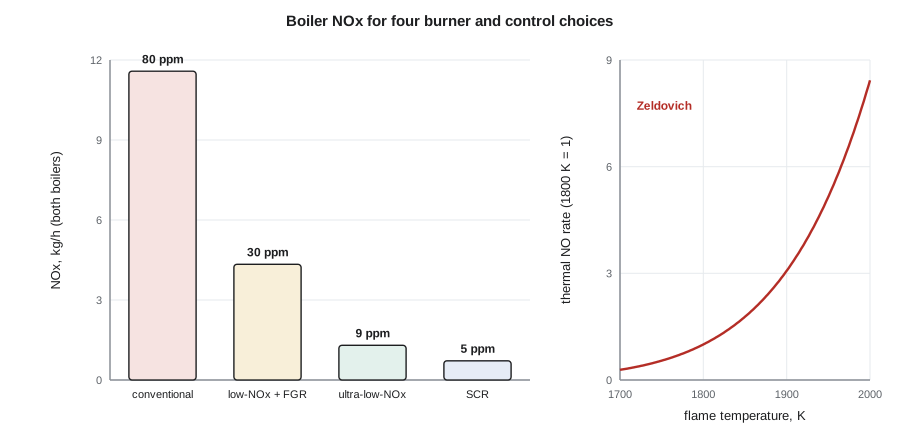
Nitrogen oxides form by three routes. Thermal NOx forms when the nitrogen and oxygen of the air react at flame temperatures, by the Zeldovich mechanism; its rate-limiting step, \(\mathrm{N_2 + O \to NO + N}\), has a very high activation energy, so the rate roughly triples for each 100 K rise in flame temperature near 1,900 K. Prompt NOx forms quickly in the fuel-rich part of the flame from hydrocarbon radicals attacking nitrogen; it is a small part of the total except in ultra-low-NOx burners. Fuel NOx forms from nitrogen bound in the fuel, which natural gas lacks but coal, heavy oil and biomass contain. For a gas-fired boiler, thermal NOx dominates, and the cure is to keep the flame cooler and keep oxygen away from its hottest parts.
Combustion controls for NOx
Most NOx reduction at gas-fired boilers comes from changing the flame. Low-NOx burners stage the air or the fuel, so that combustion starts in a fuel-rich zone with little oxygen and finishes in a cooler, leaner zone. Flue gas recirculation (FGR) mixes 10 to 25 % of the cooled flue gas back into the combustion air, which lowers the oxygen content and the flame temperature. Together, low-NOx burners and FGR bring a package boiler from about 80 ppm to about 30 ppm at 3 % oxygen. Ultra-low-NOx burners, which premix fuel and air very lean or use heavy internal recirculation, reach 9 ppm or less, at some cost in burner stability, turndown and carbon monoxide. Each step also needs more fan power and careful tuning.
Post-combustion controls for NOx
When combustion controls are not enough, the flue gas is treated. Selective catalytic reduction (SCR) injects ammonia or urea upstream of a catalyst bed, usually vanadium and titanium oxides or a zeolite, where nitrogen oxides are reduced to nitrogen and water: \(\mathrm{4\,NO + 4\,NH_3 + O_2 \to 4\,N_2 + 6\,H_2O}\). It works best between about 300 and 400 °C and can remove 80 to 95 % of the NOx. Its costs are the catalyst, the ammonia system and its hazards, and a small amount of unreacted ammonia, called slip, that leaves the stack and can itself form fine particulate. Selective non-catalytic reduction (SNCR) injects ammonia or urea directly into the hot gas at about 900 to 1,050 °C without catalyst; it is cheaper but removes only 30 to 60 %, and it suits large boilers with a suitable temperature window, not small package units.
The numbers from the code show what is at stake. The two new boilers burn about 87 mol/s of methane and produce about 19.6 Nm³/s of dry flue gas at 3 % oxygen. At 80 ppm they would emit almost 12 kg/h of NOx, close to 100 t a year at full output. Low-NOx burners with FGR bring that down to about 4.3 kg/h, and ultra-low-NOx burners to about 1.3 kg/h. SCR after low-NOx burners reaches about 0.7 kg/h, but only by adding an ammonia system to a plant that does not otherwise handle anhydrous or aqueous ammonia in bulk. Priya Venkat points out that bringing ammonia on site adds a toxic gas hazard, with its own exposure monitoring, emergency planning and process safety review.
| Option | NOx at 3 % O2 | Approximate capital | Other effects |
|---|---|---|---|
| Conventional burners | 80 ppm | Base | Highest NOx |
| Low-NOx burners + FGR | 30 ppm | Low | More fan power |
| Ultra-low-NOx burners | 9 ppm | Moderate | Narrower turndown, CO to watch |
| Low-NOx burners + SCR | 5 ppm | High | Ammonia storage, slip, catalyst |
Rules for boilers
New industrial boilers in Canada fall under the federal Multi-Sector Air Pollutants Regulations, which set NOx limits in grams per gigajoule of heat input for new and modernized boilers and heaters above a size threshold. Ontario's ECA then adds limits specific to the site, based on the ESDM modelling and on the ministry's guidance for combustion sources. Wren checks the ultra-low-NOx option, about 5 g/GJ, and the low-NOx burner option, about 17 g/GJ, against the federal limit and finds both comfortably within it. The choice between them will therefore be made on cost, on the plant-wide NOx total in the ECA, and on how the extra NOx affects the modelling of nitrogen dioxide at the nearest houses.
Wren's recommendation is ultra-low-NOx burners without SCR. The extra cost over low-NOx burners is small for new boilers, the reduction is three-fold, the plant avoids ammonia, and it leaves headroom under the plant-wide NOx total for the third dryer section. She asks for a burner vendor guarantee of 9 ppm and 50 ppm carbon monoxide at 3 % oxygen across the operating range from 25 to 100 % load, confirmed by a stack test.
Worked problem
Correcting a stack reading
A portable analyser on the old boiler reads 52 ppm NOx at 6.2 % oxygen, dry. What is the reading at 3 % oxygen, and in mg/Nm³ as NO2?
Show solution
- \(C_{ref} = 52 \times (20.9 - 3)/(20.9 - 6.2) = 52 \times 17.9/14.7 = 63.3\) ppm.
- Mass concentration \(= 63.3 \times 46.0 / 22.414 = 130\) mg/Nm³.
Answer: About 63 ppm at 3 % oxygen, or 130 mg/Nm³.
Carbon monoxide and unburned organics
Carbon monoxide is the signature of incomplete combustion: too little oxygen locally, too little time at temperature, or flame quenched on a cold surface. In boilers it is kept low by good mixing and enough excess air. It is a useful indicator, because a rise in carbon monoxide shows that combustion is going wrong before anything else does. In the DDGS dryers, carbon monoxide comes mostly from the drying solids, not the burner: hot, wet organics break down partly to carbon monoxide. The RTO oxidizes most of it to carbon dioxide, which is why dryer carbon monoxide emissions depend so strongly on the oxidizer's temperature.
Sulfur oxides and the sulfur balance
Pipeline natural gas contains almost no sulfur, a few milligrams per cubic metre from the odorant, so the boilers emit almost no sulfur dioxide. The plant's sulfur dioxide comes from the dryers, and its source is a common misunderstanding. Theo assumes it comes from the sulfuric acid the plant uses to control the pH of the mash. The sulfur balance in the code says otherwise. Corn contains about 0.12 % sulfur, mostly in its proteins; at 60 t/h that is about 73 kg/h of sulfur, compared with about 8 kg/h from the acid. Most of the sulfur leaves in the DDGS, which is valued by livestock nutritionists who watch its sulfur content closely. A few percent is released in the dryers as sulfur dioxide and reduced sulfur compounds, which the RTO converts to sulfur dioxide.
The lesson, in Wren's words, is that you must close the balance before you choose the cure. Halving the acid would cut the dryer sulfur dioxide by only about 5 %. The cures for sulfur dioxide that actually work are to lower the dryer temperature, which releases less sulfur, or to add a scrubbing step. Where sulfur dioxide must be removed from a gas, the standard methods are wet scrubbing with lime, limestone or caustic, or injection of a dry sorbent such as hydrated lime or sodium bicarbonate into the duct, with the spent sorbent caught in a downstream collector. At the plant's modest emissions, neither is justified today, but Wren notes them as options if the third dryer's stack test shows more sulfur dioxide than expected.
Monitoring combustion sources
Combustion emissions can be monitored continuously. A continuous emission monitoring system (CEMS) draws a sample from the stack, conditions it, and measures NOx, carbon monoxide and oxygen, with daily calibration and periodic audits against a reference method. CEMS are required on large units and on units with add-on controls such as SCR. Smaller boilers usually rely on an initial stack test, periodic tests or portable analyser checks, and tune-ups. For the new boilers Wren proposes a NOx and oxygen CEMS on one boiler, the same vendor model on both, so that the plant has a continuous check on its burners and a record it can defend.
Common mistakes
MistakeComparing stack NOx readings without an oxygen correction.
InsteadCorrect every reading to the reference oxygen of the limit before comparing.
MistakeAssuming the plant's sulfur dioxide comes from the sulfuric acid.
InsteadClose the sulfur balance; most of the sulfur comes in with the corn protein.
MistakeTreating SCR as the default for every boiler.
InsteadCombustion controls are cheaper and avoid ammonia; use SCR when they cannot meet the limit.
MistakeDriving NOx down without watching carbon monoxide.
InsteadLow flame temperatures and low oxygen raise CO; set and monitor both.
MistakeReporting NOx as NO because that is what is mostly emitted.
InsteadRegulations report NOx as NO2 by mass.
Summary and key terms
- Combustion makes CO, unburned organics, NOx and, from sulfur in the fuel or feed, SO2; their cures can conflict.
- Flue gas flow follows from stoichiometry and excess air; concentrations are corrected to a reference oxygen.
- Thermal NOx rises steeply with flame temperature; low-NOx burners, FGR and ultra-low-NOx burners keep flames cool.
- SCR removes 80 to 95 % of NOx with ammonia over a catalyst, at the cost of an ammonia system and slip.
- The plant's SO2 comes mostly from sulfur in the corn released in the dryers, not from the acid.
- CEMS and tune-ups show combustion sources are meeting their limits.
- Excess air
- Air supplied beyond the stoichiometric amount, usually expressed as a percentage.
- Thermal NOx
- Nitrogen oxides formed from atmospheric nitrogen and oxygen at high flame temperature.
- Flue gas recirculation (FGR)
- Returning cooled flue gas to the combustion air to lower flame temperature and oxygen.
- Selective catalytic reduction (SCR)
- Reduction of NOx to nitrogen with ammonia over a catalyst.
- Ammonia slip
- Unreacted ammonia leaving an SCR or SNCR system.
- CEMS
- Continuous emission monitoring system.
Practice problems
Work each problem on paper first, then reveal the answer to check.
Correct 40 ppm NOx measured at 5 % O2 to 3 % O2.
Show answer
\(40 \times 17.9/15.9 = 45\) ppm.
Convert 30 ppm NOx to mg/Nm³ as NO2.
Show answer
\(30 \times 46.0/22.414 = 61.6\) mg/Nm³.
Why does thermal NOx rise so steeply with temperature?
Show answer
Its rate-limiting step has a very high activation energy.
Name two disadvantages of SCR at an ethanol plant.
Show answer
Bringing ammonia on site, ammonia slip, catalyst cost and capital.
Where does most of the sulfur entering the plant leave?
Show answer
In the DDGS.
What does a rising carbon monoxide reading in a boiler indicate?
Show answer
Incomplete combustion: poor mixing, too little air or quenching.
Lesson quiz · 5 questions
Score 60% or more to complete this lesson.
Create a free account to save your progress, take quizzes and earn a certificate.