
CHE-480 · Lesson 4 of 12 · 23 min
Gaseous emission control: absorption, adsorption, oxidation and biofilters
Volatile organic compounds leave the Sarnia plant from four kinds of source: the fermentation vent, the DDGS dryers, tanks and loading racks, and leaking valves and seals. The expansion adds a fifth, the vents of the new ethyl acetate line. Each source has a different flow, concentration and composition, and no single technology suits them all. Wren gives Theo a one-page table of the sources and asks him to match each to a control technology and estimate its cost, starting with the ones he already knows.
Choosing a technology
Four families of technology control gaseous emissions. Absorption dissolves the pollutant in a liquid. Adsorption holds it on the surface of a porous solid. Oxidation, thermal or catalytic, burns it to carbon dioxide and water. Biological treatment lets microorganisms eat it. Condensation, cooling the gas until the pollutant condenses, is a fifth option for concentrated vapours. The choice depends mostly on three things: the gas flow, the pollutant concentration and whether the pollutant is worth recovering. High concentration and valuable material favour recovery by absorption, condensation or adsorption. Dilute, mixed organics in a large flow favour oxidation. Dilute, biodegradable and odorous compounds at moderate flow favour biofilters.
| Technology | Best for | Typical removal | Main cost |
|---|---|---|---|
| Absorption | Soluble gases, moderate to high concentration | 95 to 99.9 % | Liquid handling, treatment |
| Adsorption (carbon) | Dilute to moderate VOC, recovery possible | 95 to 99 % | Carbon replacement or regeneration |
| Thermal oxidation (RTO) | Large flows of dilute mixed VOC | 95 to 99 % | Fuel, capital |
| Catalytic oxidation | Clean gas, no catalyst poisons | 95 to 99 % | Catalyst, capital |
| Biofilter | Dilute, biodegradable, odorous gases | 80 to 99 % | Land, media |
| Condensation | Concentrated vapours | Depends on temperature | Refrigeration |
Absorption: the vent scrubber revisited
Theo designed the fermentation vent scrubber in CHE-314, so he begins there. The vent carries 113 mol/s of carbon dioxide with about 1.5 mol % ethanol. Ethanol is very soluble in water, so a packed tower with a modest water flow removes it efficiently. The design used 7 m of packing in two beds, with an absorption factor \(A = L/(mG)\) of 2.81 and a height of a transfer unit of 0.86 m. For dilute absorption with a straight equilibrium line, the Kremser equation gives the fraction absorbed from the number of ideal stages \(N\):
Acetaldehyde is less soluble, with a distribution coefficient about ten times that of ethanol, so water alone removes only about a third of it. The CHE-314 design added sodium bisulfite, which reacts with acetaldehyde in the liquid film and raises the effective removal above 99.9 %. This is chemical absorption: a reaction in the liquid holds the absorbed gas and keeps its back-pressure near zero, so the column behaves as if the pollutant were far more soluble than it is. Acid gas scrubbing with caustic, ammonia scrubbing with acid and hydrogen sulfide scrubbing with oxidizing solutions work the same way.
Thermal oxidation and the RTO
The DDGS dryer exhaust is the opposite of the fermentation vent: about 80 m³/s of hot, wet gas carrying a few hundred milligrams per cubic metre of a mixture of ethanol, acetic acid, lactic acid, aldehydes, furans and other organics. Nothing in it is worth recovering, and the flow is too large for adsorption. The standard answer in the industry is thermal oxidation. Burning organics completely needs the three Ts: temperature (usually 760 to 870 °C), time (0.5 to 1 s) and turbulence to mix the gas with oxygen. Destruction efficiency rises steeply with temperature; most permits for dryer oxidizers require 95 % or better, and most well-run units achieve 97 to 99 %.
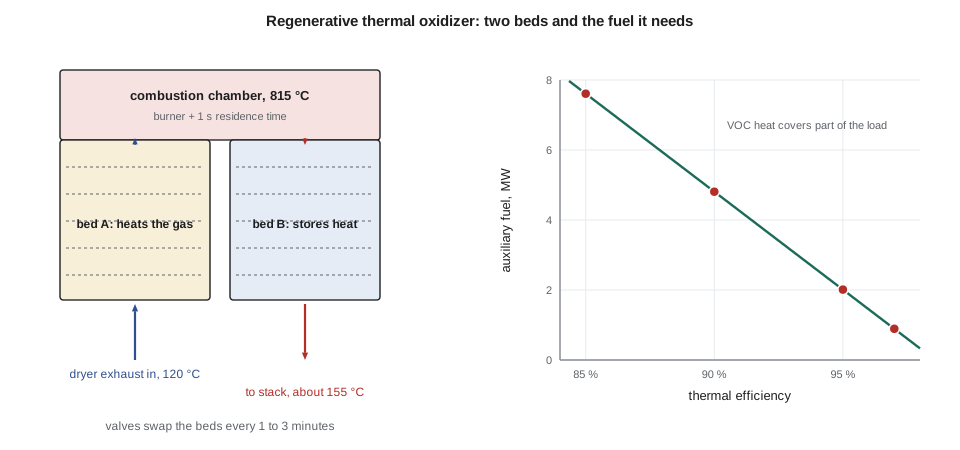
Heating 80 m³/s of gas to 815 °C with natural gas alone would take tens of megawatts. A regenerative thermal oxidizer recovers most of that heat in beds of ceramic packing. The dirty gas flows up through a hot bed, picking up heat, reaches the combustion chamber already near its final temperature, needs only a little burner fuel to finish the job, and then flows down through a second bed, giving up its heat. Every one to three minutes the valves switch, so the bed that was cooled by incoming gas is reheated by outgoing gas. Thermal efficiencies of 95 % or more are normal: the outlet gas leaves only a few tens of degrees hotter than the inlet. Two-bed RTOs leave a short puff of untreated gas in the inlet bed when the valves switch, so units that must meet high destruction efficiencies use three beds with a purge step or a rotary valve.
# Gaseous emission control: scrubber recovery (Kremser), RTO auxiliary fuel, carbon bed change-out
import math
# 1. Kremser recovery for the fermentation vent scrubber (from CHE-314: A = 2.81, 7 m packing, HOG 0.86 m)
A = 2.81                                                                   # absorption factor L/(mG)
N = 7.0 / 0.86 * (1 - 1 / A) / math.log(A)                                 # NOG -> ideal stages
frac = (A ** (N + 1) - A) / (A ** (N + 1) - 1)
print(f"scrubber: {N:.1f} ideal stages, ethanol recovery {100*frac:.2f} %")
# 2. RTO on the dryer exhaust: auxiliary natural gas versus heat recovery efficiency
m, cp, Tin, Tc = 68.0, 1.15, 120.0, 815.0       # kg/s, kJ/(kg K), C, combustion chamber C
voc, hc, dre = 117.0, 25.0, 0.97                # kg/h VOC in, MJ/kg heat of combustion, destruction
q_voc = voc * dre * hc / 3.6                    # kW released by the VOC
for te in (0.85, 0.90, 0.95, 0.97):
    loss = m * cp * (1 - te) * (Tc - Tin) * 1.03     # outlet sensible loss plus 3 % shell loss, kW
    aux = max(0.0, loss - q_voc)
    print(f"thermal efficiency {te:.0%}: auxiliary fuel {aux/1000:5.2f} MW, {aux*8400*3.6/1e6:6.0f} TJ/yr")
print(f"VOC out {voc*(1-dre):.1f} kg/h; VOC heat {q_voc:.0f} kW")
# 3. Activated carbon on the ethyl acetate tank and loading vents
load = 14.0                      # kg/day ethyl acetate in the vents
bed, wc, use = 1800.0, 0.12, 0.7 # kg carbon per bed, working capacity kg/kg, usable before breakthrough
days = bed * wc * use / load
print(f"carbon bed: change-out every {days:.0f} days, {365/days*bed/1000:.1f} t carbon per year")scrubber: 5.1 ideal stages, ethanol recovery 99.66 % thermal efficiency 85%: auxiliary fuel 7.61 MW, 230 TJ/yr thermal efficiency 90%: auxiliary fuel 4.81 MW, 145 TJ/yr thermal efficiency 95%: auxiliary fuel 2.01 MW, 61 TJ/yr thermal efficiency 97%: auxiliary fuel 0.89 MW, 27 TJ/yr VOC out 3.5 kg/h; VOC heat 788 kW carbon bed: change-out every 11 days, 60.8 t carbon per year
The results show how much the thermal efficiency matters. The VOC in the exhaust releases about 0.8 MW when it burns, which covers part of the heat loss. At 95 % thermal efficiency the oxidizer needs about 2 MW of natural gas, or about 60 TJ a year; at 85 % it would need almost four times as much. The existing RTO was rated at 95 % when new but has slipped to about 90 % as its media fouled with dust and salts. Restoring and upgrading it to 97 %, with new structured media and a third bed, is one of the carbon options Lesson 12 evaluates.
Catalytic oxidation
A regenerative catalytic oxidizer (RCO) adds a layer of platinum or palladium catalyst, or a base metal oxide, so that the organics burn at 250 to 450 °C instead of 800 °C. It saves fuel and makes less nitrogen oxide, because the flame temperature is low. Its weakness is the catalyst: phosphorus, sulfur, silicon, halogens and heavy metals poison it, and particulate masks it. Dryer exhausts at ethanol plants carry phosphorus and sulfur from the syrup, so RCOs have had a mixed record there. For the clean, concentrated vent of the ethyl acetate line, by contrast, a small catalytic oxidizer would work well.
Adsorption on activated carbon
Activated carbon has an internal surface area of 800 to 1,500 m² per gram, and organic vapours adsorb on it strongly, especially larger molecules with higher boiling points. Gas flows through a fixed bed; the organic is held in a zone near the inlet, and that zone, the mass transfer zone, moves slowly down the bed as the carbon saturates. When the leading edge of the zone reaches the outlet, the outlet concentration rises along an S-shaped breakthrough curve. The bed must be changed or regenerated before that, usually when the outlet reaches a set fraction of the inlet.
The capacity of carbon is described by an isotherm, such as the Freundlich form \(q = K C^{1/n}\), where \(q\) is the mass adsorbed per mass of carbon. In practice designers use a working capacity well below the equilibrium value, because part of the bed is in the mass transfer zone at breakthrough and because steam or thermal regeneration never removes everything. Humidity reduces capacity, because water competes for the surface, and the heat of adsorption can warm a bed handling high concentrations, which matters for safety: carbon beds handling ketones and some other solvents have caught fire.
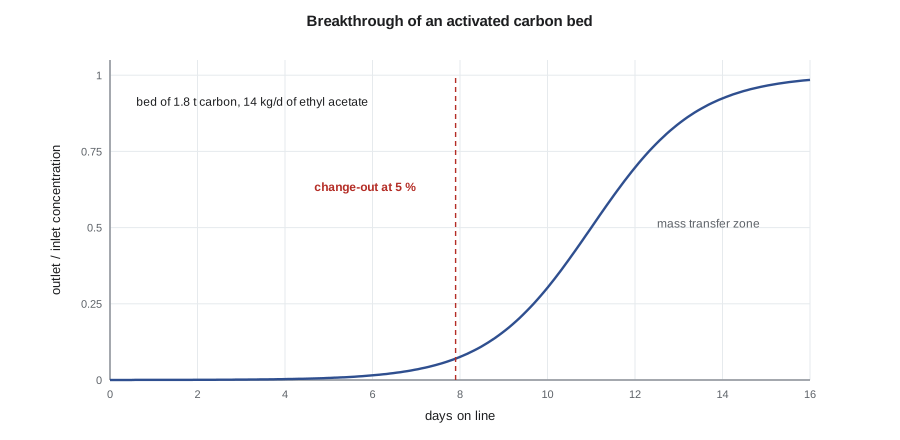
The ethyl acetate line's storage tanks and loading rack vent about 14 kg/day of ethyl acetate. The CHE-446 design routed them to two carbon beds of 1.8 t each, used in series and changed out when the outlet reaches 5 % of the inlet. With a working capacity of 0.12 kg per kg and 70 % of the bed usable at breakthrough, each bed lasts about 11 days, which means about 60 t of spent carbon a year. Theo realises that this makes spent carbon the largest hazardous waste stream at the expanded plant (Lesson 9). Wren suggests an alternative: since the RTO already runs at 815 °C next door, the vents could be piped to the RTO inlet and burned. The ethyl acetate adds a trace of fuel value, the carbon beds become a standby, and the waste disappears. Nadia Brandt will have to review the flame arrester and the concentration limits on that line, because the vent can approach the lower flammable limit during tank filling.
Worked problem
Carbon bed life
A carbon canister holds 200 kg of carbon with a working capacity of 0.10 kg/kg, and 75 % of the bed is usable before breakthrough. It treats a lab hood exhaust carrying 0.25 kg/day of solvent. How long does it last?
Show solution
- Usable capacity \(= 200 \times 0.10 \times 0.75 = 15\) kg of solvent.
- Life \(= 15 / 0.25 = 60\) days.
Answer: About 60 days, or six changes a year.
Biofilters and biotrickling filters
Microorganisms can oxidize many organic compounds and reduced sulfur compounds such as hydrogen sulfide, using them as food. A biofilter is a bed of compost, wood chips or engineered media, kept moist, through which the gas flows slowly; the organisms live in a wet film on the media. A biotrickling filter uses inert plastic packing with water recirculating over it, which gives better control of pH and nutrients. The key design variable is the empty bed residence time (EBRT), the bed volume divided by the gas flow, usually 15 to 60 s. Biofilters have low operating cost and no fuel use, and they are excellent for odour, but they need space, careful moisture control, and time to recover if they dry out, overheat or are fed a slug of something toxic.
At Sarnia the natural candidate is the anaerobic wastewater reactor that Lesson 7 proposes. Its tanks will be covered and the headspace ventilated at about 2 m³/s; the air will carry traces of hydrogen sulfide and organic acids. A biotrickling filter with an EBRT of 30 s needs about 60 m³ of packing, a vessel about 4 m in diameter and 5 m tall. Its pH must be watched, because hydrogen sulfide oxidizes to sulfuric acid in the bed.
Leak detection and repair
The last VOC source is the least visible. Every valve stem, flange, pump seal and open-ended line leaks a little. Individually the leaks are tiny; together, at a plant with thousands of components in ethanol service, they can be the largest VOC source after the dryers. The control is a program, not a device: leak detection and repair (LDAR), in which each component is checked periodically with a portable analyser or an optical gas imaging camera, and leaks above a threshold are repaired within set times. Low-emission valve packing and sealless pumps reduce the leaks at the source. The expansion's design specification calls for both on all new ethanol and ethyl acetate service.
Matching sources to controls
By the end of the week Theo's table is complete. The fermentation vent keeps its scrubber with bisulfite, upgraded for the new fermenter. The three dryer sections share an enlarged RTO, with its media replaced and a third bed added to reach 97 % thermal efficiency. The ethyl acetate vents go to the RTO, with the carbon beds as a standby. The anaerobic reactor's headspace goes to a biotrickling filter. Tanks get internal floating roofs where vapour pressure justifies them, the ethanol loadout keeps its vapour recovery, and every new component is added to the LDAR program. Wren adds a line at the bottom: every control device needs a parameter that shows it is working, recorded continuously, because the permit will ask.
Common mistakes
MistakeChoosing a technology by name rather than by gas flow and concentration.
InsteadStart from flow, concentration, composition and value; they decide the family.
MistakeAssuming water alone scrubs every organic well.
InsteadLess soluble compounds such as acetaldehyde need a reactive scrubbing liquid.
MistakeRating an RTO by destruction efficiency alone.
InsteadThermal efficiency decides fuel use; fouled media can triple the gas bill.
MistakePutting a catalytic oxidizer on a phosphorus- or sulfur-laden exhaust.
InsteadCatalyst poisons in dryer exhaust shorten catalyst life; check composition first.
MistakeRunning a carbon bed to full breakthrough.
InsteadChange at a set outlet fraction; part of the bed is still in the mass transfer zone.
Summary and key terms
- Absorption, adsorption, oxidation, biological treatment and condensation are the main gaseous controls; flow, concentration and value decide among them.
- Chemical absorption, such as bisulfite for acetaldehyde, makes a weakly soluble pollutant behave as if it were very soluble.
- Thermal oxidation needs temperature, time and turbulence; regenerative heat recovery keeps fuel use low.
- Catalytic oxidation saves fuel but is vulnerable to poisons in the gas.
- Carbon beds are sized by working capacity and changed before breakthrough; spent carbon is a waste stream.
- Biofilters suit dilute, biodegradable, odorous gases; LDAR controls fugitive leaks.
- Kremser equation
- A relation between absorption factor, number of ideal stages and fraction absorbed for dilute systems.
- Regenerative thermal oxidizer (RTO)
- A thermal oxidizer that recovers heat in alternating ceramic beds.
- Thermal efficiency
- The fraction of the heat needed to reach combustion temperature that is recovered from the outlet gas.
- Mass transfer zone
- The part of an adsorbent bed in which the concentration changes from inlet to near zero.
- Empty bed residence time (EBRT)
- Bed volume divided by gas flow rate.
- LDAR
- Leak detection and repair: periodic monitoring and repair of leaking components.
Practice problems
Work each problem on paper first, then reveal the answer to check.
What three conditions does thermal oxidation need?
Show answer
High temperature, enough residence time and good turbulence.
An RTO's thermal efficiency drops from 95 % to 90 %. Roughly how does its fuel use change?
Show answer
It more than doubles, from about 2 MW to about 4.8 MW in the plant's case.
Why is bisulfite added to the vent scrubber water?
Show answer
It reacts with acetaldehyde, which water alone absorbs poorly.
A biofilter treats 3 m³/s with an EBRT of 40 s. What media volume is needed?
Show answer
\(3 \times 40 = 120\) m³.
Why might routing the ethyl acetate vents to the RTO be better than carbon?
Show answer
It removes about 60 t/yr of spent carbon and uses an existing device.
Name a VOC control that is a program rather than a device.
Show answer
Leak detection and repair.
Lesson quiz · 5 questions
Score 60% or more to complete this lesson.
Create a free account to save your progress, take quizzes and earn a certificate.