
CHE-390 · Lesson 7 of 12 · 24 min
Batch, fed-batch and continuous fermentation
The new fermenter at Kingfisher Bioenergy could be run like the existing ones, filled, fermented and emptied as a batch, or the plant could change to continuous fermentation, which some older ethanol plants use. Malik asks Theo to compare the modes before the expansion design is fixed. The choice depends on productivity, yield, contamination risk and the plant's experience, and the comparison rests on the ideal reactor models that Theo knows from CHE-345, with a growing catalyst added.
Batch fermentation
In batch fermentation, the vessel is filled with medium and inoculum, the reaction runs to completion, and the vessel is emptied, cleaned and refilled. Nothing is added except, sometimes, acid, base or antifoam, and nothing removed except gas. At Kingfisher Bioenergy, filling a fermenter takes about 12 to 16 hours, because the mash comes from a continuous cook system at a fixed rate; fermentation then continues for the rest of the roughly 50-hour cycle; then the beer is dropped to the beer well, which feeds distillation continuously. After draining, each fermenter is washed by clean-in-place spray balls and sanitised before the next fill. A bank of fermenters on staggered schedules turns batch fermentation into a steady flow of mash in and beer out.
Batch operation has clear advantages. Each batch is a separate unit, so a contamination or a stuck fermentation affects one tank, not the plant. Cells pass through a full growth cycle and reach high ethanol, because the late part of the batch runs at high ethanol and low sugar. And batches are easy to trace and compare. The cost is time spent filling, draining and cleaning, which does not make ethanol.
Productivity, the product made per unit volume per unit time, should be calculated on the full cycle time, including turnaround. The code shows that a 54-hour fermentation reaching 130 g/L of ethanol, with 10 hours of turnaround, has a cycle productivity of about 2.0 g/L/h; shortening fermentation to 48 hours raises productivity only slightly if the final ethanol falls to 122 g/L. Faster is not always better: the last hours of a batch add ethanol slowly, but they also use the sugar that would otherwise be lost.
Continuous fermentation and the chemostat
In continuous culture, fresh medium is fed at a constant rate and broth is withdrawn at the same rate, so the volume stays constant. The simplest model is the chemostat, an ideally mixed tank. The dilution rate \(D = F/V\), the reciprocal of the residence time, plays a central role. At steady state, the cell balance says that cells must grow as fast as they are washed out:
So the operator chooses the growth rate by choosing the feed rate. Combining with the Monod equation gives the steady-state substrate and cell concentrations:
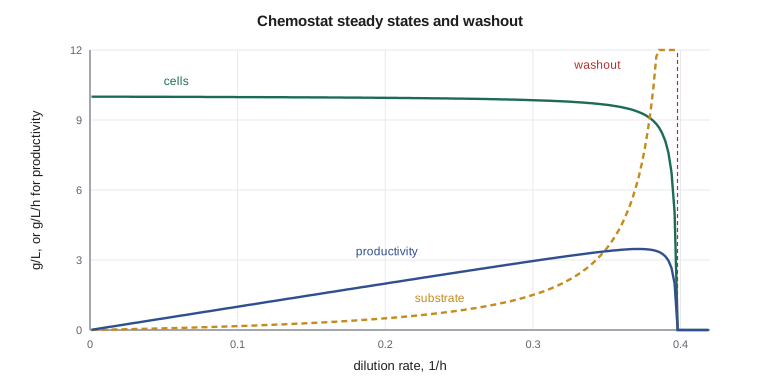
If the dilution rate exceeds the maximum growth rate the cells can achieve at the feed concentration, they are washed out faster than they can grow, and the culture fails. The critical dilution rate is \(D_c = \mu_{max} S_0/(K_s + S_0)\). The code tabulates the steady states for illustrative constants.
import math
# Chemostat: steady states, washout and productivity (Monod, no inhibition, illustrative)
mu_max, Ks, Yxs, S0 = 0.40, 0.5, 0.10, 100.0
Dc = mu_max*S0/(Ks+S0)
print(f"washout dilution rate {Dc:.3f} 1/h")
best = (0, 0)
for D in [0.05*i for i in range(1, 9)] + [0.38, 0.39]:
    if D >= Dc: print(f"D {D:.2f}: washout"); continue
    S = Ks*D/(mu_max-D); X = Yxs*(S0-S); prod = D*X
    best = max(best, (prod, D))
    print(f"D {D:.2f}: S {S:6.2f} g/L, X {X:5.2f} g/L, cell productivity {prod:5.2f} g/L/h")
Dopt = mu_max*(1 - math.sqrt(Ks/(Ks+S0)))
print(f"optimum D {Dopt:.3f} 1/h")
# Batch fermenter productivity including turnaround (fill, clean, drain)
for name, ferm_h, turn_h, titre in (("batch, 54 h", 54, 10, 130.0), ("batch, 48 h", 48, 10, 122.0)):
    print(f"{name}: {titre/(ferm_h+turn_h):.2f} g ethanol/L/h on cycle time")
# Fed-batch with exponential feed to hold mu constant
mu_set, X0, V0, Sf = 0.15, 5.0, 100.0, 300.0
for t in (0, 4, 8, 12):
    F = mu_set*X0*V0/(Yxs*Sf)*math.exp(mu_set*t)
print(f"t {t:2d} h: feed {F:6.2f} m3/h")washout dilution rate 0.398 1/h D 0.05: S 0.07 g/L, X 9.99 g/L, cell productivity 0.50 g/L/h D 0.10: S 0.17 g/L, X 9.98 g/L, cell productivity 1.00 g/L/h D 0.15: S 0.30 g/L, X 9.97 g/L, cell productivity 1.50 g/L/h D 0.20: S 0.50 g/L, X 9.95 g/L, cell productivity 1.99 g/L/h D 0.25: S 0.83 g/L, X 9.92 g/L, cell productivity 2.48 g/L/h D 0.30: S 1.50 g/L, X 9.85 g/L, cell productivity 2.96 g/L/h D 0.35: S 3.50 g/L, X 9.65 g/L, cell productivity 3.38 g/L/h D 0.40: washout D 0.38: S 9.50 g/L, X 9.05 g/L, cell productivity 3.44 g/L/h D 0.39: S 19.50 g/L, X 8.05 g/L, cell productivity 3.14 g/L/h optimum D 0.372 1/h batch, 54 h: 2.03 g ethanol/L/h on cycle time batch, 48 h: 2.10 g ethanol/L/h on cycle time t 0 h: feed 2.50 m3/h t 4 h: feed 4.56 m3/h t 8 h: feed 8.30 m3/h t 12 h: feed 15.12 m3/h
As the dilution rate rises, substrate in the outlet stays low until \(D\) approaches \(\mu_{max}\), then rises sharply; cell concentration falls; cell productivity \(DX\) rises to a maximum just below washout, at about \(D = 0.37\) h⁻¹, and then collapses. Running at maximum productivity is running at the edge of a cliff: a small drop in growth rate from a disturbance in temperature or medium can wash the culture out. Real continuous fermentations run at dilution rates well below the optimum, trading productivity for stability.
Worked problem
Washout
Yeast with \(\mu_{max} = 0.40\) h⁻¹ and \(K_s = 0.5\) g/L is fed medium with 100 g/L glucose. What is the critical dilution rate, and what residence time does it correspond to?
Show solution
- \(D_c = 0.40 \times 100/100.5 = 0.398\) h⁻¹.
- Residence time \(1/D_c = 2.5\) h.
Answer: \(D_c \approx 0.40\) h⁻¹, a residence time of about 2.5 h.
Continuous ethanol fermentation in practice
Continuous fuel ethanol plants use a cascade of four to six fermenters in series, with mash and yeast fed to the first and beer leaving the last, giving a total residence time of 40 to 60 hours. The cascade behaves more like a plug-flow reactor than a single tank, so it can reach high ethanol in the last stages while the first stages run at high growth. Yeast may be recycled from the beer or grown in a continuous propagator. Continuous plants have smaller total volume and no turnaround, and some have run for decades.
Their weakness is contamination. A chemostat is a selection device: any organism that can grow faster than the dilution rate in that medium will take over. Lactic acid bacteria grow fast and tolerate the conditions, so a contamination in a continuous system persists and spreads to every downstream stage, and it cannot be cleaned out without stopping the whole train. Batch plants contain contamination in one tank and clean each tank every cycle. This is the main reason most dry-grind plants built since the 1990s use batch fermentation, and why Rosa is firm that the new fermenter should be batch.
Fed-batch fermentation
Fed-batch operation starts with a partial fill and adds substrate during the run without withdrawing broth. It gives control over the substrate concentration and so over the cells' physiology. It is the standard mode for aerobic production of yeast for baking, enzymes and many other products, because it lets the operator keep glucose low enough to avoid the Crabtree effect and to match oxygen demand to the oxygen the vessel can supply. In ethanol plants the filling period of each fermenter is itself a fed-batch phase: mash flows in for 12 to 16 hours while the yeast is already working.
To hold the specific growth rate constant at \(\mu_{set}\), the feed must grow exponentially, matching the exponential rise in cell mass:
where \(S_f\) is the substrate concentration in the feed. The code shows the feed rising from 2.5 to 15 m³/h over 12 hours for illustrative values. In practice the feed is limited eventually by the vessel's oxygen transfer or cooling, after which a constant feed is used and growth slows. The yeast propagation tank at Kingfisher Bioenergy is run as a short fed-batch: it starts with dilute mash, and more mash is added as the yeast grows, keeping sugar moderate and oxygen available. Lesson 8 designs it.
Worked problem
Exponential feed
Cells at 5 g/L in 100 m³ are to grow at 0.15 h⁻¹ on a feed of 300 g/L glucose with \(Y_{X/S} = 0.10\). What is the initial feed rate?
Show solution
- \(F_0 = 0.15 \times 5 \times 100/(0.10 \times 300) = 2.5\) m³/h.
Answer: 2.5 m³/h, doubling about every 4.6 h.
Comparing modes
| Mode | Advantages | Disadvantages | Typical uses |
|---|---|---|---|
| Batch | Contains contamination; high final titre; simple | Turnaround time; varying conditions | Fuel ethanol (most plants), wine, many products |
| Fed-batch | Controls substrate and growth; high cell density | Needs feed control; volume limited | Baker's yeast, enzymes, proteins |
| Continuous | High productivity; steady conditions; no turnaround | Contamination and mutation selected; washout risk | Some ethanol plants, wastewater, research |
Theo's recommendation to Malik is a batch fermenter of the same size as the existing ones, about 2,600 m³ working volume, scheduled into the existing rotation, with the fill phase used as a controlled fed-batch. He adds two improvements from his calculations: shortening turnaround from 10 to 8 hours by adding a second clean-in-place pump, which is worth about 3 % more capacity, and pitching more yeast to shorten the lag, which lesson 12 sizes.
Yeast recycle and cell retention
A way to raise the productivity of continuous fermentation is to keep the cells in the vessel while the liquid passes through, so that the cell concentration is no longer limited by washout. Cells can be separated from the outflow by centrifuges or membranes and returned, or held on supports. With recycle, the dilution rate can exceed \(\mu_{max}\) without washout, because the cells' residence time is longer than the liquid's. Brazilian sugarcane ethanol plants have long used a related scheme: yeast is centrifuged from the fermented wine, washed with dilute acid to kill bacteria and reused for many cycles, which reduces the sugar spent on growing new yeast. The acid wash is the contamination control. Corn mash, with its high suspended solids, is much harder to centrifuge cleanly, which is one reason the practice is uncommon in dry-grind plants.
Scheduling a fermenter bank
Theo also checks the schedule. The cook system produces mash continuously at about 300 m³/h, and each fermenter takes about 2,600 m³, so a fermenter fills in about nine hours plus the time to bring yeast and enzymes in, which the plant counts as twelve. With a 58-hour total cycle including the fill, drain and cleaning, the number of fermenters needed is roughly the cycle time divided by the fill time, about five, and an extra vessel gives flexibility for maintenance and long fermentations. The new fermenter, Theo calculates, lets the plant either raise throughput by about 15 % or lengthen every fermentation by several hours to finish the sugar more completely, which is the choice Malik will make once the corn supply is confirmed.
The beer well, a large tank between the fermenters and the beer column, smooths the flow from batch fermenters into the continuous distillation section. It must hold at least a fermenter's contents so that a fermenter can be dropped while the column keeps running, and its size limits how far the schedule can slip before distillation has to slow. Theo's schedule tables show the beer well level hour by hour for the new arrangement, which is the first thing Carla asks to see.
Rosa adds one practical point. Whatever the mode, the yeast entering a fermentation should be in good condition: actively growing, high in viability and adapted to the mash. A continuous system keeps its yeast in a steady state for weeks, which is good for consistency but allows weaker or mutant cells, and contaminants, to accumulate. A batch system restarts with fresh, healthy yeast every cycle. For a plant whose margins depend on a fraction of a percent of yield, that fresh start is worth the turnaround time.
Common mistakes
MistakeCalculating batch productivity without turnaround time.
InsteadUse the full cycle: fill, ferment, drain and clean.
MistakeRunning a chemostat at the dilution rate of maximum productivity.
InsteadIt sits just below washout; run with margin.
MistakeAssuming continuous systems resist contamination.
InsteadA chemostat selects for the fastest-growing organism, which may be a contaminant.
MistakeFeeding a fed-batch at a constant rate and expecting constant growth.
InsteadConstant specific growth needs an exponentially rising feed.
Summary and key terms
- Batch fermentation contains contamination and reaches high titres; productivity must include turnaround.
- In a chemostat, \(\mu = D\) at steady state; above the critical dilution rate the culture washes out.
- Cell productivity peaks just below washout, so real systems run with margin.
- Continuous ethanol plants use fermenter cascades but are vulnerable to persistent contamination.
- Fed-batch operation controls substrate and growth; an exponential feed holds \(\mu\) constant.
- Dilution rate
- Feed flow divided by working volume; the reciprocal of residence time.
- Chemostat
- An ideally mixed continuous culture at steady state.
- Washout
- Loss of cells when the dilution rate exceeds the maximum growth rate.
- Fed-batch
- Operation in which substrate is added during the run without withdrawal.
- Productivity
- Product made per unit volume per unit time.
- Turnaround time
- Time spent filling, draining and cleaning between batches.
Practice problems
Work each problem on paper first, then reveal the answer to check.
A chemostat runs at \(D = 0.2\) h⁻¹. What is the specific growth rate at steady state?
Show answer
0.2 h⁻¹.
Why does outlet substrate rise sharply near washout?
Show answer
The cells must grow near \(\mu_{max}\), which needs high substrate.
A batch takes 50 h plus 8 h turnaround and reaches 128 g/L. Find the productivity.
Show answer
\(128/58 = 2.2\) g/L/h.
Why is baker's yeast made by fed-batch?
Show answer
To keep glucose low and avoid fermentation, maximising cell yield.
Why do contaminants take over continuous ethanol fermenters?
Show answer
Any organism growing faster than \(D\) is selected and persists.
What limits an exponential feed in practice?
Show answer
Oxygen transfer or cooling capacity.
Lesson quiz · 5 questions
Score 60% or more to complete this lesson.
Create a free account to save your progress, take quizzes and earn a certificate.