
CHE-390 · Lesson 11 of 12 · 21 min
Downstream processing
When a fermenter at Kingfisher Bioenergy is dropped to the beer well, the work of the cells is done, but most of the plant's equipment and energy are still ahead. The beer is about 85 % water. The ethanol must be distilled and dried, the solids separated and dried into a feed product, the water recovered and reused, and the carbon dioxide cleaned. In high-value bioprocesses, downstream processing, the recovery and purification of products, can be half or more of the production cost. This lesson surveys the unit operations of downstream processing and applies them to the stillage train at Kingfisher Bioenergy, which Theo has not yet studied in detail. Ethanol recovery itself was covered in CHE-350.
The principles of recovery
Downstream processing usually follows a sequence: removal of insolubles, such as cells and solids; isolation, which concentrates the product and removes most of the water; purification, which removes impurities that resemble the product; and polishing, which brings it to final form and specification. Two principles guide the design. First, remove the largest component early: in most fermentations that is water, and every later step is cheaper on a smaller stream. Second, recover the product with as few steps as possible, because losses multiply: five steps each at 90 % recovery give only 59 % overall. Biological products bring an extra constraint: proteins and many metabolites are damaged by heat, extreme pH and shear, so the gentler separations of membranes and chromatography replace distillation for them.
Separating solids
Cells and other solids are removed by filtration or centrifugation. Their density is close to that of water, which makes them settle slowly. Stokes' law gives the settling velocity of a small sphere in a gravity field,
which for a yeast cell 6 µm across with a density difference of 80 kg/m³ is about 1.6 µm/s, or less than 6 mm an hour. Centrifuges multiply gravity by hundreds to thousands of times. Their capacity is described by sigma theory: a centrifuge's sigma factor, \(\Sigma\), is the area of a gravity settler that would perform the same separation, and the feed rate it can handle is \(Q = v_g \Sigma\). The code shows that a decanter handling 100 m³/h of stillage to capture such fine particles would need an equivalent area of nearly 18,000 m², an impossible settling pond but an ordinary decanter centrifuge. Disc-stack centrifuges, with many closely spaced cones, reach higher sigma values for fine cells; decanters, with a scroll that conveys solids out continuously, handle the heavy solid loads of whole stillage.
Filtration passes the suspension through a medium that retains the solids. Cake filtration, used in rotary vacuum filters and filter presses, builds a layer of solids that itself does the filtering; its rate falls as the cake grows and as compressible biological solids pack down. Filter aids such as diatomaceous earth keep the cake open. Cross-flow membrane filtration, where the suspension flows along the membrane surface, limits cake growth and is widely used to separate cells from enzyme-containing broths.
The stillage train at Kingfisher Bioenergy
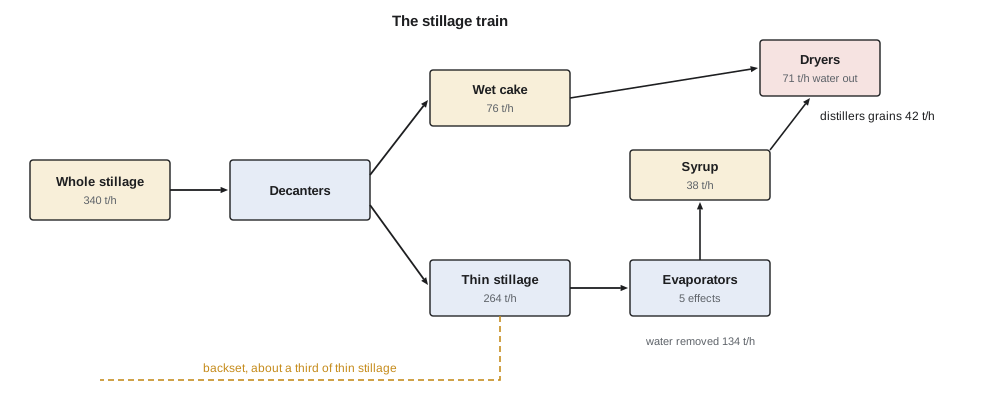
Whole stillage from the bottom of the beer column contains about 13 % solids: fibre, protein, oil, dead yeast and dissolved solids. Decanter centrifuges split it into wet cake, about a third solids, and thin stillage, with about 7 % mostly dissolved solids. A third or so of the thin stillage returns to the front of the plant as backset, recycling water, nutrients and heat. The rest goes to multiple-effect evaporators, which concentrate it to syrup of about 30 to 35 % solids. Corn oil is skimmed or centrifuged from the syrup and sold separately. Wet cake and syrup are mixed and dried in rotary drum dryers to distillers grains at about 10 % moisture. The code carries out the balance.
import math
# Downstream processing of whole stillage: decanter, evaporators and the distillers grains dryer
ws = 340.0                # t/h whole stillage (illustrative)
ts_frac = 0.13            # total solids
cake_solids, thin_solids = 0.34, 0.07
# solids balance across the decanter: ws*ts = cake*0.34 + thin*0.07, ws = cake + thin
cake = ws*(ts_frac - thin_solids)/(cake_solids - thin_solids); thin = ws - cake
print(f"wet cake {cake:.1f} t/h, thin stillage {thin:.1f} t/h")
backset = 0.35*thin; to_evap = thin - backset
syrup_solids = 0.32
syrup = to_evap*thin_solids/syrup_solids; water_evap = to_evap - syrup
print(f"backset {backset:.1f} t/h, to evaporators {to_evap:.1f} t/h -> syrup {syrup:.1f} t/h, water removed {water_evap:.1f} t/h")
for effects in (1, 3, 5):
    steam = water_evap/(0.85*effects)
    print(f"  {effects} effects: steam about {steam:.1f} t/h")
# Dryer: cake + syrup dried to 10 % moisture
wet_in = cake + syrup; solids = cake*cake_solids + syrup*syrup_solids
product = solids/0.90; water_dryer = wet_in - product
print(f"dryer feed {wet_in:.1f} t/h, product {product:.1f} t/h, water evaporated {water_dryer:.1f} t/h")
print(f"dryer heat at 3.4 MJ per kg water: {water_dryer*1000*3.4/3600:.1f} MW")
# Sigma theory: equivalent settling area needed for a particle size
mu, drho, d = 1.0e-3, 80.0, 6e-6        # Pa s, kg/m3, m
vg = drho*9.81*d**2/(18*mu)
Qs = 100.0/3600                         # m3/s per decanter
print(f"settling velocity {vg*1e6:.2f} um/s, sigma needed {Qs/vg:,.0f} m2")wet cake 75.6 t/h, thin stillage 264.4 t/h backset 92.6 t/h, to evaporators 171.9 t/h -> syrup 37.6 t/h, water removed 134.3 t/h 1 effects: steam about 158.0 t/h 3 effects: steam about 52.7 t/h 5 effects: steam about 31.6 t/h dryer feed 113.2 t/h, product 41.9 t/h, water evaporated 71.2 t/h dryer heat at 3.4 MJ per kg water: 67.3 MW settling velocity 1.57 um/s, sigma needed 17,697 m2
The decanters make about 76 t/h of wet cake and 264 t/h of thin stillage. After backset, about 172 t/h goes to the evaporators, which remove about 134 t/h of water to make about 38 t/h of syrup. A single-effect evaporator would need about one tonne of steam per tonne of water evaporated; with five effects, each effect's vapour heating the next, steam use falls to about a fifth of that. The plant has five effects, some heated with vapour from the distillation system, which is one of the main ways dry-grind plants have cut their energy use. The dryers then evaporate about 71 t/h of water to make about 42 t/h of distillers grains, needing roughly 67 MW of heat from natural gas burners at about 3.4 MJ per kilogram of water, a large share of the plant's fuel. Theo notes that this is far more heat than all the plant's fermenters combined release, and that the dryers are where the plant's carbon intensity is decided, as lesson 12 will show.
Worked problem
Recovery through several steps
A product passes through filtration at 95 %, ultrafiltration at 92 %, chromatography at 85 % and drying at 97 % recovery. What is the overall recovery?
Show solution
- \(0.95 \times 0.92 \times 0.85 \times 0.97 = 0.72\).
Answer: About 72 %; losses multiply.
Concentrating and purifying biological products
For products more delicate than ethanol, other operations take over. Ultrafiltration membranes, with pores of a few nanometres, retain proteins while letting water and small molecules through, and are the standard way to concentrate enzymes after fermentation; diafiltration washes out salts by adding water while filtering. Precipitation with salts such as ammonium sulphate, with organic solvents, or by pH adjustment brings proteins out of solution. Liquid-liquid extraction, including aqueous two-phase systems, separates products by their partition between phases, as Theo did with ethyl acetate and water in CHE-350. Adsorption and chromatography purify products by their binding to solid resins: ion-exchange chromatography by charge, affinity chromatography by specific binding, and size-exclusion by molecular size. Crystallization gives pure solid products such as citric acid and many amino acids. Drying, by spray drying, freeze drying or drum drying, gives a stable final form.
Industrial enzymes, like the plant's glucoamylase, are usually recovered by cell removal, ultrafiltration and formulation with stabilizers, without chromatography, because they are sold as technical products where activity matters and trace impurities do not. Pharmaceutical proteins, by contrast, go through several chromatography steps to reach very high purity, because impurities can be dangerous to patients. The cost of purification rises steeply with the purity required.
| Operation | Separates by | Typical use |
|---|---|---|
| Centrifugation | Density and size | Cells, stillage solids |
| Filtration | Size, on a medium | Cells, crystals |
| Ultrafiltration | Molecular size | Concentrating enzymes |
| Evaporation | Volatility of water | Thin stillage to syrup |
| Distillation | Volatility | Ethanol (CHE-350) |
| Chromatography | Charge, affinity or size | Purifying proteins |
| Drying | Removal of water | Distillers grains, enzyme powders |
Distillers grains as a product
Distillers grains are worth a large share of the plant's revenue, often a fifth or more, and are sold on their protein, fat and fibre contents and their consistency. Over-drying darkens the grains and damages the protein's digestibility, and under-drying lets them mould in storage. The dryers are controlled on outlet temperature and product moisture, and the laboratory measures moisture, protein and fat on every shift's composite. Contaminants matter too: mycotoxins from the corn are concentrated about threefold in the grains, because the starch is removed and the toxin is not, so the plant tests incoming corn and rejects loads above its limits. Feed rules administered by the Canadian Food Inspection Agency, which regulates livestock feed ingredients under the Feeds Act apply to the product's labelling and to any additives carried over from fermentation, such as antimicrobials.
Dryers also bring hazards from CHE-380: they are large combustion systems handling an organic dust, and dryer fires are a known problem in ethanol plants. They are fitted with spark detection, deluge systems and temperature interlocks, and their exhaust passes through a thermal oxidiser to destroy volatile organic compounds and odours before release, under the plant's air permit, the ECA.
Water and energy integration
The stillage train and distillation together make the plant almost a closed water loop. Backset, evaporator condensate and distillation water are reused in the cook, so fresh water use is a few litres per litre of ethanol, much less than a few decades ago. Heat is integrated too: vapour from the distillation column drives the first evaporator effect, and the evaporator's last effect runs under vacuum. Wren Halvorsen, the environmental lead, tracks water use and the quality of the small discharge. Theo maps the energy flows and confirms that the dryers and distillation dominate: the fermentation itself, for all its biology, is a small part of the energy bill.
Recovering carbon dioxide
Fermentation carbon dioxide is a product too. The gas leaving the fermenters is nearly pure carbon dioxide, saturated with water and carrying ethanol, acetaldehyde and other volatiles. The vent scrubber Theo designed in CHE-314 recovers the ethanol. Beyond it, the gas can be released, sold, or captured for storage. To sell it for beverages or dry ice, a gas company compresses it, removes the remaining impurities with activated carbon and other adsorbents, dries it, and liquefies it by refrigeration; the purity requirements for food use are strict. Sales depend on there being a market nearby, because liquid carbon dioxide is costly to transport. Capture for geological storage, discussed in lesson 12, needs compression and drying but not food-grade purity, and the fermentation stream is one of the cheapest sources of carbon dioxide to capture because it is already concentrated.
Corn oil
Corn oil, recovered from the syrup by heating and centrifuging, is a modern addition to dry-grind plants. It is sold mostly as a feedstock for biodiesel and renewable diesel, or as an animal feed ingredient, and it lowers the fat content of the distillers grains. Recovery is typically a few kilograms per tonne of corn, and chemical aids called demulsifiers improve separation. Theo adds an oil recovery line to the balance: it removes oil that would otherwise have been dried with the grains, slightly reducing the dryer load and adding a revenue stream that is valued highly because of its low carbon intensity as a fuel feedstock.
Each of these co-products shows the same downstream principle: separate the valuable component where it is most concentrated and easiest to recover. Oil is easiest to recover from syrup, where it has been concentrated by evaporation; carbon dioxide is easiest to capture at the fermenter vent, before it is diluted with air.
Theo's map of the downstream section ends with a list of improvement options for the expansion: a sixth evaporator effect, more heat recovery from the dryer exhaust, and better decanter performance so that less water reaches the dryers. Each saves energy and carbon, and each will be weighed against its cost in lesson 12.
Common mistakes
MistakeDesigning a centrifuge for cells from gravity settling alone.
InsteadUse sigma theory; biological solids settle very slowly under gravity.
MistakeAdding purification steps without counting losses.
InsteadRecovery multiplies; five steps at 90 % give 59 %.
MistakeOver-drying distillers grains to be safe.
InsteadIt damages protein value; control moisture closely.
MistakeIgnoring mycotoxins in the corn.
InsteadThey concentrate about threefold in the grains.
Summary and key terms
- Downstream processing removes solids, isolates, purifies and polishes; water is removed early.
- Biological solids settle slowly; centrifuge capacity follows \(Q = v_g\Sigma\).
- At Kingfisher Bioenergy, decanters, five-effect evaporators and rotary dryers turn stillage into syrup and distillers grains.
- The dryers use about 67 MW of heat and dominate the plant's fuel use with distillation.
- Enzymes are recovered by ultrafiltration; high-purity proteins need chromatography.
- Downstream processing
- Recovery and purification of products after fermentation.
- Sigma factor
- The area of a gravity settler equivalent to a centrifuge.
- Ultrafiltration
- Membrane separation retaining macromolecules such as proteins.
- Multiple-effect evaporator
- An evaporator train in which each effect's vapour heats the next.
- Chromatography
- Separation by differential binding to a solid phase.
- Mycotoxin
- A toxin made by moulds that can contaminate grain.
Practice problems
Work each problem on paper first, then reveal the answer to check.
Five steps each recover 90 %. What is the overall recovery?
Show answer
59 %.
Why are biological solids hard to settle?
Show answer
They are small and close to water in density.
How does a multiple-effect evaporator save steam?
Show answer
Vapour from each effect heats the next, reusing latent heat.
Why are mycotoxins concentrated in distillers grains?
Show answer
Starch is removed but the toxin stays with the solids.
Which operation would concentrate an enzyme broth?
Show answer
Ultrafiltration.
What uses most of the plant's fuel?
Show answer
The dryers and distillation.
Lesson quiz · 5 questions
Score 60% or more to complete this lesson.
Create a free account to save your progress, take quizzes and earn a certificate.