
CHE-320 · Lesson 8 of 12 · 20 min
Azeotropes and strongly non-ideal mixtures
However tall the rectifier is made, its overhead never passes about 95.6 % ethanol by mass at atmospheric pressure. Fuel ethanol must have less than 1 % water. The gap between those two numbers is the reason the plant has a molecular sieve unit, and it is one of the classic problems of chemical engineering thermodynamics. This lesson explains where the barrier comes from, how it moves with pressure, and the three ways industry gets past it. It also introduces the second azeotrope Theo will meet this term, between ethyl acetate and water, which behaves quite differently.
What an azeotrope is
An azeotrope is a mixture whose vapour and liquid have the same composition at equilibrium. At that point \(y_i = x_i\) for every component, the relative volatility is 1, and boiling the liquid produces a vapour identical to it, so distillation cannot change its composition. The word comes from Greek for 'boiling without change'. For a binary, modified Raoult's law with \(y_1 = x_1\) gives the azeotrope condition
An azeotrope forms when the activity coefficients change across the composition range enough to cross the ratio of vapour pressures. That needs strong non-ideality, close vapour pressures, or both. Ethanol and water have vapour pressures within a factor of about 2.3 and moderately large activity coefficients, which is just enough.
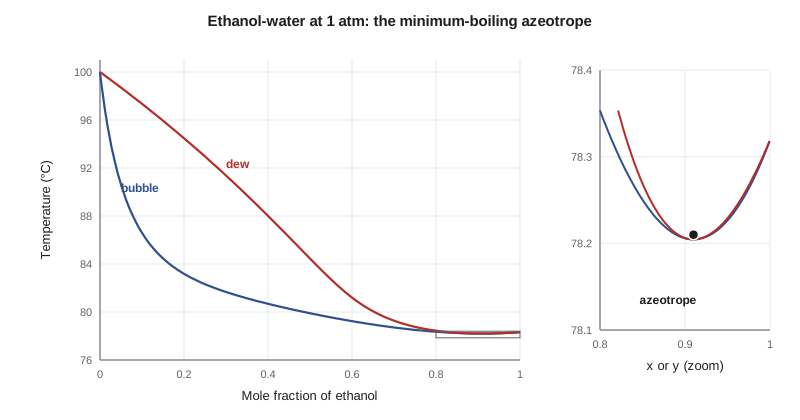
There are two kinds. A positive deviation system, such as ethanol-water, can have a minimum-boiling azeotrope: the azeotrope boils below both pure components, and it collects at the top of a column. Ethanol-water's boils at about 78.2 °C at 1 atm, 0.1 K below pure ethanol. A negative deviation system, such as acetone-chloroform or nitric acid-water, can have a maximum-boiling azeotrope, which collects at the bottom. Azeotropes turn up in a large share of the binary mixtures of common organic liquids that have been measured, so they are not a rare curiosity.
Locating the azeotrope
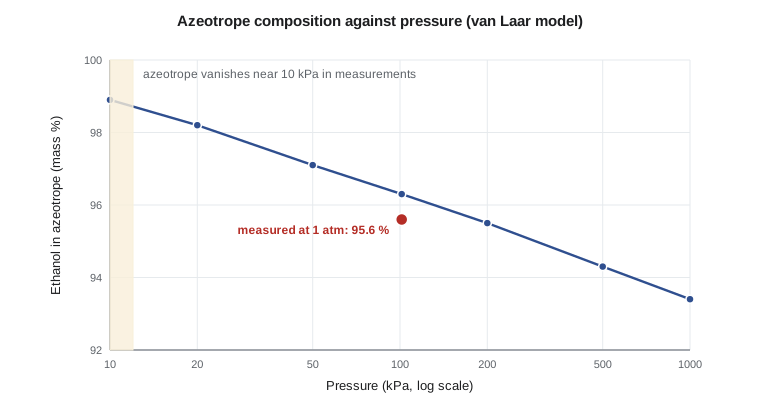
The code uses the van Laar fit from lesson 7 to compute the bubble point and vapour composition across the range and to find where \(y_1 - x_1\) changes sign. At 1 atm it puts the azeotrope at \(x_1 = 0.910\), or 96.3 % ethanol by mass, at 78.2 °C. The measured azeotrope is at about \(x_1 = 0.894\) (95.6 % by mass) and 78.15 °C. The model is slightly off because the van Laar parameters were fitted to activity coefficients, not specifically to the azeotrope, and because near the azeotrope tiny errors in \(\gamma\) move the crossing point a long way. The flatness of the curves there, with \(y - x\) only 0.001 at \(x_1 = 0.90\), is itself the practical problem: even before the azeotrope is reached, each tray achieves almost nothing.
# The ethanol-water azeotrope: location at 1 atm and how it moves with pressure (van Laar from lesson 7)
import math
ant = {"e": (8.20417, 1642.89, 230.300), "w": (8.07131, 1730.63, 233.426)}
def psat(c, T):
    A, B, C = ant[c]; return 10 ** (A - B / (T + C)) * 0.133322
A12, A21 = 1.672, 0.9304          # van Laar fit, treated as independent of temperature
def lng(x):
    x2 = 1 - x; d = A12 * x + A21 * x2
    return A12 * (A21 * x2 / d) ** 2, A21 * (A12 * x / d) ** 2

def bubble(x, P):
    lo, hi = 0.0, 250.0
    for _ in range(60):
        T = (lo + hi) / 2; l1, l2 = lng(x)
        f = x * math.exp(l1) * psat("e", T) + (1 - x) * math.exp(l2) * psat("w", T) - P
        lo, hi = (lo, T) if f > 0 else (T, hi)
    return T, x * math.exp(l1) * psat("e", T) / P

def azeotrope(P):
    # scan for y1 - x1 changing sign
    prev = None
    for i in range(1, 2000):
        x = i / 2000; T, y = bubble(x, P)
        if prev is not None and (prev[1] - prev[0]) * (y - x) < 0:
            return x, T
        prev = (x, y)
    return None, None

print(" P/kPa   azeotrope x1   T/C   mass % ethanol")
for P in (10.0, 20.0, 50.0, 101.325, 200.0, 500.0, 1000.0):
    x, T = azeotrope(P)
    if x is None:
        print(f"{P:7.1f}   no azeotrope found")
    else:
        wt = x * 46.07 / (x * 46.07 + (1 - x) * 18.02) * 100
        print(f"{P:7.1f}   {x:.4f}       {T:6.1f}   {wt:5.1f}")

# T-x-y at 1 atm near the top of the column
for x in (0.80, 0.85, 0.88, 0.90, 0.95):
    T, y = bubble(x, 101.325)
    print(f"x1 = {x:.2f}: T = {T:.2f} C, y1 = {y:.4f}, y - x = {y - x:+.4f}")

# Ethyl acetate (1) - water (2) heterogeneous azeotrope: two liquids boil where P1sat x1' g1 + P2sat x2'' g2 = P
# With both liquid phases present, each partial pressure equals the pure-component vapour pressure
# times its activity, and activities are nearly 1 in the phase rich in that component.
antea = (7.10179, 1244.95, 217.88)
def psat_ea(T): return 10 ** (antea[0] - antea[1] / (T + antea[2])) * 0.133322
lo, hi = 50.0, 80.0
for _ in range(60):
    T = (lo + hi) / 2
    f = 0.95 * psat_ea(T) + 0.98 * psat("w", T) - 101.325   # activities of about 0.95 and 0.98 (approximate)
    lo, hi = (lo, T) if f > 0 else (T, hi)
yea = 0.95 * psat_ea(T) / 101.325
print(f"ethyl acetate-water heteroazeotrope: about {T:.1f} C, vapour {yea:.2f} mole fraction ethyl acetate")P/kPa azeotrope x1 T/C mass % ethanol 10.0 0.9730 29.3 98.9 20.0 0.9545 42.2 98.2 50.0 0.9295 61.4 97.1 101.3 0.9100 78.2 96.3 200.0 0.8915 96.3 95.5 500.0 0.8655 124.2 94.3 1000.0 0.8465 148.7 93.4 x1 = 0.80: T = 78.35 C, y1 = 0.8213, y - x = +0.0213 x1 = 0.85: T = 78.25 C, y1 = 0.8591, y - x = +0.0091 x1 = 0.88: T = 78.22 C, y1 = 0.8837, y - x = +0.0037 x1 = 0.90: T = 78.21 C, y1 = 0.9010, y - x = +0.0010 x1 = 0.95: T = 78.23 C, y1 = 0.9478, y - x = -0.0022 ethyl acetate-water heteroazeotrope: about 68.7 C, vapour 0.72 mole fraction ethyl acetate
Pressure moves the azeotrope
Because the vapour pressures of ethanol and water change with temperature at different rates, the ratio \(P_2^{\text{sat}}/P_1^{\text{sat}}\) changes with pressure, and so does the composition where the azeotrope condition is met. The model output shows the trend: at lower pressure the azeotrope moves toward pure ethanol, from 96.3 % by mass at 101 kPa to 98.9 % at 10 kPa. Measurements show the azeotrope vanishing near about 9 to 11 kPa, so a column operated at very low pressure could, in principle, make anhydrous ethanol by distillation alone. At higher pressure it moves the other way, to about 94 % at 500 kPa. The model treats the van Laar parameters as independent of temperature, which is a stretch over a range from 29 to 149 °C, so these numbers show the direction and size of the effect, not design values.
This sensitivity is the basis of pressure-swing distillation. For systems whose azeotrope shifts strongly with pressure, two columns at different pressures pass material back and forth: one column's azeotropic product becomes the other's feed, and each produces one pure component. For ethanol-water the shift is too small at practical pressures, and very low-pressure operation needs huge, expensive columns, so pressure swing is not used. For other mixtures, such as tetrahydrofuran-water or acetonitrile-water, it is common.
Getting past the ethanol-water azeotrope
Industry uses three approaches, and their history explains what Theo sees in the plant. The first is azeotropic distillation with an entrainer. Adding a third component that forms a new, lower-boiling heterogeneous azeotrope with water lets a column carry water overhead, where it splits into two liquids in a decanter; the entrainer is returned and dry ethanol leaves the bottom. Benzene was the classic entrainer for most of the twentieth century; because it is a carcinogen it was replaced by cyclohexane and other hydrocarbons. The second is extractive distillation, in which a heavy solvent such as ethylene glycol is added near the top of the column to change the activity coefficients so that water is held back and ethanol goes overhead; the solvent is recovered in a second column. The third, now standard in North American fuel ethanol plants, is adsorption on molecular sieves: beds of 3A zeolite whose pores admit water molecules but exclude ethanol. The vapour from the rectifier passes through one bed while another is regenerated under vacuum, and the product contains well under 1 % water. Sieves use much less energy than the distillation routes, which is why they took over the industry in the 1980s and 1990s.
Worked problem
How far a column can get
A rectifier at 1 atm produces an overhead at 95.0 % ethanol by mass. What mole fraction is that, and how close is it to the azeotrope?
Show solution
- Moles per 100 g: ethanol \(95.0/46.07 = 2.062\), water \(5.0/18.02 = 0.277\).
- \(x_1 = 2.062/2.339 = 0.882\).
- The measured azeotrope is at \(x_1 = 0.894\); the code's T-x-y data show \(y - x\) of only about 0.004 near \(x_1 = 0.88\).
Answer: The overhead is within about 0.01 mole fraction of the azeotrope, where each additional tray gains almost nothing.
Heterogeneous azeotropes: ethyl acetate and water
Ethyl acetate and water are only partly miscible: at 25 °C water dissolves about 8 % ester by mass, and the ester dissolves about 3 % water. When a mixture of two liquid phases boils, the total pressure is the sum of the partial pressures above each phase, and because each component's activity in its own rich phase is close to 1, the mixture boils below both pure components at a fixed temperature, whatever the overall proportions. This is a heterogeneous azeotrope. The code estimates it at about 69 °C with a vapour of about 0.72 mole fraction ester, using rough activities of 0.95 and 0.98. Published data put it at about 70.4 °C and about 0.69 mole fraction ester, so the estimate is fair. Pure ethyl acetate boils at 77.1 °C and water at 100 °C.
Heterogeneous azeotropes are a gift to the process designer, because the condensed vapour separates into two liquids by gravity. The ethyl acetate line will exploit exactly this: the reaction column's overhead, condensed and cooled, splits into an ester-rich layer, returned as reflux or sent to purification, and a water-rich layer that leaves the system. Lesson 10 calculates the split, and lesson 12 designs the decanter. In reality the overhead also contains ethanol, and ethanol, ethyl acetate and water form a ternary azeotrope near 70 °C, which complicates the design.
Residue curves and ternary mixtures
For ternary mixtures with azeotropes, designers use residue curve maps, which trace how the liquid composition changes during simple batch boiling. The curves run from low-boiling to high-boiling points and are divided into regions by distillation boundaries that a simple column cannot cross. A residue curve map for ethanol, ethyl acetate and water shows the ternary azeotrope as the lowest-boiling point, with boundaries that decide which products a column can make from a given feed. CHE-350 uses these maps in distillation design; here the point is that azeotropes are not just a nuisance at one composition but shape the whole map of what separation is possible.
Common mistakes
MistakeExpecting a taller column to pass an azeotrope.
InsteadAt the azeotrope the relative volatility is 1; more stages cannot change the composition.
MistakeAssuming the azeotrope composition is fixed.
InsteadIt moves with pressure; for some mixtures enough to allow pressure-swing distillation.
MistakeTreating a heterogeneous azeotrope like a homogeneous one.
InsteadThe condensate splits into two liquids, which a decanter can separate.
MistakeUsing an activity model far from its fitted temperature to place an azeotrope.
InsteadNear the azeotrope, small errors in \(\gamma\) move the predicted point a long way; check against data.
Summary and key terms
- At an azeotrope \(y_i = x_i\); for a binary, \(\gamma_1P_1^{\text{sat}} = \gamma_2P_2^{\text{sat}}\).
- Positive deviations can give minimum-boiling azeotropes; negative deviations, maximum-boiling ones.
- Ethanol-water has a minimum-boiling azeotrope at about 95.6 % ethanol by mass and 78.15 °C at 1 atm.
- The azeotrope moves toward pure ethanol at lower pressure and disappears near about 10 kPa.
- Fuel ethanol plants use molecular sieves to remove the last water; entrainers and extractive distillation are alternatives.
- Ethyl acetate-water forms a heterogeneous azeotrope near 70 °C whose condensate splits into two liquids.
- Azeotrope
- A mixture whose vapour and liquid have the same composition at equilibrium.
- Minimum-boiling azeotrope
- An azeotrope that boils below both pure components, typical of positive deviations.
- Maximum-boiling azeotrope
- An azeotrope that boils above both pure components, typical of negative deviations.
- Heterogeneous azeotrope
- An azeotrope at which two liquid phases coexist with the vapour.
- Entrainer
- A third component added to form a new azeotrope that makes a separation possible.
- Extractive distillation
- Distillation with a heavy solvent that changes the relative volatility.
- Pressure-swing distillation
- Two columns at different pressures that exploit a shift in azeotrope composition.
- Residue curve map
- A diagram of liquid composition paths during simple boiling, divided by distillation boundaries.
Practice problems
Work each problem on paper first, then reveal the answer to check.
Convert the measured azeotrope, \(x_1 = 0.894\), to mass per cent ethanol.
Show answer
\(0.894 \times 46.07/(0.894 \times 46.07 + 0.106 \times 18.02) = 95.6\%\).
At an azeotrope with \(P_1^{\text{sat}} = 100.6\) and \(P_2^{\text{sat}} = 43.8\) kPa, what is \(\gamma_1/\gamma_2\)?
Show answer
\(43.8/100.6 = 0.435\).
Why can a column at about 10 kPa in principle make anhydrous ethanol?
Show answer
The azeotrope disappears near that pressure, so the relative volatility stays above 1.
Name the three industrial ways to dry ethanol past the azeotrope.
Show answer
Azeotropic distillation with an entrainer, extractive distillation and molecular sieve adsorption.
Why does a heterogeneous azeotrope boil at a fixed temperature whatever the overall composition?
Show answer
Each liquid phase has a fixed composition, so the partial pressures are fixed.
What does a residue curve map show?
Show answer
Liquid composition paths during simple boiling and the boundaries a simple column cannot cross.
Lesson quiz · 5 questions
Score 60% or more to complete this lesson.
Create a free account to save your progress, take quizzes and earn a certificate.