
CHE-320 · Lesson 5 of 12 · 21 min
Raoult's law, bubble points and dew points
Fuel ethanol has a methanol limit. Methanol forms in small amounts during cooking and fermentation, mostly from pectin in the corn, and the fuel ethanol specification caps it at about 0.5 % by volume. Wren Halvorsen, who looks after product quality as well as air permits, asks Theo how methanol behaves in the rectifier and whether it could build up in the product. The question needs vapour-liquid equilibrium, and methanol and ethanol are a good pair to start with, because they are chemically similar and their mixture is close to ideal. That lets Theo use the simplest model there is.
From fugacity to Raoult's law
Lesson 4 wrote the criterion of vapour-liquid equilibrium as equal fugacities. At low pressure, three simplifications turn it into a remarkably simple law. First, the vapour is an ideal gas, so \(\hat{f}_i^{\,\text{V}} = y_iP\). Second, the liquid is an ideal solution, so \(\hat{f}_i^{\,\text{L}} = x_if_i^{\text{L}}\). Third, the pure-liquid fugacity is just the vapour pressure, because \(\phi^{\text{sat}}\) and the Poynting factor are both close to 1. Together,
This is Raoult's law, first stated empirically in the 1880s. It says that each component's partial pressure above the liquid is its mole fraction times its pure vapour pressure. Its ratio form defines the K-value, \(K_i = y_i/x_i = P_i^{\text{sat}}/P\), and the relative volatility of two components, \(\alpha_{12} = K_1/K_2 = P_1^{\text{sat}}/P_2^{\text{sat}}\), which depends only on temperature. Relative volatility is what distillation exploits: the larger it is, the fewer stages a separation needs.
Vapour pressures: the Antoine equation
Raoult's law needs vapour pressures as functions of temperature. The Antoine equation, \(\log_{10}P^{\text{sat}} = A - B/(T + C)\), fits most liquids over a range of a few tens of degrees with three constants. With pressure in mmHg and temperature in °C, typical published constants are \(A = 8.081\), \(B = 1582.3\), \(C = 239.7\) for methanol, \(8.204\), \(1642.9\), \(230.3\) for ethanol and \(8.071\), \(1730.6\), \(233.4\) for water. These reproduce the normal boiling points of 64.5, 78.3 and 100.0 °C. Antoine constants are valid only over the range in which they were fitted; extrapolating them far outside it, especially toward the critical point, gives poor results. Wider-range equations such as the Wagner equation are used when accuracy matters over a large range.
The four standard calculations
Every vapour-liquid equilibrium problem for a binary or multicomponent mixture fixes some variables and asks for the rest. With \(N\) components, the phase rule gives \(F = 2 - \pi + N = N\) degrees of freedom for two phases. Fixing \(T\) or \(P\) and one phase composition gives four standard calculations:
| Calculation | Given | Find | Typical use |
|---|---|---|---|
| Bubble P | T and liquid x | P and vapour y | Vessel pressure for a stored liquid |
| Dew P | T and vapour y | P and liquid x | Pressure at which a gas starts to condense |
| Bubble T | P and liquid x | T and vapour y | Temperature on a distillation tray |
| Dew T | P and vapour y | T and liquid x | Condenser temperature for total condensation |
With Raoult's law, bubble P is direct: \(P = \sum x_iP_i^{\text{sat}}\), then \(y_i = x_iP_i^{\text{sat}}/P\). Dew P is also direct: \(1/P = \sum y_i/P_i^{\text{sat}}\). Bubble T and dew T need iteration, because the vapour pressures depend on the unknown temperature. A robust method is to bracket the temperature between the pure-component boiling points and bisect until the summation is satisfied, which is what the code does.
# Raoult's law: bubble and dew points for methanol (1) and ethanol (2), and a test on ethanol-water
import math
ant = {"methanol": (8.08097, 1582.271, 239.726), "ethanol": (8.20417, 1642.89, 230.300),
       "water": (8.07131, 1730.63, 233.426)}          # log10(P/mmHg) = A - B/(T/C + C), approximate

def psat(c, T):  # kPa
    A, B, C = ant[c]; return 10 ** (A - B / (T + C)) * 0.133322

def tsat(c, P):
    A, B, C = ant[c]; return B / (A - math.log10(P / 0.133322)) - C

def bubble_T(x1, c1, c2, P):
    lo, hi = min(tsat(c1, P), tsat(c2, P)) - 1, max(tsat(c1, P), tsat(c2, P)) + 1
    for _ in range(60):
        T = 0.5 * (lo + hi)
        f = x1 * psat(c1, T) + (1 - x1) * psat(c2, T) - P
        lo, hi = (lo, T) if f > 0 else (T, hi)
    return T, x1 * psat(c1, T) / P

def dew_T(y1, c1, c2, P):
    lo, hi = min(tsat(c1, P), tsat(c2, P)) - 1, max(tsat(c1, P), tsat(c2, P)) + 1
    for _ in range(60):
        T = 0.5 * (lo + hi)
        f = y1 / psat(c1, T) + (1 - y1) / psat(c2, T) - 1 / P
        lo, hi = (T, hi) if f > 0 else (lo, T)
    return T, y1 * P / psat(c1, T)

P = 101.325
print(f"boiling points at 1 atm: methanol {tsat('methanol', P):.1f} C, ethanol {tsat('ethanol', P):.1f} C, water {tsat('water', P):.1f} C")
for x1 in (0.002, 0.05, 0.25, 0.5, 0.75):
    T, y1 = bubble_T(x1, "methanol", "ethanol", P)
    print(f"methanol x = {x1:5.3f}: bubble T = {T:5.2f} C, y = {y1:.4f}, K = {y1 / x1:.2f}")
T, x1 = dew_T(0.5, "methanol", "ethanol", P)
print(f"dew point of y = 0.5 methanol: {T:.2f} C, liquid x = {x1:.4f}")

# Raoult's law against measured ethanol-water data at 1 atm (published values, rounded)
data = [(0.0721, 0.3891, 89.0), (0.2337, 0.5445, 82.7), (0.5079, 0.6564, 79.8), (0.8943, 0.8943, 78.15)]
for x, ymeas, Tmeas in data:
    T, y = bubble_T(x, "ethanol", "water", P)
print(f"ethanol x = {x:.4f}: Raoult T = {T:5.1f} C (measured {Tmeas}), y = {y:.3f} (measured {ymeas})")boiling points at 1 atm: methanol 64.5 C, ethanol 78.3 C, water 100.0 C methanol x = 0.002: bubble T = 78.29 C, y = 0.0034, K = 1.68 methanol x = 0.050: bubble T = 77.47 C, y = 0.0814, K = 1.63 methanol x = 0.250: bubble T = 74.28 C, y = 0.3624, K = 1.45 methanol x = 0.500: bubble T = 70.69 C, y = 0.6336, K = 1.27 methanol x = 0.750: bubble T = 67.46 C, y = 0.8401, K = 1.12 dew point of y = 0.5 methanol: 72.53 C, liquid x = 0.3681 ethanol x = 0.0721: Raoult T = 97.6 C (measured 89.0), y = 0.148 (measured 0.3891) ethanol x = 0.2337: Raoult T = 93.0 C (measured 82.7), y = 0.407 (measured 0.5445) ethanol x = 0.5079: Raoult T = 86.7 C (measured 79.8), y = 0.701 (measured 0.6564) ethanol x = 0.8943: Raoult T = 79.9 C (measured 78.15), y = 0.951 (measured 0.8943)
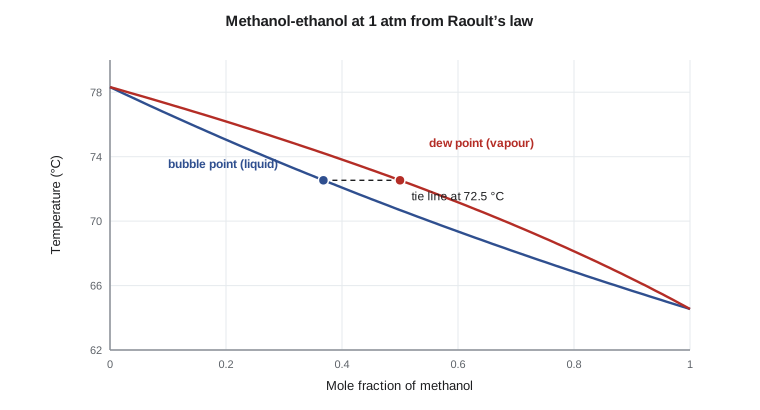
Methanol in the rectifier
At a methanol mole fraction of 0.002 in liquid ethanol, the bubble point is 78.3 °C and the K-value of methanol is 1.68: the vapour is 68 % richer in methanol than the liquid. The relative volatility of methanol to ethanol falls from about 1.7 at the ethanol end to about 1.1 near pure methanol. That is enough for a column to concentrate methanol toward the top. In the plant, the rectifier's overhead goes to the dehydration unit, so methanol tends to travel with the product. Most plants either keep methanol formation low in the cook or draw a small purge from the top of the column; Wren's question is answered by checking that the measured methanol in the product stays well inside the limit.
Worked problem
Dew point of a vapour
A vapour of 50 mol % methanol and 50 mol % ethanol at 1 atm is cooled. At what temperature does liquid first form, and what is its composition?
Show solution
- Dew T condition: \(1/P = y_1/P_1^{\text{sat}}(T) + y_2/P_2^{\text{sat}}(T)\); bisect between 64.5 and 78.3 °C.
- At 72.5 °C, \(P_1^{\text{sat}} = 137.6\) kPa and \(P_2^{\text{sat}} = 80.2\) kPa satisfy the equation.
- First liquid: \(x_1 = y_1P/P_1^{\text{sat}} = 0.5 \times 101.3/137.6 = 0.368\).
Answer: Liquid appears at about 72.5 °C with 37 mol % methanol.
Where Raoult's law fails
The last part of the output tests Raoult's law on ethanol-water, the mixture the plant actually distils, against measured data at 1 atm. The failure is dramatic. At \(x_1 = 0.072\), Raoult's law predicts a bubble point of 97.6 °C and a vapour with 15 % ethanol; the measured values are 89.0 °C and 39 %. At \(x_1 = 0.894\) the law predicts a vapour richer in ethanol than the liquid, while in reality the two compositions are equal there: that is the azeotrope of lesson 8, and Raoult's law cannot produce an azeotrope at all for a mixture whose vapour pressures differ. Ethanol and water are far from an ideal solution. Their unlike interactions differ from their like ones, so the escaping tendency of each in the mixture is not simply proportional to its mole fraction.
Mixtures that obey Raoult's law well are those whose molecules are similar in size, shape and polarity: benzene and toluene, hexane and heptane, methanol and ethanol, and isomers of each other. For most other liquid mixtures, especially those involving water, alcohols, acids and esters, the law is only a starting point. Lesson 6 adds the correction that makes it work.
Henry's law for dissolved gases
Raoult's law also fails for a gas dissolved in a liquid above its critical temperature, such as carbon dioxide in beer at 32 °C. There is no vapour pressure to use. Instead, at low concentrations the fugacity of the dissolved gas is proportional to its mole fraction with an empirical constant: \(y_iP = x_i\mathcal{H}_i\), Henry's law. For carbon dioxide in water at 25 °C, \(\mathcal{H}\) is about 1650 bar per mole fraction, so water in contact with 1 bar of carbon dioxide holds about 0.0006 mole fraction, roughly 1.5 g/L, the level found in freshly fermented beer. Henry's constants rise steeply with temperature, which is why heating beer drives the carbon dioxide off, the calculation of lesson 9.
Using K-values in practice
For mixtures of hydrocarbons at moderate pressure, engineers long used charts of K-values, such as the DePriester charts, that depend only on temperature and pressure, extending Raoult's law with empirical corrections. Simulators now compute K-values from a full thermodynamic model at each step, but the K-value form remains the language of separation calculations. It appears in flash calculations, in the McCabe-Thiele and shortcut methods of CHE-350 and in the stage-by-stage models used in design.
Bubble and dew points in the column
In a distillation column operating at steady state, the liquid on each tray is at its bubble point and the vapour rising from it is at its dew point, at the tray pressure. That is why the temperature profile of a column is a good indicator of composition. In the rectifier, a temperature reading near the top that rises above the azeotrope temperature means water is creeping up the column, and operators use a sensitive tray temperature to control the reflux. For a nearly ideal pair such as methanol-ethanol, bubble T calculations with Raoult's law give the tray temperatures directly. For ethanol-water, the same calculation needs the activity coefficients of lesson 6, but the logic is identical: given the liquid composition and the pressure, find the temperature at which the sum of the partial pressures equals the total pressure.
The phase rule also explains why a column needs both a temperature and a pressure measurement. For a binary at a fixed pressure, one more variable, the temperature, fixes the composition of both phases. If the pressure drifts, the same temperature means a different composition, so modern control systems correct tray temperatures for pressure before using them as a composition signal.
Common mistakes
MistakeApplying Raoult's law to ethanol-water.
InsteadThe mixture is strongly non-ideal; use modified Raoult's law with activity coefficients.
MistakeUsing Antoine constants far outside their fitted range.
InsteadThey are interpolating equations; check the stated temperature range.
MistakeUsing Raoult's law for a gas above its critical temperature dissolved in a liquid.
InsteadUse Henry's law, \(y_iP = x_i\mathcal{H}_i\).
MistakeSolving bubble T by guessing a temperature once.
InsteadBubble T and dew T require iteration because the vapour pressures depend on \(T\).
Summary and key terms
- Raoult's law \(y_iP = x_iP_i^{\text{sat}}\) assumes an ideal-gas vapour, an ideal liquid solution and low pressure.
- K-values \(K_i = y_i/x_i\) and the relative volatility \(\alpha_{12} = K_1/K_2\) describe how easily components separate.
- The Antoine equation fits vapour pressures over a limited range.
- Bubble P and dew P are direct with Raoult's law; bubble T and dew T need iteration.
- Methanol-ethanol is nearly ideal, with a relative volatility of about 1.7 at the ethanol end.
- Ethanol-water departs strongly from Raoult's law; dissolved gases follow Henry's law.
- Raoult's law
- y_iP = x_iP_i^sat, vapour-liquid equilibrium for an ideal solution at low pressure.
- K-value
- The ratio y_i/x_i of vapour to liquid mole fractions at equilibrium.
- Relative volatility
- The ratio of K-values of two components, the basis of separation by distillation.
- Antoine equation
- log10 P^sat = A − B/(T + C), a three-constant fit of vapour pressure.
- Bubble point
- The temperature or pressure at which a liquid of given composition first forms vapour.
- Dew point
- The temperature or pressure at which a vapour of given composition first forms liquid.
- Henry's law
- y_iP = x_iH_i, the equilibrium of a dilute dissolved gas with its vapour.
Practice problems
Work each problem on paper first, then reveal the answer to check.
Find the bubble pressure at 70 °C of a liquid with 30 mol % methanol in ethanol, given \(P_1^{\text{sat}} = 125.0\) and \(P_2^{\text{sat}} = 72.2\) kPa.
Show answer
\(P = 0.3 \times 125.0 + 0.7 \times 72.2 = 88.0\) kPa; \(y_1 = 37.5/88.0 = 0.426\).
What is the relative volatility of methanol to ethanol at 70 °C from those vapour pressures?
Show answer
\(125.0/72.2 = 1.73\).
How many degrees of freedom does a two-phase ternary have?
Show answer
\(F = 2 - 2 + 3 = 3\).
Why can Raoult's law not predict an azeotrope for components with different vapour pressures?
Show answer
\(y_1/x_1 = P_1^{\text{sat}}/P\) can equal \(y_2/x_2\) only if the vapour pressures are equal.
With \(\mathcal{H} = 1650\) bar, how much carbon dioxide dissolves in water under 1 bar of carbon dioxide?
Show answer
\(x = 1/1650 = 6.1\times10^{-4}\).
Name two mixtures that follow Raoult's law well.
Show answer
Benzene-toluene and methanol-ethanol, among others.
Lesson quiz · 5 questions
Score 60% or more to complete this lesson.
Create a free account to save your progress, take quizzes and earn a certificate.