
CHE-314 · Lesson 8 of 12 · 22 min
Gas absorption in packed towers
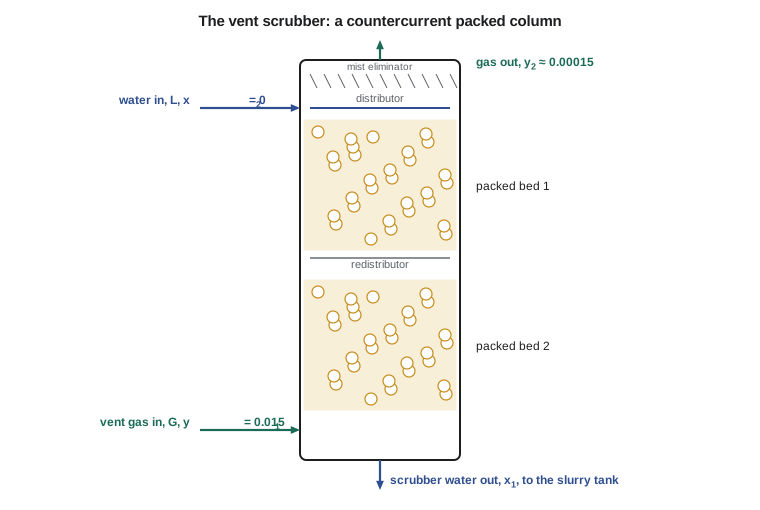
Ingrid gives Theo the design basis for the new vent scrubber on a single page. Gas: 113 mol/s of carbon dioxide carrying 1.5 mol % ethanol at 32 °C and about 1 atm. Target: recover at least 99 % of the ethanol. Liquid: fresh process water, which leaves the bottom of the scrubber and goes to the slurry tank, where the recovered ethanol rejoins the process. Equipment: a packed column, because packing handles large gas flows with low pressure drop and suits a dilute solute. Theo's task in this lesson is the mass transfer design: how much water, how many transfer units and how tall a bed. Lesson 9 then sizes the diameter and checks the hydraulics.
How a packed absorber works
In a packed absorber, liquid enters at the top through a distributor and trickles down over a bed of packing, which spreads it into thin films with a large surface area. Gas enters at the bottom and flows upward through the open spaces, so the two phases are in countercurrent contact. The gas becomes leaner in solute as it rises, and the liquid becomes richer as it falls. Countercurrent flow keeps a driving force throughout the column: at the top, the leanest gas meets the cleanest liquid; at the bottom, the richest gas meets the richest liquid. A demister at the top catches entrained droplets, and support plates, redistributors and liquid collectors complete the internals.
Material balance and the operating line
Number the bottom of the column 1 and the top 2. The carrier gas flow \(G\) and the solute-free liquid flow \(L\) are nearly constant, so a solute balance over the column from the top to any height gives a straight line relating the gas and liquid compositions at that height. For dilute systems in mole fractions,
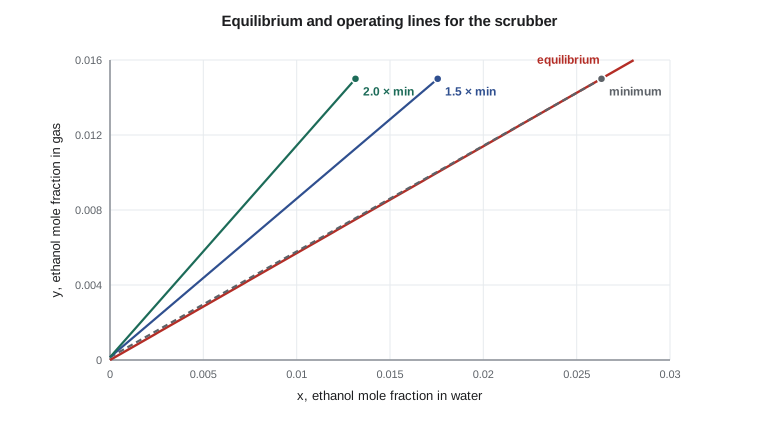
This is the operating line. It passes through the top point \((x_2, y_2)\) and the bottom point \((x_1, y_1)\), with slope \(L/G\). For absorption it lies above the equilibrium line \(y^* = mx\), because the gas must be richer than equilibrium with the liquid for solute to transfer into the liquid. The vertical distance between the two lines at any point is the overall driving force \(y - y^*\). Over the whole column, the balance fixes the liquid leaving the bottom: \(x_1 = x_2 + (G/L)(y_1 - y_2)\).
Minimum liquid rate
If the liquid flow is reduced, the operating line gets flatter and moves toward the equilibrium line. At the minimum liquid rate, the operating line touches the equilibrium line at the bottom of the column: the liquid leaving would be in equilibrium with the entering gas, the driving force there would be zero, and an infinitely tall column would be needed. For a straight equilibrium line and fresh solvent,
Practical designs use 1.2 to 2 times the minimum. A higher rate gives a shorter column but more dilute liquid and more solvent to handle, pump and, in many processes, regenerate. In this plant the solvent is simply process water that the slurry tank needs anyway, so a generous water rate costs little; that changes the usual economics in a way lesson 9 exploits.
Transfer units
The packed height comes from a differential balance on a slice of column of height \(dz\) and cross-sectional area \(S\). The solute leaving the gas equals the transfer into the liquid: \(G\,dy = K_ya\,S\,(y - y^*)\,dz\) for dilute systems. Integrating from top to bottom,
The integral \(N_{OG}\) is the number of overall gas-phase transfer units. It depends only on the separation required and on the equilibrium and operating lines: it measures how hard the job is. The group \(H_{OG}\) is the height of a transfer unit, in metres. It depends on the packing, the flows and the physical properties: it measures how good the equipment is at the job. Splitting the problem this way is the transfer-unit method of Chilton and Colburn, and it is the standard approach for packed columns. Typical \(H_{OG}\) values for random packings are 0.3 to 1.5 m, and for structured packings 0.2 to 0.6 m.
When both the equilibrium and operating lines are straight, the integral has an analytical solution due to Colburn. With the absorption factor \(A = L/(mG)\),
The absorption factor is the ratio of the slope of the operating line to that of the equilibrium line. When \(A\) is less than 1, the liquid cannot carry away all the solute and high recoveries are impossible however tall the column. When \(A\) is between about 1.2 and 2, recoveries of 99 % or more need a modest number of transfer units. Very large values of \(A\) bring diminishing returns. A useful alternative for dilute systems uses the logarithmic mean of the driving forces at the two ends: \(N_{OG} = (y_1 - y_2)/(y - y^*)_{\mathrm{lm}}\), which gives the same result when the lines are straight.
# Design of the packed absorber for the fermentation vent: ethanol recovered into water
import math
G = 113.0                 # mol/s carrier gas (CO2), lesson 1
y1 = 0.015                # inlet ethanol mole fraction (bottom)
recovery = 0.99
y2 = y1 * (1 - recovery)  # outlet (top)
x2 = 0.0                  # fresh water enters the top
m = 0.57                  # equilibrium slope at 32 C (lesson 7)

# Minimum liquid rate: outlet liquid in equilibrium with the inlet gas (dilute, straight lines)
LG_min = (y1 - y2) / (y1 / m - x2)
for factor in (1.5, 2.0):
    LG = factor * LG_min
    L = LG * G
    A = LG / m                                  # absorption factor
    x1 = x2 + (y1 - y2) / LG                    # liquid leaving the bottom
    NOG = math.log((y1 - m * x2) / (y2 - m * x2) * (1 - 1 / A) + 1 / A) / (1 - 1 / A)
    print(f"L/G = {factor} x min = {LG:.3f}: water {L:.1f} mol/s = {L * 0.01802 * 3.6:.1f} m3/h, A = {A:.2f}, x1 = {x1:.4f}, NOG = {NOG:.2f}")

# Height of a transfer unit from film coefficients and the column area (lesson 9 sizes the column)
kya, kxa = 150.0, 300.0                         # mol/(m3 s)
area = math.pi * 1.2 ** 2 / 4                   # m2 for a 1.2 m column
Kya = 1 / (1 / kya + m / kxa)
HOG = G / area / Kya
LG = 1.5 * LG_min; A = LG / m
NOG = math.log((y1 / y2) * (1 - 1 / A) + 1 / A) / (1 - 1 / A)
print(f"HOG = {HOG:.2f} m, packed height = {HOG * NOG:.1f} m at L/G = 1.5 x min")

# Ethanol recovered and its value
rec = G * (y1 / (1 - y1) - y2 / (1 - y2)) * 0.04607 * 3600     # kg/h
print(f"ethanol recovered = {rec:.0f} kg/h = {rec / 0.789:.0f} L/h")

# Sensitivity: removal fraction versus packed height at L/G = 1.5 x min
for Z in (4, 6, 8, 10):
    N = Z / HOG
    # invert the Colburn equation for y2
    ratio = ((math.exp(N * (1 - 1 / A)) - 1 / A) / (1 - 1 / A))
print(f"Z = {Z:2d} m: NOG = {N:.2f}, removal = {(1 - 1 / ratio) * 100:.2f} %")L/G = 1.5 x min = 0.846: water 95.6 mol/s = 6.2 m3/h, A = 1.49, x1 = 0.0175, NOG = 10.74 L/G = 2.0 x min = 1.129: water 127.5 mol/s = 8.3 m3/h, A = 1.98, x1 = 0.0132, NOG = 7.90 HOG = 0.86 m, packed height = 9.2 m at L/G = 1.5 x min ethanol recovered = 283 kg/h = 358 L/h Z = 4 m: NOG = 4.67, removal = 91.68 % Z = 6 m: NOG = 7.01, removal = 96.45 % Z = 8 m: NOG = 9.35, removal = 98.41 % Z = 10 m: NOG = 11.68, removal = 99.27 %
Worked problem
The first design pass
With \(m = 0.57\), \(y_1 = 0.015\), 99 % recovery and fresh water, find \((L/G)_{\min}\), the water rate at 1.5 times minimum, the number of transfer units, and the packed height for \(H_{OG} = 0.86\) m.
Show solution
- \(y_2 = 0.00015\); \((L/G)_{\min} = (0.015 - 0.00015)/(0.015/0.57) = 0.564\).
- At 1.5 times: \(L/G = 0.846\), \(L = 95.6\) mol/s, about 6.2 m\(^3\)/h of water; \(A = 0.846/0.57 = 1.49\).
- \(N_{OG} = \ln[(1 - 0.672) \times 100 + 0.672]/(1 - 0.672) = 10.7\).
- \(Z = 0.86 \times 10.7 = 9.2\) m.
Answer: The liquid leaving the bottom holds \(x_1 = 0.0175\), about 4.4 % ethanol by mass, which is welcome in the slurry tank.
Where the height of a transfer unit comes from
The overall height of a transfer unit can be split into film contributions, mirroring the resistances of lesson 7:
For the scrubber, \(H_G\) and \(H_L\) come from correlations for the chosen packing, such as those of Onda or of Billet and Schultes, or from the vendor's data for the same system, which are usually more reliable. Theo uses \(k_ya = 150\) and \(k_xa = 300\) mol/(m\(^3\) s), typical of 50 mm metal rings at these loadings, which give \(K_ya = 117\) mol/(m\(^3\) s). With the column area of 1.13 m\(^2\) that lesson 9 confirms, \(H_{OG} = 113/(1.13 \times 117) = 0.86\) m. He flags this as the number in the design with the most uncertainty and asks the packing vendor for performance data on ethanol absorption to check it.
Stripping: the reverse operation
The same equations describe stripping, in which a solute moves from a liquid into a gas, such as removing dissolved carbon dioxide from water with air or recovering ethanol from a dilute stream with steam. The operating line now lies below the equilibrium line, and the stripping factor \(S = mG/L\), the inverse of the absorption factor, plays the role that \(A\) plays in absorption: high removals need \(S\) above about 1.2. The Colburn equation applies with liquid-phase transfer units and \(S\) in place of \(A\). In the ethanol plant, the beer column that strips ethanol from fermented mash is a large, staged version of the same idea, which CHE-350 treats in detail.
Reading the sensitivity
The last part of the code output shows how recovery depends on height at the first-pass water rate: about 92 % at 4 m, 96 % at 6 m, 98.4 % at 8 m and 99.3 % at 10 m. Each extra metre buys less, because the driving force shrinks as the gas approaches the clean top. This curve is what Wren needs for the permit application. It shows how the emission rate would change if the packing performed 20 % worse than expected or if the water ran warmer than design, and so how much margin a chosen height carries. Theo also notes that raising the water rate improves recovery at a fixed height by increasing \(A\), an option he keeps open for the hydraulics check.
Worked problem
Recovery at a fixed height
A vendor offers a standard 8 m bed. At \(L/G = 0.846\) (\(A = 1.49\)) and \(H_{OG} = 0.86\) m, what recovery will it give?
Show solution
- \(N_{OG} = 8/0.86 = 9.35\).
- Invert the Colburn equation: \(y_1/y_2 = [\exp(N_{OG}(1 - 1/A)) - 1/A]/(1 - 1/A) = [\exp(3.07) - 0.672]/0.328 = 63\).
- Recovery \(= 1 - 1/63 = 98.4\%\).
Answer: Just short of the 99 % target at this water rate, so either a taller bed or more water is needed.
Common mistakes
MistakeDrawing the absorption operating line below the equilibrium line.
InsteadFor absorption, the operating line lies above the equilibrium line; for stripping, below.
MistakeDesigning at the minimum liquid rate.
InsteadIt needs an infinitely tall column; use 1.2 to 2 times the minimum.
MistakeChoosing \(A < 1\) and expecting high recovery.
InsteadWith \(A < 1\) the liquid cannot remove all the solute; raise \(L\) or lower \(m\).
MistakeTreating \(H_{OG}\) as a property of the packing alone.
InsteadIt depends on flows, properties and \(A\) through \(H_G\) and \(H_L\).
Summary and key terms
- Countercurrent packed columns keep a driving force throughout the bed.
- The operating line \(y = y_2 + (L/G)(x - x_2)\) lies above the equilibrium line for absorption.
- The minimum liquid rate pinches the lines at the bottom; design at 1.2 to 2 times it.
- Packed height is \(Z = H_{OG}N_{OG}\): the difficulty of the separation times the effectiveness of the packing.
- For straight lines, the Colburn equation gives \(N_{OG}\) from the absorption factor \(A = L/(mG)\) and the end compositions.
- First pass for the scrubber: 6.2 m\(^3\)/h of water, \(N_{OG} = 10.7\), \(H_{OG} = 0.86\) m, about 9.2 m of packing.
- Operating line
- The line relating gas and liquid compositions at each height of a column, from a material balance.
- Minimum liquid rate
- The liquid flow at which the operating line touches the equilibrium line.
- Absorption factor
- A = L/(mG), the ratio of operating to equilibrium line slopes.
- Number of transfer units
- A dimensionless measure of the difficulty of a separation, the integral of dy/(y − y*).
- Height of a transfer unit
- The packed height that provides one transfer unit, G/(K_ya S).
- Countercurrent flow
- Flow of the two phases in opposite directions through the equipment.
- Colburn equation
- The analytical expression for N_OG with straight equilibrium and operating lines.
Practice problems
Work each problem on paper first, then reveal the answer to check.
Find \(x_1\) for \(G = 100\) mol/s, \(L = 120\) mol/s, \(y_1 = 0.02\), \(y_2 = 0.0004\), \(x_2 = 0\).
Show answer
\(x_1 = (100/120)(0.0196) = 0.0163\).
With \(m = 1.0\), \(y_1 = 0.02\) and 98 % recovery with clean solvent, what is \((L/G)_{\min}\)?
Show answer
\(0.0196/0.02 = 0.98\).
Compute \(N_{OG}\) for \(A = 2\) and \(y_1/y_2 = 50\) with clean solvent.
Show answer
\(N_{OG} = 2\ln(0.5 \times 50 + 0.5) = 6.48\).
If \(H_{OG} = 0.7\) m and \(N_{OG} = 8\), how tall is the bed?
Show answer
5.6 m, before allowances for distributors and supports.
What happens to the required height as \(L\) approaches \((L)_{\min}\)?
Show answer
It grows without limit.
Why is a generous water rate cheap in this scrubber?
Show answer
The water goes to the slurry tank, which needs makeup water anyway.
Lesson quiz · 5 questions
Score 60% or more to complete this lesson.
Create a free account to save your progress, take quizzes and earn a certificate.