
CHE-314 · Lesson 2 of 12 · 23 min
Molecular diffusion and Fick's law
Before Theo can size a scrubber he needs numbers for how fast ethanol diffuses through carbon dioxide and through water. Ingrid points him to the plant's old design files, where the vendor quoted diffusion coefficients without saying where they came from. Her rule is simple: every property in a design calculation needs a source or a method, and the method's likely error. This lesson builds that toolkit, starting from Fick's law and ending with estimating methods for gases and liquids that are accurate enough for design.
Fick's law
In 1855 Adolf Fick proposed that the diffusive flux of a species is proportional to the gradient of its concentration, by direct analogy with Fourier's law of heat conduction. For a binary mixture of A and B, in one direction \(z\), the molar flux of A relative to the molar-average velocity of the mixture is
The minus sign says that diffusion runs down the gradient, from high to low concentration. The proportionality constant \(D_{AB}\) is the binary diffusion coefficient, or diffusivity, with units of m\(^2\)/s. It is a property of the pair of species, the temperature, the pressure and, in liquids, the composition. In a binary mixture \(D_{AB} = D_{BA}\): A diffusing through B and B diffusing through A are the same process seen from opposite sides, because the two diffusive fluxes relative to the molar-average velocity are equal and opposite.
Fick's law describes diffusion relative to the moving mixture. The total flux relative to fixed coordinates adds the transport of A by the bulk flow of the mixture. For a binary system,
The second term is the bulk-flow or convective contribution caused by diffusion itself. When equal numbers of A and B molecules cross a plane in opposite directions, \(N_A + N_B = 0\) and the bulk-flow term vanishes. When only A moves, as when ethanol evaporates into stagnant air, the bulk flow adds to diffusion. Lesson 3 solves both cases. For the rest of this lesson, the focus is on the diffusion coefficient itself.
The size of diffusion coefficients
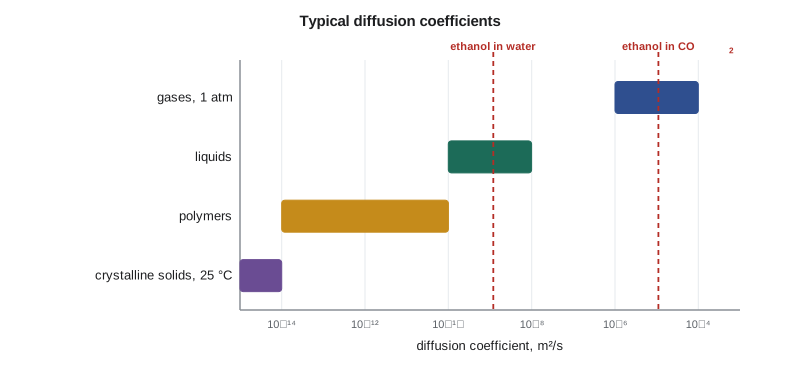
Diffusion coefficients span many orders of magnitude, and knowing the typical ranges catches errors quickly. In gases at atmospheric pressure, diffusivities are around \(10^{-5}\) m\(^2\)/s (0.1 cm\(^2\)/s), give or take a factor of three. In liquids they are about ten thousand times smaller, around \(10^{-9}\) m\(^2\)/s. In polymers they range from \(10^{-10}\) down to \(10^{-14}\) m\(^2\)/s or less, and in crystalline solids at room temperature they can be smaller still. A rough rule gives the time for diffusion to spread over a distance \(L\): \(t \approx L^2/D\). Spreading over 1 cm takes about 8 seconds in a gas but about a day in water, which is why liquid mixing depends on stirring and why the liquid side of an interface is often the slow one.
Diffusion in gases
Kinetic theory gives a clear picture of gas diffusion. Molecules move at hundreds of metres per second but collide constantly, so each one wanders randomly with a step length equal to the mean free path, about 60 to 100 nm at atmospheric pressure. The diffusivity is roughly one third of the mean speed times the mean free path. Doubling the pressure halves the mean free path, so the gas diffusivity is inversely proportional to pressure. Raising the temperature makes molecules faster and, at constant pressure, the gas less dense, so diffusivity rises roughly as \(T^{1.75}\) in practice.
The Chapman-Enskog theory turns this picture into an equation using the Lennard-Jones parameters introduced in CHE-250, and it is accurate to a few per cent for nonpolar gases. For design, a simpler empirical method by Fuller, Schettler and Giddings is widely used. It needs only molar masses and a set of atomic diffusion volumes that are summed for each molecule:
Here \(D_{AB}\) is in cm\(^2\)/s, \(T\) in kelvin, \(P\) in atmospheres, molar masses in g/mol and the diffusion volumes \(V\) in cm\(^3\)/mol. The diffusion volumes come from tables: for example, about 26.9 for carbon dioxide, 19.7 for air, 13.1 for water and 16.3 for oxygen; ethanol's value, built up from its atoms, is about 50.4. The method is typically within 5 to 10 % of measured values for common gases, which is good enough for nearly all design work.
Worked problem
Ethanol diffusing through the vent gas
Estimate \(D_{AB}\) for ethanol in carbon dioxide at 32 °C and 1 atm with the Fuller method.
Show solution
- \(M_{AB} = 2/(1/46.07 + 1/44.01) = 45.0\) g/mol, so \(M_{AB}^{1/2} = 6.71\).
- \(V_A^{1/3} + V_B^{1/3} = 50.36^{1/3} + 26.9^{1/3} = 3.69 + 3.00 = 6.69\); squared, 44.8.
- \(T^{1.75} = 305.15^{1.75} = 2.22\times10^{4}\).
- \(D_{AB} = 1.43\times10^{-3} \times 2.22\times10^4/(1 \times 6.71 \times 44.8) = 0.106\) cm\(^2\)/s, or \(1.06\times10^{-5}\) m\(^2\)/s.
Answer: Ethanol diffuses about 20 % more slowly in carbon dioxide than in air, mainly because carbon dioxide molecules are larger.
Diffusion in liquids
Molecules in a liquid are packed almost as closely as in a solid, and a diffusing molecule moves by squeezing past its neighbours. No theory is as complete as kinetic theory for gases, but the Stokes-Einstein equation gives the right idea: a sphere of radius \(r\) moving slowly through a fluid of viscosity \(\mu\) has a diffusivity \(D = k_BT/(6\pi\mu r)\). Diffusivity in liquids therefore rises with temperature, falls with viscosity and falls with molecular size. The quantity \(D\mu/T\) is roughly constant for a given solute and solvent, which is a handy way to correct a measured value to another temperature.
For dilute solutes, the Wilke-Chang correlation is the usual design estimate:
Here \(D_{AB}\) is in cm\(^2\)/s, \(M_B\) is the solvent molar mass, \(T\) is in kelvin, \(\mu_B\) is the solvent viscosity in centipoise (mPa s), \(V_A\) is the molar volume of the solute at its normal boiling point in cm\(^3\)/mol, and \(\phi\) is an association factor for the solvent: 2.6 for water, 1.9 for methanol, 1.5 for ethanol and 1.0 for unassociated solvents. Errors of 10 to 20 % are common, and larger for water as a solute or for large molecules. Where measured values exist, they are better: the measured diffusivity of ethanol at infinite dilution in water at 25 °C is about \(1.2\times10^{-9}\) m\(^2\)/s, a little below the Wilke-Chang estimate.
| Solute in water | V_A (cm³/mol) | Wilke-Chang at 25 °C (m²/s) | Wilke-Chang at 32 °C (m²/s) |
|---|---|---|---|
| ethanol | 59.2 | 1.5 × 10⁻⁹ | 1.75 × 10⁻⁹ |
| carbon dioxide | 34.0 | 2.0 × 10⁻⁹ | 2.4 × 10⁻⁹ |
| oxygen | 25.6 | 2.4 × 10⁻⁹ | 2.9 × 10⁻⁹ |
In concentrated liquid mixtures the diffusivity depends strongly on composition. For ethanol and water it passes through a minimum at intermediate concentrations, because the molecules associate through hydrogen bonds and the thermodynamic driving force is not simply the concentration gradient. Rigorous treatments use gradients of chemical potential, or the Maxwell-Stefan equations for multicomponent mixtures. For the dilute scrubber water, where ethanol stays below a few mole per cent, the infinite-dilution value is adequate.
Electrolytes and the effect of temperature
Dissolved salts and the ions of weak acids diffuse as pairs or groups because the solution must stay electrically neutral; the faster ion is held back by the slower one. Bisulfite solutions used in lesson 12 follow this behaviour, but at low concentrations the effect is small enough for design to ignore. Temperature matters more. From 25 to 32 °C, water's viscosity falls from 0.89 to about 0.77 mPa s, so liquid diffusivities rise by about 20 %. Gas diffusivities rise by only about 4 % over the same range. A scrubber that runs warmer in summer therefore sees faster liquid-side diffusion but, as lesson 7 shows, also less favourable equilibrium, and the equilibrium effect usually wins.
# Diffusion coefficients: Fuller-Schettler-Giddings for gases, Wilke-Chang for liquids
import math
# Fuller diffusion volumes (sum of atomic/structural increments), cm3/mol
V = {'ethanol': 50.36, 'CO2': 26.9, 'air': 19.7, 'water': 13.1, 'O2': 16.3}
M = {'ethanol': 46.07, 'CO2': 44.01, 'air': 28.97, 'water': 18.02, 'O2': 32.0}

def fuller(a, b, T, P_atm=1.0):
    """D_AB in cm2/s; T in K, P in atm."""
    MAB = 2.0 / (1.0 / M[a] + 1.0 / M[b])
    return 0.00143 * T ** 1.75 / (P_atm * math.sqrt(MAB) * (V[a] ** (1 / 3) + V[b] ** (1 / 3)) ** 2)

for a, b in [('ethanol', 'CO2'), ('ethanol', 'air'), ('water', 'air'), ('O2', 'air')]:
    D = fuller(a, b, 305.15)
    print(f"D({a}-{b}) at 32 C = {D:.3f} cm2/s = {D * 1e-4:.2e} m2/s")

# Temperature and pressure scaling of a gas diffusivity
D298 = fuller('ethanol', 'air', 298.15)
D373 = fuller('ethanol', 'air', 373.15)
print(f"ethanol-air: {D298:.3f} cm2/s at 25 C, {D373:.3f} cm2/s at 100 C, ratio {D373 / D298:.2f}")
print(f"ethanol-air at 25 C and 2 atm = {fuller('ethanol', 'air', 298.15, 2.0):.3f} cm2/s")

# Wilke-Chang for a dilute solute A in solvent B
def wilke_chang(VA, T, mu_cP, phi=2.6, MB=18.02):
    """D_AB in cm2/s; VA = molar volume of solute at normal boiling point, cm3/mol; mu in cP."""
    return 7.4e-8 * math.sqrt(phi * MB) * T / (mu_cP * VA ** 0.6)

mu_w = {298.15: 0.890, 305.15: 0.765}   # water viscosity, cP
for name, VA in [('ethanol', 59.2), ('CO2', 34.0), ('O2', 25.6)]:
    for T in (298.15, 305.15):
        D = wilke_chang(VA, T, mu_w[T])
        print(f"D({name} in water) at {T - 273.15:.0f} C = {D:.2e} cm2/s")

# Stokes-Einstein check: radius implied for ethanol in water at 25 C
kB = 1.380649e-23
D_e = wilke_chang(59.2, 298.15, 0.890) * 1e-4   # m2/s
r = kB * 298.15 / (6 * math.pi * 0.890e-3 * D_e)
print(f"Stokes-Einstein radius of ethanol = {r * 1e9:.2f} nm")

# Characteristic diffusion time t ~ L^2 / D
for L, D, what in [(0.01, 0.13e-4, '1 cm in gas'), (0.01, 1.2e-9, '1 cm in water'), (100e-6, 1.2e-9, '100 um in water')]:
    t = L ** 2 / D
print(f"time to diffuse {what}: {t:.3g} s")D(ethanol-CO2) at 32 C = 0.106 cm2/s = 1.06e-05 m2/s D(ethanol-air) at 32 C = 0.131 cm2/s = 1.31e-05 m2/s D(water-air) at 32 C = 0.264 cm2/s = 2.64e-05 m2/s D(O2-air) at 32 C = 0.211 cm2/s = 2.11e-05 m2/s ethanol-air: 0.125 cm2/s at 25 C, 0.186 cm2/s at 100 C, ratio 1.48 ethanol-air at 25 C and 2 atm = 0.063 cm2/s D(ethanol in water) at 25 C = 1.47e-05 cm2/s D(ethanol in water) at 32 C = 1.75e-05 cm2/s D(CO2 in water) at 25 C = 2.05e-05 cm2/s D(CO2 in water) at 32 C = 2.44e-05 cm2/s D(O2 in water) at 25 C = 2.42e-05 cm2/s D(O2 in water) at 32 C = 2.89e-05 cm2/s Stokes-Einstein radius of ethanol = 0.17 nm time to diffuse 1 cm in gas: 7.69 s time to diffuse 1 cm in water: 8.33e+04 s time to diffuse 100 um in water: 8.33 s
Note the pattern in the output. The Stokes-Einstein radius implied for ethanol, about 0.17 nm, is smaller than its real size. The equation was derived for spheres much larger than the solvent molecules, so it gives the right trend but not exact sizes for small molecules. And the diffusion times show the gap between phases: 8 seconds to cross a centimetre of gas, almost a day to cross a centimetre of still water, but only 8 seconds to cross 100 micrometres of water. That last number is why interfaces in mass transfer equipment are designed to be thin and constantly renewed.
Worked problem
Correcting a liquid diffusivity to another temperature
The measured diffusivity of ethanol in water is \(1.24\times10^{-9}\) m\(^2\)/s at 25 °C. Estimate it at 32 °C, where water's viscosity is 0.765 mPa s instead of 0.890 mPa s.
Show solution
- Use \(D\mu/T\) constant: \(D_{32} = D_{25} \times (305.15/298.15) \times (0.890/0.765)\).
- \(D_{32} = 1.24\times10^{-9} \times 1.023 \times 1.163 = 1.48\times10^{-9}\) m\(^2\)/s.
Answer: A 7 K rise increases the liquid diffusivity by almost 20 %, mostly through the change in viscosity.
Common mistakes
MistakeUsing a gas diffusivity at high pressure without correction.
InsteadGas diffusivity varies roughly as \(1/P\); halve it at 2 atm.
MistakeApplying Wilke-Chang to concentrated mixtures.
InsteadIt is for dilute solutes; concentrated mixtures need composition-dependent data or models.
MistakeMixing cm\(^2\)/s and m\(^2\)/s.
Instead1 cm\(^2\)/s = \(10^{-4}\) m\(^2\)/s; a gas value of 0.1 cm\(^2\)/s is \(10^{-5}\) m\(^2\)/s.
MistakeTreating \(D_{AB}\) and \(D_{BA}\) as different in a binary mixture.
InsteadFor binary diffusion they are equal.
Summary and key terms
- Fick's law: the diffusive flux relative to the mixture is \(-cD_{AB}\,dy_A/dz\); the total flux adds bulk flow.
- Gas diffusivities are about \(10^{-5}\) m\(^2\)/s, liquid diffusivities about \(10^{-9}\) m\(^2\)/s, and solids much lower.
- The Fuller method estimates gas diffusivities within about 5 to 10 %; they scale as about \(T^{1.75}/P\).
- The Wilke-Chang correlation estimates dilute liquid diffusivities within about 10 to 20 %; \(D\mu/T\) is roughly constant.
- Diffusion time scales as \(L^2/D\), which is why interfaces must be thin and renewed.
- For the scrubber: ethanol in carbon dioxide about \(1.1\times10^{-5}\) and ethanol in water about \(1.5\times10^{-9}\) m\(^2\)/s at 32 °C.
- Fick's law
- The statement that diffusive flux is proportional to the concentration gradient.
- Diffusion coefficient
- The proportionality constant in Fick's law, with units of m²/s.
- Bulk flow
- Transport of a species by the net motion of the whole mixture, including motion caused by diffusion.
- Diffusion volume
- An empirical molecular parameter used in the Fuller method for gas diffusivities.
- Wilke-Chang correlation
- An empirical estimate of the diffusivity of a dilute solute in a liquid.
- Association factor
- A solvent parameter in the Wilke-Chang correlation that accounts for hydrogen bonding.
- Stokes-Einstein equation
- A relation between the diffusivity of a sphere, temperature, viscosity and radius.
Practice problems
Work each problem on paper first, then reveal the answer to check.
Estimate the time for water vapour to diffuse 2 mm through still air.
Show answer
\(t \approx L^2/D = (0.002)^2/2.6\times10^{-5} = 0.15\) s.
A gas diffusivity is 0.12 cm\(^2\)/s at 1 atm and 25 °C. Estimate it at 3 atm and 25 °C.
Show answer
About 0.04 cm\(^2\)/s, since \(D \propto 1/P\).
What happens to the bulk-flow term when \(N_A + N_B = 0\)?
Show answer
It vanishes, and the total flux equals the diffusive flux.
Why is the Wilke-Chang association factor for water larger than for benzene?
Show answer
Water molecules hydrogen bond strongly, so it behaves as a solvent with a higher effective molar mass.
Estimate the increase in a gas diffusivity from 25 °C to 100 °C.
Show answer
\((373/298)^{1.75} = 1.48\), so about 48 %.
Which phase is usually slower for diffusion across a 0.1 mm layer?
Show answer
The liquid, by about four orders of magnitude.
Lesson quiz · 5 questions
Score 60% or more to complete this lesson.
Create a free account to save your progress, take quizzes and earn a certificate.