
CHE-314 · Lesson 1 of 12 · 26 min
Mass transfer in chemical engineering
Theo Laurent starts his third co-op term at Kingfisher Bioenergy in Sarnia, this time in the process engineering group. The plant makes about 200 million litres of fuel ethanol a year from corn, and Ingrid Solheim, the senior process engineer who supervised him in earlier terms, hands him a project on his first morning. The tall stack beside the fermenters releases the carbon dioxide that yeast make while they turn sugar into ethanol. That gas leaves saturated with ethanol vapour and carries traces of acetaldehyde and other organic compounds. A water scrubber already treats it, but the plant is adding fermentation capacity, and the existing scrubber is too small. Wren Halvorsen, the plant's environmental compliance lead, needs a new scrubber that meets an Environmental Compliance Approval (ECA) issued by the Ontario Ministry of the Environment, Conservation and Parks under section 9 of the Environmental Protection Act, with air dispersion modelling against the point-of-impingement standards of O. Reg. 419/05. Ingrid wants it to recover as much ethanol as possible, because every kilogram that leaves the stack is product the plant paid to make. The scrubber is a mass transfer problem from top to bottom, and this course follows Theo as he learns the tools to design it.
What mass transfer is
Mass transfer is the movement of a chemical species from one place to another because of a difference in its concentration, or more precisely in its chemical potential. It happens whenever a mixture is not uniform. A drop of food colouring spreads through still water, perfume reaches the far side of a room, sugar dissolves from a cube, and oxygen moves from air bubbles into a fermentation broth. In each case molecules move, on average, from regions where they are more concentrated toward regions where they are less concentrated, and the movement continues until the concentration difference disappears or until something keeps renewing it.
Two mechanisms carry mass. Molecular diffusion is the net movement caused by the random thermal motion of individual molecules. It acts in every fluid and solid, but it is slow: a molecule in a liquid diffuses only about a millimetre in a minute. Convective mass transfer adds the bulk motion of the fluid, such as flow along a surface, turbulent eddies or the stirring in a tank, which carries dissolved or vapour-phase material much faster and keeps renewing the concentration differences near interfaces. Almost every industrial mass transfer process combines the two: turbulence moves material quickly through the bulk of each phase, and diffusion carries it the last short distance across thin layers near an interface.
The analogy with heat transfer, which Theo studied in CHE-312, is close and useful. Heat flows from high to low temperature by conduction and convection; mass flows from high to low concentration by diffusion and convection. Fourier's law for conduction has a twin in Fick's law for diffusion, the heat transfer coefficient has a twin in the mass transfer coefficient, and the dimensionless groups of heat transfer, the Nusselt and Prandtl numbers, have twins in the Sherwood and Schmidt numbers. Many results can be carried straight across, and this course uses the analogy often. The important difference is that mass transfer usually takes place between two phases that are not in equilibrium with each other, and the equilibrium relationship between the phases, which has no exact counterpart in heat transfer, controls how far the transfer can go.
Mass transfer operations in an ethanol plant
Ingrid walks Theo through the plant with a highlighter and a process flow diagram, marking every place where mass transfer decides how a unit works. The list is long. The yeast propagation tanks are aerated so the yeast can grow before they are sent to the fermenters, and the rate at which oxygen dissolves from air bubbles sets how fast they can grow. The fermenters release carbon dioxide, which carries ethanol vapour to the scrubber. The scrubber absorbs that ethanol into water. The distillation columns and the molecular sieve dehydration units separate ethanol from water. The cooling tower cools process water by evaporating part of it into air. The rotary dryers drive water out of the wet distillers grains to make dried distillers grains with solubles (DDGS), the animal feed co-product. Even the quality control lab relies on mass transfer, from evaporation of samples to diffusion in chromatography columns.
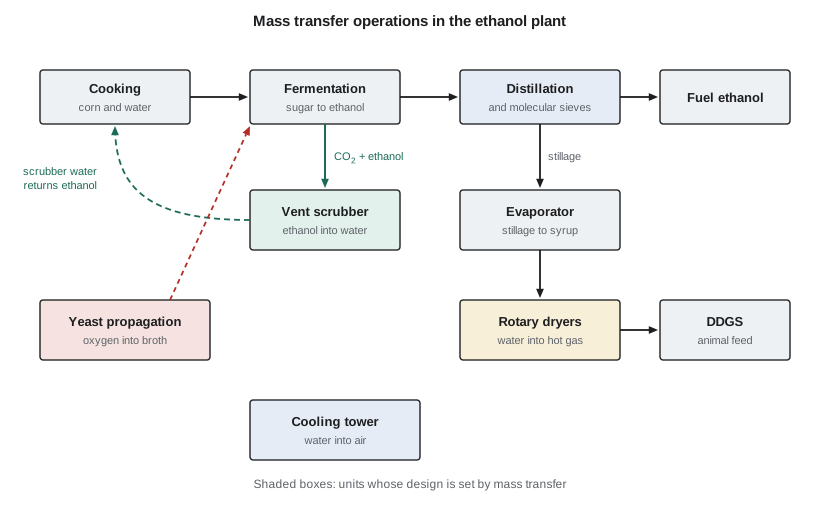
Engineers group these operations by the phases involved. Gas absorption moves a component from a gas into a liquid, as in the vent scrubber; stripping does the reverse. Distillation transfers components between a liquid and its vapour. Extraction moves solutes between two liquids. Adsorption moves molecules from a fluid onto a solid surface, as in the molecular sieves. Drying removes a liquid from a solid into a gas, and humidification adds vapour to a gas. This course concentrates on the rate side of mass transfer: diffusion, mass transfer coefficients, interphase transfer and the design of packed columns, cooling towers and dryers. The next course, CHE-350, takes up equilibrium-stage design of distillation, staged absorption, extraction and adsorption.
Concentrations, fractions and ratios
Mass transfer calculations use several ways to describe how much of a species is present, and mixing them up is a common source of errors. Molar concentration \(c_A\), in mol/m\(^3\), is the amount of A per unit volume of mixture; mass concentration \(\rho_A\), in kg/m\(^3\), is its mass per unit volume. Mole fraction is \(y_A\) in a gas or \(x_A\) in a liquid, and mass fraction is \(w_A\). For an ideal gas the total molar concentration is \(c = P/RT\), the mole fraction equals the volume fraction and the ratio of partial pressure to total pressure:
Gas absorption design often uses mole ratios, the moles of solute per mole of solute-free carrier, \(Y = y/(1-y)\) and \(X = x/(1-x)\). The carrier gas and the absorbing liquid flow through the column at nearly constant rates even when the solute is being removed, so material balances written in mole ratios stay straight lines. For dilute systems, below a few mole per cent, the mole ratio and the mole fraction are almost equal, and the simpler fractions are good enough. Environmental permits add their own units: parts per million by volume (ppmv), which equals a mole fraction times \(10^6\) for a gas, and mass concentrations in mg/m\(^3\) at a stated reference temperature and pressure.
Worked problem
The vent gas in several units
The fermentation vent gas leaves at 32 °C and 101.3 kPa and contains 1.5 mol % ethanol in carbon dioxide. Express the ethanol content as a molar concentration, a mass concentration, a mass fraction, ppmv and a mole ratio.
Show solution
- Total concentration: \(c = P/RT = 101\,325/(8.314 \times 305.15) = 39.9\) mol/m\(^3\).
- Ethanol: \(c_A = 0.015 \times 39.9 = 0.599\) mol/m\(^3\), or \(0.599 \times 46.07 = 27.6\) g/m\(^3\).
- Mass fraction: \(w_A = 0.015 \times 46.07/(0.015 \times 46.07 + 0.985 \times 44.01) = 0.0157\).
- ppmv: \(0.015 \times 10^6 = 15\,000\) ppmv; mole ratio \(Y = 0.015/0.985 = 0.0152\).
Answer: Because ethanol and carbon dioxide have similar molar masses, the mass fraction is close to the mole fraction here. That is a coincidence of this mixture, not a general rule.
Fluxes and driving forces
The rate of mass transfer is expressed as a flux, the amount of a species crossing a unit area per unit time. The molar flux \(N_A\) has units of mol/(m\(^2\) s) and the mass flux \(n_A\) units of kg/(m\(^2\) s). Fluxes are vectors: they have a direction. A flux can be measured relative to fixed coordinates, such as the wall of a column, or relative to the moving mixture. The difference matters when the whole mixture is flowing as a result of the diffusion itself, a case lesson 3 treats in detail.
Every mass transfer rate equation has the same form as Newton's law of cooling: a flux equals a coefficient times a driving force. For transfer between a surface and a fluid, the driving force is the difference between the concentration at the surface and in the bulk fluid, and the coefficient is a mass transfer coefficient \(k_c\) in m/s:
The driving force can be written with concentrations, mole fractions or partial pressures, and each choice gives a coefficient with different units, as lesson 5 shows. The coefficient bundles together everything about the flow, the geometry and the physical properties, and much of chemical engineering practice is about predicting it. The driving force is set by the process: how far the phases are from equilibrium. A good design keeps the driving force large where it can and makes the interfacial area large, because the total transfer rate in a piece of equipment is the flux times the area.
Worked problem
A first estimate of a flux
Suppose the gas film beside a wetted surface in the scrubber has a mass transfer coefficient \(k_c = 0.02\) m/s, the bulk gas holds 0.599 mol/m\(^3\) of ethanol, and the water at the surface takes up ethanol so fast that the gas concentration right at the surface is close to zero. What is the flux?
Show solution
- \(N_A = k_c (c_{A,b} - c_{A,s}) = 0.02 \times (0.599 - 0) = 0.0120\) mol/(m\(^2\) s), or 12 mmol/(m\(^2\) s).
- Per square metre of wetted surface this is \(0.012 \times 46.07 \times 3600 = 2.0\) kg of ethanol per hour.
Answer: A packed column provides hundreds of square metres of wetted surface, which is why a modest column can recover hundreds of kilograms of ethanol per hour.
Why the scrubber matters
Theo runs the numbers for the expanded plant before writing anything else. Fermentation makes almost exactly one mole of carbon dioxide for each mole of ethanol, so the vent carries about 150 thousand tonnes of carbon dioxide a year, about 113 mol/s on an operating basis of 8,400 hours a year. At 1.5 mol % ethanol, that gas would carry away close to 290 kg of ethanol every hour if nothing captured it. Over a year that is more than two million litres of product, enough to justify a well-designed scrubber on economics alone, before the air permit is even considered.
# Concentration units and a first flux estimate for the fermentation vent gas
R = 8.314          # J/(mol K)
P = 101325.0       # Pa
T = 305.15         # K (32 C vent gas)
M_EtOH, M_CO2 = 46.07, 44.01   # g/mol

y_EtOH = 0.015                 # mole fraction ethanol in the vent gas
c_total = P / (R * T)          # mol/m3, ideal gas
c_EtOH = y_EtOH * c_total      # mol/m3
mass_conc = c_EtOH * M_EtOH    # g/m3
w_EtOH = y_EtOH * M_EtOH / (y_EtOH * M_EtOH + (1 - y_EtOH) * M_CO2)
print(f"total molar concentration   = {c_total:.2f} mol/m3")
print(f"ethanol molar concentration = {c_EtOH:.3f} mol/m3")
print(f"ethanol mass concentration  = {mass_conc:.1f} g/m3")
print(f"ethanol mass fraction       = {w_EtOH:.4f}")
print(f"ethanol volume fraction     = {y_EtOH * 1e6:.0f} ppmv")

# Mole ratio (solute-free basis) used in absorber design
Y = y_EtOH / (1 - y_EtOH)
print(f"mole ratio Y = {Y:.4f} mol ethanol per mol CO2")

# Vent gas flow: CO2 made by fermentation of a 200 ML/yr plant
ethanol_kg_yr = 200e6 * 0.789          # kg/yr (density 0.789 kg/L)
co2_kg_yr = ethanol_kg_yr * M_CO2 / M_EtOH   # 1 mol CO2 per mol ethanol
co2_mol_s = co2_kg_yr * 1000 / M_CO2 / (8400 * 3600)  # 8400 operating h/yr
print(f"CO2 to the vent = {co2_kg_yr / 1e6:.0f} thousand t/yr, {co2_mol_s:.0f} mol/s")
etoh_lost = co2_mol_s * Y * M_EtOH / 1000 * 3600   # kg/h if not scrubbed
print(f"ethanol carried by the vent gas without scrubbing = {etoh_lost:.0f} kg/h")

# A flux: N = k_c * delta c across a gas film
k_c = 0.02                      # m/s, illustrative gas-film coefficient
N = k_c * (c_EtOH - 0.0)        # mol/(m2 s), to a liquid that holds ethanol near zero at the surface
print(f"flux across the film = {N * 1000:.2f} mmol/(m2 s)")total molar concentration = 39.94 mol/m3 ethanol molar concentration = 0.599 mol/m3 ethanol mass concentration = 27.6 g/m3 ethanol mass fraction = 0.0157 ethanol volume fraction = 15000 ppmv mole ratio Y = 0.0152 mol ethanol per mol CO2 CO2 to the vent = 151 thousand t/yr, 113 mol/s ethanol carried by the vent gas without scrubbing = 286 kg/h flux across the film = 11.98 mmol/(m2 s)
The code confirms the hand calculations and puts the scale of the problem in one place. The scrubber's job is to bring the ethanol in the vent down by about 99 %, return the recovered ethanol to the process in the scrubber water, and remove most of the acetaldehyde, whose concentration beyond the property line Ontario assesses against a point-of-impingement standard. Doing that well needs diffusion coefficients, mass transfer coefficients, equilibrium data and a method for sizing packed columns. Those are the subjects of lessons 2 through 9; lesson 12 brings them together in a design.
Safety and regulation around mass transfer equipment
Mass transfer equipment handles flammable and toxic material in large quantities, and its design is tied to safety rules. Ethanol vapour is flammable between about 3.3 and 19 volume per cent in air, and carbon dioxide displaces oxygen, so the vent stack and scrubber are designed to discharge high above working areas, and confined-space rules apply to the scrubber column during maintenance. Workers handling bisulfite or other scrubber chemicals rely on safety data sheets under WHMIS, and the duties of the employer and workers are set by Ontario's Occupational Health and Safety Act. Air emissions are governed by an Environmental Compliance Approval (ECA) issued by the Ontario Ministry of the Environment, Conservation and Parks under section 9 of the Environmental Protection Act, with air dispersion modelling against the point-of-impingement standards of O. Reg. 419/05. Engineers who seal the design must hold a licence from Professional Engineers Ontario. Theo is not yet licensed, so Ingrid, who is a P.Eng., will review and take responsibility for his work.
Common mistakes
MistakeMixing mole fractions and mass fractions in one balance.
InsteadPick one basis, convert everything to it and say which one you used.
MistakeUsing a coefficient with the wrong driving-force units.
InsteadEach driving force (concentration, mole fraction, partial pressure) has its own coefficient; convert carefully (lesson 5).
MistakeTreating ppmv as a mass ratio.
InsteadFor gases ppmv is a mole or volume fraction times a million; mg/m\(^3\) needs the molar mass and a reference temperature and pressure.
MistakeAssuming mass transfer continues until a phase is empty.
InsteadIt stops at equilibrium; the equilibrium relationship limits how far transfer can go.
Summary and key terms
- Mass transfer is the movement of a species caused by a difference in concentration or chemical potential.
- Molecular diffusion acts everywhere but slowly; convection carries material quickly through the bulk of each phase.
- Heat and mass transfer are closely analogous: Fick's law matches Fourier's law, and the Sherwood and Schmidt numbers match the Nusselt and Prandtl numbers.
- Concentrations, mole and mass fractions, mole ratios and ppmv each have their place; convert with care.
- Every rate equation has the form flux equals a coefficient times a driving force.
- The fermentation vent carries about 290 kg/h of ethanol before scrubbing, which motivates the scrubber design that runs through this course.
- Mass transfer
- The movement of a chemical species from one location to another because of a concentration or chemical potential difference.
- Molecular diffusion
- Net movement of molecules caused by their random thermal motion in a concentration gradient.
- Convective mass transfer
- Transfer that combines diffusion with the bulk motion of a fluid.
- Molar flux
- The amount of a species crossing a unit area per unit time, in mol/(m² s).
- Mole ratio
- Moles of solute per mole of solute-free carrier, used in absorber design.
- Mass transfer coefficient
- The ratio of a flux to its driving force, bundling the effects of flow, geometry and properties.
- Gas absorption
- Transfer of a component from a gas into a liquid in which it dissolves or reacts.
Practice problems
Work each problem on paper first, then reveal the answer to check.
Name three mass transfer operations in an ethanol plant and the species each one moves.
Show answer
For example: the vent scrubber (ethanol into water), the yeast propagation tank (oxygen into broth), the dryer (water into hot gas).
Convert 2.0 mol % carbon dioxide in air at 25 °C and 1 atm to mol/m\(^3\).
Show answer
\(c = 101\,325/(8.314 \times 298.15) = 40.9\) mol/m\(^3\); \(0.02 \times 40.9 = 0.82\) mol/m\(^3\).
Write the mole ratio for a gas with 5 mol % solute.
Show answer
\(Y = 0.05/0.95 = 0.0526\).
Which mechanism carries most of the material through a turbulent fluid, and which carries it across the thin layer at an interface?
Show answer
Turbulent convection through the bulk; molecular diffusion across the thin layer.
What limits how far absorption can go even with unlimited contact time?
Show answer
The equilibrium between the gas and the liquid.
Express 1.5 mol % ethanol as ppmv.
Show answer
15,000 ppmv.
Lesson quiz · 5 questions
Score 60% or more to complete this lesson.
Create a free account to save your progress, take quizzes and earn a certificate.