
CHE-312 · Lesson 8 of 12 · 23 min
Natural convection
In much of a building, and in much of a plant, nothing drives the air but temperature itself. Warm air beside a hot surface is less dense than the air around it, so it rises, and cooler air flows in to replace it. This is natural, or free, convection. It heats the patient rooms of Riverside General Hospital through wall-mounted convector panels, it carries heat away from bare pipes in Northgate's mechanical rooms, it governs heat loss from the tops of storage tanks, and it moves air inside the gap of every double-glazed window. Its coefficients are small, typically 2 to 10 W/m²·K in air, which is why radiation often matters as much. This lesson develops the physics and the main correlations, and shows how to tell whether a flow is natural, forced or mixed.
Buoyancy-driven flow
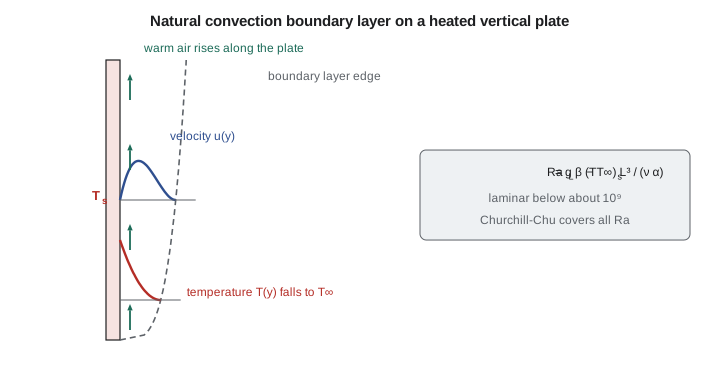
In natural convection the fluid velocity is not given; it is produced by the heat transfer itself. Near a heated vertical plate, a boundary layer forms in which the velocity is zero at the wall, rises to a maximum and falls back to zero at the edge of the layer, while the temperature falls from \(T_s\) to \(T_\infty\). The driving force is buoyancy, proportional to the density difference, which for small temperature differences is \(\rho\beta(T_s - T_\infty)\), where \(\beta\) is the volumetric thermal expansion coefficient. For an ideal gas, \(\beta = 1/T\), with \(T\) in kelvin, evaluated at the film temperature.
The relevant dimensionless group, playing the role that the Reynolds number plays in forced convection, is the Grashof number, the ratio of buoyancy to viscous forces. Combined with the Prandtl number, it gives the Rayleigh number, which governs heat transfer:
On a vertical plate the boundary layer is laminar for Rayleigh numbers below about \(10^9\) and becomes turbulent above that. Because \(\text{Ra}\) grows with \(L^3\), large surfaces reach turbulence: a 0.6 m panel in a room has \(\text{Ra} \approx 7\times10^8\), just laminar, while a 3 m wall would be turbulent.
Correlations for external natural convection
Natural convection correlations take the form \(\overline{\text{Nu}}_L = C\,\text{Ra}_L^n\), with \(n = 1/4\) for laminar and \(1/3\) for turbulent flow, or more general forms that cover both. The most widely used for a vertical plate is the Churchill-Chu correlation, valid for all Rayleigh numbers:
It also applies to vertical cylinders whose diameter is large compared with the boundary layer thickness. For a long horizontal cylinder, Churchill and Chu give a similar form based on the diameter, valid for \(\text{Ra}_D\) up to about \(10^{12}\):
Horizontal plates behave differently on their two faces. On the upper face of a hot plate, or the lower face of a cold one, buoyant plumes rise freely from the surface and heat transfer is relatively strong: \(\overline{\text{Nu}}_L = 0.54\,\text{Ra}_L^{1/4}\) for \(10^4\) to \(10^7\) and \(0.15\,\text{Ra}_L^{1/3}\) above that. On the lower face of a hot plate, warm fluid is trapped beneath and must creep out to the edges, so heat transfer is weak: \(\overline{\text{Nu}}_L = 0.52\,\text{Ra}_L^{1/5}\). For these correlations the characteristic length is the plate area divided by its perimeter. Spheres have their own correlation, approaching \(\text{Nu} = 2\) as the Rayleigh number falls.
# Natural convection: a hospital convector panel, bare pipe in the mechanical room, a tank top and a window
import math
g = 9.81
AIR = [(250, 11.44e-6, 0.0223, 0.720), (300, 15.89e-6, 0.0263, 0.707), (350, 20.92e-6, 0.0300, 0.700),
       (400, 26.41e-6, 0.0338, 0.690), (450, 32.39e-6, 0.0373, 0.686)]
def air(T):
    for a, b in zip(AIR, AIR[1:]):
        if a[0] <= T <= b[0]:
            f = (T - a[0]) / (b[0] - a[0])
            return tuple(x + f * (y - x) for x, y in zip(a[1:], b[1:]))
def Ra(Ts, Tinf, L):
    Tf = (Ts + Tinf) / 2 + 273.15
    nu, k, Pr = air(Tf)
    alpha = nu / Pr
    return g * (1 / Tf) * abs(Ts - Tinf) * L**3 / (nu * alpha), k, Pr, nu

def vertical_plate(Ra, Pr):                 # Churchill and Chu, all Rayleigh numbers
    return (0.825 + 0.387 * Ra**(1/6) / (1 + (0.492/Pr)**(9/16))**(8/27))**2
def horizontal_cylinder(Ra, Pr):            # Churchill and Chu, Ra up to about 1e12
    return (0.60 + 0.387 * Ra**(1/6) / (1 + (0.559/Pr)**(9/16))**(8/27))**2
sigma = 5.670e-8

# 1. A wall-mounted panel at 70 C, 0.6 m high, 1.2 m long, in a 21 C patient room
H, W, Ts, Tr = 0.6, 1.2, 70.0, 21.0
R, k, Pr, _ = Ra(Ts, Tr, H)
h = vertical_plate(R, Pr) * k / H
q_c = h * H * W * (Ts - Tr)
q_r = 0.9 * sigma * H * W * ((Ts+273.15)**4 - (Tr+273.15)**4)
print(f"panel front face: Ra = {R:.2e} ({'laminar' if R < 1e9 else 'turbulent'}), h = {h:.2f} W/m2.K, "
      f"convection {q_c:.0f} W, radiation {q_r:.0f} W")

# 2. A bare horizontal DN50 hot-water pipe (OD 60.3 mm) at 90 C in a 25 C mechanical room
D, Ts, Tr = 0.0603, 90.0, 25.0
R, k, Pr, _ = Ra(Ts, Tr, D)
h = horizontal_cylinder(R, Pr) * k / D
h_r = 0.85 * sigma * ((Ts+273.15)**4 - (Tr+273.15)**4) / (Ts - Tr)
print(f"bare pipe: Ra_D = {R:.2e}, h_conv = {h:.2f}, h_rad = {h_r:.2f} W/m2.K, loss {(h+h_r)*math.pi*D*(Ts-Tr):.0f} W/m")

# 3. The flat top of a 3 m diameter hot-water storage tank, 60 C surface in 20 C air (hot face up)
Dt, Ts, Tr = 3.0, 60.0, 20.0
Lc = (math.pi * Dt**2 / 4) / (math.pi * Dt)                 # area / perimeter
R, k, Pr, _ = Ra(Ts, Tr, Lc)
Nu_up = 0.54 * R**0.25 if R < 1e7 else 0.15 * R**(1/3)
Nu_dn = 0.52 * R**0.2                                       # hot face down (for comparison)
print(f"tank top: Ra = {R:.2e}, h(hot face up) = {Nu_up*k/Lc:.2f}, h(hot face down) = {Nu_dn*k/Lc:.2f} W/m2.K")

# 4. Air gap in a double-glazed control-room window, 1.2 m tall, panes at 15 C and -10 C
Hg, T1, T2 = 1.2, 15.0, -10.0
for Lg in (0.006, 0.013, 0.025, 0.050):
    R, k, Pr, _ = Ra(T1, T2, Lg)
    Nu_e = max(1.0, 0.42 * R**0.25 * Pr**0.012 * (Hg/Lg)**-0.3) if R > 1e3 else 1.0
    print(f"window gap {Lg*1000:4.0f} mm: Ra_L = {R:8.0f}, Nu = {Nu_e:.2f}, effective k = {Nu_e*k:.4f} W/m.K, "
          f"flux across the gap {Nu_e*k*(T1-T2)/Lg:5.1f} W/m2")

# 5. Is the panel's flow mixed? Compare buoyancy with a 0.3 m/s draft from a supply diffuser
R, k, Pr, nu = Ra(70.0, 21.0, 0.6)
Gr = R / Pr; Re = 0.3 * 0.6 / nu
print(f"Gr/Re^2 = {Gr/Re**2:.1f} ({'natural' if Gr/Re**2 > 10 else 'mixed' if Gr/Re**2 > 0.1 else 'forced'} convection dominates)")panel front face: Ra = 7.27e+08 (laminar), h = 5.13 W/m2.K, convection 181 W, radiation 234 W bare pipe: Ra_D = 8.25e+05, h_conv = 6.52, h_rad = 7.04 W/m2.K, loss 167 W/m tank top: Ra = 1.26e+09, h(hot face up) = 5.89, h(hot face down) = 1.25 W/m2.K window gap 6 mm: Ra_L = 728, Nu = 1.00, effective k = 0.0244 W/m.K, flux across the gap 101.5 W/m2 window gap 13 mm: Ra_L = 7404, Nu = 1.00, effective k = 0.0244 W/m.K, flux across the gap 46.8 W/m2 window gap 25 mm: Ra_L = 52659, Nu = 1.98, effective k = 0.0483 W/m.K, flux across the gap 48.3 W/m2 window gap 50 mm: Ra_L = 421273, Nu = 4.11, effective k = 0.1000 W/m.K, flux across the gap 50.0 W/m2 Gr/Re^2 = 10.1 (natural convection dominates)
Worked problem
A convector panel in a patient room
A wall panel 0.6 m high and 1.2 m long, at 70 °C, heats a patient room at 21 °C. Find the natural convection coefficient and the heat output from its front face by convection and radiation (emissivity 0.9, walls at room temperature). At a film temperature of 318.6 K: ν = 1.78 × 10⁻⁵ m²/s, k = 0.0277 W/m·K, Pr = 0.705.
Show solution
- \(\beta = 1/318.6\) K⁻¹; \(\text{Ra}_L = 9.81(1/318.6)(49)(0.6^3)/(1.78\times10^{-5} \cdot 2.52\times10^{-5}) = 7.3\times10^8\): laminar.
- Churchill-Chu: \(\overline{\text{Nu}}_L = 111\), so \(\bar h = 111(0.0277)/0.6 = 5.13\) W/m²·K.
- Convection: \(q = 5.13(0.72)(49) = 181\) W.
- Radiation: \(q = 0.9(5.67\times10^{-8})(0.72)(343.15^4 - 294.15^4) = 234\) W.
Answer: More than half of the panel's front-face output is radiation, which is why such units are often called radiators even though manufacturers rate them as convectors. Ratings published in catalogues are measured in test rooms and include both modes, the back face and any fins behind the panel. When Northgate lowers its supply temperature, the panel's output falls faster than the temperature difference, because both h and the radiation coefficient fall with it, so low-temperature district systems need larger emitters.
Worked problem
A bare hot-water pipe in the mechanical room
A horizontal DN50 hot-water pipe (outside diameter 60.3 mm) at 90 °C runs through a mechanical room at 25 °C. Its surface emissivity is 0.85. Find the convection and radiation coefficients and the heat loss per metre.
Show solution
- Film temperature 330.7 K; \(\text{Ra}_D = 8.3\times10^5\).
- Churchill-Chu for a horizontal cylinder: \(\overline{\text{Nu}}_D = 13.8\); \(h = 6.5\) W/m²·K.
- Radiation coefficient: \(h_r = 0.85\sigma(363.15^2 + 298.15^2)(363.15 + 298.15) = 7.0\) W/m²·K.
- \[q' = (6.5 + 7.0)\,\pi(0.0603)(65) = 167\ \text{W/m}\]
Answer: Thirty metres of such bare pipe in a mechanical room add 5 kW of unwanted heat, which then has to be removed by ventilation in summer. Insulating it with 25 mm of mineral wool would cut the loss by about 85 percent.
Enclosures
Natural convection inside a closed space, such as the gap between two panes of glass, a wall cavity or the air space in a solar collector, is described by an effective conductivity: \(k_{\text{eff}} = k\,\overline{\text{Nu}}\), so that the heat flux is \(k_{\text{eff}}(T_1 - T_2)/L\), where \(L\) is the gap width. For a vertical enclosure heated on one side and cooled on the other, there is no flow at all to speak of below a Rayleigh number of about 1000; the air conducts as if it were still, and \(\text{Nu} = 1\). Above that, a circulating cell forms and the Nusselt number rises. Correlations depend on the aspect ratio \(H/L\); one widely used form for tall enclosures is \(\overline{\text{Nu}}_L = 0.42\,\text{Ra}_L^{1/4}\text{Pr}^{0.012}(H/L)^{-0.3}\).
Worked problem
The gap in a double-glazed window
The control-room windows are 1.2 m tall, with the inner pane at 15 °C and the outer at −10 °C. Compare the heat flux across the gap for gap widths of 6, 13, 25 and 50 mm.
Show solution
- 6 mm: \(\text{Ra}_L = 730\), below the onset of convection, so \(\text{Nu} = 1\); flux 102 W/m².
- 13 mm: \(\text{Ra}_L = 7400\); the correlation gives a Nusselt number of about 1.0, so the gap still conducts; flux 47 W/m².
- 25 mm: \(\text{Ra}_L = 52{,}700\); \(\text{Nu} = 1.98\); flux 48 W/m².
- 50 mm: \(\text{Ra}_L = 421{,}000\); \(\text{Nu} = 4.1\); flux 50 W/m².
Answer: Widening the gap beyond about 13 to 20 mm brings no benefit, because convection grows as fast as the path lengthens. This is why sealed glazing units use gaps in that range, and why low-emissivity coatings and argon or krypton fill, which attack radiation and lower the gas conductivity, are the real routes to better windows. The 13 mm result also stretches the correlation beyond its tested aspect ratio, which is acceptable here only because conduction dominates.
Mixed convection
When a forced flow is weak and temperature differences are large, buoyancy and forced flow act together. The ratio \(\text{Gr}_L/\text{Re}_L^2\) measures their relative strength: if it is much less than 1, forced convection dominates; if it is much greater than 1, natural convection dominates; near 1, both matter and the flow is mixed. A common approximation combines the two Nusselt numbers as \(\text{Nu}^3 = \text{Nu}_F^3 \pm \text{Nu}_N^3\), with the plus sign when the flows assist each other and the minus sign when they oppose. For the convector panel, a 0.3 m/s draft from a nearby supply diffuser gives \(\text{Gr}/\text{Re}^2 \approx 10\), so natural convection still dominates, but a stronger draft would change the panel's output, which is why the hospital's air distribution design keeps supply jets away from the emitters.
Hydronic emitters sold in Canada are rated by manufacturers under standard test methods, and Canadian designers often derate catalogue outputs to the lower supply temperatures used in modern district and condensing-boiler systems. Fenestration performance is rated under CSA standards and the National Building Code, and window U-values are reported in W/m²·K; in Winnipeg's climate, triple glazing has become common in new institutional buildings.
Common mistakes
MistakeUsing T in °C for β of an ideal gas.
Insteadβ = 1/T with T in kelvin, at the film temperature.
MistakeUsing the vertical-plate correlation for a horizontal plate.
InsteadHorizontal faces need their own correlations and the length A/P.
MistakeIgnoring radiation in natural convection problems.
InsteadRadiation is often as large as natural convection in air.
MistakeAssuming any enclosed air gap convects.
InsteadBelow Ra ≈ 1000 the gap conducts with Nu = 1.
MistakeTreating weakly forced flows as purely forced.
InsteadCheck Gr/Re²; near 1 the flow is mixed.
Summary and key terms
- Natural convection is driven by buoyancy; its coefficients in air are only about 2 to 10 W/m²·K.
- The Rayleigh number Ra = gβΔT L³/(να) governs; vertical plates become turbulent near Ra = 10⁹.
- Churchill-Chu correlations cover vertical plates and horizontal cylinders over all Rayleigh numbers.
- Hot faces up transfer heat well; hot faces down transfer poorly.
- Enclosures use k_eff = k Nu; window gaps above about 13 to 20 mm bring little benefit.
- Gr/Re² decides whether flow is forced, natural or mixed.
- Natural convection
- Convection driven by density differences in a gravity field.
- Buoyancy
- The upward force on a fluid that is lighter than its surroundings.
- Volumetric expansion coefficient
- β, the fractional change of volume per kelvin; 1/T for an ideal gas.
- Grashof number
- Gr = gβΔT L³/ν², the ratio of buoyancy to viscous forces.
- Rayleigh number
- Ra = Gr Pr, the governing parameter for natural convection heat transfer.
- Churchill-Chu correlation
- A natural convection correlation valid over the whole Rayleigh range.
- Enclosure
- A closed space within which natural convection circulates.
- Effective conductivity
- k_eff = k Nu, used to express convection in an enclosure as conduction.
- Mixed convection
- Convection in which forced and buoyant flows are of similar importance.
Practice problems
Work each problem on paper first, then reveal the answer to check.
Find β for air at a film temperature of 320 K.
Show answer
1/320 = 0.003125 K⁻¹.
How does Ra change if the height of a vertical plate doubles?
Show answer
It rises eightfold.
In the program, lower the panel to 50 °C. Find the new convection output.
Show answer
About 93 W from the front face.
Why does a hot plate facing down transfer less heat than one facing up?
Show answer
Warm air is trapped below the plate and must flow to the edges to escape.
A gap has Nu = 1.5 and k = 0.025 W/m·K. Find k_eff.
Show answer
0.0375 W/m·K.
For Gr/Re² = 0.05, which mode dominates?
Show answer
Forced convection.
Lesson quiz · 5 questions
Score 60% or more to complete this lesson.
Create a free account to save your progress, take quizzes and earn a certificate.