
CHE-312 · Lesson 5 of 12 · 29 min
Transient conduction
Steady-state analysis tells Northgate how much heat its pipes lose in normal operation. Some of the most important questions, though, are about time. If a pump trips on a −30 °C night, how many hours before the water in a stopped service line freezes? How fast must a temperature sensor respond for a control loop to stay stable? How long does a concrete valve chamber take to cool when its heating fails, and how deep will frost reach under a cleared parking lot? These are transient conduction problems, in which temperatures change with time as well as position. This lesson presents three standard approaches: the lumped capacitance method, the one-term series solutions for walls, cylinders and spheres, and the semi-infinite solid.
The lumped capacitance method
The simplest transient model assumes that the temperature inside a body is uniform at every instant, so it changes only with time. An energy balance on the whole body, losing heat by convection to a fluid at \(T_\infty\), gives \(-hA_s(T - T_\infty) = \rho V c\,dT/dt\), whose solution is an exponential decay:
The time constant \(\tau\) is the product of a thermal resistance, \(1/(hA_s)\), and a thermal capacitance, \(\rho V c\). After one time constant the body has completed 63 percent of its temperature change; after three, 95 percent; after about 4.6, 99 percent. The analogy with a resistor-capacitor circuit is exact, and it extends to bodies cooled through insulation, where the resistance is that of the insulation rather than a convection film.
When is lumping valid?
The lumped model is accurate when conduction inside the body is fast compared with convection at its surface, so internal temperature differences stay small. The ratio of the two resistances is the Biot number:
where \(k\) is the conductivity of the solid, not of the fluid, and \(L_c\) is a characteristic length: half the thickness for a plane wall cooled on both faces, \(r_o/2\) for a long cylinder and \(r_o/3\) for a sphere. When Bi is less than about 0.1, the error of the lumped model is under about 5 percent. The time scale is described by the Fourier number, \(\text{Fo} = \alpha t/L_c^2\), a dimensionless time, and the lumped solution can be written compactly as \(\theta/\theta_i = \exp(-\text{Bi}\cdot\text{Fo})\).
# Transient conduction: lumped bodies, a plane wall by the one-term solution and frost in the ground
import math

# 1. Lumped capacitance: a bead thermocouple dropped into a hot-water stream
d, rho, c, k = 0.0010, 8500.0, 400.0, 25.0    # bead diameter (m) and properties of the junction
h = 1200.0                                    # water-side coefficient, W/m2.K
Lc = d / 6                                    # V/A for a sphere
Bi = h * Lc / k
tau = rho * c * Lc / h
print(f"thermocouple: Bi = {Bi:.4f}, time constant {tau:.2f} s; reaches 99 % of a step in {tau*math.log(100):.1f} s")

# 2. A stopped service pipe in winter: how long until the water reaches 0 C?
#    Water plus steel treated as one lumped mass; the foam is the resistance to the cold soil.
L_svc, Di = 1.0, 0.0545                       # per 1 m of DN50 service pipe (inside diameter, m)
m_w = 1000 * math.pi / 4 * Di**2 * L_svc       # water mass, kg
m_st = 7850 * math.pi / 4 * (0.0603**2 - Di**2) * L_svc
C = m_w * 4200 + m_st * 470                    # J/K
R = math.log(0.0625 / 0.03015) / (2 * math.pi * 0.027) + 0.5   # foam to a 125 mm casing plus soil, m.K/W (soil value assumed)
T_i, T_soil = 60.0, -8.0
tau_p = R * C
t0 = tau_p * math.log((T_i - T_soil) / (0 - T_soil))
print(f"service pipe: C = {C/1000:.1f} kJ/K, R' = {R:.2f} m.K/W, time constant {tau_p/3600:.1f} h, reaches 0 C after {t0/3600:.0f} h")

# 3. One-term solution: a 0.60 m concrete wall of a valve chamber, both faces suddenly at -25 C
def zeta1_plane(Bi):
    lo, hi = 1e-9, math.pi / 2 - 1e-12
    for _ in range(200):
        m = (lo + hi) / 2
        lo, hi = (m, hi) if m * math.tan(m) < Bi else (lo, m)
    return (lo + hi) / 2
kc, alpha, Lw, hc = 1.4, 6.9e-7, 0.30, 25.0   # concrete; half-thickness (m); windy outside coefficient
Bi_w = hc * Lw / kc
z1 = zeta1_plane(Bi_w)
C1 = 4 * math.sin(z1) / (2 * z1 + math.sin(2 * z1))
T0, Tinf = 10.0, -25.0
for hours in (12, 24, 48, 96):
    Fo = alpha * hours * 3600 / Lw**2
    th = C1 * math.exp(-z1**2 * Fo)
    flag = "" if Fo > 0.2 else "  (Fo < 0.2: one-term solution only approximate)"
    print(f"wall midplane after {hours:3d} h: Fo = {Fo:.3f}, T = {Tinf + th*(T0 - Tinf):6.1f} C{flag}")
print(f"  Bi = {Bi_w:.2f}, zeta1 = {z1:.4f}, C1 = {C1:.4f}")

# 4. Semi-infinite solid: depth reached by 0 C after a long cold spell (no latent heat, so an upper bound)
alpha_s, Ti_g, Ts = 5.5e-7, 5.0, -15.0       # frozen-soil diffusivity (assumed), initial ground, surface
def erfinv(y):
    lo, hi = 0.0, 5.0
    for _ in range(100):
        m = (lo + hi) / 2
        lo, hi = (m, hi) if math.erf(m) < y else (lo, m)
    return (lo + hi) / 2
eta0 = erfinv((0 - Ts) / (Ti_g - Ts))
for days in (30, 60, 100):
    t = days * 86400
print(f"after {days:3d} days at the surface temperature: 0 C isotherm at {2*eta0*math.sqrt(alpha_s*t):.2f} m")thermocouple: Bi = 0.0080, time constant 0.47 s; reaches 99 % of a step in 2.2 s service pipe: C = 11.7 kJ/K, R' = 4.80 m.K/W, time constant 15.6 h, reaches 0 C after 33 h wall midplane after 12 h: Fo = 0.331, T = -0.7 C wall midplane after 24 h: Fo = 0.662, T = -11.5 C wall midplane after 48 h: Fo = 1.325, T = -20.8 C wall midplane after 96 h: Fo = 2.650, T = -24.6 C Bi = 5.36, zeta1 = 1.3278, C1 = 1.2433 after 30 days at the surface temperature: 0 C isotherm at 1.94 m after 60 days at the surface temperature: 0 C isotherm at 2.75 m after 100 days at the surface temperature: 0 C isotherm at 3.55 m
Worked problem
Thermocouple response
A bead thermocouple of 1.0 mm diameter (ρ = 8500 kg/m³, c = 400 J/kg·K, k = 25 W/m·K) is placed in the district water flow with h = 1200 W/m²·K. Find the Biot number, the time constant and the time to reach 99 percent of a step change.
Show solution
- For a sphere, \(L_c = D/6 = 1.67 \times 10^{-4}\) m; \(\text{Bi} = 1200(1.67\times10^{-4})/25 = 0.008\), so lumping is valid.
- \(\tau = \rho c L_c/h = 8500(400)(1.67\times10^{-4})/1200 = 0.47\) s.
- \[t_{99\%} = \tau \ln 100 = 4.6\tau = 2.2\ \text{s}\]
Answer: In air, with h nearer 50 W/m²·K, the same bead would have a time constant of about 11 s. Sensors installed in thermowells respond far more slowly, often taking a minute or more, because the well adds both mass and resistance. Control engineers must include that lag when tuning loops.
Worked problem
How long before a stopped service line freezes?
A DN50 steel service pipe (inside diameter 54.5 mm, outside 60.3 mm) carrying water at 60 °C is insulated with polyurethane foam (k = 0.027 W/m·K) inside a 125 mm casing and buried in soil at −8 °C. A pump fails and the water stops. Treating the water and steel as one lumped mass, with the foam and an assumed soil resistance of 0.5 m·K/W in series, estimate the time for the water to reach 0 °C.
Show solution
- Per metre: water mass \(1000 \cdot \tfrac{\pi}{4}(0.0545)^2 = 2.33\) kg; steel mass 3.78 kg.
- \(C' = 2.33(4200) + 3.78(470) = 11.7\) kJ/K per metre.
- \(R' = \ln(62.5/30.15)/(2\pi \cdot 0.027) + 0.5 = 4.30 + 0.5 = 4.80\) m·K/W.
- \(\tau = R'C' = 4.80 \times 11{,}700 = 56{,}100\) s = 15.6 h.
- \[t = \tau \ln\frac{60 - (-8)}{0 - (-8)} = 15.6 \ln 8.5 = 33\ \text{h}\]
Answer: The water would take more than a day to reach 0 °C, and freezing itself would take much longer, because removing the latent heat of the water, 334 kJ/kg, takes about four times as long as cooling it from 60 °C to 0 °C. The lumped model is reasonable here because the water and steel have a small internal resistance compared with the foam. This is the basis for Northgate's operating rule that a stopped service in winter must be restored, or drained, within 24 hours. Insulation buys time; it never prevents freezing indefinitely.
Spatial effects: the one-term solutions
When the Biot number exceeds about 0.1, the temperature inside the body varies significantly, and the heat equation must be solved in space and time. For a plane wall of thickness \(2L\), a long cylinder or a sphere, initially at \(T_i\) and suddenly exposed to fluid at \(T_\infty\) on all surfaces, the exact solutions are infinite series. For Fourier numbers above about 0.2, all terms but the first are negligible, and the midplane or centre temperature is
where \(\zeta_1\) and \(C_1\) depend only on the Biot number, here defined with \(L\) (the half-thickness) or \(r_o\). For a plane wall, \(\zeta_1\) is the first root of \(\zeta\tan\zeta = \text{Bi}\) and \(C_1 = 4\sin\zeta_1/(2\zeta_1 + \sin 2\zeta_1)\); for a cylinder, \(\zeta_1 J_1(\zeta_1)/J_0(\zeta_1) = \text{Bi}\), with Bessel functions; for a sphere, \(1 - \zeta_1\cot\zeta_1 = \text{Bi}\). Tables of \(\zeta_1\) and \(C_1\) appear in every heat transfer text. The temperature at any position is the centre value multiplied by a shape function, \(\cos(\zeta_1 x/L)\) for a wall, and the energy removed up to time \(t\) as a fraction of the maximum possible is also given in closed form.

Worked problem
A valve chamber wall
A concrete valve chamber has walls 0.60 m thick (k = 1.4 W/m·K, α = 6.9 × 10⁻⁷ m²/s) at a uniform 10 °C when its heater fails. Assume both faces are exposed to −25 °C with h = 25 W/m²·K (a conservative simplification, since the inside air would cool more slowly). Find the midplane temperature after 12, 24 and 48 hours.
Show solution
- \(\text{Bi} = hL/k = 25(0.30)/1.4 = 5.36\); solving \(\zeta\tan\zeta = 5.36\) gives \(\zeta_1 = 1.328\), \(C_1 = 1.243\).
- 12 h: \(\text{Fo} = 6.9\times10^{-7}(43{,}200)/0.30^2 = 0.331\); \(\theta_0^* = 1.243\,e^{-1.763(0.331)} = 0.694\); \(T_0 = -25 + 0.694(35) = -0.7\) °C.
- 24 h: Fo = 0.662, \(T_0 = -11.5\) °C. 48 h: Fo = 1.325, \(T_0 = -20.8\) °C.
Answer: The concrete's large thermal mass delays freezing at the centre of the wall by about half a day, but not much longer. Valves and instruments inside the chamber, with much less mass, would freeze sooner, so the chamber's heater has a low-temperature alarm that pages the operator on call.
The semi-infinite solid
A body that extends far enough from its surface that the far side never feels a surface change behaves as a semi-infinite solid. The ground beneath a surface, a thick wall early in a transient, and a metal part touched briefly by a hot tool all fit this model. For a sudden change of surface temperature from \(T_i\) to \(T_s\), the solution is
where erf is the Gauss error function, available in every calculator library. The penetration depth of a temperature change grows with \(\sqrt{\alpha t}\), so a disturbance that reaches 1 m in 30 days reaches only 2 m after 120 days. Related solutions exist for a constant surface heat flux and for convection at the surface, and for two semi-infinite bodies suddenly brought into contact, which explains why steel feels colder to the touch than wood at the same temperature: the contact temperature is weighted toward the body with the larger \(\sqrt{k\rho c}\).
Worked problem
Frost under a cleared parking lot
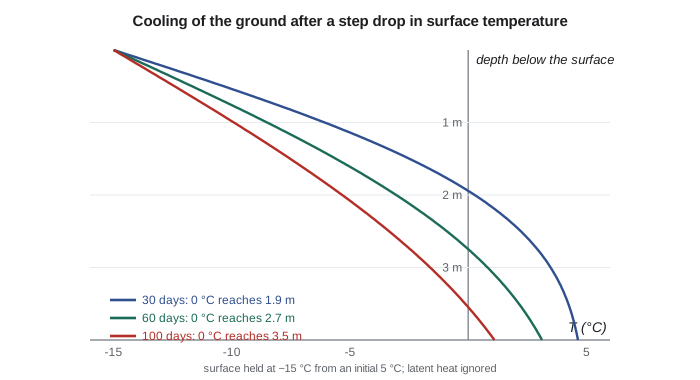
Ground initially at 5 °C has its surface held at −15 °C by a cleared, snow-free parking lot. Using α = 5.5 × 10⁻⁷ m²/s and ignoring latent heat, find the depth of the 0 °C isotherm after 30, 60 and 100 days.
Show solution
- The 0 °C isotherm satisfies \(\operatorname{erf}(\eta) = (0 + 15)/(5 + 15) = 0.75\), so \(\eta = 0.813\).
- 30 days: \(x = 2(0.813)\sqrt{5.5\times10^{-7}(2.59\times10^6)} = 1.94\) m.
- 60 days: 2.75 m. 100 days: 3.55 m.
Answer: These depths are upper bounds, because freezing the soil's moisture releases latent heat that slows the frost front considerably; the Stefan solution and its engineering forms account for this. Observed frost depths in cleared areas of the prairies are typically around 1.5 to 2.5 m. The result still makes the key point: snow cover, which insulates the surface, and the depth of burial are what protect buried water lines.
Canadian utilities in cold regions design buried water and sewer services for frost, and many prairie municipalities require services to be buried 2.4 m or more, or insulated with rigid foam boards where depth is limited. Northgate's own design guide requires heat tracing or insulation on any service where the 24-hour freeze estimate is uncomfortably short, and the operating procedure for a winter outage is written around it.
Common mistakes
MistakeUsing the fluid's conductivity in the Biot number.
InsteadBi = hL_c/k uses the solid's conductivity.
MistakeApplying lumped capacitance with Bi above 0.1.
InsteadCheck Bi first; use the one-term or numerical solution otherwise.
MistakeUsing the full thickness as L in a wall cooled on both sides.
InsteadL is the half-thickness when both faces are exposed.
MistakeUsing the one-term solution at very small times.
InsteadIt requires Fo above about 0.2; early on, use the semi-infinite solution.
MistakeIgnoring latent heat in freezing problems.
InsteadPhase change slows freezing greatly; sensible-only estimates are bounds.
Summary and key terms
- Lumped capacitance gives exponential decay with time constant τ = ρVc/(hA_s) = R_t C_t.
- Lumping is valid when Bi = hL_c/k is below about 0.1, with L_c = V/A_s.
- A stopped insulated service line reaches 0 °C in about a day and a half; freezing takes much longer.
- For Bi > 0.1 and Fo > 0.2, one-term solutions give centre temperatures of walls, cylinders and spheres.
- A semi-infinite solid responds with an error-function profile; penetration grows as √(αt).
- Latent heat and snow cover strongly limit frost penetration.
- Transient conduction
- Conduction in which temperatures change with time.
- Lumped capacitance
- A model that treats a body's temperature as uniform in space.
- Time constant
- τ = ρVc/(hA_s), the time for 63 percent of a step response.
- Biot number
- Bi = hL_c/k, the ratio of internal conduction to surface convection resistance.
- Fourier number
- Fo = αt/L², a dimensionless time.
- One-term solution
- The first term of the series solution for transient conduction, valid for Fo above about 0.2.
- Semi-infinite solid
- A body so deep that its far side does not respond during the time of interest.
- Error function
- The function erf(η) that describes temperature in a semi-infinite solid after a surface step.
- Thermal capacitance
- ρVc, the energy stored per kelvin of temperature change.
Practice problems
Work each problem on paper first, then reveal the answer to check.
A copper sphere of 10 mm diameter (k = 400 W/m·K) is cooled with h = 100 W/m²·K. Is lumping valid?
Show answer
Bi = 100(0.00167)/400 = 0.0004; yes.
A body has τ = 120 s. How long until it completes 95 percent of a step change?
Show answer
About 3τ = 360 s.
In the program, double the foam resistance of the service line. How does the time to 0 °C change?
Show answer
It nearly doubles, to about 63 h, since τ is proportional to the total resistance.
Find the Biot number of a 0.2 m thick steel slab (k = 45 W/m·K), cooled on both faces with h = 200 W/m²·K.
Show answer
Bi = 200(0.1)/45 = 0.44; lumping is not valid.
How much longer does it take a temperature change to penetrate twice as deep into a semi-infinite solid?
Show answer
Four times as long.
Why does steel feel colder than wood at the same temperature?
Show answer
Its larger √(kρc) pulls the contact temperature toward its own.
Lesson quiz · 5 questions
Score 60% or more to complete this lesson.
Create a free account to save your progress, take quizzes and earn a certificate.