
CHE-250 · Lesson 6 of 12 · 24 min
Solutions and colligative properties
Most of the liquids at Kingfisher Bioenergy are solutions. The mash entering the fermenters is a solution of sugars and dextrins in water; the beer leaving them is a solution of ethanol, carbon dioxide and dissolved solids; the thin stillage sent to the evaporators carries proteins, salts and glycerol. Lesson 5 dealt with pure substances. This lesson asks what happens when a second substance dissolves in a liquid: how the chemical potential of the solvent changes, why solutions freeze lower and boil higher than pure solvents, and why water moves across a membrane toward a more concentrated solution with enough force to drive a whole technology, reverse osmosis.
Theo's tasks for this lesson are practical. The plant's water treatment supervisor wants to know what pressure the reverse osmosis unit must reach to recover clean water from evaporator condensate. The fermentation team asks why a mash with 30 percent dissolved sugar does not freeze in an outdoor tank on a cold night, and the lab wants a quick way to estimate the molar mass of an unknown dissolved carbohydrate. All three answers come from the same idea.
Describing composition
Several measures of composition are used for solutions, and colligative property formulas each prefer one. Mole fraction, \(x_i = n_i/n_{total}\), is natural for thermodynamics. Molality, \(m\), the moles of solute per kilogram of solvent, does not change with temperature because it depends only on masses, which makes it the preferred unit for freezing and boiling points. Molarity, \(c\), moles per litre of solution, is convenient in the lab and appears in osmotic pressure. In dilute aqueous solutions molality and molarity are nearly equal, because a litre of solution contains close to a kilogram of water.
Ideal solutions and the entropy of mixing
An ideal solution is one in which the different molecules interact with each other just as strongly as like molecules do, so mixing produces no heat and no volume change. Mixing is still spontaneous, because it increases entropy. For an ideal mixture formed from pure components at the same temperature and pressure:
Because every mole fraction is less than one, every logarithm is negative, so \(\Delta_{mix}S\) is positive and \(\Delta_{mix}G\) negative. For an equimolar binary mixture at 25 °C, \(\Delta_{mix}G = RT\ln 0.5 = -1.72\) kJ per mole of mixture. Mixing is a purely entropic process in an ideal solution, the same entropy-driven tendency that pulls the equilibrium minimum of Lesson 4 away from pure products.
In an ideal solution, the chemical potential of each component is lowered from its pure-liquid value by \(RT\ln x_i\):
where \(\mu_i^*\) is the chemical potential of pure liquid \(i\). That single equation underlies Raoult's law in Lesson 7 and all four colligative properties in this lesson. Real solutions such as ethanol and water depart from it, and those departures are measured with activity coefficients, introduced in Lesson 7. Mixing 50 mL of ethanol with 50 mL of water gives only about 96 mL of solution, a sign of strong ethanol-water attraction through hydrogen bonds. The beer column and every ethanol plant volume calculation have to account for that contraction, which is why ethanol content is measured with density tables rather than by simply adding volumes.
Colligative properties
Colligative properties depend on the number of dissolved particles, not on their identity. There are four: lowering of the solvent's vapour pressure, elevation of its boiling point, depression of its freezing point and osmotic pressure. All four have the same origin. A nonvolatile solute lowers the chemical potential of the solvent in the liquid phase by \(RT\ln x_{solvent}\), while the pure solid solvent and the pure solvent vapour are unaffected. The liquid therefore becomes more stable relative to the other phases over a wider range of conditions.
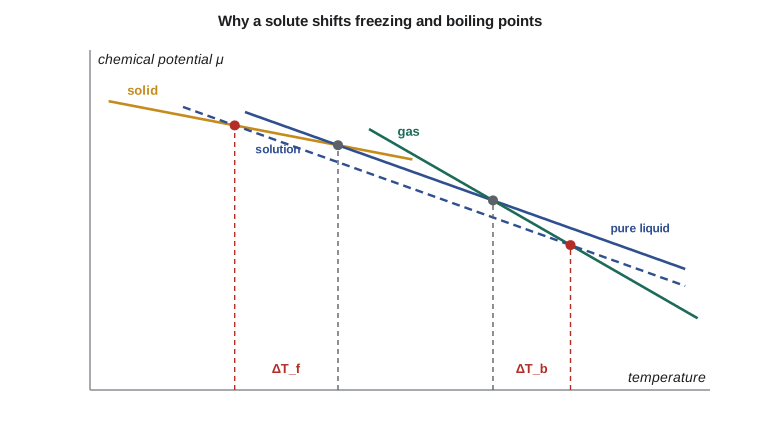
The figure shows the effect. Lowering the liquid line moves its intersection with the solid line to lower temperature, so the freezing point falls, and moves its intersection with the gas line to higher temperature, so the boiling point rises. Because the solid line is steeper than the gas line near the crossing points, the same drop in chemical potential shifts the freezing point more than the boiling point: freezing point depression is always larger than boiling point elevation for the same solution.
Vapour pressure lowering
For a nonvolatile solute in an ideal solution, the solvent's vapour pressure is proportional to its mole fraction, \(P = x_{solvent} P^*\), where \(P^*\) is the vapour pressure of the pure solvent. The fractional lowering, \((P^* - P)/P^*\), therefore equals the mole fraction of solute. A 30 weight percent glucose solution has a glucose mole fraction of about 0.041, so its water vapour pressure is about 4 percent lower than that of pure water at the same temperature. Evaporators concentrating stillage must run slightly hotter than the boiling point of pure water at their operating pressure, and the difference, called boiling point rise, grows as the syrup becomes more concentrated.
Boiling point elevation and freezing point depression
For dilute solutions, combining the chemical potential of the solvent with the Clausius-Clapeyron equation gives simple linear formulas:
where \(m\) is the molality of solute particles. The constants depend only on the solvent. For water, \(K_b = 0.512\) K kg/mol and \(K_f = 1.86\) K kg/mol. The constants are derived from the solvent's own properties, for example \(K_f = RT_f^2 M_{solvent}/\Delta_{fus}H\), so solvents with low enthalpies of fusion and high molar masses have large constants. Camphor, with \(K_f\) near 40 K kg/mol, was once a favourite solvent for molar mass measurements for that reason.
Worked problem
Will the mash freeze?
A mash tank holds a solution of 30 percent glucose by mass. Estimate its freezing point, treating the solution as ideal and dilute.
Show solution
- In 1 kg of solution: 300 g glucose and 700 g water. Moles of glucose \(= 300/180.16 = 1.665\) mol.
- Molality \(= 1.665/0.700 = 2.38\) mol/kg.
- \(\Delta T_f = 1.86 \times 2.38 = 4.4\) K, so the freezing point is about −4.4 °C.
Answer: About −4.4 °C. The solution is too concentrated for the dilute formula to be exact, so the true value is a little lower, but the estimate shows that a tank of mash survives a mild frost that would freeze a tank of water. A real mash contains larger dextrins as well as glucose, which contribute fewer particles per gram and less depression.
Electrolytes dissociate into ions, and each ion counts as a separate particle. The van 't Hoff factor \(i\) multiplies the molality: \(i = 2\) for sodium chloride, 3 for calcium chloride, in dilute solution. In concentrated solutions ions associate partly and \(i\) is somewhat smaller. Road salt works by this principle: a sodium chloride solution can stay liquid down to about −21 °C, which is why salt is ineffective on very cold days and calcium chloride, with three ions and a lower eutectic, is used instead.
Worked problem
Molar mass from freezing point depression
The lab dissolves 10.0 g of an unknown carbohydrate in 200 g of water and measures a freezing point of −0.465 °C. Estimate the molar mass.
Show solution
- \(m = \Delta T_f/K_f = 0.465/1.86 = 0.250\) mol/kg.
- Moles of solute \(= 0.250 \times 0.200 = 0.0500\) mol.
- \(M = 10.0/0.0500 = 200\) g/mol.
Answer: About 200 g/mol, between a monosaccharide (180) and a disaccharide (342), suggesting a mixture or a sugar alcohol. Freezing point measurements are still used in clinical labs, where osmometers measure the total particle concentration of blood and urine.
Osmotic pressure
When a solution is separated from pure solvent by a membrane that lets solvent through but not solute, solvent flows into the solution. The flow continues until the pressure on the solution side rises enough to raise the solvent's chemical potential back to that of the pure solvent. The extra pressure needed is the osmotic pressure, \(\Pi\). For dilute solutions it obeys the van 't Hoff equation, which looks just like the ideal gas law:
with \(c\) in mol/m³ to give \(\Pi\) in pascals. Osmotic pressures are large. A 0.10 mol/L glucose solution at 30 °C has an osmotic pressure of about 2.5 bar, enough to support a column of water 25 m high. That is why osmotic pressure is the most sensitive colligative property and is used to measure the molar masses of proteins and polymers, whose freezing point effects are too small to detect.
If a pressure greater than \(\Pi\) is applied to the solution side, solvent flows the other way, out of the solution and through the membrane. That is reverse osmosis, used worldwide to desalinate seawater and at many ethanol plants to polish water for the boilers and cooling towers. Seawater, about 0.6 mol/L sodium chloride, has an osmotic pressure near 30 bar, so desalination plants typically run at 55 to 80 bar to get a useful flow. Evaporator condensate at an ethanol plant is much more dilute, so a lower pressure suffices to recover it as clean process water.
| Solution at 30 °C | Particle concentration (mol/L) | Osmotic pressure (bar) |
|---|---|---|
| 0.10 M glucose | 0.10 | 2.5 |
| 0.10 M sodium chloride | 0.20 | 5.0 |
| Seawater-like 0.6 M sodium chloride | 1.2 | 30 |
| Typical evaporator condensate | about 0.01 | about 0.25 |
Calculating colligative properties
The program below calculates freezing points and boiling point rises for fermentation solutions, osmotic pressures for several solutions relevant to water treatment, the ideal Gibbs energy and entropy of mixing for a binary mixture, and the molar mass of the unknown solute from the example above.
# Colligative properties of fermentation solutions and the ideal Gibbs energy of mixing
import math
R = 8.314
Kf, Kb = 1.86, 0.512        # water, K kg/mol

def molality(mass_frac, M):
    # mol solute per kg water for a binary solution
    return mass_frac / M * 1000 / (1 - mass_frac)

# glucose (180.16 g/mol) at the start of fermentation, and ethanol at the end
for label, w, M in (('glucose 30 wt%', 0.30, 180.16), ('glucose 5 wt%', 0.05, 180.16)):
    m = molality(w, M)
    print(f"{label:16s} m = {m:5.2f} mol/kg  freezing point = {-Kf * m:6.2f} C  boiling point rise = {Kb * m:5.2f} K")
# ethanol is volatile, so only the freezing point estimate applies
m = molality(0.12, 46.07)
print(f"ethanol 12 wt%   m = {m:5.2f} mol/kg  freezing point = {-Kf * m:6.2f} C  (volatile: no boiling point rise)")

# osmotic pressure (van 't Hoff, dilute): glucose and salt solutions at 30 C
T = 303.15
for label, c, i in (('0.10 M glucose', 100, 1), ('0.10 M NaCl', 100, 2), ('seawater-like 0.6 M NaCl', 600, 2)):
    print(f"{label:26s} osmotic pressure = {i * c * R * T / 1e5:6.1f} bar")   # c in mol/m3

# ideal Gibbs energy and entropy of mixing for 1 mol of a binary at 298 K
print()
for x in (0.1, 0.3, 0.5):
    dS = -R * (x * math.log(x) + (1 - x) * math.log(1 - x))
    print(f"x = {x}: dS_mix = {dS:5.2f} J/(mol K), dG_mix = {-298.15 * dS / 1000:6.3f} kJ/mol")

# molar mass of an unknown sugar from freezing point depression
dTf, w_solute, w_water = 0.465, 10.0, 200.0   # K, g, g
M = Kf * w_solute / (dTf * w_water / 1000)
print(f"\nunknown solute: M = {M:.0f} g/mol")glucose 30 wt% m = 2.38 mol/kg freezing point = -4.42 C boiling point rise = 1.22 K glucose 5 wt% m = 0.29 mol/kg freezing point = -0.54 C boiling point rise = 0.15 K ethanol 12 wt% m = 2.96 mol/kg freezing point = -5.51 C (volatile: no boiling point rise) 0.10 M glucose osmotic pressure = 2.5 bar 0.10 M NaCl osmotic pressure = 5.0 bar seawater-like 0.6 M NaCl osmotic pressure = 30.2 bar x = 0.1: dS_mix = 2.70 J/(mol K), dG_mix = -0.806 kJ/mol x = 0.3: dS_mix = 5.08 J/(mol K), dG_mix = -1.514 kJ/mol x = 0.5: dS_mix = 5.76 J/(mol K), dG_mix = -1.718 kJ/mol unknown solute: M = 200 g/mol
Ethanol lowers the freezing point of water, which is why beer and spirits freeze below 0 °C, but it does not raise the boiling point. Ethanol is itself volatile, so the colligative boiling point formula, which assumes a nonvolatile solute, does not apply. A mixture of two volatile liquids needs the vapour-liquid equilibrium methods of Lesson 7.
Common mistakes
MistakeUsing molarity instead of molality in the freezing point formula.
InsteadΔT_f = K_f m uses molality, moles per kilogram of solvent.
MistakeForgetting the van 't Hoff factor for electrolytes.
InsteadCount every ion: sodium chloride gives about two particles per formula unit.
MistakeApplying boiling point elevation to a volatile solute such as ethanol.
InsteadThe formula assumes the solute does not evaporate; volatile mixtures need Raoult's law for both components.
MistakeUsing the dilute formulas at high concentration without caution.
InsteadThey become approximate above about 1 mol/kg; real solutions deviate from ideality.
Summary and key terms
- Ideal mixing has ΔH = 0 and is driven entirely by entropy: ΔmixG = nRT Σ xᵢ ln xᵢ.
- In an ideal solution the solvent's chemical potential is lowered by RT ln x_solvent.
- Colligative properties depend only on the number of dissolved particles.
- ΔT_b = K_b m and ΔT_f = K_f m; for water K_b = 0.512 and K_f = 1.86 K kg/mol.
- Osmotic pressure Π = icRT is large and is reversed in reverse osmosis.
- Electrolytes contribute one particle per ion, measured by the van 't Hoff factor i.
- Ideal solution
- A solution in which unlike molecules interact like like molecules, so mixing has no heat or volume change.
- Molality
- Moles of solute per kilogram of solvent.
- Colligative property
- A property that depends on the number of solute particles rather than their identity.
- Freezing point depression
- The lowering of a solvent's freezing point by a dissolved solute, ΔT_f = K_f m.
- Boiling point elevation
- The raising of a solvent's boiling point by a nonvolatile solute, ΔT_b = K_b m.
- Osmotic pressure
- The pressure needed to stop solvent flowing through a semipermeable membrane into a solution.
- Reverse osmosis
- Forcing solvent out of a solution through a membrane by applying a pressure greater than the osmotic pressure.
- Van 't Hoff factor
- The number of particles each formula unit of solute produces in solution.
Practice problems
Work each problem on paper first, then reveal the answer to check.
What is the freezing point of a 1.0 mol/kg aqueous solution of calcium chloride, assuming complete dissociation?
Show answer
\(\Delta T_f = 3 \times 1.86 \times 1.0 = 5.6\) K, so about −5.6 °C.
Calculate ΔmixG for 1 mol of an ideal mixture with x = 0.2 at 300 K.
Show answer
\(8.314 \times 300 \times (0.2\ln 0.2 + 0.8\ln 0.8) = -1.25\) kJ.
What is the osmotic pressure of 0.050 mol/L glucose at 25 °C?
Show answer
\(50 \times 8.314 \times 298 = 1.24 \times 10^5\) Pa, or 1.24 bar.
Why is freezing point depression larger than boiling point elevation for the same solution?
Show answer
Near the crossings, the solid's chemical potential line is steeper than the vapour's, so the same drop shifts the freezing point more.
By what fraction does 0.5 mole fraction of a nonvolatile solute lower a solvent's vapour pressure in an ideal solution?
Show answer
By half, since P = x_solvent P*.
Why can't freezing point depression measure the molar mass of a large protein accurately?
Show answer
A gram of protein gives so few particles that ΔT_f is too small to measure; osmotic pressure is far more sensitive.
Lesson quiz · 5 questions
Score 60% or more to complete this lesson.
Create a free account to save your progress, take quizzes and earn a certificate.