
CHE-250 · Lesson 2 of 12 · 23 min
Real gases and intermolecular forces
The kinetic theory of Lesson 1 treats molecules as points that never attract each other. That picture cannot explain why carbon dioxide condenses to a liquid when the neighbouring liquefaction plant compresses and cools it, or why the gas is noticeably less compressible than an ideal gas near its critical point. In CHE-220 you handled those effects with equations of state: the virial equation, cubic equations such as Peng-Robinson, and generalized correlations. This lesson explains where those equations come from. Real gases deviate from ideality because real molecules have size and because they attract each other, and both effects can be described by a single curve, the intermolecular potential energy.
Theo's question for this lesson comes from the carbon dioxide buyer's specification sheet, which quotes a second virial coefficient and a critical temperature. Ingrid asks him to explain, in molecular terms, why carbon dioxide is so much easier to liquefy than nitrogen, why ethanol vapour behaves less ideally than carbon dioxide at the same reduced conditions, and how anyone can estimate the size of a molecule from a pressure-volume measurement.
The intermolecular potential
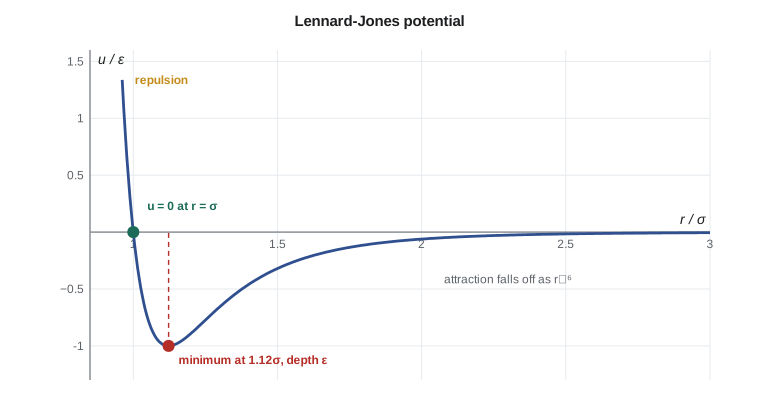
Consider two molecules approaching each other. Far apart, they do not interact and their potential energy is zero. As they come closer, they begin to attract, and the potential energy falls below zero. At very close range their electron clouds overlap and they repel strongly, so the potential energy rises steeply. The curve of potential energy against separation therefore has a minimum, a potential well, at some distance comparable to the molecular diameter. The depth of the well measures how strongly the molecules attract; the position of the steep wall measures their size.
The most widely used model of this curve is the Lennard-Jones 12-6 potential:
Here \(\sigma\) is the separation at which the potential crosses zero, a measure of molecular diameter, and \(\varepsilon\) is the depth of the well. The \(r^{-6}\) term represents attraction and has a sound physical basis: dispersion forces between neutral molecules fall off with the sixth power of distance. The \(r^{-12}\) term represents repulsion; its exponent is chosen mainly for mathematical convenience. The minimum lies at \(r_{min} = 2^{1/6}\sigma \approx 1.12\sigma\). Parameters are usually quoted as \(\sigma\) in nanometres or ångströms and \(\varepsilon/k_B\) in kelvins, so that \(\varepsilon/k_B\) can be compared directly with temperature.
| Gas | σ (nm) | ε/k_B (K) | Critical temperature (K) |
|---|---|---|---|
| Helium | 0.256 | 10 | 5.2 |
| Nitrogen | 0.370 | 95 | 126 |
| Methane | 0.376 | 148 | 191 |
| Carbon dioxide | 0.394 | 195 | 304 |
| Ethanol | 0.453 | 362 | 514 |
The table shows a striking pattern. The critical temperature, above which a gas cannot be liquefied however hard it is compressed, is roughly 1.3 times \(\varepsilon/k_B\) for simple molecules. That makes sense: a liquid can form only when the thermal energy \(k_BT\) is small enough that molecules can be held in each other's potential wells. Helium, with a well only 10 K deep, must be cooled to about 5 K before it liquefies. Carbon dioxide, with a well about 195 K deep, can be liquefied at room temperature, which is why the neighbouring plant can store it as a liquid in insulated tanks at around −20 °C and 20 bar rather than needing cryogenic equipment.
Where attraction comes from
Three kinds of attraction act between neutral molecules, and you met them qualitatively in CHE-243. Dispersion forces arise because the electron cloud of any molecule fluctuates, creating a momentary dipole that induces a dipole in a neighbour; they act between all molecules and grow with the number of electrons and the size of the molecule. Dipole-dipole forces act between molecules with permanent dipoles; averaged over rotation, they too fall off as \(r^{-6}\). Hydrogen bonds are especially strong, directional dipole interactions involving H attached to O, N or F.
Carbon dioxide has no dipole moment, but it has a quadrupole: each oxygen carries a partial negative charge and the carbon a partial positive one. Quadrupole interactions add to its dispersion attraction, which is one reason carbon dioxide liquefies more easily than nitrogen, a molecule of similar size. Ethanol vapour adds strong hydrogen bonding, so its molecules form short-lived pairs even in the gas, and its behaviour departs from the ideal gas law more than its size alone would suggest.
The van der Waals picture
Johannes van der Waals proposed the first useful equation of state for real gases in 1873 by correcting the ideal gas law for the two effects just described:
The constant \(b\) is the excluded volume per mole. Two hard spheres of diameter \(d\) cannot approach closer than \(d\), so each pair excludes a sphere of radius \(d\) from the other. Working through the geometry gives \(b = \tfrac{2}{3}\pi N_A d^3\), four times the actual volume of the molecules. The term \(a/V_m^2\) accounts for attraction: molecules near a wall are pulled back by their neighbours, so they strike the wall less hard, and the effect is proportional to the square of the concentration. Larger \(a\) means stronger attraction.
In CHE-220 you used the conditions at the critical point to express \(a\) and \(b\) in terms of the critical temperature and pressure, \(a = 27R^2T_c^2/(64P_c)\) and \(b = RT_c/(8P_c)\). Turning that around gives a simple way to estimate molecular size from macroscopic data, as the next example shows. The estimates are rough, because the van der Waals equation is a crude model, but they land within about 20 percent of diameters measured by other methods, which was a remarkable achievement in the 1870s, before most chemists accepted that molecules were real.
Worked problem
Estimating the size of a carbon dioxide molecule
Carbon dioxide has \(T_c = 304.1\) K and \(P_c = 73.8\) bar. Estimate the van der Waals constant \(b\) and the molecular diameter it implies.
Show solution
- \(b = RT_c/(8P_c) = (8.314)(304.1)/(8 \times 73.8 \times 10^5) = 4.28 \times 10^{-5}\) m³/mol, or 42.8 cm³/mol.
- Solve \(b = \tfrac{2}{3}\pi N_A d^3\) for \(d\): \(d^3 = 3b/(2\pi N_A) = 3(4.28 \times 10^{-5})/(2\pi \times 6.022 \times 10^{23}) = 3.39 \times 10^{-29}\) m³.
- \(d = 3.24 \times 10^{-10}\) m, or 0.32 nm.
Answer: About 0.32 nm. Viscosity data give a Lennard-Jones σ of about 0.39 nm; the van der Waals value is smaller because the model packs all the repulsion into a hard sphere and lumps the rest into the attraction term.
The compressibility factor and its molecular meaning
The compressibility factor \(Z = PV_m/(RT)\) measures departure from ideality. You plotted it in CHE-220 for carbon dioxide; here we interpret it. At moderate pressures and temperatures below about \(2T_c\), attraction dominates: molecules spend a little more time close together than random motion would suggest, they hit the walls a little less hard, and \(Z < 1\). At very high pressure the molecules are crowded so closely that their excluded volume dominates, and \(Z > 1\). At very high temperature molecules move so fast that the shallow attractive well hardly matters, and repulsion makes \(Z\) slightly greater than 1 even at moderate pressure.
The virial expansion and the second virial coefficient
The virial equation expands \(Z\) in powers of molar density:
Its great advantage is that each coefficient has a precise molecular meaning. The second virial coefficient \(B\) depends only on interactions between pairs of molecules; the third, \(C\), on triples; and so on. Statistical mechanics gives \(B\) exactly in terms of the pair potential:
The integrand has a simple interpretation. At short range, where repulsion makes \(u\) very large, the exponential is nearly zero and the bracket is −1, giving a positive contribution to \(B\): the excluded volume. Near the well, \(u\) is negative, the exponential exceeds 1, and the bracket is positive, giving a negative contribution: attraction. At low temperature the attractive part wins and \(B\) is large and negative; at high temperature the repulsive part wins and \(B\) becomes positive. The temperature at which \(B = 0\) is the Boyle temperature, where a gas behaves almost ideally over a wide pressure range. For the Lennard-Jones potential the Boyle temperature is about \(3.42\,\varepsilon/k_B\).
The program below calculates van der Waals constants and molecular diameters from critical data for four gases at the plant, then integrates the Lennard-Jones potential numerically to find the second virial coefficient of carbon dioxide at several temperatures, the compressibility factor at 10 bar from the truncated virial equation, and the Boyle temperature.
# Molecular size and attraction from critical constants, and the second virial coefficient
# of carbon dioxide from a Lennard-Jones potential (parameters approximate)
import math

R = 8.314; NA = 6.02214e23; kB = 1.380649e-23

crit = {  # Tc (K), Pc (bar), approximate
    'nitrogen': (126.2, 33.9), 'carbon dioxide': (304.1, 73.8),
    'ethanol': (513.9, 61.4), 'water': (647.1, 220.6)}
print("gas              a (Pa m6/mol2)  b (cm3/mol)  d from b (nm)")
for name, (Tc, Pc) in crit.items():
    Pc *= 1e5
    a = 27 * R ** 2 * Tc ** 2 / (64 * Pc)
    b = R * Tc / (8 * Pc)
    d = (3 * b / (2 * math.pi * NA)) ** (1 / 3)      # b = (2/3) pi NA d^3
    print(f"{name:16s} {a:10.3f}      {b * 1e6:8.1f}    {d * 1e9:6.3f}")

# Lennard-Jones potential for CO2 (sigma and epsilon/k approximate)
sigma, eps_k = 3.94e-10, 195.0
eps = eps_k * kB
u = lambda r: 4 * eps * ((sigma / r) ** 12 - (sigma / r) ** 6)
rmin = 2 ** (1 / 6) * sigma
print(f"\nLJ minimum at r = {rmin * 1e9:.3f} nm, well depth = {eps * NA / 1000:.2f} kJ/mol")

def B2(T, n=4000):
    # B(T) = -2 pi NA * integral of (exp(-u/kT) - 1) r^2 dr, trapezoid rule from 0.5 sigma to 6 sigma plus the hard core
    r0, r1 = 0.5 * sigma, 6 * sigma
    h = (r1 - r0) / n
    g = lambda r: (math.exp(-u(r) / (kB * T)) - 1) * r * r
    s = 0.5 * (g(r0) + g(r1)) + sum(g(r0 + i * h) for i in range(1, n))
    total = s * h - r0 ** 3 / 3                     # below 0.5 sigma the integrand is simply -r^2
    return -2 * math.pi * NA * total * 1e6          # cm3/mol

for T in (250, 300, 400, 600, 800):
    B = B2(T)
    Z = 1 + B * 1e-6 * 10e5 / (R * T)              # truncated virial Z at 10 bar
    print(f"T = {T:4d} K   B = {B:7.1f} cm3/mol   Z(10 bar) = {Z:.3f}")

# Boyle temperature: B(T) = 0, found by bisection
lo, hi = 300.0, 1500.0
for _ in range(50):
    mid = (lo + hi) / 2
    if B2(mid) < 0: lo = mid
    else: hi = mid
print(f"Boyle temperature from LJ = {mid:.0f} K ({mid / eps_k:.2f} times epsilon/k)")gas a (Pa m6/mol2) b (cm3/mol) d from b (nm) nitrogen 0.137 38.7 0.313 carbon dioxide 0.365 42.8 0.324 ethanol 1.254 87.0 0.410 water 0.554 30.5 0.289 LJ minimum at r = 0.442 nm, well depth = 1.62 kJ/mol T = 250 K B = -124.3 cm3/mol Z(10 bar) = 0.940 T = 300 K B = -87.1 cm3/mol Z(10 bar) = 0.965 T = 400 K B = -44.6 cm3/mol Z(10 bar) = 0.987 T = 600 K B = -6.6 cm3/mol Z(10 bar) = 0.999 T = 800 K B = 10.5 cm3/mol Z(10 bar) = 1.002 Boyle temperature from LJ = 662 K (3.40 times epsilon/k)
The Lennard-Jones model gives about −87 cm³/mol for carbon dioxide at 300 K, while measured values are closer to −120 cm³/mol. The gap comes from the quadrupole and the elongated shape of the molecule, which a spherical 12-6 potential cannot capture. For design work you would use measured virial coefficients or the generalized correlations of CHE-220. The value of this calculation is understanding: it shows exactly how molecular size and attraction combine to produce the departures from ideality that equations of state describe.
Corresponding states and the Joule-Thomson effect
If all simple molecules interacted through potentials of the same shape, differing only in \(\sigma\) and \(\varepsilon\), then their properties would be identical when expressed in reduced units such as \(T/T_c\) and \(P/P_c\). That is the principle of corresponding states, and it explains why the generalized compressibility charts of CHE-220 work. It works best for small, nearly spherical, nonpolar molecules; for elongated or polar molecules a third parameter, such as Pitzer's acentric factor, is needed to account for the different shape of their potentials.
The intermolecular potential also explains the Joule-Thomson effect, the temperature change of a gas expanding through a valve at constant enthalpy, which you calculated with departure functions in CHE-220. When a gas expands, its molecules move farther apart. Below the inversion temperature, attraction dominates, so pulling molecules apart against their attraction takes energy from their motion and the gas cools. Above the inversion temperature, roughly twice the Boyle temperature, repulsion dominates and expansion warms the gas. Carbon dioxide's inversion temperature is well above room temperature, so it cools sharply when throttled; that is why the outside of a carbon dioxide cylinder valve frosts during rapid discharge, and why the liquefaction plant can use throttling to produce liquid.
Common mistakes
MistakeTreating the van der Waals b as the actual volume of the molecules.
InsteadIt is the excluded volume, four times the volume of the molecules themselves.
MistakeAssuming nonpolar molecules have no attraction.
InsteadDispersion forces act between all molecules and grow with molecular size; quadrupoles add more for molecules like carbon dioxide.
MistakeExpecting Z to be less than 1 at all pressures.
InsteadAt high enough pressure excluded volume dominates and Z exceeds 1.
MistakeUsing a spherical Lennard-Jones potential for polar or elongated molecules without checking.
InsteadSuch molecules need extra parameters or measured data; corresponding states works best for simple, nonpolar species.
Summary and key terms
- Real gases deviate from ideality because molecules have size (repulsion) and attract each other at short range.
- The Lennard-Jones potential uses σ for size and ε for attraction; the minimum lies at 1.12σ.
- Critical temperatures scale with well depth: deeper wells mean easier liquefaction.
- The van der Waals b is the excluded volume, and critical constants give rough molecular diameters.
- The second virial coefficient depends only on pair interactions; it is negative at low T and positive above the Boyle temperature.
- Corresponding states and the Joule-Thomson effect both follow from the shape of the intermolecular potential.
- Intermolecular potential
- The potential energy of two molecules as a function of their separation.
- Lennard-Jones potential
- A 12-6 model of the intermolecular potential with size parameter σ and well depth ε.
- Dispersion force
- Attraction between molecules caused by correlated fluctuations of their electron clouds.
- Excluded volume
- The volume per mole that the centres of other molecules cannot enter, the van der Waals b.
- Second virial coefficient
- The coefficient B(T) in the virial expansion, determined by pair interactions.
- Boyle temperature
- The temperature at which B(T) = 0 and a gas behaves nearly ideally over a wide pressure range.
- Corresponding states
- The principle that substances behave alike at the same reduced temperature and pressure.
- Inversion temperature
- The temperature above which a gas warms rather than cools on Joule-Thomson expansion.
Practice problems
Work each problem on paper first, then reveal the answer to check.
Where is the minimum of the Lennard-Jones potential for σ = 0.37 nm?
Show answer
\(2^{1/6} \times 0.37 = 0.415\) nm.
Using \(T_c \approx 1.3\,\varepsilon/k_B\), estimate the critical temperature of methane from ε/k_B = 148 K.
Show answer
About 192 K, close to the measured 191 K.
What is the sign of B for carbon dioxide at room temperature, and what does it mean?
Show answer
Negative; attraction dominates, so Z < 1 at moderate pressure.
Calculate b for nitrogen from \(T_c = 126.2\) K and \(P_c = 33.9\) bar.
Show answer
\((8.314)(126.2)/(8 \times 33.9 \times 10^5) = 3.87 \times 10^{-5}\) m³/mol, or 38.7 cm³/mol.
Why does helium warm slightly when throttled at room temperature?
Show answer
Room temperature is far above helium's inversion temperature (about 40 K), so repulsion dominates.
Why does ethanol vapour need more than two parameters in a corresponding-states model?
Show answer
It is polar, hydrogen bonds and is not spherical, so its potential has a different shape from simple molecules.
Lesson quiz · 5 questions
Score 60% or more to complete this lesson.
Create a free account to save your progress, take quizzes and earn a certificate.