
CHE-250 · Lesson 4 of 12 · 24 min
Chemical equilibrium
Lesson 3 showed that ethanol dehydration has a positive standard Gibbs energy at room temperature and a negative one above about 360 K. That tells Theo the direction of the reaction under standard conditions, but a reactor never holds every species at exactly 1 bar. As the reaction proceeds, reactants are used up and products build up, and the Gibbs energy of the mixture changes. The reaction stops, not because the reactants run out, but because the Gibbs energy reaches a minimum somewhere between pure reactants and pure products. Where that minimum lies is the equilibrium composition, and it sets the best conversion any reactor can achieve.
Theo has two equilibrium problems on his list. The dehydration proposal needs an estimate of how much ethylene a reactor can make at different temperatures and pressures. Closer to home, the quality lab traces small amounts of ethyl acetate in the product to the reaction of ethanol with acetic acid made by bacterial contamination during fermentation. Ingrid wants to know how far that esterification can go, and whether the same reaction could be run on purpose to make ethyl acetate, a widely used solvent, from the plant's own ethanol.
The reaction quotient and the equilibrium constant
Consider a general reaction \(a\text{A} + b\text{B} \xrightleftharpoons{} c\text{C} + d\text{D}\). Its Gibbs energy change for the actual mixture, not the standard states, is:
The activity \(a_i\) of each species measures its effective concentration relative to its standard state. For an ideal gas, \(a_i = p_i/P^\circ\), its partial pressure in bar. For a solute in an ideal dilute solution, \(a_i = c_i/c^\circ\), its concentration in mol/L. For a pure liquid or solid, and for the solvent in a dilute solution, \(a_i = 1\). The quantity \(Q\) is the reaction quotient. The equation follows directly from the chemical potentials of Lesson 3: each term \(RT\ln a_i\) is the difference between the actual and standard chemical potential of species \(i\).
At equilibrium, \(\Delta_r G = 0\), and the reaction quotient takes a special value, the equilibrium constant \(K\):
This is one of the most useful equations in chemistry. It converts tabulated thermodynamic data into the composition of an equilibrium mixture. A negative \(\Delta_r G^\circ\) gives \(K > 1\), so products dominate at equilibrium; a positive value gives \(K < 1\). Because of the exponential, modest changes in \(\Delta_r G^\circ\) produce enormous changes in \(K\): at 298 K, every 5.7 kJ/mol in \(\Delta_r G^\circ\) changes \(K\) by a factor of ten.
Comparing \(Q\) with \(K\) tells you which way a mixture will move. If \(Q < K\), \(\Delta_r G\) is negative and the reaction proceeds forward; if \(Q > K\), it proceeds in reverse; if \(Q = K\), nothing changes. That comparison is the quantitative form of Le Chatelier's principle.
Why does a reaction not simply run to completion when \(\Delta_r G^\circ\) is negative? Picture the Gibbs energy of the mixture plotted against the extent of reaction, from pure reactants to pure products: it falls, passes through a minimum and rises again, and equilibrium is the minimum, where the slope \(\Delta_r G\) is zero. The Gibbs energy of the mixture includes a mixing term: a mixture of reactants and products has higher entropy, and so lower Gibbs energy, than either pure reactants or pure products. That mixing contribution pulls the minimum away from the ends of the curve, so every reaction stops short of completion, though for very large \(K\) the remaining reactant is too small to measure.
Equilibrium in solution: the esterification of ethanol
The reaction of acetic acid with ethanol to give ethyl acetate and water, \(\text{CH}_3\text{COOH} + \text{C}_2\text{H}_5\text{OH} \xrightleftharpoons{} \text{CH}_3\text{COOC}_2\text{H}_5 + \text{H}_2\text{O}\), is the textbook liquid-phase equilibrium. Its equilibrium constant, written with mole fractions or concentrations, is about 4 and changes little with temperature, because the enthalpy of reaction is small. You met it in CHE-243 as an example of nucleophilic acyl substitution; here we ask how far it goes.
Worked problem
Equilibrium conversion in esterification
Equal amounts of acetic acid and ethanol, 1 mol each, are mixed with a little acid catalyst and allowed to reach equilibrium. Taking \(K = 4\) and treating the mixture as ideal, find the fraction of acid converted.
Show solution
- Let \(x\) mol react. At equilibrium: acid \(1 - x\), ethanol \(1 - x\), ester \(x\), water \(x\). The total amount stays 2 mol, so it cancels from mole fractions.
- \(K = \dfrac{x \cdot x}{(1 - x)(1 - x)} = 4\), so \(x/(1 - x) = 2\).
- \(x = 2/3 = 0.667\).
Answer: Two thirds of the acid is converted. To push conversion higher, industry uses an excess of one reactant or removes water or ester as it forms, often in a reactive distillation column that combines reaction and separation in one vessel.
Le Chatelier's principle predicts how to shift this equilibrium. Adding more ethanol raises the denominator of \(Q\), making \(Q < K\), so more acid reacts. With 2 mol of ethanol per mole of acid the conversion rises to about 85 percent, and with 4 mol to about 93 percent. Adding water does the opposite: starting with 1 mol of water in the feed lowers the conversion to about 54 percent. That is why the small amounts of acetic acid in the beer convert only partly to ethyl acetate: the beer is mostly water, which holds the equilibrium far toward the acid and alcohol.
Gas-phase equilibrium and the effect of pressure
For gas-phase reactions, the equilibrium constant is written in partial pressures, and the total pressure enters through the mole fractions. For the dehydration of 1 mol of ethanol to extent \(\xi\), the equilibrium mixture contains \(1 - \xi\) mol ethanol, \(\xi\) mol ethylene and \(\xi\) mol water, \(1 + \xi\) mol in total. With each partial pressure equal to the mole fraction times the total pressure \(P\) (in bar):
Because the reaction turns one mole of gas into two, raising the pressure lowers the equilibrium conversion: at a fixed \(K\), a larger \(P\) requires a smaller \(\xi\). This is Le Chatelier's principle again: compressing the mixture favours the side with fewer gas molecules. Diluting the feed with an inert gas such as nitrogen has the same effect as lowering the pressure, because it lowers the partial pressures of all the reacting species.
| Temperature (K) | K (approximate) | Conversion at 1 bar | Conversion at 10 bar |
|---|---|---|---|
| 400 | 4.8 | 91% | 57% |
| 500 | 73 | 99.3% | 94% |
| 600 | 450 | 99.9% | 98.9% |
| 700 | 1,700 | over 99.9% | 99.7% |
The table shows why commercial ethanol dehydration runs at 300 to 450 °C and near atmospheric pressure. Equilibrium is not the only constraint, though. At lower temperatures the competing reaction that joins two ethanol molecules into diethyl ether becomes important, and at higher temperatures the catalyst begins to form coke and heavier by-products. Equilibrium sets the ceiling; rates and selectivity, the subjects of Lessons 9 to 11, decide how close a real reactor gets.
Temperature and the van 't Hoff equation
Applying the Gibbs-Helmholtz equation from Lesson 3 to \(\Delta_r G^\circ = -RT\ln K\) gives the van 't Hoff equation:
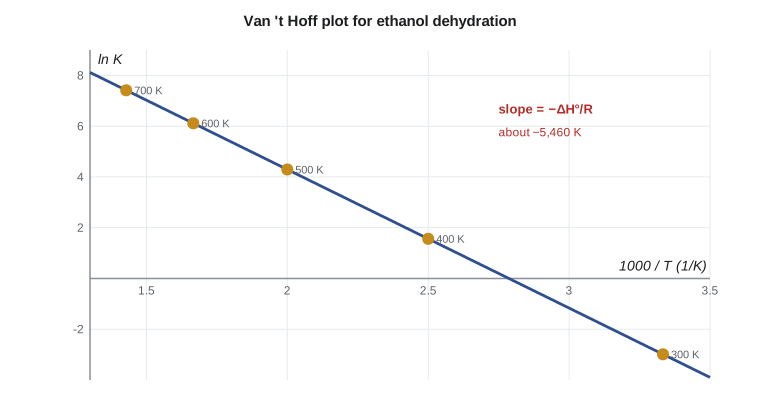
The integrated form assumes \(\Delta_r H^\circ\) is constant over the temperature range. For an endothermic reaction (\(\Delta_r H^\circ > 0\)), \(K\) increases with temperature; for an exothermic one it decreases. A plot of \(\ln K\) against \(1/T\) is a straight line with slope \(-\Delta_r H^\circ/R\), a convenient way to extract reaction enthalpies from equilibrium measurements, much as Lesson 5 extracts enthalpies of vaporization from vapour pressures.
Worked problem
Predicting K at a higher temperature
The dehydration equilibrium constant is about 73 at 500 K and \(\Delta_r H^\circ = 45.4\) kJ/mol. Estimate \(K\) at 600 K.
Show solution
- \(\ln(K_2/K_1) = -(45{,}400/8.314)(1/600 - 1/500) = -5461 \times (-3.333 \times 10^{-4}) = 1.820\).
- \(K_2/K_1 = e^{1.820} = 6.17\).
- \(K_2 = 73 \times 6.17 \approx 450\).
Answer: About 450, matching the value calculated directly from ΔG° at 600 K, as it must when ΔH° and ΔS° are taken as constant.
Le Chatelier's principle, quantitatively
Le Chatelier's principle says that a system at equilibrium responds to a disturbance in a way that partly offsets it. With the equations of this lesson you no longer need to guess the direction: compute \(Q\) after the disturbance and compare it with \(K\). Adding a reactant or removing a product lowers \(Q\) and drives the reaction forward. Raising the pressure of a gas reaction changes \(Q\) unless the moles of gas are equal on both sides. Changing the temperature changes \(K\) itself, in the direction given by the sign of \(\Delta_r H^\circ\). Adding a catalyst changes nothing about the equilibrium; it only helps the system get there faster.
| Change | Effect on Q or K | Shift in dehydration |
|---|---|---|
| Add ethanol | Q falls | Forward |
| Remove water | Q falls | Forward |
| Raise total pressure | Q rises (2 mol gas from 1) | Backward |
| Dilute with nitrogen | Q falls | Forward |
| Raise temperature | K rises (endothermic) | Forward |
| Add catalyst | No change | None; equilibrium reached faster |
Calculating equilibrium compositions
Equilibrium problems often lead to equations that cannot be solved by hand, especially with several species or inerts. The program below solves the esterification equilibrium for different feed ratios and the dehydration equilibrium at several temperatures and pressures by bisection, a simple and reliable root-finding method. It also checks the van 't Hoff prediction against the direct calculation.
# Equilibrium conversions: liquid esterification and gas-phase ethanol dehydration
import math
R = 8.314

# 1) CH3COOH + C2H5OH <=> CH3COOC2H5 + H2O, K about 4 (approximate, nearly independent of T)
K = 4.0
def ester_conversion(acid, alcohol, water=0.0):
    # solve K = x (water + x) / ((acid - x)(alcohol - x)) for x by bisection on [0, min feed]
    lo, hi = 0.0, min(acid, alcohol) - 1e-12
    f = lambda x: x * (water + x) - K * (acid - x) * (alcohol - x)
    for _ in range(100):
        mid = (lo + hi) / 2
        if f(mid) < 0: lo = mid
        else: hi = mid
    return mid
for alc, w in ((1, 0), (2, 0), (4, 0), (1, 1)):
    x = ester_conversion(1.0, alc, w)
    print(f"acid 1, ethanol {alc}, water {w}: acid conversion = {100 * x:5.1f}%")

# 2) C2H5OH(g) <=> C2H4(g) + H2O(g); dH = 45.4 kJ/mol, dS = 126.5 J/(mol K) (approximate, held constant)
dH, dS = 45.4e3, 126.5
def Kdehyd(T): return math.exp(-(dH - T * dS) / (R * T))
def dehyd_conv(T, P, inert=0.0):
    # 1 mol ethanol plus inert: K = xi^2 / ((1 - xi)(1 + xi + inert)) * P
    Kp = Kdehyd(T)
    lo, hi = 0.0, 1.0 - 1e-12
    for _ in range(100):
        mid = (lo + hi) / 2
        if mid ** 2 * P / ((1 - mid) * (1 + mid + inert)) < Kp: lo = mid
        else: hi = mid
    return mid
print()
for T in (400, 500, 600, 700):
    print(f"T = {T} K  K = {Kdehyd(T):9.3g}  conversion at 1 bar = {100 * dehyd_conv(T, 1):5.1f}%  at 10 bar = {100 * dehyd_conv(T, 10):5.1f}%")
print(f"400 K, 1 bar, 4 mol nitrogen per mol ethanol: conversion = {100 * dehyd_conv(400, 1, 4):.1f}%")

# 3) van 't Hoff check: K at 600 K predicted from K at 500 K
K500 = Kdehyd(500)
K600 = K500 * math.exp(-dH / R * (1 / 600 - 1 / 500))
print(f"van 't Hoff: K(600) from K(500) = {K600:.4g}")acid 1, ethanol 1, water 0: acid conversion = 66.7% acid 1, ethanol 2, water 0: acid conversion = 84.5% acid 1, ethanol 4, water 0: acid conversion = 93.0% acid 1, ethanol 1, water 1: acid conversion = 54.3% T = 400 K K = 4.78 conversion at 1 bar = 90.9% at 10 bar = 56.9% T = 500 K K = 73.3 conversion at 1 bar = 99.3% at 10 bar = 93.8% T = 600 K K = 452 conversion at 1 bar = 99.9% at 10 bar = 98.9% T = 700 K K = 1.66e+03 conversion at 1 bar = 100.0% at 10 bar = 99.7% 400 K, 1 bar, 4 mol nitrogen per mol ethanol: conversion = 96.7% van 't Hoff: K(600) from K(500) = 452.2
Diluting the dehydration feed with 4 mol of nitrogen per mole of ethanol raises the equilibrium conversion at 400 K from 91 to about 97 percent, the same effect as lowering the pressure fivefold. Industrial units often dilute with steam instead, which is easier to separate from ethylene by condensation; because water is also a product, steam shifts the equilibrium back slightly, but at the high temperatures used the conversion is already close to complete.
Common mistakes
MistakeIncluding pure liquids, solids or the solvent in K.
InsteadTheir activities are 1, so they drop out of the expression.
MistakeThinking a catalyst increases the equilibrium yield.
InsteadIt speeds up both directions equally and leaves K unchanged.
MistakeUsing the van 't Hoff equation with ΔH in kJ and R in J.
InsteadUse consistent units: ΔH in J/mol with R = 8.314 J/(mol K).
MistakeForgetting that total pressure matters for gas reactions with a change in moles.
InsteadWrite each partial pressure as mole fraction times total pressure before solving.
Summary and key terms
- ΔrG = ΔrG° + RT ln Q; at equilibrium ΔrG = 0 and Q = K.
- ΔrG° = −RT ln K converts thermodynamic data into equilibrium compositions.
- Activities are partial pressures in bar for ideal gases, concentrations for dilute solutes and 1 for pure liquids and solids.
- Mixing makes the Gibbs energy minimum fall between pure reactants and pure products.
- Pressure and inert dilution affect gas reactions that change the number of moles of gas.
- The van 't Hoff equation: ln K varies linearly with 1/T, with slope −ΔrH°/R.
- Reaction quotient
- The product of activities of products over reactants, each raised to its stoichiometric coefficient, for any mixture.
- Equilibrium constant
- The value of the reaction quotient at equilibrium, K = exp(−ΔrG°/RT).
- Activity
- The effective concentration of a species relative to its standard state.
- Extent of reaction
- The number of moles of reaction that have occurred, ξ.
- Le Chatelier's principle
- A system at equilibrium responds to a disturbance in a way that partly offsets it.
- Van 't Hoff equation
- The relation d ln K/dT = ΔrH°/RT², giving the temperature dependence of K.
- Reactive distillation
- Carrying out a reaction in a distillation column so that products are removed as they form.
Practice problems
Work each problem on paper first, then reveal the answer to check.
If ΔrG° = −11.4 kJ/mol at 298 K, what is K?
Show answer
\(K = \exp(11{,}400/(8.314 \times 298)) = 99\), about 100.
In the esterification, what conversion results from 1 mol acid and 3 mol ethanol with K = 4?
Show answer
Solving \(x^2/((1 - x)(3 - x)) = 4\) gives \(x \approx 0.90\).
Does raising the pressure help or hurt the synthesis of ammonia, N₂ + 3H₂ ⇌ 2NH₃?
Show answer
It helps, because four moles of gas become two.
An exothermic reaction has K = 100 at 400 K. Will K be larger or smaller at 500 K?
Show answer
Smaller, because ln K falls with temperature when ΔrH° is negative.
Q for a mixture is 2.0 and K is 4.8. Which way does the reaction go?
Show answer
Forward, because Q < K and ΔrG is negative.
Why does the beer contain much less ethyl acetate than the acetic acid in it would suggest from K = 4?
Show answer
The beer is mostly water, a product, which holds the equilibrium toward the acid and alcohol.
Lesson quiz · 5 questions
Score 60% or more to complete this lesson.
Create a free account to save your progress, take quizzes and earn a certificate.