
CHE-250 · Lesson 11 of 12 · 24 min
Reaction mechanisms and catalysis
Lessons 9 and 10 treated a rate law as something to be measured. This lesson asks where rate laws come from. Most reactions do not happen in a single collision; they proceed through a sequence of simple steps, the reaction mechanism, and the rate law is a fingerprint of that sequence. Understanding mechanisms explains why orders can be fractional, why some reactions are inhibited by their own products, and how catalysts work. Catalysis is the reason Kingfisher Bioenergy exists at all: enzymes turn starch into sugar in hours instead of years, yeast enzymes turn sugar into ethanol, and the proposed ethylene unit would depend on a solid acid catalyst.
Theo's problem is enzyme dosing. The plant buys glucoamylase, the enzyme that breaks dextrins into glucose during fermentation, and the supplier quotes its activity in terms of two numbers, \(V_{max}\) and \(K_m\). Ingrid wants Theo to measure those numbers from lab data, understand what they mean physically and use them to estimate how long saccharification takes.
Elementary steps and molecularity
An elementary step is a single molecular event: one molecule falling apart or rearranging (unimolecular), two molecules colliding and reacting (bimolecular), or, rarely, three molecules meeting at once (termolecular). The number of molecules involved is the step's molecularity. For an elementary step, and only for an elementary step, the rate law can be written directly from the equation: a bimolecular step \(\text{A} + \text{B} \to \text{products}\) has rate \(k[\text{A}][\text{B}]\), because the rate is proportional to the frequency of A-B collisions. Termolecular steps are rare because the chance of three molecules colliding simultaneously is small.
A mechanism is a proposed sequence of elementary steps that adds up to the overall reaction. Species formed in one step and consumed in a later one are intermediates; they appear in the mechanism but not in the overall equation. A mechanism can never be proved, only supported: it must reproduce the measured rate law, and good mechanisms are also consistent with other evidence, such as detected intermediates, isotope effects and stereochemistry. The hydroxide-ester mechanism from CHE-243, with its tetrahedral intermediate, is an example that has passed all those tests.
The rate-determining step
When one step in a sequence is much slower than all the others, it controls the overall rate, much as the slowest worker on an assembly line sets the line's output. Steps after the slow step cannot go faster than it feeds them; steps before it reach equilibrium while waiting. The rate law then depends on the slow step and on any equilibria before it. If the first step is slow, the rate law is simply that of the first step. If a fast reversible step comes first, the rate law includes its equilibrium constant, and that is how orders other than the stoichiometric coefficients arise.
Worked problem
A rate law from a pre-equilibrium
A proposed mechanism for \(2\text{NO} + \text{O}_2 \to 2\text{NO}_2\) has a fast equilibrium \(2\text{NO} \xrightleftharpoons{} \text{N}_2\text{O}_2\), with equilibrium constant \(K_1\), followed by a slow step \(\text{N}_2\text{O}_2 + \text{O}_2 \to 2\text{NO}_2\), with rate constant \(k_2\). Derive the rate law.
Show solution
- The slow step sets the rate: \(r = k_2[\text{N}_2\text{O}_2][\text{O}_2]\).
- The intermediate is in equilibrium with NO: \([\text{N}_2\text{O}_2] = K_1[\text{NO}]^2\).
- Substituting: \(r = k_2 K_1 [\text{NO}]^2[\text{O}_2]\).
Answer: Third order overall, matching experiment. The observed rate constant is \(k_2K_1\); because the pre-equilibrium is exothermic, K₁ falls with temperature, which is why this reaction becomes slightly slower as it is heated, an unusual negative apparent activation energy.
The steady-state approximation
When intermediates are highly reactive, they never build up: they are destroyed almost as fast as they form, and their concentration stays small and nearly constant after a brief start-up period. The steady-state approximation sets the rate of change of each such intermediate to zero, \(d[\text{I}]/dt \approx 0\), which turns the differential equations of a mechanism into algebraic equations. For a simple sequence \(\text{A} \to \text{I} \to \text{P}\) with \(k_2 \gg k_1\), it gives \([\text{I}] = k_1[\text{A}]/k_2\) and a product formation rate of \(k_1[\text{A}]\), as the program at the end of this lesson confirms by solving the full equations numerically.
Catalysis
A catalyst speeds up a reaction without being consumed, by providing an alternative pathway with a lower activation energy. Because it lowers the barrier in both directions equally, it speeds the forward and reverse reactions by the same factor and leaves the equilibrium constant unchanged, as Lessons 4 and 9 explained. A catalyst therefore cannot make an unfavourable reaction favourable; it only helps a favourable one reach equilibrium sooner. It can, however, change selectivity dramatically by speeding one pathway much more than its competitors, which is often its most valuable property.
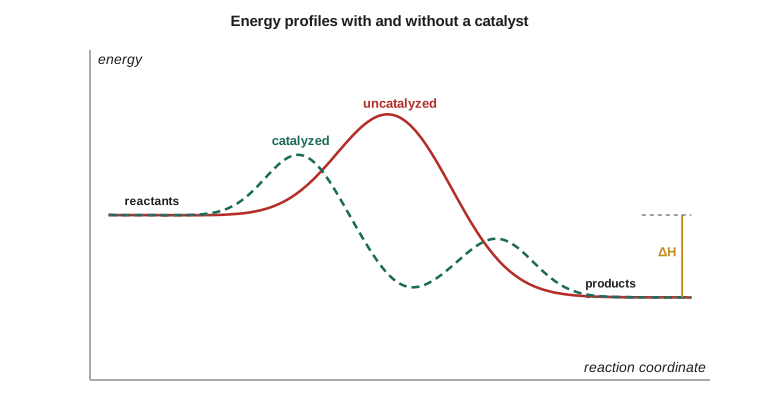
Catalysts are classified by phase. A homogeneous catalyst is in the same phase as the reactants, such as the sulfuric acid that catalyzes esterification by protonating the carbonyl oxygen. A heterogeneous catalyst is in a different phase, usually a solid with reactants in a gas or liquid, such as the alumina or zeolite catalysts used for ethanol dehydration. Enzymes are biological catalysts, proteins whose active sites are shaped to bind particular substrates; they are often treated as a separate class because their rate laws have a characteristic form.
Enzyme kinetics: the Michaelis-Menten mechanism
Enzymes speed reactions by factors of a million or more, with exquisite selectivity. Their kinetics is described by the mechanism proposed by Leonor Michaelis and Maud Menten in 1913. The enzyme E binds the substrate S reversibly to form an enzyme-substrate complex ES, which then converts the substrate to product P and releases the enzyme unchanged:
Applying the steady-state approximation to ES, and using the fact that the total enzyme is conserved, gives the Michaelis-Menten equation:
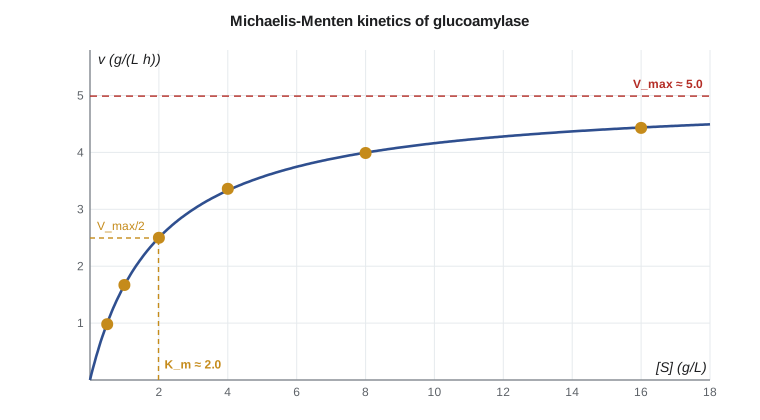
The maximum rate \(V_{max}\) is reached when every enzyme molecule is busy; it equals \(k_{cat}[\text{E}]_0\), where \(k_{cat}\), the turnover number, is how many substrate molecules one enzyme converts per second when saturated. The Michaelis constant \(K_m\) is the substrate concentration at which the rate is half its maximum. A small \(K_m\) means the enzyme reaches full speed at low substrate concentration.
The equation explains why enzyme reactions change order as they proceed. When \([\text{S}] \gg K_m\), the rate is nearly \(V_{max}\), independent of substrate: zero order. When \([\text{S}] \ll K_m\), the rate is \((V_{max}/K_m)[\text{S}]\): first order. In a fermenter, saccharification starts nearly zero order while dextrins are abundant, then slows to first order as they run low, which is why the last few grams per litre of dextrin take a disproportionate share of the batch time.
Measuring Vmax and Km
For decades, biochemists found the two constants with the Lineweaver-Burk plot, a double reciprocal form of the equation, \(1/v = (K_m/V_{max})(1/[\text{S}]) + 1/V_{max}\), which gives a straight line with intercept \(1/V_{max}\) and slope \(K_m/V_{max}\). The plot is still useful for seeing at a glance how an inhibitor acts, but it is a poor way to estimate parameters, because taking reciprocals magnifies the errors in the slowest, least accurate rate measurements. Fitting the original equation directly by nonlinear least squares gives better estimates, and computers make it easy.
Worked problem
Enzyme constants from lab data
The lab measures initial glucose formation rates at dextrin concentrations of 0.5, 1, 2, 4, 8 and 16 g/L and obtains 0.98, 1.67, 2.50, 3.36, 3.99 and 4.43 g/(L h). Check that a Michaelis-Menten fit gives \(V_{max} \approx 5.0\) g/(L h) and \(K_m \approx 2.0\) g/L.
Show solution
- At [S] = 2 g/L, the model predicts \(v = 5.0 \times 2/(2.0 + 2) = 2.50\) g/(L h), matching the measurement.
- At [S] = 16 g/L: \(5.0 \times 16/18 = 4.44\) g/(L h), against 4.43 measured.
- At [S] = 0.5 g/L: \(5.0 \times 0.5/2.5 = 1.00\), against 0.98 measured.
Answer: The constants reproduce all the data closely. The program below finds them by both methods and shows that the Lineweaver-Burk estimates drift slightly, as expected from the way the reciprocal transformation weights the data.
Inhibition
Molecules that bind to an enzyme and slow it down are inhibitors. A competitive inhibitor resembles the substrate and competes for the active site; it raises the apparent \(K_m\) but leaves \(V_{max}\) unchanged, because enough substrate can always outcompete it. A noncompetitive inhibitor binds elsewhere and reduces the fraction of active enzyme, lowering \(V_{max}\). Product inhibition is especially important in industry. Glucose inhibits the enzymes that produce it, and ethanol, at high concentration, inhibits the yeast's enzymes. That is one reason the plant runs simultaneous saccharification and fermentation: yeast consumes glucose as fast as glucoamylase makes it, keeping glucose low and its inhibition weak.
Heterogeneous catalysis
On a solid catalyst, a reaction proceeds through a cycle of steps: reactants diffuse to the surface, adsorb onto active sites, react while adsorbed, and the products desorb and diffuse away. Adsorption is the subject of Lesson 12, and its equilibrium, described by the Langmuir isotherm, leads to rate laws with the same saturating form as the Michaelis-Menten equation. When reactants cover nearly all the sites, the rate becomes independent of their pressure, just as an enzyme saturates. That parallel is no accident: in both cases a limited number of active sites must be occupied before reaction can occur.
Calculating enzyme kinetics
The program below fits the glucoamylase data by Lineweaver-Burk and by nonlinear least squares, integrates the Michaelis-Menten equation to find the time needed to hydrolyze 90 percent of 20 g/L of dextrin, and checks the steady-state approximation against an exact numerical solution for a two-step sequence.
# Michaelis-Menten parameters for glucoamylase (illustrative data), and a check of the
# steady-state approximation for A -> I -> P by numerical integration
import math

S = [0.5, 1.0, 2.0, 4.0, 8.0, 16.0]          # substrate, g/L of dextrin
v = [0.98, 1.67, 2.50, 3.36, 3.99, 4.43]     # initial rate, g/(L h)

# 1) Lineweaver-Burk: 1/v = (Km/Vmax)(1/S) + 1/Vmax
x = [1 / s for s in S]; y = [1 / r for r in v]
n = len(x); mx = sum(x) / n; my = sum(y) / n
m = sum((a - mx) * (b - my) for a, b in zip(x, y)) / sum((a - mx) ** 2 for a in x)
c = my - m * mx
print(f"Lineweaver-Burk: Vmax = {1 / c:.2f} g/(L h), Km = {m / c:.2f} g/L")

# 2) nonlinear least squares: for each trial Km, the best Vmax is linear; scan Km
best = None
for i in range(1, 2001):
    Km = i * 0.005
    f = [s / (Km + s) for s in S]
    Vmax = sum(a * b for a, b in zip(f, v)) / sum(a * a for a in f)
    sse = sum((r - Vmax * a) ** 2 for r, a in zip(v, f))
    if best is None or sse < best[0]:
        best = (sse, Km, Vmax)
print(f"nonlinear fit:   Vmax = {best[2]:.2f} g/(L h), Km = {best[1]:.2f} g/L")

# 3) time to hydrolyze 90% of 20 g/L dextrin (integrated Michaelis-Menten, Euler steps)
Km, Vmax = best[1], best[2]
s, t, dt = 20.0, 0.0, 0.001
while s > 2.0:
    s -= Vmax * s / (Km + s) * dt; t += dt
print(f"time to reach 90% conversion from 20 g/L: {t:.1f} h")

# 4) steady-state approximation for A -> I -> P with k1 = 1, k2 = 50 (per minute)
k1, k2 = 1.0, 50.0
A, I, P, t = 1.0, 0.0, 0.0, 0.0
dt = 1e-4
while t < 2.0 - 1e-12:
    dA = -k1 * A; dI = k1 * A - k2 * I; dP = k2 * I
    A += dA * dt; I += dI * dt; P += dP * dt; t += dt
print(f"at t = 2 min: P exact = {P:.4f}, P steady-state = {1 - math.exp(-k1 * 2):.4f}, I = {I:.4f} (k1 A/k2 = {k1 * A / k2:.4f})")Lineweaver-Burk: Vmax = 5.09 g/(L h), Km = 2.09 g/L nonlinear fit: Vmax = 4.99 g/(L h), Km = 1.99 g/L time to reach 90% conversion from 20 g/L: 4.5 h at t = 2 min: P exact = 0.8619, P steady-state = 0.8647, I = 0.0028 (k1 A/k2 = 0.0027)
The steady-state prediction of product formed agrees with the exact solution to within half a percent, and the intermediate's concentration matches \(k_1[\text{A}]/k_2\) closely. The approximation is excellent whenever intermediates are destroyed much faster than they form, which is why it underlies the kinetics of enzymes, catalysts and chain reactions throughout chemical engineering.
Common mistakes
MistakeWriting a rate law from the overall equation.
InsteadOnly elementary steps have rate laws given by their stoichiometry; derive the overall law from the mechanism.
MistakeIncluding intermediates in the final rate law.
InsteadEliminate them using a pre-equilibrium or the steady-state approximation.
MistakeThinking a catalyst shifts equilibrium toward products.
InsteadIt speeds both directions equally; only selectivity among competing paths changes.
MistakeRelying on Lineweaver-Burk for accurate Km and Vmax.
InsteadFit the Michaelis-Menten equation directly; reciprocals magnify errors at low substrate.
Summary and key terms
- Elementary steps have rate laws given by their molecularity; overall rate laws come from the mechanism.
- A slow step controls the rate; fast pre-equilibria before it bring their equilibrium constants into the rate law.
- The steady-state approximation sets d[I]/dt ≈ 0 for reactive intermediates.
- Catalysts lower activation energy, speed both directions equally and can greatly improve selectivity.
- Michaelis-Menten: v = Vmax[S]/(Km + [S]), zero order at high substrate and first order at low substrate.
- Competitive inhibitors raise apparent Km; product inhibition shapes how fermentation is run.
- Elementary step
- A single molecular event whose rate law follows directly from its stoichiometry.
- Molecularity
- The number of molecules taking part in an elementary step.
- Intermediate
- A species formed and consumed during a mechanism that does not appear in the overall equation.
- Rate-determining step
- A step much slower than the others that controls the overall rate.
- Steady-state approximation
- Setting the rate of change of a reactive intermediate's concentration to zero.
- Michaelis constant
- The substrate concentration at which an enzyme reaction runs at half its maximum rate.
- Turnover number
- The number of substrate molecules one enzyme molecule converts per unit time when saturated, k_cat.
- Competitive inhibitor
- A molecule that competes with the substrate for an enzyme's active site, raising the apparent Km.
Practice problems
Work each problem on paper first, then reveal the answer to check.
What is the rate law of the elementary step 2A → B?
Show answer
\(r = k[\text{A}]^2\).
With Vmax = 5.0 g/(L h) and Km = 2.0 g/L, what is the rate at [S] = 6.0 g/L?
Show answer
\(5.0 \times 6/8 = 3.75\) g/(L h).
At what substrate concentration does that enzyme run at 90 percent of Vmax?
Show answer
\(0.9 = S/(2 + S)\) gives S = 18 g/L.
A competitive inhibitor doubles the apparent Km. What happens to Vmax?
Show answer
It is unchanged.
Why is the Lineweaver-Burk plot a poor way to estimate parameters?
Show answer
Reciprocals give the most weight to the slowest, least accurate measurements.
Why does a solid catalyst's rate stop rising with reactant pressure at high pressure?
Show answer
The surface sites become nearly fully covered, so the rate saturates.
Lesson quiz · 5 questions
Score 60% or more to complete this lesson.
Create a free account to save your progress, take quizzes and earn a certificate.