
CHE-250 · Lesson 1 of 12 · 26 min
Gases and the kinetic molecular theory
Every fermenter at the Kingfisher Bioenergy plant in Sarnia breathes out carbon dioxide. About as much carbon dioxide leaves the fermenters as ethanol is made, so a plant producing 380 million litres of ethanol a year releases roughly 300,000 tonnes of the gas. It passes through a water scrubber that recovers ethanol vapour, and part of it goes to a neighbouring company that purifies and liquefies it. In CHE-200 you wrote material balances on that stream, and in CHE-220 you used equations of state to predict its pressure, volume and temperature. Physical chemistry asks a deeper question: why do gases behave the way they do? The answer comes from picturing a gas as an enormous number of tiny molecules in constant, random motion.
Process engineer Ingrid Solheim has given co-op student Theo Laurent a year-long set of problems that all need physical chemistry. How fast does carbon dioxide leak through a pinhole, and why does nitrogen leak faster? How much carbon dioxide dissolves in the beer? Why does the ethanol-water mixture refuse to separate beyond about 95 percent ethanol by distillation? How fast do the enzymes break down starch, and why does a few degrees of temperature matter so much? Why do the molecular sieve beds stop working when they fill up? Each lesson of this course gives Theo one more tool. This first lesson builds the molecular picture that the rest of the course depends on.
The postulates of the kinetic molecular theory
The kinetic molecular theory describes an ideal gas with a few simple assumptions. A gas is made of molecules that are very small compared with the average distance between them, so the molecules themselves take up almost none of the container's volume. The molecules move in straight lines in random directions until they collide with each other or with the walls. Collisions are perfectly elastic: kinetic energy can be passed from one molecule to another, but the total is conserved. Apart from collisions, the molecules exert no forces on each other. Finally, the average kinetic energy of the molecules depends only on the absolute temperature.
These assumptions are never exactly true. Real molecules have size and attract each other at short range, which is why real gases condense and why the ideal gas law fails at high pressure. Lesson 2 adds those effects back. For carbon dioxide at the fermenter vent, though, near atmospheric pressure and 30 °C, the assumptions are good to within about half a percent, and they let us calculate pressure, molecular speeds, collision rates and leak rates from first principles.
Pressure from molecular collisions
Pressure is the force per unit area that molecules exert as they bounce off a wall. Consider one molecule of mass \(m\) moving with velocity component \(u_x\) toward a wall. When it bounces back elastically its momentum changes by \(2mu_x\). Counting how many molecules strike the wall per second and averaging over all directions of motion gives the central result of the theory:
Here \(N\) is the number of molecules and \(\overline{u^2}\) is the mean of the squared speed. Comparing this with the ideal gas law, \(PV = nRT = Nk_BT\), shows that \(\tfrac{1}{2} m \overline{u^2} = \tfrac{3}{2} k_B T\). The average translational kinetic energy of a molecule is \(\tfrac{3}{2}k_BT\), where \(k_B = 1.381 \times 10^{-23}\) J/K is the Boltzmann constant, the gas constant per molecule. Per mole, the translational kinetic energy is \(\tfrac{3}{2}RT\), about 3.8 kJ/mol at 30 °C. Temperature is therefore a direct measure of the average kinetic energy of molecular motion, and every gas at the same temperature has the same average translational kinetic energy, whatever its molar mass.
Because the kinetic energy is the same, heavier molecules must move more slowly. Carbon dioxide (44 g/mol) and nitrogen (28 g/mol) leaving the scrubber at the same temperature carry the same average energy, but the nitrogen molecules move about 25 percent faster. That difference drives effusion, diffusion and the separation of isotopes, and it explains why a small leak in a carbon dioxide line lets air in more readily than carbon dioxide escapes.
The Maxwell-Boltzmann distribution of speeds
Not every molecule moves at the same speed. Collisions constantly redistribute energy, and at equilibrium the speeds settle into a fixed distribution worked out by Maxwell and Boltzmann in the nineteenth century. The probability density of finding a molecule with speed \(v\) is:
The \(v^2\) factor counts the number of ways of having a given speed, since there are more combinations of velocity components for larger speeds. The exponential factor, a Boltzmann factor, makes high kinetic energies increasingly unlikely. The product rises from zero, passes through a maximum and then falls off with a long tail at high speed. Three characteristic speeds summarize it: the most probable speed, the mean speed and the root-mean-square speed.
In these formulas \(M\) must be in kilograms per mole so that the speeds come out in metres per second. The three speeds always stand in the ratio 1 : 1.128 : 1.225. The root-mean-square speed is the one tied directly to kinetic energy and pressure; the mean speed appears in collision and effusion rates.
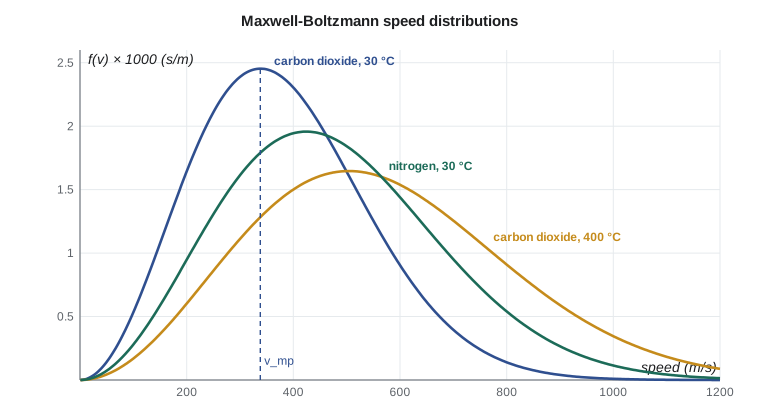
The figure shows two trends. Raising the temperature moves the distribution to higher speeds and flattens it, so a larger fraction of molecules has high energy. Lowering the molar mass does the same thing at a fixed temperature. The high-speed tail matters a great deal later in the course: in Lesson 10 you will see that reaction rates depend on the small fraction of collisions energetic enough to break bonds, and that fraction grows rapidly with temperature.
Worked problem
Molecular speeds of carbon dioxide at the fermenter vent
Calculate the most probable, mean and root-mean-square speeds of carbon dioxide molecules at 30 °C.
Show solution
- Convert the temperature and molar mass: \(T = 303.15\) K and \(M = 0.04401\) kg/mol.
- Most probable speed: \(v_{mp} = \sqrt{2(8.314)(303.15)/0.04401} = \sqrt{114{,}540} = 338\) m/s.
- Mean speed: \(\bar{v} = 1.128 \times 338 = 382\) m/s.
- Root-mean-square speed: \(v_{rms} = 1.225 \times 338 = 415\) m/s.
Answer: About 340, 380 and 415 m/s. A carbon dioxide molecule at room temperature moves faster than a passenger jet, about 1,370 km/h on average, though it changes direction billions of times each second.
Collisions and the mean free path
If molecules move at hundreds of metres per second, why does the smell of ethanol take seconds or minutes to cross a room? Because each molecule travels only a tiny distance before hitting another and changing direction. Treat each molecule as a hard sphere of diameter \(d\). Two molecules collide when their centres come within \(d\) of each other, so each molecule sweeps out a collision cross-section \(\sigma = \pi d^2\). Accounting for the relative motion of the molecules, the average distance travelled between collisions, the mean free path, is:
where \(n^* = P/(k_BT)\) is the number density of molecules. The collision frequency of one molecule is \(z = \bar{v}/\lambda\). For carbon dioxide at 1 atm and 30 °C, with a collision diameter of about 0.39 nm, the mean free path is about 60 nm, roughly 150 molecular diameters, and each molecule collides about six billion times per second. Lowering the pressure lengthens the mean free path in proportion. In a high-vacuum system at \(10^{-6}\) mbar the mean free path is tens of metres, longer than the equipment, and gas molecules travel wall to wall without meeting each other.
Diffusion, viscosity and thermal conductivity
The same picture explains transport properties. Diffusion is the net movement of molecules from high to low concentration by random motion. Viscosity is the transfer of momentum between layers of gas moving at different speeds. Thermal conductivity is the transfer of kinetic energy from hot regions to cold ones. In each case molecules carry a property a distance of about one mean free path before passing it on in a collision, so simple kinetic theory predicts each transport coefficient is roughly proportional to \(\bar{v}\lambda\).
Two predictions follow that surprised Maxwell himself. First, because \(\lambda\) is inversely proportional to pressure and the number of carriers is directly proportional to it, the viscosity and thermal conductivity of a gas are nearly independent of pressure over a wide range. Second, because \(\bar{v}\) rises with \(\sqrt{T}\), gas viscosity increases with temperature, the opposite of liquids. Both predictions are confirmed by experiment and matter in design: the pressure drop across the plant's carbon dioxide blower rises on a hot day partly because the gas becomes more viscous.
| Property | Kinetic-theory proportionality | Effect of raising T | Effect of raising P |
|---|---|---|---|
| Diffusion coefficient | \(\bar{v}\lambda\) | Increases | Decreases (inversely) |
| Viscosity | \(\rho\bar{v}\lambda\) | Increases | Nearly unchanged |
| Thermal conductivity | \(\rho c_v \bar{v}\lambda\) | Increases | Nearly unchanged |
Effusion and Graham's law
Effusion is the escape of gas through a hole small compared with the mean free path, so that molecules leave one at a time without colliding near the opening. The rate at which molecules strike a hole of area \(A\) is \(\tfrac{1}{4} n^* \bar{v} A\). At the same temperature and pressure, the effusion rate is therefore proportional to \(\bar{v}\), and so inversely proportional to the square root of molar mass. This is Graham's law:
Nitrogen effuses \(\sqrt{44.01/28.01} = 1.25\) times faster than carbon dioxide. Graham's law was used on a vast scale in the 1940s to enrich uranium, passing uranium hexafluoride through thousands of porous barriers because the lighter isotope effuses about 0.4 percent faster. At the plant, the effect is smaller in scale but real: hydrogen and helium leak through fittings that hold carbon dioxide, which is why leak testing of the liquefaction unit uses helium as a tracer gas.
Worked problem
Leak rates of nitrogen and carbon dioxide
During a pressure test, a pinhole in a vessel filled first with nitrogen and then with carbon dioxide at the same temperature and pressure lets out 5.0 litres of nitrogen in 10 minutes. How long would 5.0 litres of carbon dioxide take to escape, assuming true effusion?
Show solution
- Graham's law: \(\text{rate}_{N_2}/\text{rate}_{CO_2} = \sqrt{44.01/28.01} = 1.253\).
- Carbon dioxide escapes more slowly, so the time is longer by the same factor.
- \(t_{CO_2} = 10 \times 1.253 = 12.5\) minutes.
Answer: About 12.5 minutes. Most real leaks at test pressure are wider than the mean free path and behave partly as viscous flow, so Graham's law gives a useful estimate rather than an exact answer.
Energy in molecules: equipartition
Molecules can store energy in rotation and vibration as well as in translation. The equipartition theorem says that at high enough temperature each quadratic term in the energy contributes \(\tfrac{1}{2}k_BT\) per molecule. Translation in three directions gives \(\tfrac{3}{2}k_BT\). A linear molecule such as carbon dioxide or nitrogen adds two rotational terms, \(k_BT\); a nonlinear molecule such as water or ethanol adds three. Vibrations add more, but only at temperatures where the vibrational energy levels are well populated.
Equipartition explains the heat capacities you used in CHE-200 and CHE-220. A monatomic gas such as argon has \(C_v = \tfrac{3}{2}R = 12.5\) J/(mol K). Nitrogen at room temperature has \(C_v\) close to \(\tfrac{5}{2}R = 20.8\) J/(mol K), because rotation is fully active but vibration is not. Carbon dioxide has a larger value, about 28.5 J/(mol K) at 25 °C, because its low-frequency bending vibration is already partly excited. As temperature rises, more vibrations switch on and heat capacities increase, which is why your heat-capacity polynomials in CHE-200 had positive temperature coefficients.
Calculating speeds, collisions and leak rates
The program below applies the formulas of this lesson to the three gases Theo meets at the fermenter vent. It computes the characteristic speeds, the mean free path and collision rate of carbon dioxide, the fraction of molecules faster than 600 m/s found by integrating the Maxwell-Boltzmann distribution, and the Graham's law ratio for a leak.
# Molecular speeds, collision frequency and mean free path for gases at the fermenter vent
import math

R = 8.314          # J/(mol K)
kB = 1.380649e-23  # J/K
NA = 6.02214e23

def speeds(M, T):
    m = M / 1000 / NA                       # mass of one molecule, kg
    vmp = math.sqrt(2 * kB * T / m)          # most probable speed
    vavg = math.sqrt(8 * kB * T / (math.pi * m))
    vrms = math.sqrt(3 * kB * T / m)
    return vmp, vavg, vrms

def fraction_above(M, T, v0, vmax=5000, n=20000):
    # integrate the Maxwell-Boltzmann distribution from v0 to vmax with the trapezoid rule
    m = M / 1000 / NA
    a = m / (2 * kB * T)
    f = lambda v: 4 * math.pi * (a / math.pi) ** 1.5 * v * v * math.exp(-a * v * v)
    h = (vmax - v0) / n
    return h * (0.5 * f(v0) + sum(f(v0 + i * h) for i in range(1, n)) + 0.5 * f(vmax))

T = 303.15  # 30 C
gases = [('carbon dioxide', 44.01, 3.9e-10), ('nitrogen', 28.01, 3.7e-10), ('ethanol', 46.07, 4.5e-10)]
for name, M, d in gases:
    vmp, vavg, vrms = speeds(M, T)
    print(f"{name:15s} v_mp = {vmp:5.0f}  v_avg = {vavg:5.0f}  v_rms = {vrms:5.0f} m/s")

# mean free path and collision frequency of CO2 at 1 atm and 30 C
P = 101325
n_dens = P / (kB * T)                         # molecules per m3
d = 3.9e-10                                   # approximate collision diameter, m
sigma = math.pi * d ** 2
lam = 1 / (math.sqrt(2) * sigma * n_dens)
vavg = speeds(44.01, T)[1]
z = vavg / lam
print(f"number density = {n_dens:.3e} per m3")
print(f"mean free path = {lam * 1e9:.1f} nm, collisions per molecule = {z:.2e} per s")
print(f"fraction of CO2 molecules faster than 600 m/s: {fraction_above(44.01, T, 600):.3f}")
# Graham's law: relative effusion rate of N2 and CO2 through a pinhole leak
print(f"effusion rate ratio N2/CO2 = {math.sqrt(44.01 / 28.01):.3f}")carbon dioxide v_mp = 338 v_avg = 382 v_rms = 415 m/s nitrogen v_mp = 424 v_avg = 479 v_rms = 520 m/s ethanol v_mp = 331 v_avg = 373 v_rms = 405 m/s number density = 2.421e+25 per m3 mean free path = 61.1 nm, collisions per molecule = 6.25e+09 per s fraction of CO2 molecules faster than 600 m/s: 0.099 effusion rate ratio N2/CO2 = 1.253
About one carbon dioxide molecule in ten moves faster than 600 m/s at 30 °C. That fraction rises steeply with temperature, a theme that returns in Lesson 10 when the energy needed is not 8 kJ/mol of kinetic energy but the 50 to 100 kJ/mol needed to start a chemical reaction.
Common mistakes
MistakeUsing molar mass in grams per mole in the speed formulas.
InsteadConvert to kilograms per mole, or the speeds come out too small by a factor of about 32.
MistakeAssuming all molecules in a gas move at the same speed.
InsteadSpeeds follow the Maxwell-Boltzmann distribution, with a long high-speed tail.
MistakeThinking that heavier gases have more kinetic energy at the same temperature.
InsteadAverage translational kinetic energy depends only on temperature; heavier molecules simply move more slowly.
MistakeApplying Graham's law to any leak.
InsteadIt holds strictly only for effusion through holes small compared with the mean free path.
Summary and key terms
- The kinetic theory treats a gas as point molecules in random motion with elastic collisions and no other interactions.
- Pressure comes from momentum transfer at the walls, and \(PV = \tfrac{1}{3}Nm\overline{u^2}\) shows that average kinetic energy is \(\tfrac{3}{2}k_BT\).
- Speeds follow the Maxwell-Boltzmann distribution; \(v_{mp}\), \(\bar{v}\) and \(v_{rms}\) are in the ratio 1 : 1.128 : 1.225.
- The mean free path is inversely proportional to pressure and is about 60 nm for air-like gases at 1 atm.
- Gas viscosity and thermal conductivity are nearly independent of pressure and increase with temperature.
- Effusion rates are inversely proportional to the square root of molar mass (Graham's law).
- Kinetic molecular theory
- A model of gases as molecules in random motion whose collisions produce pressure and whose average kinetic energy measures temperature.
- Boltzmann constant
- The gas constant per molecule, 1.381 × 10⁻²³ J/K.
- Maxwell-Boltzmann distribution
- The equilibrium distribution of molecular speeds in a gas.
- Root-mean-square speed
- The square root of the mean of the squared molecular speeds, √(3RT/M).
- Mean free path
- The average distance a molecule travels between collisions.
- Collision cross-section
- The area πd² within which two molecular centres must pass for a collision.
- Effusion
- Escape of gas molecules one at a time through a hole small compared with the mean free path.
- Equipartition theorem
- At high temperature each quadratic energy term contributes ½k_BT per molecule.
Practice problems
Work each problem on paper first, then reveal the answer to check.
Calculate the root-mean-square speed of nitrogen at 0 °C.
Show answer
\(\sqrt{3(8.314)(273.15)/0.02801} = 493\) m/s.
By what factor does the mean speed of a gas change when its absolute temperature doubles?
Show answer
It increases by \(\sqrt{2} = 1.41\).
What happens to the mean free path of carbon dioxide if the pressure is reduced from 1 atm to 0.1 atm at constant temperature?
Show answer
It increases tenfold, to about 600 nm.
Which effuses faster, ethanol vapour or water vapour, and by how much?
Show answer
Water, by \(\sqrt{46.07/18.02} = 1.60\) times.
Estimate \(C_v\) for argon and for nitrogen at room temperature from equipartition.
Show answer
Argon \(\tfrac{3}{2}R = 12.5\) J/(mol K); nitrogen \(\tfrac{5}{2}R = 20.8\) J/(mol K).
Why does gas viscosity rise with temperature while liquid viscosity falls?
Show answer
In a gas, faster molecules carry momentum between layers more effectively; in a liquid, viscosity is controlled by intermolecular attraction, which heat helps molecules overcome.
Lesson quiz · 5 questions
Score 60% or more to complete this lesson.
Create a free account to save your progress, take quizzes and earn a certificate.