
CHE-200 · Lesson 8 of 12 · 23 min
Single-phase systems: liquids, ideal gases and real gases
The carbon dioxide leaving the fermenters is nearly pure once the water and traces of ethanol are scrubbed out. Kingfisher Bioenergy sells it to a gas company that compresses, dries and liquefies it for drinks, food freezing and greenhouses. The gas company wants to know the volumetric flow at the compressor suction and the gas density at its 20 bar intermediate stage, and the plant's process safety team wants to know how much carbon dioxide is stored in a pipe at that pressure. Theo is asked to provide the numbers. They need the relations between pressure, volume, temperature and amount for gases and liquids, the subject of this lesson.
Liquid and solid densities
Liquids and solids are nearly incompressible: their densities change only slightly with pressure, and the change is ignored in most balances. Densities do change with temperature, typically by a few tenths of a percent per 10 °C for organic liquids, and published tables give values over a range of temperatures. For a pure liquid, look up the density at the stream temperature, or use the value at a nearby temperature if the precision needed is modest.
For a liquid mixture, a simple estimate assumes that volumes add, so that the specific volume of the mixture is the mass-fraction-weighted sum of the pure-component specific volumes. Some mixtures follow this closely. Ethanol and water do not: mixing 50 mL of each gives only about 96 mL, because the molecules pack more tightly together than in either pure liquid. For such mixtures, use measured density tables, which is exactly what the industry does: ethanol strength is measured by density and converted with standard tables.
The ideal gas law
At low pressure and moderate temperature, gases follow the ideal gas equation of state. Here \(P\) is the absolute pressure, \(V\) the volume, \(n\) the moles, \(T\) the absolute temperature and \(R\) the gas constant. In flow form, volumetric and molar flow rates replace volume and moles. The ideal gas law assumes that the molecules take up no volume and do not attract each other, which is a good approximation when they are far apart.
A rough rule says the ideal gas law is accurate to about one percent when the molar volume exceeds about 5 L/mol for diatomic gases and about 20 L/mol for other gases. Most gases at atmospheric pressure satisfy it easily. Carbon dioxide at 20 bar and room temperature, close to its critical temperature of 31 °C, does not.
Standard conditions
Gas flows are often quoted as volumes at standard temperature and pressure, which is really a way of stating a molar flow. Unfortunately there are several standards. The scientific standard of 0 °C and 1 atm gives 22.414 L/mol, written as normal cubic metres, Nm³. The natural gas industry in Canada uses 15 °C and 101.325 kPa, giving 23.645 L/mol, while the US gas industry uses 60 °F and 14.696 psia, at which one lbmol occupies 379.5 standard cubic feet, scf. Always state the standard you use when reporting a standard volume.
| Standard | Temperature | Pressure | Molar volume |
|---|---|---|---|
| Scientific (normal) | 0 °C (273.15 K) | 1 atm (101.325 kPa) | 22.414 L/mol; 359.0 ft³/lbmol |
| Canadian gas industry | 15 °C | 101.325 kPa | 23.645 L/mol |
| US gas industry | 60 °F (15.6 °C) | 14.696 psia | 379.5 scf/lbmol |
| IUPAC (since 1982) | 0 °C | 100 kPa | 22.711 L/mol |
Worked problem
Flow at the compressor suction
The fermenters release 35 880 kg/h of carbon dioxide. After scrubbing, it reaches the compressor suction at 30 °C and 1.05 bar absolute. Assuming ideal gas behaviour, find the volumetric flow at the suction and at standard conditions of 0 °C and 1 atm.
Show solution
- Molar flow \(= 35\,880/44.01 = 815.3\ \text{kmol/h}\).
- At the suction: \(\dot{V} = \dot{n}RT/P = 815.3 \times 8.314 \times 303.15/105 = 19\,570\ \text{m}^3/\text{h}\).
- Standard volume \(= 815.3 \times 22.414 = 18\,270\ \text{Nm}^3/\text{h}\).
Answer: At the suction the gas is close to ideal, so these figures are reliable to well under one percent. The compressor must move nearly 20 000 m³ of gas every hour, which is why the first stage of a carbon dioxide compressor is physically the largest.
Ideal gas mixtures
In an ideal gas mixture, each component behaves as if it were alone. Its partial pressure \(p_i\) is the pressure it would exert alone in the whole volume at the same temperature, and it equals the mole fraction times the total pressure. The partial pressures add up to the total pressure, which is Dalton's law. Similarly, the pure-component volume, the volume a component would occupy alone at the total pressure, equals the mole fraction times the total volume, which is Amagat's law. For ideal gases, mole fractions and volume fractions are therefore equal.
Partial pressures matter for every process involving condensation, absorption or reaction. In the carbon dioxide scrubber, the partial pressure of ethanol vapour in the gas determines how much ethanol the wash water can absorb, and in Lesson 9 the partial pressure of water vapour determines when it condenses.
Real gases and the compressibility factor
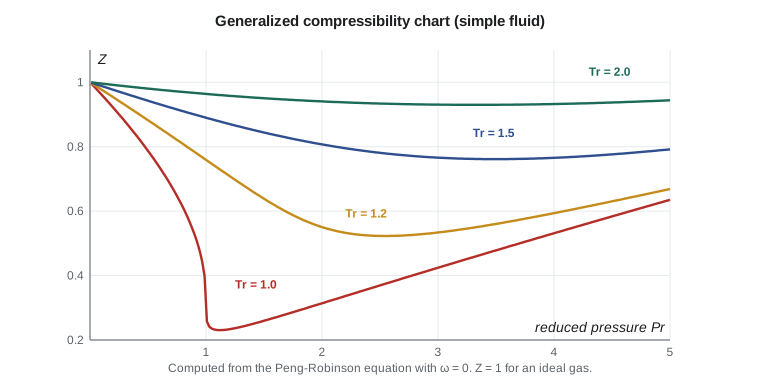
At high pressure or low temperature, gas molecules are close enough that their volume and their attractions matter. The compressibility factor \(Z\) measures the departure from ideal behaviour. It is defined so that the real gas law looks like the ideal one: \(Z = 1\) for an ideal gas, \(Z < 1\) when attractions dominate and the gas is denser than ideal, and \(Z > 1\) at very high pressures when molecular volume dominates.
Gases behave similarly when compared at the same reduced temperature and reduced pressure, the actual values divided by their critical values. This principle of corresponding states lets one generalized chart of \(Z\) against reduced pressure, with lines of reduced temperature, serve all gases approximately. Adding a third parameter, the acentric factor \(\omega\), which describes how far a molecule's shape departs from a simple sphere, improves accuracy considerably for nonspherical molecules such as carbon dioxide and hydrocarbons.
The virial equation
At low to moderate pressure, the simplest real-gas correction is the truncated virial equation, \(Z = 1 + BP/(RT)\), where \(B\) is the second virial coefficient, a function of temperature only. The Pitzer correlation estimates it from critical properties and the acentric factor, giving a method that needs only three numbers per gas. It works well when \(Z\) is above about 0.85, roughly reduced pressures below about half the reduced temperature.
Worked problem
Carbon dioxide at 20 bar
After the first compressor stages and an intercooler, carbon dioxide is at 20.0 bar and 35 °C. For carbon dioxide, \(T_c = 304.2\ \text{K}\), \(P_c = 73.8\ \text{bar}\) and \(\omega = 0.224\). Estimate \(Z\) with the Pitzer virial correlation, and find the gas density and the mass of carbon dioxide held in 400 m of pipe with an internal diameter of 0.30 m.
Show solution
- \(T_r = 308.15/304.2 = 1.013\); \(P_r = 20.0/73.8 = 0.271\).
- \(B^0 = 0.083 - 0.422/1.013^{1.6} = -0.330\); \(B^1 = 0.139 - 0.172/1.013^{4.2} = -0.024\).
- \(Z = 1 + (-0.330 + 0.224 \times -0.024)(0.271/1.013) = 0.910\).
- Density \(= PM/(ZRT) = 2000 \times 44.01/(0.910 \times 8.314 \times 308.15) = 37.8\ \text{kg/m}^3\), against 34.4 kg/m³ for an ideal gas.
- Pipe volume \(= \pi(0.15)^2(400) = 28.3\ \text{m}^3\); mass held \(= 28.3 \times 37.8 = 1070\ \text{kg}\).
Answer: The ideal gas law would underestimate the density, and the inventory, by about 9 percent of the real value. The Peng-Robinson equation in the program gives \(Z = 0.896\), about 1.5 percent lower again, showing that the virial estimate is near the edge of its range here. For safety studies, such as working out how much carbon dioxide could escape from a broken line, the more accurate value is used.
Cubic equations of state
For higher pressures and for liquids as well as gases, engineers use cubic equations of state, named because they are cubic in volume or in \(Z\). The van der Waals equation of 1873 was the first; the Soave-Redlich-Kwong and Peng-Robinson equations, from the 1970s, are the workhorses of today's process simulators. Each uses the critical temperature, critical pressure and acentric factor of each component, plus mixing rules for mixtures. Solving the cubic gives up to three roots: below the critical temperature, the largest is the vapour root and the smallest the liquid root.
# Carbon dioxide compression: ideal gas versus real-gas estimates
import math
R = 8.314                       # J/(mol K)
Tc, Pc, w = 304.2, 73.8e5, 0.224    # CO2 critical temperature (K), pressure (Pa), acentric factor

def z_virial(T, P):
    """Pitzer correlation for the second virial coefficient (valid at low to moderate pressure)."""
    Tr, Pr = T / Tc, P / Pc
    B0 = 0.083 - 0.422 / Tr ** 1.6
    B1 = 0.139 - 0.172 / Tr ** 4.2
    return 1 + (B0 + w * B1) * Pr / Tr

def z_pr(T, P):
    """Peng-Robinson equation of state, largest (vapour-like) root by Newton's method."""
    k = 0.37464 + 1.54226 * w - 0.26992 * w ** 2
    alpha = (1 + k * (1 - math.sqrt(T / Tc))) ** 2
    a = 0.45724 * R ** 2 * Tc ** 2 / Pc * alpha
    b = 0.07780 * R * Tc / Pc
    A, B = a * P / (R * T) ** 2, b * P / (R * T)
    f = lambda Z: Z ** 3 - (1 - B) * Z ** 2 + (A - 3 * B ** 2 - 2 * B) * Z - (A * B - B ** 2 - B ** 3)
    df = lambda Z: 3 * Z ** 2 - 2 * (1 - B) * Z + (A - 3 * B ** 2 - 2 * B)
    Z = 1.0
    for _ in range(100):
        Z -= f(Z) / df(Z)
    return Z

M = 44.01
T = 308.15                      # 35 C, after the compressor intercooler
print(" P (bar)   Z virial   Z PR   density ideal  density PR (kg/m3)")
for p_bar in (1.0, 5.0, 10.0, 20.0, 30.0, 40.0):
    P = p_bar * 1e5
    zi, zp = z_virial(T, P), z_pr(T, P)
    rho_ideal = P * M / 1000 / (R * T)
    print(f"{p_bar:8.0f}{zi:11.3f}{zp:7.3f}{rho_ideal:15.1f}{rho_ideal / zp:12.1f}")

# Volumetric flow of the recovered gas at the compressor suction and discharge
m = 35_880.0 / 3600             # kg/s from Lesson 1
n = m / M * 1000                # mol/s
for label, p_bar, T in (('suction 1.05 bar, 30 C', 1.05, 303.15), ('discharge 20 bar, 35 C', 20.0, 308.15)):
    P = p_bar * 1e5
    V_ideal = n * R * T / P
    print(f"{label}: ideal {V_ideal * 3600:8.0f} m3/h, Peng-Robinson {V_ideal * z_pr(T, P) * 3600:8.0f} m3/h")

# Standard volume (0 C, 1 atm)
print(f"Standard volume {n * 0.022414 * 3600:.0f} Nm3/h") P (bar) Z virial Z PR density ideal density PR (kg/m3)
1 0.996 0.995 1.7 1.7
5 0.978 0.975 8.6 8.8
10 0.955 0.949 17.2 18.1
20 0.910 0.896 34.4 38.3
30 0.865 0.839 51.5 61.4
40 0.820 0.778 68.7 88.3
suction 1.05 bar, 30 C: ideal 19569 m3/h, Peng-Robinson 19462 m3/h
discharge 20 bar, 35 C: ideal 1044 m3/h, Peng-Robinson 936 m3/h
Standard volume 18273 Nm3/hThe table from the program shows the virial and Peng-Robinson values agreeing within half a percent at 5 bar but parting company above about 20 bar. At 40 bar, with the gas only a few degrees above its critical temperature of 31 °C, ideal gas density is wrong by more than 20 percent. That is the region where the gas company's liquefaction plant operates, and its design uses an equation of state, not the ideal gas law.
Common mistakes
MistakeUsing gauge pressure or degrees Celsius in PV = nRT.
InsteadUse absolute pressure and absolute temperature.
MistakeQuoting a standard volume without saying which standard.
InsteadState the temperature and pressure; 0 °C, 15 °C and 60 °F standards differ by up to 5 percent.
MistakeAssuming liquid mixture volumes add for ethanol and water.
InsteadEthanol and water shrink on mixing; use measured density tables.
MistakeApplying the truncated virial equation at high reduced pressure.
InsteadUse it only when Z is above about 0.85; otherwise use a cubic equation of state.
MistakeUsing a gas constant with inconsistent units.
InsteadMatch R to the units of P, V, n and T, for example 8.314 kPa·m³/(kmol·K).
Summary and key terms
- Liquid densities change little with pressure; mixtures may not follow volume additivity.
- Ideal gases follow PV = nRT with absolute P and T; flows use the same form.
- Standard volumes are molar amounts in disguise; always state the standard.
- Partial pressure p_i = y_i P; partial pressures add to the total.
- Real gases use PV = ZnRT; Z depends on reduced temperature, reduced pressure and ω.
- The virial equation suits moderate pressures; cubic equations of state cover gases and liquids.
- Equation of state
- A relation between pressure, volume, temperature and amount of a substance.
- Ideal gas
- A gas whose molecules occupy no volume and do not interact, following PV = nRT.
- Partial pressure
- The pressure a component of a gas mixture would exert alone in the same volume.
- Compressibility factor
- Z = PV/(nRT), a measure of departure from ideal gas behaviour.
- Reduced temperature
- Absolute temperature divided by the critical temperature.
- Acentric factor
- A parameter describing how a molecule departs from simple spherical behaviour.
- Corresponding states
- The principle that fluids behave alike at the same reduced conditions.
Practice problems
Work each problem on paper first, then reveal the answer to check.
Find the volume of 10 kmol of nitrogen at 200 kPa and 50 °C, assuming ideal gas.
Show answer
V = 10 × 8.314 × 323.15/200 = 134.3 m³.
A gas mixture at 3 bar is 20 mol% CO₂. What is the CO₂ partial pressure?
Show answer
0.2 × 3 = 0.6 bar.
How many kmol are in 1000 Nm³ of gas?
Show answer
1000/22.414 = 44.6 kmol.
For CO₂ at 30 bar and 35 °C, what does the program give for Z by Peng-Robinson?
Show answer
About 0.839, so the density is about 61 kg/m³ rather than 52 kg/m³.
Why does the first stage of a CO₂ compressor handle the largest volume?
Show answer
The gas is at its lowest pressure there, so the same molar flow occupies the most volume.
Estimate the density of a 60:40 by mass mixture of water (997 kg/m³) and ethanol (785 kg/m³) assuming volume additivity, and say whether the real value is higher or lower.
Show answer
1/(0.6/997 + 0.4/785) = 899 kg/m³; the real value is higher, about 935 kg/m³ at 20 °C, because the mixture shrinks.
Lesson quiz · 5 questions
Score 60% or more to complete this lesson.
Create a free account to save your progress, take quizzes and earn a certificate.