
CHE-200 · Lesson 6 of 12 · 24 min
Reacting systems: stoichiometry, conversion and yield
Every fermenter batch at Kingfisher Bioenergy ends with a laboratory report: residual sugar, ethanol, glycerol and organic acids. Last week one fermenter showed lactic acid at three times the usual level, a sign that bacteria had got into the mash and were competing with the yeast for sugar. Ingrid asks Theo how much ethanol that contamination cost. Answering that needs balances on a system with reactions, where molecular species appear and disappear. This lesson introduces the tools: stoichiometry, limiting and excess reactants, conversion, extent of reaction, and yield and selectivity when more than one reaction takes place.
Stoichiometry
A balanced chemical equation states the ratios in which species react and form. The numbers in front of each formula are the stoichiometric coefficients. In \(\text{N}_2 + 3\text{H}_2 \to 2\text{NH}_3\), one mole of nitrogen reacts with three moles of hydrogen to make two moles of ammonia. The equation must balance atoms of every element, and it balances mass, but it need not balance moles: four moles of reactant make two moles of product here. The stoichiometric ratio of two species is the ratio of their coefficients, which converts an amount of one into the amount of the other that reacts with it or forms from it.
Engineers write stoichiometric coefficients with signs, \(\nu_i\), negative for reactants and positive for products. For ammonia synthesis, \(\nu_{\text{N}_2} = -1\), \(\nu_{\text{H}_2} = -3\) and \(\nu_{\text{NH}_3} = +2\). Inert species, which pass through without reacting, have \(\nu = 0\). This sign convention makes the balance equations compact, as the extent of reaction shows below.
Limiting and excess reactants
Reactants are rarely fed in exactly stoichiometric proportions. The limiting reactant is the one that would run out first if the reaction went to completion; it is present in less than the stoichiometric amount relative to the others. The other reactants are in excess. The percentage excess of a reactant compares the amount fed with the amount needed to react completely with the limiting reactant.
To find the limiting reactant, divide the moles of each reactant fed by its stoichiometric coefficient; the smallest ratio identifies the limiting one. A feed of 100 mol N₂ and 320 mol H₂ gives ratios of 100 and 106.7, so nitrogen limits, and hydrogen is fed in \((320 - 300)/300 = 6.7\) percent excess. Plants deliberately feed one reactant in excess when it is cheap and the other is expensive, to push the expensive one toward full use; combustion with excess air, in Lesson 7, is the most common case.
Fractional conversion
Reactions rarely go to completion. The fractional conversion of a reactant is the fraction of the amount fed that reacts. Conversion is defined for a particular reactant, usually the limiting one, and its value depends on which reactant you choose when the feed is not stoichiometric.
For continuous processes, the same definition is written with molar flows. Lesson 5 showed that in a process with recycle, the single-pass conversion and the overall conversion differ; both use this same form with different reference points.
Extent of reaction
The extent of reaction \(\xi\) measures how far a reaction has gone, in moles. For a single reaction, the amount of each species after reaction equals the amount before plus its signed coefficient times the extent. One value of \(\xi\) describes the change in every species at once, which is why the extent is the most useful variable for reaction balances.
For several reactions, each reaction \(j\) has its own extent \(\xi_j\), and the change in each species is the sum of its changes in all the reactions in which it takes part. This form also handles the degree-of-freedom analysis cleanly: in a reacting system, each independent reaction adds one unknown extent, and each species balance remains an equation.
Only independent reactions count. Reactions are independent if none of them can be obtained by adding or subtracting multiples of the others. If a third reaction is just the sum of the first two, it adds no new extent and must be left out.
Multiple reactions: yield and selectivity
Most real reactors make unwanted by-products alongside the desired product. In fermentation, yeast converts glucose to ethanol and carbon dioxide, but some sugar goes to glycerol, new yeast cells and, when bacteria are present, organic acids such as lactic and acetic acid. Two measures describe how much of the feed goes where. Yield compares the desired product formed with some reference: the amount that could have formed if all the reactant had gone to product, or the amount of reactant fed or consumed. Selectivity compares the desired product with an undesired one.
Definitions of yield vary between industries and textbooks, so always state which you mean. The ethanol industry often quotes yield as litres of ethanol per tonne of corn, or as a percentage of the theoretical yield from the starch in the corn, which is the second definition above applied to glucose.
Worked problem
A contaminated fermenter
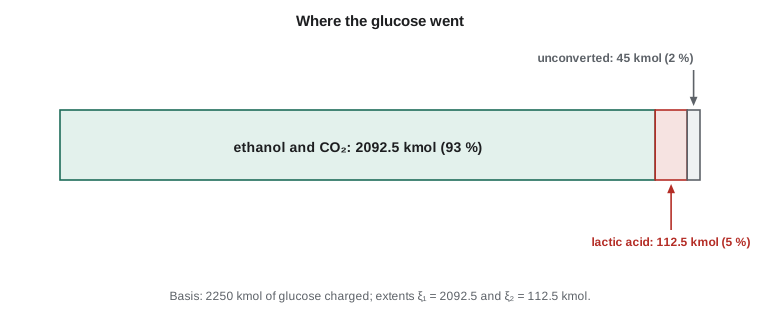
A fermenter is charged with mash containing 2250 kmol of glucose. At the end of fermentation, 98 percent of the glucose has been consumed and the ethanol made is 93 percent of the theoretical maximum. The only side reaction is lactic acid formation by bacteria, \(\text{C}_6\text{H}_{12}\text{O}_6 \to 2\,\text{C}_3\text{H}_6\text{O}_3\). Find the extents of both reactions, the final amounts, the selectivity of ethanol over lactic acid and the ethanol lost to the bacteria.
Show solution
- Reaction 1 makes 2 mol of ethanol per unit extent, so the maximum ethanol is \(2 \times 2250 = 4500\ \text{kmol}\). Ethanol made \(= 0.93 \times 4500 = 4185\ \text{kmol}\), so \(\xi_1 = 2092.5\ \text{kmol}\).
- Glucose consumed \(= 0.98 \times 2250 = 2205\ \text{kmol} = \xi_1 + \xi_2\), so \(\xi_2 = 112.5\ \text{kmol}\).
- Final amounts: glucose \(2250 - 2205 = 45\); ethanol 4185; carbon dioxide 4185; lactic acid \(2 \times 112.5 = 225\ \text{kmol}\).
- Selectivity \(= 4185/225 = 18.6\ \text{mol ethanol per mol lactic acid}\).
- Ethanol lost to the bacteria \(= 2\xi_2 = 225\ \text{kmol} = 10.4\ \text{t}\) per batch.
Answer: The bacteria took about 5 percent of the consumed sugar, worth more than 13 000 L of ethanol per batch. Lactic acid also stresses the yeast, so contamination often lowers the ethanol yield further than the sugar balance alone suggests. Plants control it with sanitation, careful temperature and pH control, and sometimes antibiotics approved for use in fermentation.
# Extent of reaction for a fermenter batch with a side reaction
# R1: C6H12O6 -> 2 C2H5OH + 2 CO2      (yeast)
# R2: C6H12O6 -> 2 C3H6O3              (lactic acid bacteria)
species = ['glucose', 'ethanol', 'CO2', 'lactic acid']
nu = {'R1': [-1, 2, 2, 0], 'R2': [-1, 0, 0, 2]}
n0 = [2250.0, 0.0, 0.0, 0.0]          # kmol charged per batch
conversion = 0.98                     # fraction of glucose consumed
ethanol_yield = 0.93                  # ethanol made / ethanol possible from all glucose fed

xi1 = ethanol_yield * n0[0]           # each extent of R1 makes 2 ethanol; max is 2*n0
xi2 = conversion * n0[0] - xi1
n = [n0[i] + nu['R1'][i] * xi1 + nu['R2'][i] * xi2 for i in range(4)]
for s, v in zip(species, n):
    print(f"{s:12s} {v:9.1f} kmol")
print(f"Extents: R1 = {xi1:.1f} kmol, R2 = {xi2:.1f} kmol")
print(f"Selectivity ethanol/lactic acid = {n[1] / n[3]:.1f} mol/mol")
print(f"Fractional yield of ethanol on glucose consumed = {n[1] / (2 * (n0[0] - n[0])):.3f}")

# Atom balances as a check (C, H, O atoms per molecule)
atoms = {'glucose': (6, 12, 6), 'ethanol': (2, 6, 1), 'CO2': (1, 0, 2), 'lactic acid': (3, 6, 3)}
for j, el in enumerate('CHO'):
    before = sum(n0[i] * atoms[s][j] for i, s in enumerate(species))
    after = sum(n[i] * atoms[s][j] for i, s in enumerate(species))
    print(f"{el} atoms: before {before:9.1f}, after {after:9.1f} kmol")

# Masses in tonnes
M = {'glucose': 180.16, 'ethanol': 46.07, 'CO2': 44.01, 'lactic acid': 90.08}
print("Mass change: " + ", ".join(f"{s} {n[i] * M[s] / 1000 - n0[i] * M[s] / 1000:+.1f} t" for i, s in enumerate(species)))glucose 45.0 kmol ethanol 4185.0 kmol CO2 4185.0 kmol lactic acid 225.0 kmol Extents: R1 = 2092.5 kmol, R2 = 112.5 kmol Selectivity ethanol/lactic acid = 18.6 mol/mol Fractional yield of ethanol on glucose consumed = 0.949 C atoms: before 13500.0, after 13500.0 kmol H atoms: before 27000.0, after 27000.0 kmol O atoms: before 13500.0, after 13500.0 kmol Mass change: glucose -397.3 t, ethanol +192.8 t, CO2 +184.2 t, lactic acid +20.3 t
The same calculation works for the plant as a whole. Fermentation runs in batches, but the plant staggers them so that one fermenter is always filling, several are fermenting and one is emptying to the beer well. Over a day, the beer well delivers a steady flow, and an engineer can treat the fermenter bank as a single continuous reactor with extents expressed as rates, in kmol/h. That is the view a process simulator takes, and it is how the plant's daily production report is calculated from the sugar fed and the ethanol shipped. The batch view is still needed to diagnose a single bad fermenter, as Theo did here, because a contaminated batch is diluted and hidden once its beer mixes with the rest.
Molecular and atomic balances
There are three equivalent ways to set up balances on a reacting system. A molecular species balance writes input − output + generation − consumption for each species, with generation and consumption expressed through reaction rates or extents. The extent-of-reaction method writes each outlet flow as inlet plus \(\sum_j \nu_{ij}\xi_j\), as above. An atomic species balance writes input = output for each element, because atoms are neither created nor destroyed; no reaction terms appear at all. Atomic balances are especially convenient when the reactions are many or not fully known, as in combustion of complex fuels.
The number of independent equations differs between the methods, but the degrees of freedom come out the same when each is counted correctly. For molecular balances with extents: unknowns include one extent per independent reaction. For atomic balances: the number of independent atom balances can be less than the number of elements if two elements always appear in the same ratio, such as nitrogen and argon in an inert stream, so check independence before counting.
Chemical equilibrium
Many reactions are reversible and stop short of completion because the reverse reaction catches up with the forward one. At equilibrium, the composition satisfies an equilibrium relation whose constant \(K\) depends on temperature. For gas-phase reactions at modest pressure, \(K\) is written in terms of mole fractions or partial pressures raised to the stoichiometric coefficients. Thermodynamics courses show how to calculate \(K\) from property data; here it is given, and the task is to combine it with the material balance.
Worked problem
Equilibrium in the water-gas shift
Hydrogen plants use the water-gas shift reaction, \(\textKingfisher Bioenergy + \text{H}_2\text{O} \xrightleftharpoons{} \textKingfisher Bioenergy_2 + \text{H}_2\), to turn carbon monoxide into extra hydrogen. A feed of 1.00 mol CO and 2.00 mol steam reaches equilibrium at a temperature where \(K = y_{\textKingfisher Bioenergy_2} y_{\text{H}_2}/(y_{\textKingfisher Bioenergy} y_{\text{H}_2\text{O}}) = 1.00\). Find the equilibrium composition and the conversion of CO.
Show solution
- Extents: \(n_{\textKingfisher Bioenergy} = 1 - \xi\), \(n_{\text{H}_2\text{O}} = 2 - \xi\), \(n_{\textKingfisher Bioenergy_2} = \xi\), \(n_{\text{H}_2} = \xi\); total \(= 3\ \text{mol}\), unchanged by the reaction.
- Because the total cancels, \(K = \xi^2/[(1 - \xi)(2 - \xi)] = 1\), so \(\xi^2 = 2 - 3\xi + \xi^2\) and \(\xi = 0.667\ \text{mol}\).
- Mole fractions: CO 0.111, H₂O 0.444, CO₂ 0.222, H₂ 0.222.
- Conversion of CO \(= 0.667/1.00 = 0.667\).
Answer: Feeding excess steam pushes the equilibrium toward hydrogen: with equimolar feed the conversion would be only 0.5. Lowering the temperature also raises \(K\) for this exothermic reaction, which is why shift reactors run in two stages, a hot one for speed and a cooler one for conversion.
Degrees of freedom with reactions
Counting degrees of freedom on a reacting system adds one step. List the unknown stream variables as before, then add one unknown for each independent reaction extent. List one balance for each molecular species, plus specifications such as conversion or yield, plus any equilibrium relations. In the fermenter example, the unknowns were the four final amounts and two extents, six in all; the equations were four species balances, the conversion and the yield specification, six in all; so the problem was exactly specified.
Common mistakes
MistakeDefining conversion with respect to the wrong reactant.
InsteadState which reactant the conversion refers to, usually the limiting one.
MistakeUsing an unbalanced equation.
InsteadCheck that every element balances before using the coefficients.
MistakeIncluding dependent reactions as separate extents.
InsteadOnly independent reactions count; drop any that are combinations of others.
MistakeAssuming total moles are conserved in a reaction.
InsteadMoles are conserved only when the sum of the coefficients is zero; mass and atoms are always conserved.
MistakeMixing yield definitions from different sources.
InsteadState the basis: theoretical maximum, reactant fed or reactant consumed.
Summary and key terms
- Balanced equations give stoichiometric ratios; signed coefficients ν are negative for reactants.
- The limiting reactant runs out first; others are in percentage excess.
- Fractional conversion is the fraction of a reactant fed that reacts.
- The extent of reaction ξ gives every species: n_i = n_i0 + Σ ν_ij ξ_j.
- Yield and selectivity describe how multiple reactions share the feed.
- Atomic balances need no reaction terms; equilibrium relations add equations for reversible reactions.
- Stoichiometric coefficient
- The number in front of a species in a balanced equation; negative for reactants in signed form.
- Limiting reactant
- The reactant that would be used up first if the reaction went to completion.
- Percentage excess
- The amount of a reactant fed beyond the stoichiometric requirement, as a percentage of that requirement.
- Fractional conversion
- The fraction of a reactant fed that reacts.
- Extent of reaction
- A measure, in moles, of how far a reaction has proceeded.
- Yield
- The amount of desired product relative to a stated reference amount.
- Selectivity
- The ratio of desired product to undesired product.
- Equilibrium constant
- A temperature-dependent number relating equilibrium amounts of reactants and products.
Practice problems
Work each problem on paper first, then reveal the answer to check.
A burner is fed 10 mol/h CH₄ and 25 mol/h O₂ for CH₄ + 2O₂ → CO₂ + 2H₂O. Which reactant limits, and what is the percentage excess?
Show answer
CH₄ limits (10 versus 12.5); O₂ is in (25 − 20)/20 = 25 % excess.
In the ammonia reaction, 50 mol N₂ and 150 mol H₂ react with ξ = 20 mol. Find all amounts.
Show answer
N₂ 30, H₂ 90, NH₃ 40 mol.
In the fermenter example, what is the fractional yield of ethanol on glucose consumed?
Show answer
4185/(2 × 2205) = 0.949.
Are the reactions A → B, B → C and A → C independent?
Show answer
No; the third is the sum of the first two, so only two are independent.
In the program, raise the ethanol yield to 0.95. What happens to the lactic acid?
Show answer
ξ₁ = 2137.5, ξ₂ = 67.5, so lactic acid falls to 135 kmol and the selectivity rises to about 31.7.
In the shift example, find the CO conversion with 1 mol CO and 1 mol steam.
Show answer
ξ²/(1 − ξ)² = 1 gives ξ = 0.5, a conversion of 0.5.
Lesson quiz · 5 questions
Score 60% or more to complete this lesson.
Create a free account to save your progress, take quizzes and earn a certificate.