
CHE-200 · Lesson 5 of 12 · 26 min
Recycle, bypass and purge
Lesson 4 found that the molecular sieve recovers only about 85 percent of the ethanol it receives in the product; the rest leaves in the regeneration stream. Sending that stream to a drain would waste millions of dollars of ethanol a year, so the plant returns it to the beer column, where the ethanol is recovered again. That return is a recycle. Kingfisher Bioenergy is also studying a small ammonia plant that would make fertilizer from hydrogen produced with renewable electricity, and its synthesis loop is the textbook example of recycle with a purge. Theo is asked to work out how recycle changes both processes. This lesson covers the three stream arrangements that make real plants efficient: recycle, bypass and purge.
Why processes recycle
A recycle stream returns material from a point downstream to a point upstream in the same process. Plants recycle for several reasons. Reactions rarely go to completion in one pass, so unreacted feed is separated from the product and sent back to the reactor. Separations are never perfect, so streams containing valuable product are returned for another try. Solvents, catalysts and heat carriers are expensive and are reused many times. Recycle can also dilute a feed to control temperature or moderate a fast reaction. The ethanol plant recycles backset to the slurry tank, regeneration ethanol to the beer column, evaporator condensate to the cook water, and carbon dioxide scrubber water to the fermenters.
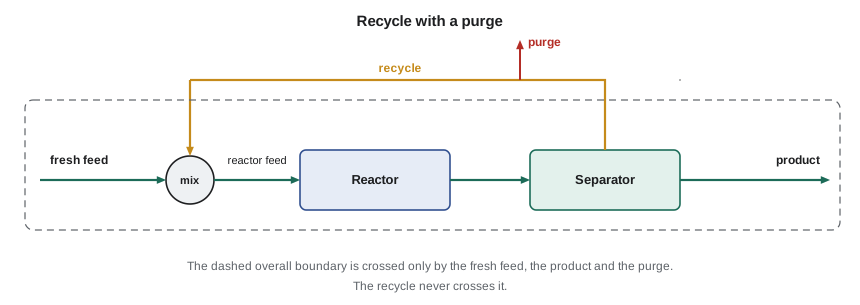
The language matters. The fresh feed enters the process from outside. The process feed, or unit feed, is what actually enters the reactor or separator after the recycle has joined the fresh feed. The recycle ratio is the recycle flow divided by the fresh feed flow. In a loop with a high recycle ratio, the internal flows can be many times the plant's net throughput, and the equipment inside the loop must be sized for those internal flows.
A strategy for recycle problems
Recycle problems look harder than they are. The key is to choose boundaries in the right order. Usually the overall boundary, which crosses only the fresh feed, the products and any purge, has the fewest unknowns and should be solved first. The recycle stream never crosses the overall boundary, so it does not appear there at all. Then solve the mixing point, the reactor or the separator, whichever has zero degrees of freedom next.
Worked problem
Recycling the sieve regeneration stream
Rectifier overhead at 40 720 kg/h and 92.5 percent ethanol feeds the molecular sieve. The sieve produces anhydrous ethanol at 99.5 percent, and its regeneration stream, at 66 percent ethanol, is returned to the beer column. The beer column and rectifier together lose 0.28 percent of the ethanol they receive to the stillage and waste water. Treat the beer column, rectifier and sieve as one block with fresh beer containing 37 800 kg/h of ethanol. What fraction of the ethanol in the beer becomes product?
Show solution
- Overall boundary around the block: ethanol enters only in the beer, 37 800 kg/h; it leaves in the product and in the losses. The regeneration stream is internal and does not appear.
- Losses are 0.28 percent of the ethanol fed to the columns, which is the beer plus the recycle. Let \(R_E\) be the ethanol in the recycle; column losses \(= 0.0028(37\,800 + R_E)\).
- Ethanol reaching the sieve \(= 0.9972(37\,800 + R_E)\). With 85 percent of it going to product and 15 percent to recycle, \(R_E = 0.15 \times 0.9972(37\,800 + R_E)\), so \(R_E = 0.14958(37\,800 + R_E)\) and \(R_E = 6648\ \text{kg/h}\).
- Product ethanol \(= 0.85 \times 0.9972 \times 44\,448 = 37\,675\ \text{kg/h}\); losses \(= 0.0028 \times 44\,448 = 124\ \text{kg/h}\).
- Overall recovery \(= 37\,675/37\,800 = 99.67\ \text{percent}\).
Answer: Without the recycle, the sieve's 85 percent single-pass recovery would cap the plant at 85 percent. With it, nearly all the ethanol reaches the product and the only true losses are the small amounts in the stillage and waste water. The price is a larger flow through the columns, about 18 percent more ethanol, which costs steam.
The example shows the most important idea about recycle: the overall performance of a process depends on what leaves it, not on what happens in a single pass through one unit. A separator or reactor with modest single-pass performance can still give an excellent overall result if the unconverted or unrecovered material is recycled, provided there is a way out for everything that enters.
Overall and single-pass conversion
For a process with a reactor and a recycle, two conversions are defined. The single-pass conversion is the fraction of a reactant entering the reactor that reacts in one pass. The overall conversion is the fraction of the reactant in the fresh feed that reacts in the process as a whole. Lesson 6 covers reaction balances in full; here it is enough to see how recycle separates the two numbers.
If every bit of unreacted feed is separated and recycled, and nothing else leaves, the overall conversion approaches 100 percent regardless of the single-pass conversion. In practice, separations are imperfect and purges remove some reactant, so the overall conversion is high but not complete.
Purge streams
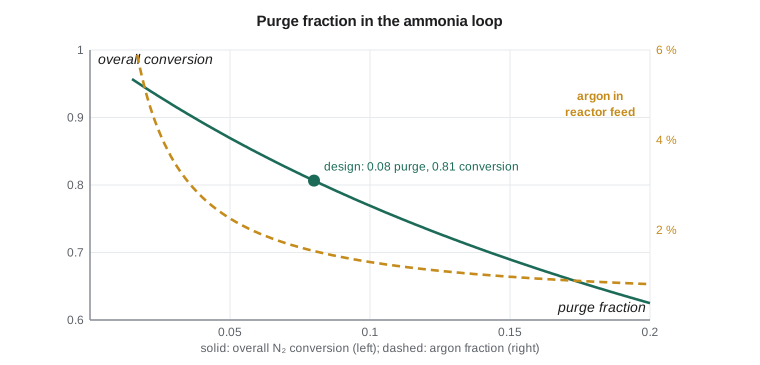
Recycle has a trap. Any substance that enters with the fresh feed and has no exit will build up in the loop without limit. Inert gases in a reactor feed, such as argon and methane in ammonia synthesis gas, are the classic case: they are not consumed by the reaction and are not condensed with the product, so they circulate with the recycle gas. Without a way out, their concentration rises until the reaction stops. The cure is a purge, a small stream bled from the recycle line. At steady state, the inert leaving in the purge must equal the inert entering in the fresh feed.
The purge removes valuable reactants too, because they have the same composition as the rest of the recycle. A small purge keeps losses low but lets the inert concentration rise, which dilutes the reactants and enlarges the loop. A large purge keeps the inert concentration low but wastes reactant. Choosing the purge fraction is an economic trade-off.
Worked problem
Purge in an ammonia synthesis loop
Fresh synthesis gas at 100 mol/h contains 74.70 mol H₂, 24.90 mol N₂ and 0.40 mol argon. It mixes with recycle gas and enters a reactor where 25 percent of the nitrogen entering reacts, \(\text{N}_2 + 3\text{H}_2 \to 2\text{NH}_3\). All the ammonia condenses in the separator; the remaining gas is recycled, except that 8 percent of it is purged. Find the nitrogen fed to the reactor, the ammonia made, the argon fraction in the reactor feed and the overall nitrogen conversion.
Show solution
- Nitrogen balance on the loop: let \(F\) be the nitrogen entering the reactor. The reactor leaves \(0.75F\); 92 percent is recycled, so \(F = 24.90 + 0.92(0.75F) = 24.90 + 0.69F\), giving \(F = 80.32\ \text{mol/h}\).
- Nitrogen reacted \(= 0.25 \times 80.32 = 20.08\ \text{mol/h}\); ammonia made \(= 40.16\ \text{mol/h}\).
- Argon: \(A = 0.40 + 0.92A\), so the argon entering the reactor is \(A = 5.00\ \text{mol/h}\). The hydrogen balance gives 240.9 mol/h entering, so the reactor feed totals \(80.32 + 240.9 + 5.00 = 326.3\ \text{mol/h}\) and the argon fraction is 1.53 percent.
- Nitrogen purged \(= 0.08 \times 0.75 \times 80.32 = 4.82\ \text{mol/h}\); overall conversion \(= (24.90 - 4.82)/24.90 = 0.806\).
Answer: A single-pass conversion of only 25 percent becomes an overall conversion of about 81 percent, with a recycle ratio of 2.26. Reducing the purge to 2 percent raises the overall conversion to 94 percent, but the argon in the reactor feed climbs to 5 percent and the recycle compressor must move about a third more gas. Real ammonia plants balance these effects, and they recover hydrogen from the purge gas to cut the losses further.
Solving loops by iteration
The ammonia loop could be solved by hand because each species gave a single linear equation. Larger problems, and any with nonlinear relations such as equilibrium, are solved by iteration. Choose a stream inside the loop, usually the recycle, as the tear stream; guess its flows; calculate around the loop to get a new value; and repeat until the guess and the result agree. This is called successive substitution. It is exactly what sequential modular simulators do, and it converges slowly when the recycle ratio is high, which is why simulators add acceleration methods.
# Recycle with purge: an ammonia synthesis loop solved by successive substitution
# N2 + 3 H2 -> 2 NH3. Fresh feed (mol/h): H2, N2 and argon as an inert.
fresh = {'H2': 74.70, 'N2': 24.90, 'Ar': 0.40}
X = 0.25            # single-pass conversion of N2 in the reactor
purge_frac = 0.08   # fraction of the separator gas that is purged

def loop(purge_frac, tol=1e-8):
    rec = {'H2': 0.0, 'N2': 0.0, 'Ar': 0.0}   # first guess: no recycle
    for it in range(1, 20000):
        feed = {k: fresh[k] + rec[k] for k in fresh}          # mixer
        xi = X * feed['N2']                                   # extent of reaction
        out = {'H2': feed['H2'] - 3 * xi, 'N2': feed['N2'] - xi, 'Ar': feed['Ar'], 'NH3': 2 * xi}
        gas = {k: out[k] for k in ('H2', 'N2', 'Ar')}         # separator: all NH3 condensed
        new = {k: (1 - purge_frac) * gas[k] for k in gas}     # splitter
        if max(abs(new[k] - rec[k]) for k in rec) < tol:
            return it, feed, out, gas, new
        rec = new
    raise RuntimeError('did not converge')

it, feed, out, gas, rec = loop(purge_frac)
nf = sum(feed.values())
print(f"Converged in {it} iterations")
print(f"Reactor feed {nf:.1f} mol/h; argon fraction {feed['Ar'] / nf:.4f}")
print(f"Recycle {sum(rec.values()):.1f} mol/h; recycle ratio {sum(rec.values()) / sum(fresh.values()):.2f}")
purge = {k: purge_frac * gas[k] for k in gas}
print(f"Ammonia product {out['NH3']:.2f} mol/h; purge {sum(purge.values()):.2f} mol/h")
overall = 1 - purge['N2'] / fresh['N2']
print(f"Overall N2 conversion {overall:.3f} versus single-pass {X:.2f}")
print("\npurge fraction  Ar in reactor feed  overall conversion  recycle ratio")
for p in (0.02, 0.05, 0.08, 0.12, 0.20):
    _, f, o, g, r = loop(p)
print(f"{p:14.2f}{f['Ar'] / sum(f.values()):20.4f}{1 - p * g['N2'] / fresh['N2']:20.3f}{sum(r.values()) / 100:15.2f}")Converged in 210 iterations
Reactor feed 326.3 mol/h; argon fraction 0.0153
Recycle 226.3 mol/h; recycle ratio 2.26
Ammonia product 40.16 mol/h; purge 19.68 mol/h
Overall N2 conversion 0.806 versus single-pass 0.25
purge fraction Ar in reactor feed overall conversion recycle ratio
0.02 0.0505 0.943 2.96
0.05 0.0226 0.870 2.54
0.08 0.0153 0.806 2.26
0.12 0.0113 0.735 1.96
0.20 0.0080 0.625 1.51Bypass
A bypass sends part of a feed around a process unit and blends it back with the unit's outlet. It is used when a unit overshoots a target and only part of the stream needs treatment, when a unit has limited capacity, or to control a temperature or composition finely. The balance on a bypass is an ordinary splitter and mixer problem.
Worked problem
Bypassing the water treatment unit
The plant draws 90 m³/h of well water containing 620 mg/L of dissolved solids for its cooling tower makeup. A reverse osmosis unit produces permeate at 15 mg/L, recovering 75 percent of its feed as permeate; the rest is reject. The cooling tower can accept makeup at 200 mg/L. What fraction of the well water can bypass the unit, and how much makeup is delivered?
Show solution
- Let \(b\) be the bypass flow; RO feed \(= 90 - b\); permeate \(= 0.75(90 - b)\).
- Makeup flow \(= b + 0.75(90 - b) = 67.5 + 0.25b\).
- Solids balance on the blending point (treating densities as equal): \(620b + 15(0.75)(90 - b) = 200(67.5 + 0.25b)\).
- Expanding: \(620b + 1012.5 - 11.25b = 13\,500 + 50b\), so \(558.75b = 12\,487.5\) and \(b = 22.3\ \text{m}^3/\text{h}\).
- Bypass fraction \(= 22.3/90 = 0.248\); makeup \(= 67.5 + 0.25 \times 22.3 = 73.1\ \text{m}^3/\text{h}\).
Answer: About a quarter of the well water can skip treatment, which shrinks the reverse osmosis unit and its reject stream. Without the bypass, all 90 m³/h would pass through the unit and deliver only 67.5 m³/h of makeup that is far purer than the tower needs.
Common mistakes
MistakeIncluding the recycle stream in the overall balance.
InsteadThe recycle stays inside the overall boundary and does not appear in its balance.
MistakeConfusing single-pass and overall conversion.
InsteadSingle-pass is based on reactor feed; overall is based on fresh feed.
MistakeForgetting that inerts accumulate in a recycle loop.
InsteadEvery species that enters must have an exit; a purge provides it for inerts.
MistakeAssuming the purge has a different composition from the recycle.
InsteadA purge is taken by a splitter, so it has exactly the recycle composition.
MistakeTreating successive substitution as exact after a few iterations.
InsteadIterate until the change between passes is negligible; high recycle ratios converge slowly.
Summary and key terms
- Recycle returns unconverted reactant, unrecovered product or reusable material to an earlier point.
- Solve the overall boundary first; the recycle stream does not cross it.
- Overall conversion can far exceed single-pass conversion when unreacted feed is recycled.
- A purge prevents inerts from building up; at steady state, inert in equals inert in purge.
- Purge size trades reactant losses against inert concentration and loop size.
- Bypass sends part of a stream around a unit; loops are solved by tearing and iterating.
- Recycle
- A stream returned from a downstream point to an upstream point in a process.
- Fresh feed
- Material entering the process from outside.
- Recycle ratio
- The recycle flow divided by the fresh feed flow.
- Single-pass conversion
- The fraction of a reactant entering a reactor that reacts in one pass.
- Overall conversion
- The fraction of a reactant in the fresh feed that reacts in the whole process.
- Purge
- A stream bled from a recycle to remove inerts or impurities.
- Bypass
- A stream sent around a process unit and blended with its outlet.
- Tear stream
- A stream whose values are guessed to start an iterative loop calculation.
Practice problems
Work each problem on paper first, then reveal the answer to check.
A reactor converts 30 % of A per pass; all unreacted A is separated and recycled with no purge. What is the overall conversion of A?
Show answer
100 %, because the only exit for A is through reaction.
Fresh feed contains 1 mol/h of an inert. The purge is 20 mol/h. What is the inert mole fraction in the recycle?
Show answer
1/20 = 0.05.
In the ammonia example, why does reducing the purge raise the recycle flow?
Show answer
Less gas leaves, so more circulates, and the inert concentration rises until the inert purged equals the inert fed.
In the sieve example, what is the overall recovery if the sieve's single-pass recovery is 80 %?
Show answer
R_E = 0.20 × 0.9972(37 800 + R_E) gives R_E = 9418 kg/h; product = 0.80 × 0.9972 × 47 218 = 37 669 kg/h; recovery 99.65 %.
In the program, what purge fraction keeps the argon in the reactor feed near 2 percent?
Show answer
About 0.06, between the 0.05 and 0.08 rows of the table.
Why is a bypass useful in the water treatment example?
Show answer
Only part of the water needs treatment to meet the target, so a smaller unit with less reject does the job.
Lesson quiz · 5 questions
Score 60% or more to complete this lesson.
Create a free account to save your progress, take quizzes and earn a certificate.