
CHE-200 · Lesson 7 of 12 · 24 min
Combustion balances
The boiler house at Kingfisher Bioenergy burns natural gas to raise the steam that heats the distillation columns, the evaporators and the cook process, and separate gas burners heat the air for the grain dryers. Fuel is the plant's second largest cost after corn, and every kilogram of carbon dioxide from the stacks counts toward the plant's emissions report to the Ontario Ministry of the Environment, Conservation and Parks. An analyzer on the boiler stack reads 3.0 percent oxygen. Ingrid asks Theo what that number means for the air flow and the stack losses, and whether the burners are set correctly. Combustion is the most common reaction in industry, and its balances have their own vocabulary, which this lesson explains.
Combustion chemistry
Combustion is the rapid reaction of a fuel with oxygen. Fuels contain mostly carbon and hydrogen, often with some sulphur, oxygen and nitrogen. In complete combustion, all the carbon burns to carbon dioxide, all the hydrogen to water and any sulphur to sulphur dioxide. In incomplete or partial combustion, some carbon leaves as carbon monoxide, and sometimes as soot or unburned hydrocarbon. Carbon monoxide is toxic and wastes fuel, so burners are set to keep it very low, typically below 100 ppm in a boiler flue.
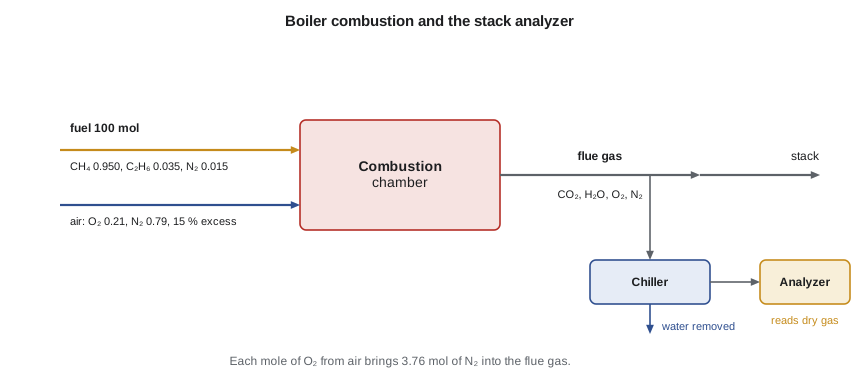
Almost every industrial burner uses air as the oxygen source. For balance work, dry air is taken as 21 percent oxygen and 79 percent nitrogen by moles, with the small amounts of argon and carbon dioxide lumped into the nitrogen. So every mole of oxygen brings \(79/21 = 3.76\) moles of nitrogen, and the nitrogen, which passes through essentially unchanged, makes up most of the flue gas. The average molar mass of air is 28.97 g/mol.
Theoretical and excess air
Theoretical oxygen is the amount needed to burn all the fuel completely: all carbon to carbon dioxide and all hydrogen to water. Theoretical air is the air that contains the theoretical oxygen. Both are defined for complete combustion even when the actual combustion is incomplete, so that they depend only on the fuel fed. Excess air is the air fed beyond the theoretical amount, usually given as a percentage of the theoretical air.
Burners always run with some excess air, because mixing of fuel and air is never perfect and a fuel-rich flame makes carbon monoxide and soot. Too much excess air, though, heats a large mass of nitrogen and oxygen that carries energy up the stack. Natural gas boilers typically run at 10 to 20 percent excess air, oil burners at 15 to 30 percent and solid fuel at 25 percent or more. Modern controls trim the air continuously using the stack oxygen reading.
Wet and dry flue gas analysis
The composition of a flue gas can be reported including the water vapour, a wet basis, or excluding it, a dry basis, sometimes called an Orsat analysis after an old absorption instrument. Many stack analyzers draw a sample through a chiller that condenses the water before measuring, so they read on a dry basis. Converting between the bases needs only the amount of water: divide each dry-basis amount by the total dry moles, or each wet amount by the total wet moles.
A common trap is to forget which basis an analyzer reports. A 3 percent oxygen reading on a dry basis corresponds to only about 2.5 percent on a wet basis for natural gas, because about one sixth of the wet flue gas is water. The difference matters when back-calculating excess air or comparing with an emission limit stated on a particular basis.
Worked problem
Flue gas from the boiler
The boiler burns natural gas containing 95.0 mol% methane, 3.5 mol% ethane and 1.5 mol% nitrogen with 15 percent excess air. Combustion is complete. Taking 100 mol of fuel as the basis, find the air fed and the flue gas composition on wet and dry bases.
Show solution
- Atoms in the fuel: C \(= 95.0 + 2(3.5) = 102.0\ \text{mol}\); H \(= 4(95.0) + 6(3.5) = 401.0\ \text{mol}\).
- Theoretical O₂ \(= 102.0 + 401.0/4 = 202.25\ \text{mol}\). O₂ fed \(= 1.15 \times 202.25 = 232.6\ \text{mol}\); N₂ fed \(= 3.76 \times 232.6 = 875.0\ \text{mol}\); air fed \(= 1107.6\ \text{mol}\).
- Products: CO₂ \(= 102.0\); H₂O \(= 401.0/2 = 200.5\); O₂ left \(= 232.6 - 202.25 = 30.3\); N₂ \(= 875.0 + 1.5 = 876.5\ \text{mol}\).
- Totals: wet 1209.3 mol, dry 1008.8 mol.
- Wet basis: CO₂ 8.43 %, H₂O 16.58 %, O₂ 2.51 %, N₂ 72.48 %. Dry basis: CO₂ 10.11 %, O₂ 3.01 %, N₂ 86.88 %.
Answer: The stack analyzer's 3.0 percent dry oxygen corresponds to about 15 percent excess air for this fuel. Each mole of fuel needs about 11 moles of air and makes about 12 moles of flue gas, three quarters of it nitrogen. That large inert flow is why stack temperature and excess air control matter so much for boiler efficiency.
Working back from a flue gas analysis
Plant engineers often know the flue gas analysis and need the excess air, the fuel composition or the air flow. The nitrogen in the flue gas is the key: if the fuel contains little nitrogen, almost all of it came from the air, so it fixes the air fed. Carbon in the flue gas, as carbon dioxide and carbon monoxide, fixes the fuel burned. With those two, the excess air follows. Remember that excess air is always based on complete combustion, even when the analysis shows carbon monoxide.
Worked problem
Excess air from a dryer burner analysis
A dryer burner fires methane. The dry flue gas analysis is 8.69 % CO₂, 0.46 % CO, 4.80 % O₂ and 86.05 % N₂. Find the percentage excess air.
Show solution
- Basis: 100 mol of dry flue gas. Nitrogen comes only from air, so O₂ fed \(= 86.05 \times 21/79 = 22.87\ \text{mol}\).
- Carbon balance: methane burned \(= 8.69 + 0.46 = 9.15\ \text{mol}\).
- Theoretical O₂ for complete combustion of 9.15 mol CH₄ \(= 2 \times 9.15 = 18.30\ \text{mol}\).
- Percent excess air \(= (22.87 - 18.30)/18.30 \times 100 = 25.0\ \text{percent}\).
- Check with an oxygen atom balance: O₂ used \(= 8.69 + 0.23 + 9.15 = 18.07\); O₂ left \(= 22.87 - 18.07 = 4.80\ \text{mol}\), matching the analysis.
Answer: The burner runs at 25 percent excess air, yet about 5 percent of the carbon still leaves as carbon monoxide. That combination usually means poor mixing rather than too little air, and the remedy is burner maintenance, not more air. Adding air would raise the stack losses without fixing the cause.
# Natural gas combustion in the plant boiler: theoretical air, excess air and flue gas
fuel = {'CH4': 0.950, 'C2H6': 0.035, 'N2': 0.015}   # mole fractions in the fuel gas
atoms = {'CH4': (1, 4), 'C2H6': (2, 6), 'N2': (0, 0)}  # (C, H) per molecule

def flue(excess, basis=100.0, co_frac=0.0):
    """Flue gas (mol) for `basis` mol of fuel; co_frac = fraction of carbon burned to CO."""
    C = sum(basis * y * atoms[s][0] for s, y in fuel.items())
    H = sum(basis * y * atoms[s][1] for s, y in fuel.items())
    O2_theo = C + H / 4                      # complete combustion to CO2 and H2O
    O2_fed = O2_theo * (1 + excess)
    N2_fed = O2_fed * 79 / 21
    CO = co_frac * C
    CO2 = C - CO
    H2O = H / 2
    O2_out = O2_fed - (CO2 + CO / 2) - H2O / 2
    N2 = N2_fed + basis * fuel['N2']
    return {'CO2': CO2, 'CO': CO, 'H2O': H2O, 'O2': O2_out, 'N2': N2}, O2_theo, O2_fed / 0.21

gas, O2_theo, air = flue(0.15)
tot = sum(gas.values()); dry = tot - gas['H2O']
print(f"Per 100 mol fuel: theoretical O2 {O2_theo:.1f} mol, air fed at 15 % excess {air:.1f} mol")
print(f"{'':6s}{'mol':>8s}{'wet %':>8s}{'dry %':>8s}")
for k, v in gas.items():
    print(f"{k:6s}{v:8.1f}{100 * v / tot:8.2f}{'' if k == 'H2O' else f'{100 * v / dry:8.2f}':>8s}")
print(f"Total {tot:.1f} mol wet, {dry:.1f} mol dry")

print("\nexcess air   O2 in dry flue gas (%)")
for ex in (0.0, 0.05, 0.10, 0.15, 0.20, 0.30, 0.50):
    g, _, _ = flue(ex)
    d = sum(g.values()) - g['H2O']
    print(f"{ex * 100:9.0f} %{100 * g['O2'] / d:16.2f}")

# Back-calculate excess air from a measured 3.0 % O2 (dry) by bisection
lo, hi = 0.0, 1.0
for _ in range(60):
    mid = (lo + hi) / 2
    g, _, _ = flue(mid)
    if 100 * g['O2'] / (sum(g.values()) - g['H2O']) < 3.0: lo = mid
    else: hi = mid
print(f"\nMeasured 3.0 % O2 dry means about {mid * 100:.1f} % excess air")Per 100 mol fuel: theoretical O2 202.2 mol, air fed at 15 % excess 1107.6 mol
mol wet % dry %
CO2 102.0 8.43 10.11
CO 0.0 0.00 0.00
H2O 200.5 16.58
O2 30.3 2.51 3.01
N2 876.5 72.48 86.88
Total 1209.3 mol wet, 1008.8 mol dry
excess air O2 in dry flue gas (%)
0 % 0.00
5 % 1.11
10 % 2.11
15 % 3.01
20 % 3.83
30 % 5.26
50 % 7.51
Measured 3.0 % O2 dry means about 15.0 % excess airFuels with oxygen, sulphur and moisture
Other fuels need a little more care. Biogas from the plant's anaerobic digester is mostly methane and carbon dioxide; the carbon dioxide passes through unchanged and adds to the flue gas. Solid and liquid fuels are described by an ultimate analysis, the mass fractions of carbon, hydrogen, sulphur, oxygen, nitrogen, moisture and ash. Convert each to moles of atoms per kilogram of fuel, then compute theoretical oxygen as \(n_{\text{C}} + n_{\text{H}}/4 + n_{\text{S}} - n_{\text{O}}/2\), subtracting the oxygen already in the fuel. Moisture in the fuel adds to the flue gas water, and ash leaves as a solid.
Ethanol itself is a fuel, burned in some engines and in the plant's thermal oxidizer, which destroys volatile organic compounds vented from the fermenters and dryers. Its formula contains oxygen, so it needs less air per mole of carbon than methane: \(\text{C}_2\text{H}_5\text{OH} + 3\,\text{O}_2 \to 2\,\textKingfisher Bioenergy_2 + 3\,\text{H}_2\text{O}\) uses 1.5 mol of oxygen per mole of carbon, against 2 for methane.
Carbon dioxide from combustion
Carbon balances also feed emission reports. Every mole of carbon in the fuel becomes a mole of carbon dioxide, apart from small amounts of carbon monoxide and unburned fuel. For natural gas of the composition above, burning 1 kmol of fuel releases 1.02 kmol, or 44.9 kg, of carbon dioxide. Emission reporting programs in both countries require large emitters to calculate these figures from fuel use and carbon content, and fuel suppliers report the gas composition for that purpose. The plant's fermentation carbon dioxide is biogenic, because the carbon came from corn that absorbed it from the air in the previous season, and reporting rules treat it separately from fossil carbon dioxide from the boiler.
| Fuel | Theoretical air (kg air per kg fuel) | CO₂ formed (kg per kg fuel) |
|---|---|---|
| Methane | 17.2 | 2.74 |
| Natural gas (example above) | 16.7 | 2.69 |
| Ethanol | 8.98 | 1.91 |
| Hydrogen | 34.2 | 0 |
Flammability and safe firing
Balances also underpin combustion safety. A fuel and air mixture burns only within its flammability limits: methane in air between about 5 and 15 percent by volume, and ethanol vapour between about 3.3 and 19 percent. Below the lower limit there is too little fuel to sustain a flame; above the upper limit there is too little oxygen. Burner management systems purge a boiler's furnace with several volume changes of air before every ignition attempt, so that any fuel that leaked in is diluted far below the lower limit before a spark is struck. A failed ignition is followed by another purge, never by an immediate retry.
The same arithmetic protects people. The fermenters release carbon dioxide continuously, and a tank or pit full of it contains too little oxygen to breathe, which is why confined space entry at an ethanol plant requires atmospheric testing and ventilation. Ethanol vapour from tank vents and loading racks can reach its lower flammable limit in poorly ventilated spaces, so storage areas are classified for electrical equipment and vapours are collected and sent to the thermal oxidizer or a vapour recovery unit. A quick balance, how much vapour or gas enters a space and how much air flows through it, tells an engineer whether a concentration could approach a hazardous level.
Carbon monoxide deserves a final mention. It has no colour or smell, it binds to blood haemoglobin far more strongly than oxygen, and a few hundred ppm can cause harm within hours. Fuel-burning equipment indoors, such as propane forklifts in a warehouse, needs ventilation sized from the same kind of balance, and CO detectors provide a second line of protection.
Common mistakes
MistakeBasing excess air on the oxygen actually used when combustion is incomplete.
InsteadExcess air is always based on complete combustion of all the fuel fed.
MistakeForgetting the nitrogen that comes with the air.
InsteadEach mole of O₂ in air brings 3.76 mol of N₂, which appears in the flue gas.
MistakeComparing a dry analyzer reading with a wet-basis calculation.
InsteadCheck the basis; remove the water from the calculated flue gas before comparing with a dry analysis.
MistakeIgnoring oxygen already present in the fuel.
InsteadSubtract half the fuel's oxygen atoms from the theoretical O₂.
MistakeRaising excess air to cure carbon monoxide caused by poor mixing.
InsteadHigh CO with plenty of excess oxygen points to burner problems, not air shortage.
Summary and key terms
- Complete combustion turns C to CO₂, H to H₂O and S to SO₂; incomplete combustion leaves CO.
- Air is taken as 21 % O₂ and 79 % N₂, so each mole of O₂ brings 3.76 mol N₂.
- Theoretical oxygen is for complete combustion; excess air is a percentage above theoretical.
- Flue gas can be analysed wet or dry; many analyzers read dry.
- From a dry analysis, nitrogen fixes the air and carbon fixes the fuel burned.
- Carbon balances give the CO₂ emitted per unit of fuel.
- Complete combustion
- Combustion in which all carbon forms CO₂ and all hydrogen forms H₂O.
- Theoretical air
- The air containing exactly the oxygen needed for complete combustion.
- Excess air
- Air fed beyond the theoretical amount, usually as a percentage of it.
- Flue gas
- The gaseous products of combustion leaving a furnace or boiler.
- Dry basis analysis
- A gas composition calculated with the water vapour removed.
- Ultimate analysis
- The elemental composition of a fuel by mass.
- Thermal oxidizer
- A combustion unit that destroys volatile organic compounds in vent gases.
Practice problems
Work each problem on paper first, then reveal the answer to check.
How much air is theoretically needed to burn 1 mol of propane, C₃H₈?
Show answer
5 mol O₂, so 5/0.21 = 23.8 mol of air.
Methane is burned with 20 % excess air. How many moles of air per mole of methane?
Show answer
2 × 1.2/0.21 = 11.4 mol.
A flue gas is 12.0 % water on a wet basis and 4.0 % O₂ wet. What is the O₂ on a dry basis?
Show answer
4.0/0.88 = 4.55 %.
A dry flue analysis from burning pure carbon shows 79.0 % N₂ and 2.0 % O₂. Find the excess air.
Show answer
O₂ fed = 21.0; O₂ used = 19.0 = C burned; excess = 2/19 = 10.5 %.
In the program, what excess air gives 5 % dry oxygen?
Show answer
About 28 percent, between the 20 and 30 percent rows.
Why does ethanol need less air per kg than methane?
Show answer
It contains oxygen already and has less hydrogen per carbon, so its theoretical oxygen per kilogram is much lower.
Lesson quiz · 5 questions
Score 60% or more to complete this lesson.
Create a free account to save your progress, take quizzes and earn a certificate.