
CHE-200 · Lesson 4 of 12 · 24 min
Balances on multiple-unit processes
Real processes are chains of units. In the back end of the ethanol plant, whole stillage from the beer column goes to decanter centrifuges, which split it into wet cake and thin stillage. Part of the thin stillage returns to the slurry tank as backset; the rest goes to a multiple-effect evaporator that concentrates it to syrup. The syrup is mixed with the wet cake and dried in rotary dryers to make distillers dried grains with solubles, sold as animal feed. The dryers are the largest energy users in the plant after distillation, so Ingrid asks Theo to work out how much water each unit removes. That means a balance on four connected units, which is the subject of this lesson.
Subsystems and boundaries
In a multiple-unit process, a balance can be written around any subsystem: a single unit, a mixing point, a splitting point, a group of units, or the whole process. Each choice of boundary gives a different set of equations. The flows that cross the boundary appear in its balances; flows that stay inside cancel out. Drawing several boundaries on one flowchart and counting the degrees of freedom for each is the key to solving these problems efficiently.
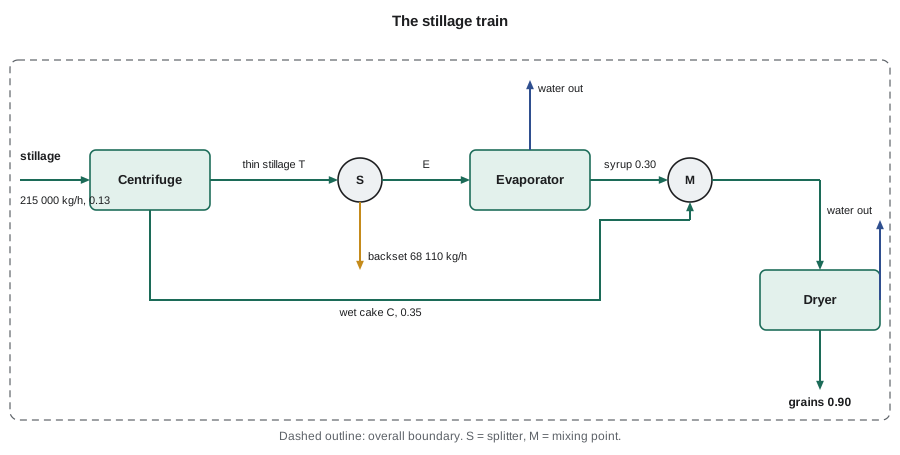
The overall boundary around the whole stillage train has as inputs only the whole stillage, and as outputs the backset, the evaporator vapour, the dryer vapour and the dried grains. The wet cake, thin stillage, evaporator feed and syrup are internal and do not appear. An overall balance is often the quickest way to find product flows, but it cannot tell you anything about internal streams.
Degrees of freedom for multiple units
Count degrees of freedom for each subsystem separately, using only the unknowns and equations that belong to it. Then look for a subsystem with zero degrees of freedom, solve it, and mark its streams as known. That usually reduces the degrees of freedom of a neighbouring subsystem to zero, and the solution proceeds unit by unit. For the whole process, the total degrees of freedom equal the sum of the unknowns in all streams minus all independent equations on all units. Balances on every unit plus an overall balance are not all independent: the overall balance is the sum of the unit balances.
A useful bookkeeping rule: for a process of \(k\) units handling \(N\) species with no reaction, there are at most \(kN\) independent material balances, whichever \(k\) boundaries you choose, as long as together they include every unit. Choosing which \(k\) boundaries to use is a matter of convenience.
Splitters and mixers
A stream splitter divides a stream into two or more streams of identical composition. Because the outlets have the same composition as the inlet, the splitter gives only one independent balance, a total balance, no matter how many components there are. Writing species balances on a splitter adds nothing new, and counting them as extra equations is a classic mistake. The composition restrictions take their place: they are already used when every outlet is labelled with the inlet's fractions.
A mixing point combines streams of different composition into one. It behaves like any other unit, with as many independent balances as there are species. Mixers are where recycle streams rejoin the process, so they appear in nearly every recycle problem in Lesson 5.
| Unit | Independent balances (N species) | Notes |
|---|---|---|
| Separator or mixer | N | Total plus N − 1 species, or N species |
| Splitter | 1 | All outlets have the inlet composition |
| Evaporator or dryer with one volatile | N | The nonvolatile solids are a tie component |
| Overall process | N | Not independent of the full set of unit balances |
The stillage train
Worked problem
Water removal in the stillage train
Whole stillage at 215 000 kg/h contains 13.0 percent solids. The centrifuge makes wet cake at 35 percent solids and thin stillage at 7.0 percent solids. A splitter returns 68 110 kg/h of thin stillage as backset, and the rest is evaporated to syrup at 30 percent solids. The syrup and cake are mixed and dried to grains at 90 percent solids. Find every stream and the water removed in the evaporator and dryer.
Show solution
- Centrifuge (DF = 0): total \(215\,000 = C + T\); solids \(0.13(215\,000) = 0.35C + 0.07T\). Solving, \(T = 215\,000(0.35 - 0.13)/(0.35 - 0.07) = 168\,930\ \text{kg/h}\) and \(C = 46\,070\ \text{kg/h}\).
- Splitter (one balance): evaporator feed \(E = 168\,930 - 68\,110 = 100\,820\ \text{kg/h}\) at 7.0 percent solids.
- Evaporator, solids as tie component: syrup \(= 100\,820 \times 0.07/0.30 = 23\,520\ \text{kg/h}\); vapour \(= 77\,300\ \text{kg/h}\).
- Mixer: dryer feed \(= 46\,070 + 23\,520 = 69\,600\ \text{kg/h}\) containing \(0.35(46\,070) + 0.30(23\,520) = 23\,180\ \text{kg/h}\) of solids, 33.3 percent.
- Dryer: grains \(= 23\,180/0.90 = 25\,760\ \text{kg/h}\); water evaporated \(= 69\,600 - 25\,760 = 43\,840\ \text{kg/h}\).
- Overall check: out \(= 68\,110 + 77\,300 + 25\,760 + 43\,840 = 215\,010\ \text{kg/h}\), equal to the input within rounding.
Answer: The evaporator removes about 77 t/h of water and the dryers about 44 t/h. Evaporating water in a multiple-effect evaporator costs far less energy per kilogram than drying it, because each effect reuses the vapour from the one before. That is why plants push as much water as possible out in the evaporator and why the syrup concentration is a key operating target.
The order of solution followed the degrees of freedom. The centrifuge had two unknowns and two balances, so it went first. Its outputs made the splitter solvable, then the evaporator, then the mixer and dryer. An overall balance at the end served as a check rather than as a step. In a different problem, for example one where the grains production is given and the stillage flow is unknown, the overall balance might be the place to start.
# Stillage train: centrifuge -> evaporator -> dryer, with backset split off the thin stillage
S = 215_000.0          # kg/h whole stillage from the beer column
s_S = 0.130            # solids mass fraction in whole stillage
s_cake, s_thin = 0.35, 0.070   # wet cake and thin stillage solids fractions
backset = 68_110.0     # kg/h of thin stillage returned to the slurry tank (Lesson 3)
s_syrup = 0.30         # syrup solids leaving the evaporator
s_ddgs = 0.90          # dried grains solids

# Centrifuge: total and solids balances in two unknowns (cake C, thin stillage T)
T = S * (s_cake - s_S) / (s_cake - s_thin)
C = S - T
print(f"Centrifuge: wet cake {C:9.0f} kg/h, thin stillage {T:9.0f} kg/h")

# Splitter: same composition in both outlets
E_feed = T - backset
print(f"Splitter: backset {backset:9.0f} kg/h, evaporator feed {E_feed:9.0f} kg/h")

# Evaporator: solids are a tie component
syrup = E_feed * s_thin / s_syrup
vap_evap = E_feed - syrup
print(f"Evaporator: syrup {syrup:9.0f} kg/h, water evaporated {vap_evap:9.0f} kg/h")

# Mixer + dryer: wet cake and syrup combine, dryer removes water to 90 % solids
solids_in = C * s_cake + syrup * s_syrup
dryer_feed = C + syrup
ddgs = solids_in / s_ddgs
vap_dryer = dryer_feed - ddgs
print(f"Dryer: feed {dryer_feed:9.0f} kg/h at {solids_in / dryer_feed:.3f} solids, DDGS {ddgs:9.0f} kg/h, water out {vap_dryer:9.0f} kg/h")

# Overall check on the train (boundary around all four units)
out = backset + vap_evap + ddgs + vap_dryer
print(f"Overall: in {S:.0f} kg/h, out {out:.0f} kg/h")
solids_out = backset * s_thin + ddgs * s_ddgs
print(f"Solids: in {S * s_S:.0f} kg/h, out {solids_out:.0f} kg/h")Centrifuge: wet cake 46071 kg/h, thin stillage 168929 kg/h Splitter: backset 68110 kg/h, evaporator feed 100819 kg/h Evaporator: syrup 23524 kg/h, water evaporated 77294 kg/h Dryer: feed 69596 kg/h at 0.333 solids, DDGS 25758 kg/h, water out 43838 kg/h Overall: in 215000 kg/h, out 215000 kg/h Solids: in 27950 kg/h, out 27950 kg/h
A second example: two columns in series
The ethanol from the beer column is still wet. The rectifier concentrates the beer column vapour toward the azeotrope, the composition at which a boiling ethanol and water mixture gives a vapour of the same composition, about 95.6 percent ethanol by mass at atmospheric pressure. Ordinary distillation cannot pass that point, so the rectifier product goes to molecular sieves, beds of zeolite pellets that adsorb water molecules but not the larger ethanol molecules. Treating the two separations in series is another multiple-unit problem.
Worked problem
Rectifier and sieve in series
The rectifier receives 64 990 kg/h of vapour at 58 percent ethanol. Its overhead product is 92.5 percent ethanol, and its bottoms, sent to waste water treatment after a side stripper, contain 0.1 percent ethanol. The molecular sieve takes the rectifier overhead and produces anhydrous ethanol at 99.5 percent, and its regeneration stream, which leaves at 60 percent ethanol, is sent back to the beer column. If the sieve recovers 85 percent of the ethanol it receives in the product, find the product flow.
Show solution
- Rectifier (DF = 0): \(D = 64\,990(0.58 - 0.001)/(0.925 - 0.001) = 40\,720\ \text{kg/h}\); bottoms \(= 24\,270\ \text{kg/h}\).
- Ethanol to the sieve \(= 0.925 \times 40\,720 = 37\,670\ \text{kg/h}\); ethanol in product \(= 0.85 \times 37\,670 = 32\,020\ \text{kg/h}\).
- Product flow \(= 32\,020/0.995 = 32\,180\ \text{kg/h}\); regeneration stream \(= 40\,720 - 32\,180 = 8540\ \text{kg/h}\), with \((37\,670 - 32\,020)/8540 = 66\) percent ethanol.
- The calculated regeneration stream is 66 percent ethanol, not the stated 60 percent: the data are overspecified and slightly inconsistent.
Answer: The extra information about the regeneration stream composition was more than the problem needed, and it disagrees with the recovery figure. In plant work this is exactly the kind of mismatch that sends an engineer to recheck an analyzer or a flowmeter. If the 60 percent figure is trusted instead, the recovery works out to about 88.5 percent. Lesson 5 shows how sending the regeneration stream back as a recycle raises the overall recovery close to 100 percent.
Wet basis and dry basis
Moisture in solids can be reported two ways, and both appear in the stillage train. On a wet basis, moisture is the mass of water divided by the total mass of wet material; grains at 10 percent moisture contain 10 kg of water in every 100 kg. On a dry basis, moisture is the mass of water divided by the mass of dry solids; the same grains hold 11.1 kg of water per 100 kg of dry solids. Feed buyers quote wet-basis moisture, while dryer designers often use dry basis, because the dry solids flow is constant through a dryer and the water removed is then simply the dry solids flow times the change in dry-basis moisture.
For the dryer in the example, the feed at 33.3 percent solids has a dry-basis moisture of 2.00 kg of water per kg of solids, and the product at 90 percent solids has 0.111. With 23 180 kg/h of dry solids, the water removed is \(23\,180 \times (2.00 - 0.111) = 43\,790\ \text{kg/h}\), matching the earlier result within rounding. When a problem gives moistures, always check which basis is meant before you start.
Strategy for larger problems
As problems grow, the hand procedure becomes a strategy for ordering calculations. Write the degrees of freedom of every unit and of the overall process in a small table. Start where the count is zero. After each unit is solved, update the table. If no unit has zero degrees of freedom, look for a combination of units, or set up the equations for several units together and solve them as a linear system. Process simulators use the same two approaches: sequential modular simulators solve one unit at a time in a chosen order, while equation-oriented simulators solve all the equations at once.
| Boundary | Unknowns | Independent equations | DF |
|---|---|---|---|
| Centrifuge | C, T | 2 (total, solids) | 0 |
| Splitter | E | 1 (total) | 0 once T is known |
| Evaporator | syrup, vapour | 2 (total, solids) | 0 once E is known |
| Mixer and dryer | dryer feed, grains, vapour | 2 + 2 | 0 once cake and syrup are known |
| Overall | evaporator vapour, dryer vapour, grains | 2 | +1: not solvable alone |
Common mistakes
MistakeWriting species balances on a splitter as extra equations.
InsteadA splitter gives only one independent balance; its outlets share the inlet composition.
MistakeCounting the overall balance as independent of all the unit balances.
InsteadThe overall balance is the sum of the unit balances and adds no new information.
MistakeStarting with the overall balance when it has positive degrees of freedom.
InsteadStart with whichever subsystem has zero degrees of freedom.
MistakeUsing an overspecified data set without checking consistency.
InsteadUse the extra data as a check; a mismatch points to a measurement error.
MistakeLosing track of which streams are internal.
InsteadMark boundaries on the flowchart; internal streams cancel in a balance around a group of units.
Summary and key terms
- Balances can be written around any subsystem; internal streams cancel.
- Count degrees of freedom for each subsystem and solve the zero-DF units first.
- For k units and N species, at most kN independent balances exist.
- A splitter gives one independent balance because outlet compositions equal the inlet.
- Overall balances are good checks and sometimes good starting points.
- Overspecified data reveal inconsistencies that point to measurement errors.
- Subsystem
- Any part of a process enclosed by a boundary for a balance.
- Splitter
- A unit that divides a stream into streams of the same composition.
- Mixing point
- A point where streams of different composition combine.
- Azeotrope
- A mixture whose boiling vapour has the same composition as the liquid.
- Molecular sieve
- An adsorbent that removes small molecules, such as water, by size.
- Sequential modular
- A simulation approach that solves one unit at a time in order.
- Equation-oriented
- A simulation approach that solves all the process equations together.
Practice problems
Work each problem on paper first, then reveal the answer to check.
A splitter divides 500 kg/h of a three-component stream into two outlets in a 2:3 ratio. How many independent balances does it give, and what are the outlet flows?
Show answer
One; the outlets are 200 and 300 kg/h, both with the inlet composition.
Two separators in series each handle three components. What is the maximum number of independent material balances?
Show answer
Six, three for each unit.
In the stillage example, what grains flow results if the dryer product is 88 % solids?
Show answer
23 180/0.88 = 26 340 kg/h.
Why is the overall boundary of the stillage train not solvable alone?
Show answer
It has three unknown outlet streams but only two independent balances (total and solids).
In the program, raise the syrup solids to 0.35. How much less water must the dryer remove?
Show answer
The dryer water falls from about 43 840 to about 40 480 kg/h while the evaporator removes about 3360 kg/h more.
A sieve receives 37 670 kg/h of ethanol and recovers 90 % in a 99.5 % product. Find the product flow.
Show answer
33 900/0.995 = 34 070 kg/h.
Lesson quiz · 5 questions
Score 60% or more to complete this lesson.
Create a free account to save your progress, take quizzes and earn a certificate.