
CHE-200 · Lesson 12 of 12 · 25 min
Energy balances on reactive processes
Two reactions dominate the energy picture at Kingfisher Bioenergy. Fermentation releases heat, and the fermenters need large plate coolers and cooling tower water to hold the yeast at about 32 °C; if the cooling falls behind, the yeast slows down and the batch stalls. Combustion in the boiler releases far more heat, most of which goes into steam, and Lesson 10 assumed an 84 percent efficiency without checking it. For the final task of his placement, Theo is asked to calculate the fermenter cooling load and to confirm the boiler efficiency from the flue gas temperature. Both need energy balances that include the heat of reaction, the subject of this lesson, which brings together everything in the course.
Heat of reaction
When reactants turn into products at constant temperature and pressure, the enthalpy of the system changes because chemical bonds are broken and made. The heat of reaction \(\Delta\hat{H}_r(T, P)\) is the enthalpy change when stoichiometric amounts of reactants, at temperature \(T\) and pressure \(P\), react completely to form products at the same \(T\) and \(P\). It is quoted per mole of reaction as written, in kJ/mol. A negative value means the products have less enthalpy than the reactants and the reaction is exothermic, releasing heat; a positive value means endothermic, absorbing heat.
The standard heat of reaction \(\Delta\hat{H}_r^\circ\) refers to reactants and products at a standard state, usually 25 °C and 1 atm, with each species in a stated phase. The phases matter: methane combustion releases 890.3 kJ/mol when the product water is liquid, but 802.3 kJ/mol when it is vapour, the difference being twice the heat of vaporization of water at 25 °C. For a reaction that proceeds to an extent \(\xi\), the enthalpy change is the extent times the heat of reaction.
Hess's law and heats of formation
Because enthalpy is a state property, heats of reaction can be added and subtracted just like the equations they describe. If a reaction equals the sum of two others, its heat of reaction equals the sum of theirs. This is Hess's law, and it means that heats of reaction never need to be measured for every reaction; a table of a few standard values serves for all.
The most useful table is of standard heats of formation \(\Delta\hat{H}_f^\circ\): the heat of the reaction that forms one mole of a compound from its elements in their natural states at 25 °C and 1 atm. Elements in those states, such as O₂ gas, N₂ gas and graphite carbon, have heats of formation of zero by definition. Any standard heat of reaction then follows from the heats of formation of the species, weighted by their signed stoichiometric coefficients.
| Species | Phase | ΔH_f° (kJ/mol) |
|---|---|---|
| Methane | gas | −74.85 |
| Carbon dioxide | gas | −393.5 |
| Water | liquid | −285.84 |
| Water | vapour | −241.83 |
| Ethanol | liquid | −277.63 |
| Glucose | solid | −1273.3 |
| Ammonia | gas | −46.19 |
| Oxygen, nitrogen, hydrogen | gas | 0 |
Worked problem
Heat of the fermentation reaction
Find the standard heat of reaction for \(\text{C}_6\text{H}_{12}\text{O}_6(s) \to 2\,\text{C}_2\text{H}_5\text{OH}(l) + 2\,\textKingfisher Bioenergy_2(g)\) from the table. Then estimate the cooling load for the plant's fermenter bank, which ferments 90 percent of 81 600 kg/h of glucose on average, assuming the fermenters stay at constant temperature.
Show solution
- \(\Delta\hat{H}_r^\circ = 2(-277.63) + 2(-393.5) - (-1273.3) = -69.0\ \text{kJ/mol}\) of glucose.
- Glucose fermented \(= 0.90 \times 81\,600/180.16 = 407.6\ \text{kmol/h}\).
- Heat released \(= 407.6 \times 69.0 = 28\,100\ \text{MJ/h} = 7.8\ \text{MW}\).
- At constant temperature, with no shaft work and negligible sensible-heat changes, \(\dot{Q} = \dot{\xi}\Delta\hat{H}_r = -7.8\ \text{MW}\): this heat must be removed.
Answer: The fermenters need about 7.8 MW of cooling, close to the duty of the beer preheater, all of it rejected through the cooling towers. The calculation ignores the heats of solution of glucose and ethanol in the mash and the heat from yeast growth, so plants size their coolers with a margin. In late summer, when the cooling water is warmest, keeping fermenters at temperature is one of the main operating challenges.
Heats of combustion and heating values
For organic compounds, heats of formation are themselves usually found from measured heats of combustion, the heat released when a substance burns completely in oxygen to carbon dioxide and water. Fuels are rated by their heating values, the negatives of their heats of combustion per unit mass or volume. The higher heating value, HHV, counts the product water as liquid and so includes the heat recovered by condensing it; the lower heating value, LHV, counts it as vapour. Natural gas is usually sold on its higher heating value; boiler and engine efficiencies are quoted on either basis, so always check which.
For methane, HHV is 55.5 MJ/kg and LHV is 50.0 MJ/kg, a difference of about 10 percent. Condensing boilers, which cool the flue gas below its water dew point, recover part of that difference, which is why their efficiencies on an LHV basis can appear to exceed 100 percent.
Energy balances with reaction
The energy balance for a reactor is the same open-system balance as Lesson 10: \(\Delta\dot{H} = \dot{Q} - \dot{W}_s\), with kinetic and potential energy usually negligible. The difference is in how \(\Delta\dot{H}\) is calculated. Two methods are standard, and both give the same answer when applied consistently.
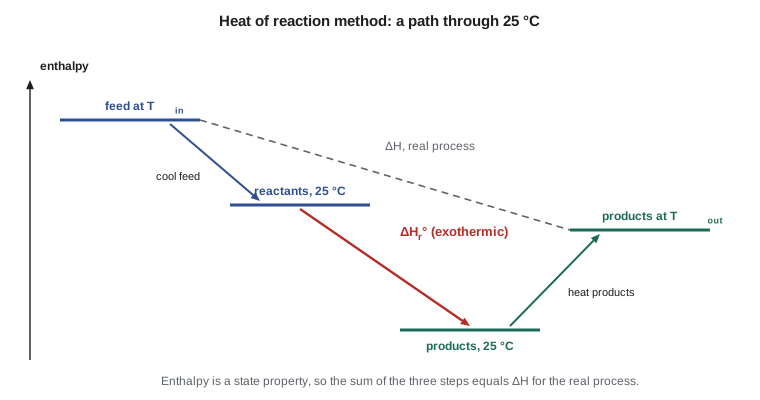
In the heat of reaction method, the reference states are the reactants and products at the temperature of the known heat of reaction, usually 25 °C, in the phases for which it is known. The path takes the feed from its actual state to 25 °C, lets the reaction occur at 25 °C, and takes the products from 25 °C to their actual state. This method suits single reactions with known heats of reaction.
In the heat of formation method, the reference states are the elements at 25 °C. Each species' specific enthalpy is its heat of formation plus the sensible and latent heat to bring it from 25 °C to its actual state. The reaction term disappears because it is built into the heats of formation. This method suits multiple reactions or cases where the reactions are not fully known, because only the inlet and outlet compositions are needed.
Worked problem
Checking the boiler efficiency
Treat the boiler fuel as pure methane at 25 °C, burned completely with 15 percent excess air at 25 °C. The flue gas leaves the economizer at 180 °C. Find the heat transferred to the water and steam per mole of methane, and the boiler efficiency on the higher heating value. Use the heat capacity polynomials in the program.
Show solution
- Basis: 1 mol CH₄. O₂ fed \(= 2 \times 1.15 = 2.30\ \text{mol}\); N₂ fed \(= 3.76 \times 2.30 = 8.65\ \text{mol}\). Products: CO₂ 1, H₂O(g) 2, O₂ 0.30, N₂ 8.65 mol.
- Heat of reaction method with water vapour as product: \(\xi = 1\ \text{mol}\), \(\Delta\hat{H}_r^\circ = -802.3\ \text{kJ/mol}\). Feed is at 25 °C, so its sensible enthalpy is zero.
- Product enthalpies from 25 to 180 °C (kJ/mol): CO₂ 6.22, H₂O 5.31, O₂ 4.68, N₂ 4.54. Total \(= 6.22 + 2(5.31) + 0.30(4.68) + 8.65(4.54) = 57.5\ \text{kJ}\).
- \(\Delta H = -802.3 + 57.5 = -744.8\ \text{kJ}\). With no shaft work, \(Q = -744.8\ \text{kJ}\): 744.8 kJ leaves the combustion gases and goes to the water and steam.
- Efficiency on HHV \(= 744.8/890.3 = 0.837\).
Answer: The calculation confirms the 84 percent efficiency assumed in Lesson 10, before small radiation and blowdown losses. The largest loss is the latent heat of the water vapour in the flue gas, which leaves uncondensed, followed by the sensible heat of the 180 °C gas, about two thirds of which is carried by the nitrogen. Cutting excess air or adding a condensing economizer are the two classic improvements.
Adiabatic reactors and the adiabatic flame temperature
If a reactor is insulated and has no shaft work, \(\Delta\dot{H} = 0\): all the heat released by the reaction goes into heating the products. The outlet temperature that satisfies this balance is the adiabatic reaction temperature. For combustion it is the adiabatic flame temperature, the highest temperature a flame can reach for a given fuel and air ratio. It is found by trial and error, because the product enthalpies depend on temperature through the heat capacity integrals.
The flame temperature falls as excess air rises, because the same heat warms more gas, and rises when the air is preheated. Real flames run somewhat cooler than the calculated value because, at very high temperatures, some carbon dioxide and water dissociate, absorbing heat, and because the flame loses heat by radiation. Burner and furnace designers use the adiabatic flame temperature as an upper bound and to estimate the formation of nitrogen oxides, which rises steeply above about 1500 °C.
# Heats of reaction from heats of formation, and the adiabatic flame temperature of methane
HF = {'CH4(g)': -74.85, 'CO2(g)': -393.5, 'H2O(l)': -285.84, 'H2O(g)': -241.83,
      'C2H5OH(l)': -277.63, 'C6H12O6(s)': -1273.3, 'O2(g)': 0.0, 'N2(g)': 0.0}   # kJ/mol at 25 C

def dHr(reaction):
    """reaction: dict of species -> signed stoichiometric coefficient."""
    return sum(nu * HF[s] for s, nu in reaction.items())

comb_hhv = dHr({'CH4(g)': -1, 'O2(g)': -2, 'CO2(g)': 1, 'H2O(l)': 2})
comb_lhv = dHr({'CH4(g)': -1, 'O2(g)': -2, 'CO2(g)': 1, 'H2O(g)': 2})
ferm = dHr({'C6H12O6(s)': -1, 'C2H5OH(l)': 2, 'CO2(g)': 2})
print(f"Methane combustion: dHr = {comb_hhv:.1f} kJ/mol (water liquid), {comb_lhv:.1f} kJ/mol (water vapour)")
print(f"  HHV {-comb_hhv / 16.04:.1f} MJ/kg, LHV {-comb_lhv / 16.04:.1f} MJ/kg")
print(f"Fermentation: dHr = {ferm:.1f} kJ/mol glucose")
glucose = 81_600 / 180.16 * 0.90          # kmol/h fermented (Lesson 1)
print(f"  Fermenter cooling load {-ferm * glucose / 3600:.1f} MW")

# Adiabatic flame temperature: products heated from 25 C by the heat of combustion (water as vapour)
CP = {'CO2': (36.11e-3, 4.233e-5, -2.887e-8, 7.464e-12), 'H2O': (33.46e-3, 0.6880e-5, 0.7604e-8, -3.593e-12),
      'O2': (29.10e-3, 1.158e-5, -0.6076e-8, 1.311e-12), 'N2': (29.00e-3, 0.2199e-5, 0.5723e-8, -2.871e-12)}

def H(sp, T):                              # kJ/mol relative to 25 C, T in C
    a, b, c, d = CP[sp]
    f = lambda t: a * t + b * t ** 2 / 2 + c * t ** 3 / 3 + d * t ** 4 / 4
    return f(T) - f(25.0)

def flame(excess, T_air=25.0):
    O2 = 2 * (1 + excess); N2 = O2 * 79 / 21
    prod = {'CO2': 1, 'H2O': 2, 'O2': O2 - 2, 'N2': N2}
    q_in = -comb_lhv + O2 * H('O2', T_air) + N2 * H('N2', T_air)   # preheated air brings extra enthalpy
    lo, hi = 25.0, 3000.0
    for _ in range(80):
        T = (lo + hi) / 2
        if sum(n * H(s, T) for s, n in prod.items()) < q_in: lo = T
        else: hi = T
    return T

print("\nexcess air   flame temperature (C)   with air preheated to 200 C")
for ex in (0.0, 0.15, 0.30, 0.50, 1.00):
print(f"{ex * 100:9.0f} %{flame(ex):18.0f}{flame(ex, 200.0):22.0f}")Methane combustion: dHr = -890.3 kJ/mol (water liquid), -802.3 kJ/mol (water vapour)
HHV 55.5 MJ/kg, LHV 50.0 MJ/kg
Fermentation: dHr = -69.0 kJ/mol glucose
Fermenter cooling load 7.8 MW
excess air flame temperature (C) with air preheated to 200 C
0 % 2072 2194
15 % 1860 1981
30 % 1693 1815
50 % 1515 1639
100 % 1207 1338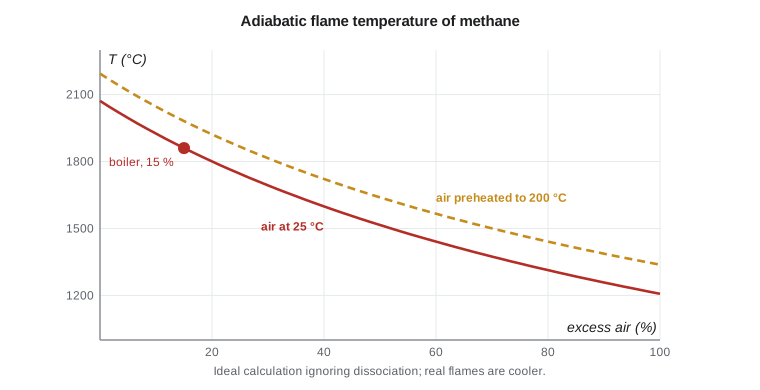
Bringing it together
Theo's last report to Ingrid combined every lesson in this course. The material balances of Lessons 1 to 6 traced the corn through starch, sugar and fermentation to ethanol, carbon dioxide and grains. Lesson 7's combustion balance turned the stack oxygen reading into an excess air figure. Lessons 8 and 9 handled the gas compressor and the dryer exhaust. Lessons 10 to 12 put numbers on the steam, the cooling and the fuel. A modern process simulator does all of this automatically, but every result it gives rests on the same conservation laws, and an engineer who can check its answers by hand, with a quick overall balance, is the one who catches a broken flowmeter or a mistyped composition before it costs money.
Common mistakes
MistakeUsing the heat of reaction with the wrong phase of water.
InsteadCheck whether ΔH_r assumes liquid or vapour water and make the path match.
MistakeForgetting to multiply the heat of reaction by the extent.
InsteadΔH = ξ ΔH_r; ΔH_r is per mole of reaction as written.
MistakeMixing the heat of reaction and heat of formation methods in one balance.
InsteadChoose one reference scheme and apply it to every stream.
MistakeComparing efficiencies on HHV and LHV bases.
InsteadState the basis; the two differ by about 10 percent for natural gas.
MistakeExpecting real flames to reach the calculated adiabatic flame temperature.
InsteadDissociation and radiation keep real flames cooler; the calculated value is an upper bound.
Summary and key terms
- The heat of reaction is the enthalpy change for stoichiometric reactants turning into products at the same T and P.
- Hess's law lets heats of reaction be added; ΔH_r° = Σ ν_i ΔH_f,i°.
- HHV includes condensing the product water; LHV does not.
- Reactor energy balances use either the heat of reaction method or the heat of formation method.
- Adiabatic reactors have ΔH = 0; the adiabatic flame temperature falls with excess air and rises with preheat.
- Material and energy balances together describe the whole plant, from corn to steam.
- Heat of reaction
- The enthalpy change when stoichiometric reactants form products at the same temperature and pressure.
- Exothermic
- Releasing heat; having a negative heat of reaction.
- Endothermic
- Absorbing heat; having a positive heat of reaction.
- Hess's law
- The principle that heats of reaction add in the same way as the reaction equations.
- Heat of formation
- The heat of reaction forming one mole of a compound from its elements in their standard states.
- Lower heating value
- The heat released by complete combustion with the product water left as vapour.
- Adiabatic flame temperature
- The temperature reached by combustion products when no heat is lost.
Practice problems
Work each problem on paper first, then reveal the answer to check.
Find ΔH_r° for N₂ + 3H₂ → 2NH₃.
Show answer
2(−46.19) = −92.38 kJ/mol; exothermic.
Find the LHV of methane per mole from the HHV and a heat of vaporization of water at 25 °C of 44.0 kJ/mol.
Show answer
890.3 − 2(44.0) = 802.3 kJ/mol.
A reactor makes 50 kmol/h of ammonia at constant temperature. What cooling is needed?
Show answer
ξ = 25 kmol/h; Q = 25 000 × (−92.38) kJ/h = −2.31 GJ/h, about 0.64 MW removed.
In the boiler example, what happens to the efficiency if the flue gas leaves at 140 °C?
Show answer
The product enthalpy falls to about 42.5 kJ, so Q = −759.8 kJ and the efficiency rises to about 85.3 %.
Using the program, how much does preheating the air to 200 °C raise the flame temperature at 15 % excess air?
Show answer
From about 1860 °C to about 1981 °C, an increase of about 120 °C.
Why does the heat of formation method suit processes with many reactions?
Show answer
Only inlet and outlet compositions are needed; the reactions are built into the heats of formation.
Lesson quiz · 5 questions
Score 60% or more to complete this lesson.
Create a free account to save your progress, take quizzes and earn a certificate.