
BUS-220 · Lesson 9 of 12 · 38 min
Pricing
Price is the only element of the marketing mix that produces revenue; every other element represents cost. It is also the most flexible element: a firm can change a price in an afternoon, while changing a product or a distribution network takes months or years. Yet many firms set prices poorly, relying on habit, on simple cost-plus formulas or on whatever competitors charge, and leave money on the table or drive customers away. In the narrowest sense, price is the amount of money charged for a product or service. More broadly, it is the sum of all the values that customers give up to gain the benefits of having or using a product. This lesson covers the major approaches to setting prices, price elasticity, pricing strategies for new products and product mixes, price adjustments and price changes, and the legal and ethical rules that govern pricing.
What drives pricing decisions
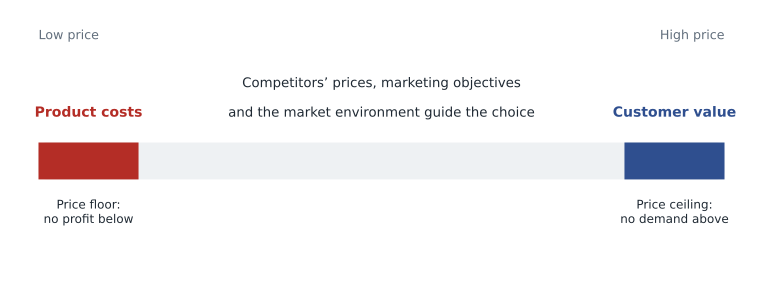
The price a firm charges falls somewhere between one that is too high to produce any demand and one that is too low to produce a profit. Customer perceptions of value set the ceiling; product costs set the floor. Within those limits, the firm must consider competitors' strategies and prices, its own overall marketing strategy, objectives and mix, the nature of the market and demand, and other external factors such as the economy, resellers and government.
Customer value-based pricing
Customer value-based pricing uses buyers' perceptions of value as the key to pricing. The firm assesses customer needs and value perceptions, sets a target price to match perceived value, and only then determines the costs that can be incurred and designs the product to deliver the desired value at the target price. This reverses the cost-based sequence, in which the firm designs a product, totals its costs and adds a markup.
Two types of value-based pricing are common. Good-value pricing offers the right combination of quality and good service at a fair price, as seen in discount retailers, store brands and no-frills airlines. Everyday low pricing (EDLP), charging a constant low price with few or no temporary discounts, is one form; high-low pricing, charging higher prices on an everyday basis but running frequent promotions on selected items, is the alternative many department stores and grocers use. Value-added pricing attaches value-added features and services to differentiate the offer and support higher prices, rather than cutting prices to match competitors. A firm that offers free installation, an extended warranty and expert support can charge more than a bare-bones competitor.
A useful concept here is economic value to the customer (EVC): the maximum amount a customer should be willing to pay, based on the price of the best alternative plus the value of any differentiating benefits, minus any extra costs. If a commercial dishwasher saves a restaurant $1,500 a year in water and labour compared with the alternative that costs $8,000, over a five-year life its EVC is roughly $8,000 + 5 × $1,500 = $15,500, ignoring discounting. The firm can price anywhere up to that figure, sharing some of the value with the customer to give a reason to switch.
Cost-based pricing
Cost-based pricing involves setting prices based on the costs of producing, distributing and selling the product plus a fair rate of return. Fixed costs (overhead) do not vary with production or sales level, such as rent, salaries and insurance. Variable costs vary directly with production, such as materials and packaging. Total costs are the sum of fixed and variable costs at a given level of production.
The simplest method is cost-plus pricing, or markup pricing: adding a standard markup to the cost of the product. Retailers often think instead in terms of margin, the percentage of the selling price that is gross profit. Markup and margin are easily confused, and confusing them is one of the most common pricing errors in small businesses.
Worked problem
Markup versus margin
A gift shop buys handmade mugs for $12 each. The owner wants a 40 % gross margin. Her assistant prices the mugs at $16.80, explaining that he added 40 % to cost. What went wrong, and what price gives a 40 % margin?
Show solution
- The assistant applied a 40 % markup on cost: $12 × 1.40 = $16.80.
- Margin at $16.80 = ($16.80 − $12) ÷ $16.80 = $4.80 ÷ $16.80 ≈ 28.6 %, well below the target.
- Price for a 40 % margin = $12 ÷ (1 − 0.40) = $12 ÷ 0.60 = $20.00.
- Check: ($20 − $12) ÷ $20 = 40 %. The equivalent markup on cost is $8 ÷ $12 ≈ 66.7 %.
Answer: A 40 % margin requires a $20 price, a 66.7 % markup on cost. Adding 40 % to cost yields only a 28.6 % margin.
Markup pricing remains popular because sellers are more certain about costs than about demand, and because when all firms in an industry use it, prices tend to be similar and price competition is minimized. But it ignores demand and competitor prices, so it is unlikely to lead to the best price.
Break-even pricing, or the closely related target-return pricing, sets price to break even on the costs of making and marketing a product, or to make a target return. Lesson 7 used break-even analysis to judge a launch. In pricing, the firm calculates break-even volumes at several possible prices and compares them with the demand expected at each price.
Worked problem
Contribution margin and target profit
A small brewery's canning line has fixed costs of $240,000 a year. Each 4-pack has variable costs of $5.50 (ingredients, cans, labels, excise duty and delivery). The brewery wants a profit of $60,000 a year. Compare the volume required at wholesale prices of $9.50 and $11.00, and the contribution margin ratio at each price.
Show solution
- At $9.50: unit contribution = $4.00; contribution margin ratio = 4.00 ÷ 9.50 ≈ 42 %.
- Volume = ($240,000 + $60,000) ÷ $4.00 = 75,000 four-packs.
- At $11.00: unit contribution = $5.50; ratio = 5.50 ÷ 11.00 = 50 %.
- Volume = $300,000 ÷ $5.50 ≈ 54,545 four-packs.
- The higher price needs about 27 % fewer units; the question is whether demand falls by more or less than that at $11.
Answer: At $9.50 the brewery must sell 75,000 four-packs; at $11.00, about 54,500. The right price depends on how sensitive retailers and drinkers are to the difference.
Competition-based pricing
Competition-based pricing sets prices based on competitors' strategies, costs, prices and market offerings. Consumers base their judgments of a product's value partly on the prices that competitors charge for similar products. The firm should ask how its offer compares with competitors' in customer value and how strong competitors are and what their pricing strategies are. If the firm's offer delivers more value, it can charge more; if less, it must charge less or improve the offer. The goal is not to match or beat competitors' prices automatically, but to set prices relative to the value delivered.
Price elasticity of demand
Each price the firm might charge leads to a different level of demand. Price elasticity of demand measures how responsive demand is to a change in price. It is the percentage change in quantity demanded divided by the percentage change in price. Because demand usually falls as price rises, elasticity is negative, but marketers often quote its absolute value. If demand hardly changes with a small price change, demand is inelastic (absolute value below 1); if demand changes greatly, it is elastic (above 1).
Elasticity determines what happens to revenue when price changes. If demand is elastic, a price cut raises total revenue because the gain in volume outweighs the lower price; if demand is inelastic, a price increase raises revenue. Buyers are less price-sensitive when the product is unique or high in quality, prestige or exclusiveness, when substitutes are hard to find or compare, when the total expenditure is low relative to income, when the cost is shared with another party, and when switching is costly. They are more sensitive when many close substitutes exist and prices are easy to compare, which online shopping and price-comparison tools have made much easier.
Worked problem
Using elasticity to judge a price cut
A streaming service charges $16 a month and has 400,000 subscribers. Research estimates the price elasticity of demand at −1.6 in the relevant range. Management is considering cutting the price by 10 % to $14.40. Estimate the new subscriber count and revenue, and comment on profit if each subscriber costs $4 a month to serve.
Show solution
- Percentage change in quantity = −1.6 × (−10 %) = +16 %.
- New subscribers ≈ 400,000 × 1.16 = 464,000.
- Old revenue = 400,000 × $16 = $6.40 million a month; new revenue = 464,000 × $14.40 ≈ $6.68 million.
- Old contribution = 400,000 × ($16 − $4) = $4.80 million; new contribution = 464,000 × ($14.40 − $4) ≈ $4.83 million.
- Revenue rises about 4 %, but contribution rises less than 1 %, and serving 64,000 more subscribers may add support costs.
Answer: With elastic demand, the cut raises revenue by about 4 % but barely changes contribution, so it is only worth doing if the new subscribers bring other benefits such as lower churn or advertising income.
Firms can estimate elasticity from past sales and price data, from experiments that vary price across stores or customer groups, or from surveys. The code below fits a constant-elasticity demand curve to simulated weekly data by regressing the logarithm of quantity on the logarithm of price, and then finds the price that maximizes contribution. With constant elasticity E (in absolute value greater than 1) and unit variable cost c, theory says the profit-maximizing price is c × E ÷ (E − 1).
import math, random

random.seed(909)
# Simulated weekly sales of a snack at different shelf prices
true_elasticity, scale = -2.2, 9000.0
prices = [round(random.uniform(2.49, 4.99), 2) for _ in range(40)]
qty = [scale * p ** true_elasticity * math.exp(random.gauss(0, 0.08)) for p in prices]

# Least-squares fit of ln(Q) = a + b ln(P)
x = [math.log(p) for p in prices]; y = [math.log(q) for q in qty]
mx, my = sum(x) / len(x), sum(y) / len(y)
b = sum((xi - mx) * (yi - my) for xi, yi in zip(x, y)) / sum((xi - mx) ** 2 for xi in x)
a = my - b * mx
print(f"Estimated elasticity b = {b:.2f}")

cost = 1.40
best = max((p / 100 for p in range(150, 701)),
           key=lambda p: (p - cost) * math.exp(a) * p ** b)
E = -b
print(f"Search: best price = ${best:.2f}")
print(f"Formula c*E/(E-1): ${cost * E / (E - 1):.2f}")Estimated elasticity b = -2.19 Search: best price = $2.58 Formula c*E/(E-1): $2.58
In practice, elasticity varies along the demand curve and changes over time and across segments, so firms treat such estimates as a guide and test prices carefully.
New product pricing
Pricing strategies usually change as a product passes through its life cycle, and the introductory stage is especially challenging. Market-skimming pricing sets a high price for a new product to skim maximum revenues layer by layer from the segments willing to pay the high price; the firm then lowers the price over time to reach more price-sensitive segments. Skimming makes sense when the product's quality and image support its higher price, when enough buyers want it at that price, when costs of producing a smaller volume are not so high that they cancel the advantage, and when competitors cannot easily enter. Market-penetration pricing sets a low initial price to penetrate the market quickly and deeply, attracting many buyers and winning a large market share. It works when the market is highly price-sensitive, when production and distribution costs fall as volume increases, and when the low price helps keep competitors out. Penetration pricing must be sustainable; a firm that cannot later raise prices or lower costs will be stuck with thin margins.
Product mix pricing
Pricing changes when the product is part of a mix, because the firm seeks prices that maximize profits on the total mix. Product line pricing sets price steps between products in a line based on cost differences, customer evaluations of features and competitors' prices, for example good, better and best models at $199, $299 and $449. Optional-product pricing prices optional or accessory products sold with the main product, such as a car's upgraded audio system. Captive-product pricing sets prices for products that must be used with the main product, such as razor blades, printer cartridges and game subscriptions; the main product is often priced low and the captive product carries the margin, a strategy that can backfire if customers feel exploited. By-product pricing sets a price for by-products to help offset the costs of disposing of them and make the main product's price more competitive. Product bundle pricing combines several products and offers the bundle at a reduced price, such as phone, internet and television packages; bundling can promote products customers might not otherwise buy, but the bundle price must be low enough to get them to buy it.
Price adjustment strategies
Companies usually adjust their basic prices to account for customer differences and changing situations. Discounts include cash discounts for prompt payment (for example, 2/10 net 30, meaning a 2 % discount if paid within 10 days, otherwise full payment due in 30 days), quantity discounts, functional (trade) discounts offered to channel members for performing certain functions, and seasonal discounts. Allowances include trade-in allowances and promotional allowances paid to dealers for advertising or display.
Segmented pricing sells a product or service at two or more prices where the difference is not based on differences in costs. It includes customer-segment pricing (student and senior discounts), product-form pricing (different versions priced differently but not according to their costs), location pricing (theatre seats) and time pricing (off-peak rates). For segmented pricing to work, the market must be segmentable, segments must show different degrees of demand, the costs of segmenting must not exceed the extra revenue, and the practice must be legal and must not cause customer resentment.
Psychological pricing considers the psychology of prices, not simply the economics. Consumers often use price to judge quality when they cannot judge it directly. Reference prices, the prices buyers carry in their minds and refer to when looking at a product, can be shaped by displaying a regular price next to a sale price or placing a product next to more expensive ones. Charm pricing, ending prices in 9 or 99, relies on the left-digit effect: $19.99 is perceived as closer to $19 than $20. Promotional pricing temporarily prices products below list price, and sometimes below cost, to create buying excitement and urgency, but frequent promotions can train customers to wait for deals and erode brand value.
Dynamic pricing adjusts prices continually to meet the characteristics and needs of individual customers and situations. Airlines, hotels, ride-hailing services and online retailers change prices frequently based on demand, time, competitor prices and inventory. Surge pricing during peak demand is efficient in economic terms but can feel unfair, especially during emergencies, and several US states have price-gouging laws that limit price increases on essential goods during declared emergencies. Personalized pricing based on an individual's data raises serious fairness and privacy concerns, and regulators in both countries have begun to examine it.
International pricing must consider economic conditions, competitive situations, laws, wholesale and retail systems, and consumer perceptions in each market. Costs differ too, including transportation, tariffs, importer margins and currency fluctuations, which is why a product can cost much more abroad. Exchange-rate swings between the Canadian and US dollars regularly force cross-border sellers to revisit their prices.
Initiating and responding to price changes
A firm considering a price cut should ask how much extra volume it needs just to keep the same total contribution. The answer is often surprisingly large, especially for low-margin products.
Worked problem
How much more must we sell after a price cut?
A furniture retailer sells a sofa at $1,000 that costs $700 in variable costs. It is considering a 10 % price cut to $900. By how much must unit sales rise to keep total contribution unchanged? What if it raised the price by 10 % instead?
Show solution
- Original unit contribution = $1,000 − $700 = $300.
- Price change ΔP = −$100.
- Required volume change = 100 ÷ (300 − 100) = 100 ÷ 200 = +50 %.
- A 10 % price cut needs a 50 % rise in unit sales just to stand still.
- For a 10 % increase, ΔP = +$100: required change = −100 ÷ (300 + 100) = −25 %. The retailer could lose up to a quarter of its unit sales before contribution fell.
Answer: A 10 % cut requires 50 % more volume, while a 10 % increase can absorb a 25 % volume loss. Low-margin businesses should be especially wary of price cuts.
Price increases are often necessary when costs rise, but they must be handled carefully. Firms should avoid the image of price gouging by explaining the reasons, giving advance notice, and considering alternatives such as unbundling services, reducing features or offering a cheaper option. Shrinkflation, reducing package size without lowering price, is legal if net quantity is labelled accurately, but customers often resent it when they discover it. When a competitor changes its price, a firm should ask why, whether the change is temporary or permanent, and what will happen to its share and profits if it does not respond, before choosing to hold its price, add value, cut its price or launch a low-price fighter brand.
Public policy and pricing
Pricing is regulated to protect competition and consumers. Under Canada's Competition Act, agreements between competitors to fix prices, allocate markets or restrict output are criminal offences, and since 2023 the prohibition also covers agreements between employers to fix wages or not to poach employees. Abuse of dominance, which can include predatory pricing intended to eliminate a competitor, is a civil matter reviewed by the Competition Tribunal. Misleading price representations are prohibited, including inflated 'regular price' claims (the ordinary selling price provisions require that a substantial volume of the product was sold at the regular price, or that it was offered in good faith at that price for a substantial period) and drip pricing, advertising a price that cannot be obtained because of additional fixed, mandatory charges. Government-imposed sales taxes such as the GST and HST may be added at checkout and need not be included in the advertised price, but other mandatory fees must be. Quebec's Consumer Protection Act also requires the advertised price to include all mandatory charges except the QST and GST.
Ethical pricing goes beyond legal compliance. A useful test is whether the firm would be comfortable explaining its pricing to customers openly. Hidden fees, confusing subscription renewals, prices that exploit people in desperate situations and personalized prices that penalize loyal customers may be legal in some cases but damage trust and invite regulation.
Common mistakes
MistakeConfusing markup on cost with margin on price.
InsteadUse price = cost ÷ (1 − margin) to hit a target margin.
MistakeSetting prices by cost alone.
InsteadStart from customer value and competitors' offers; use costs as the floor.
MistakeCutting prices to gain sales without checking required volume.
InsteadCalculate the volume increase needed to maintain contribution; it is often very large.
MistakeTreating elasticity as fixed forever.
InsteadRe-estimate it for different segments, price ranges and time periods, and test.
MistakeRunning constant promotions.
InsteadUse promotions sparingly to avoid training customers to wait for deals.
MistakeAdvertising a low headline price and adding mandatory fees at checkout.
InsteadShow the all-in price, except government-imposed taxes, to comply with drip-pricing rules and keep trust.
Summary and key terms
- Customer value sets the price ceiling and costs set the floor; competitors and strategy guide the choice between.
- Value-based pricing includes good-value pricing (EDLP and high-low) and value-added pricing; EVC estimates what a customer should pay.
- Cost-based pricing includes markup and break-even or target-profit pricing; markup on cost differs from margin on price.
- Price elasticity measures demand sensitivity; elastic demand makes cuts raise revenue, inelastic demand makes increases raise revenue.
- New products can be priced for skimming or penetration.
- Product mix pricing covers line, optional, captive, by-product and bundle pricing.
- Price adjustments include discounts, segmented, psychological, promotional, dynamic and international pricing.
- Required volume change after a price cut = −ΔP ÷ (contribution + ΔP); small cuts can need large volume gains.
- Price fixing, predatory pricing, misleading regular prices and drip pricing are regulated in both countries.
- Price
- The sum of all values customers give up to gain the benefits of a product.
- Customer value-based pricing
- Setting price based on buyers' perceptions of value rather than on cost.
- Everyday low pricing
- Charging a constant low price with few temporary discounts.
- Markup
- Price minus cost, expressed as a percentage of cost.
- Gross margin
- Price minus cost, expressed as a percentage of price.
- Contribution margin
- Price minus unit variable cost; the amount each unit contributes to fixed costs and profit.
- Price elasticity of demand
- The percentage change in quantity demanded divided by the percentage change in price.
- Market-skimming pricing
- Setting a high initial price and lowering it over time.
- Captive-product pricing
- Setting prices for products that must be used with a main product.
- Drip pricing
- Advertising a price that cannot be obtained because of additional mandatory charges.
Practice problems
Work each problem on paper first, then reveal the answer to check.
An item costs $30 and sells for $50. What are the markup and the margin?
Show answer
Markup 66.7 %; margin 40 %.
What price gives a 35 % margin on a $26 cost?
Show answer
$26 ÷ 0.65 = $40.
Fixed costs $90,000, target profit $30,000, price $40, variable cost $25. What volume is needed?
Show answer
$120,000 ÷ $15 = 8,000 units.
Price rises 5 % and quantity falls 2 %. What is the elasticity, and is demand elastic?
Show answer
−0.4; inelastic.
When does penetration pricing make sense?
Show answer
When the market is price-sensitive, costs fall with volume and the low price deters competitors.
Give an example of captive-product pricing.
Show answer
Printer cartridges or coffee pods.
Explain the terms 2/10 net 30.
Show answer
A 2 % discount if paid within 10 days; otherwise the full amount is due in 30 days.
Contribution is $40 on a $100 price. What volume increase is needed after a $10 cut?
Show answer
10 ÷ 30 ≈ 33 %.
Why is charm pricing effective?
Show answer
The left-digit effect makes $9.99 feel closer to $9 than to $10.
Portfolio task: find an advertised price with added fees and judge whether it complies with drip-pricing rules.
Show answer
Answers vary; a good answer distinguishes optional add-ons and government taxes from mandatory fees.
Lesson quiz · 5 questions
Score 60% or more to complete this lesson.
Create a free account to save your progress, take quizzes and earn a certificate.