
BUS-130 · Lesson 4 of 12 · 29 min
Attitudes, emotions and job satisfaction
How people feel about their work affects whether they stay, how hard they try, whether they help colleagues and how they treat customers. This lesson examines work attitudes such as job satisfaction, commitment and engagement, explains how they are measured and what they predict, and then turns to emotions: how feelings at work arise, how they spread and what it costs employees to manage them. Psychological health and safety, including stress and burnout, is covered in depth in HSE-109; here the focus is on attitudes and emotions as drivers of everyday behaviour.
What attitudes are
An attitude is an evaluative statement or judgment about an object, person or event. Attitudes have three components. The cognitive component is a belief or opinion ("My manager assigns work unfairly"). The affective component is the emotional part ("I resent my manager"). The behavioural component is an intention to act in a certain way ("I am going to look for another job"). The three usually line up, but not always, and the gaps are revealing.
When attitudes and behaviour conflict, people experience cognitive dissonance, an uncomfortable tension that Leon Festinger described in the 1950s. People reduce dissonance by changing the behaviour, changing the attitude, or finding a justification. An employee who believes the company's product is overpriced but must sell it may come to believe the product is worth the price, may quit, or may tell themselves that customers can always say no. The strength of the pressure depends on how important the issue is, how much responsibility the person feels for it and how large the rewards are. Large rewards provide an easy justification, which is why paying people a lot to do something they find distasteful tends not to change their attitudes.
Attitudes predict behaviour best when they are strong, specific to the behaviour, easily accessible in memory and supported by social norms, and when the person has the opportunity to act. A general attitude, such as liking one's employer, predicts general behaviours such as staying with the company over several years better than any single specific act.
Job satisfaction
Job satisfaction is a positive feeling about one's job resulting from an evaluation of its characteristics. It is not one thing; people can be satisfied with their colleagues but dissatisfied with their pay. Surveys use either a single global question ("All things considered, how satisfied are you with your job?") or a summation of facets such as the work itself, pay, promotion, supervision and co-workers. Research consistently finds that the work itself, especially interesting, challenging and autonomous work, is the facet most strongly related to overall satisfaction. Pay matters, particularly for people with low incomes and for perceived fairness, but above a reasonable level more pay is only weakly related to satisfaction.
| Facet | Typical survey item | Relationship to overall satisfaction |
|---|---|---|
| The work itself | My job lets me use my skills and abilities | Strongest |
| Supervision | My manager treats me with respect | Strong |
| Co-workers | The people I work with cooperate to get the job done | Moderate |
| Promotion opportunities | I have a fair chance of advancing here | Moderate |
| Pay | I am paid fairly for the work I do | Moderate; strongest when pay is low or seen as unfair |
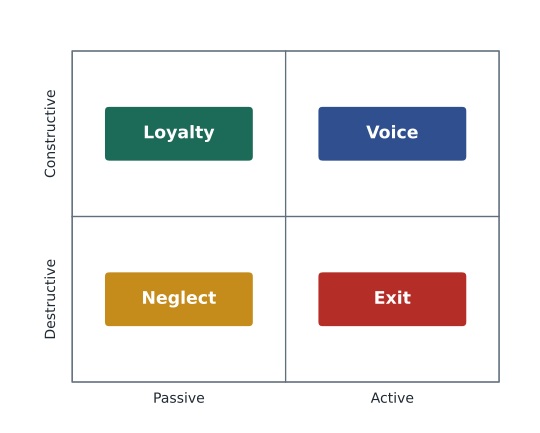
What happens when people are dissatisfied? The exit–voice–loyalty–neglect framework describes four responses along two dimensions: constructive versus destructive and active versus passive. Exit (leaving or looking for a new job) is active and destructive for the organization. Voice (suggesting improvements, raising concerns or involving a union) is active and constructive. Loyalty (waiting patiently and defending the organization) is passive and constructive. Neglect (absenteeism, lateness, reduced effort) is passive and destructive. Organizations that make voice easy and safe can turn potential exit and neglect into improvement.
Is a satisfied worker a productive worker? The relationship is real but moderate. A large meta-analysis by Judge and colleagues (2001) found an average correlation of about 0.30 between job satisfaction and individual job performance, stronger for complex jobs. At the organizational level, business units with more satisfied and engaged employees tend to have better customer satisfaction, productivity and lower turnover. Satisfaction is also linked to organizational citizenship, lower absenteeism and, especially, lower turnover intentions. The causal arrow runs both ways: doing well at work also makes people more satisfied.
Organizational commitment
Organizational commitment is the degree to which an employee identifies with an organization and wants to remain a member. John Meyer and Natalie Allen, at the University of Western Ontario, distinguished three forms. Affective commitment is emotional attachment and belief in the organization's values ("I want to stay"). Continuance commitment is the perceived cost of leaving, such as losing a pension or seniority ("I need to stay"). Normative commitment is a sense of obligation ("I ought to stay"). Affective commitment is the form most strongly linked to performance and citizenship. Continuance commitment alone can produce people who stay but do the minimum, sometimes called the retired-in-place problem.
Perceived organizational support, the belief that the organization values one's contributions and cares about one's well-being, is one of the strongest predictors of affective commitment. People reciprocate: when they feel supported, they feel an obligation to help the organization succeed. Concrete signs of support include fair treatment, recognition, development opportunities and flexibility during personal difficulties.
Employee engagement
Engagement goes beyond satisfaction. A satisfied employee may be content but passive; an engaged employee brings energy and enthusiasm to the work. Wilmar Schaufeli and colleagues define work engagement as a positive state characterized by vigour (energy and resilience), dedication (enthusiasm, pride and a sense of significance) and absorption (being fully concentrated and happily engrossed). Gallup uses a 12-item survey asking about basic needs, such as knowing what is expected and having the right materials, as well as recognition, development and a sense of purpose. Engagement is the opposite pole of burnout, which HSE-109 discusses.
Engagement surveys are a common tool, but they are only useful if the organization acts on the results. Surveying employees and then doing nothing visible teaches people that their voice does not matter and can lower engagement. A good survey cycle includes clear communication of results, team-level discussions, a few focused action plans and follow-up. Pulse surveys of a few questions run frequently, and some organizations track an employee net promoter score (eNPS).
The eNPS asks, "On a scale of 0 to 10, how likely are you to recommend this organization as a place to work?" People answering 9 or 10 are promoters, 7 or 8 are passives and 0 to 6 are detractors. The score ranges from −100 to +100. It is simple, but it hides detail, so it should be read alongside facet questions and comments.
import random, statistics

random.seed(130)
# Simulated 0-10 recommend scores for two departments
weights_ops = [2, 2, 3, 4, 5, 8, 10, 14, 18, 16, 18]
weights_it = [1, 1, 1, 2, 3, 5, 7, 12, 22, 24, 22]
ops = random.choices(range(11), weights=weights_ops, k=180)
it = random.choices(range(11), weights=weights_it, k=60)

def summary(scores):
    n = len(scores)
    promoters = sum(s >= 9 for s in scores) / n * 100
    detractors = sum(s <= 6 for s in scores) / n * 100
    return n, statistics.mean(scores), statistics.stdev(scores), promoters, detractors, promoters - detractors

for name, s in [("Operations", ops), ("IT", it)]:
    n, m, sd, p, d, e = summary(s)
print(f"{name:10s} n={n:3d} mean={m:4.2f} sd={sd:4.2f} promoters={p:4.1f}% detractors={d:4.1f}% eNPS={e:+5.1f}")Operations n=180 mean=6.81 sd=2.45 promoters=28.3% detractors=39.4% eNPS=-11.1 IT n= 60 mean=7.88 sd=1.70 promoters=41.7% detractors=20.0% eNPS=+21.7
Worked problem
Reading an engagement survey
An engagement survey of a 320-person distribution company returns 240 responses (75 %). On the eNPS question, 84 respondents answer 9–10, 72 answer 7–8 and 84 answer 0–6. On a facet item scored 1–5, "I know what is expected of me at work" averages 4.3, while "In the last seven days I have received recognition for good work" averages 2.4. What do the results show and what should the company do?
Show solution
- Compute shares: promoters = 84 ÷ 240 = 35 %; passives = 72 ÷ 240 = 30 %; detractors = 84 ÷ 240 = 35 %.
- eNPS = 35 − 35 = 0, which means as many people would discourage friends from joining as would encourage them.
- The 75 % response rate is good, so the results are probably representative, though non-respondents may be less engaged.
- Expectations are clear (4.3), but recognition is weak (2.4). Recognition is a basic need that is cheap to address.
- Action: share results openly, ask teams to discuss the recognition gap and choose one or two actions (for example, weekly shout-outs and manager training in specific praise), then re-survey in a quarter.
Answer: An eNPS of 0 and a low recognition score point to an inexpensive, high-impact priority: more frequent, specific recognition, followed by a visible check on progress.
The cost of turnover
Attitudes matter financially because dissatisfaction and low commitment drive turnover. Not all turnover is bad. Some is functional, when low performers leave or when new people bring fresh skills. But replacing a good employee is expensive. Costs include separation (exit processing, unused vacation payouts), vacancy (lost output, overtime for others), replacement (advertising, recruiter fees, interviewing time) and training (onboarding, mentoring and the months before a new hire reaches full productivity). Estimates vary widely by role, from a fraction of annual salary for entry-level jobs to more than a year's salary for specialized professionals and executives.
Worked problem
Estimating the cost of turnover
A software company with 150 developers averaging $110,000 in salary has an annual turnover rate of 18 %. For each departure it estimates: recruiting costs of $15,000 (agency fees and advertising), 40 hours of interviewing time at $85 an hour, a vacancy of 8 weeks during which half the developer's output is lost, and a ramp-up of 6 months at an average of 50 % productivity. Estimate the annual cost of turnover and the saving if turnover fell to 12 %.
Show solution
- Departures per year = 150 × 0.18 = 27.
- Weekly salary = $110,000 ÷ 52 ≈ $2,115.
- Interviewing = 40 × $85 = $3,400.
- Vacancy = 8 weeks × $2,115 × 0.5 ≈ $8,460 of lost output (using salary as a rough proxy for value).
- Ramp-up = 26 weeks × $2,115 × 0.5 ≈ $27,495 of lost productivity.
- Cost per departure ≈ $15,000 + $3,400 + $8,460 + $27,495 = $54,355, or about 49 % of salary.
- Annual cost ≈ 27 × $54,355 ≈ $1.47 million.
- At 12 % turnover: 18 departures × $54,355 ≈ $0.98 million, saving about $0.49 million a year.
Answer: Turnover costs this company about $1.5 million a year. Cutting it from 18 % to 12 % would save roughly half a million dollars, which helps justify investment in better managers, development and recognition.
Emotions and moods
Affect is a broad term covering the feelings people experience. Emotions are intense feelings directed at someone or something, such as anger at a colleague or joy at a promotion; they are usually brief and accompanied by distinct facial expressions. Moods are less intense, longer-lasting feelings that often lack a clear cause. Moods can be described along two dimensions: positive versus negative, and high versus low energy. Positive moods are linked to more creativity, helpfulness and openness to new ideas, while negative moods can sharpen attention to detail and critical thinking. Neither is simply good or bad; context matters.
Affective events theory, proposed by Howard Weiss and Russell Cropanzano, holds that work events, such as daily hassles, recognition, conflicts and small wins, trigger emotional reactions that build up over time to shape attitudes and behaviour. A single angry customer may not matter much, but a steady stream of them, combined with a lack of support, gradually erodes satisfaction. This is why managers should pay attention to the daily texture of work, not only to annual pay and benefits.
Emotions are contagious. Emotional contagion is the process by which people catch the emotions of others, often unconsciously, through mimicking facial expressions, tone and posture. A leader's mood can spread through a team, and a single highly negative team member can lower the mood and performance of the group. Customers can catch employees' moods too, which is one reason service organizations care so much about frontline morale.
Emotional labour
Many jobs require employees to display emotions that the organization considers appropriate, whatever they actually feel. Arlie Hochschild called this emotional labour in her study of flight attendants. Nurses, call centre agents, teachers, retail workers and police officers all perform emotional labour. Felt emotions are what a person actually feels; displayed emotions are what the organization requires. When the two differ, the gap is called emotional dissonance.
Employees manage the gap in two ways. Surface acting means hiding true feelings and faking the required expression, such as smiling at an abusive customer. Deep acting means trying to actually feel the required emotion, for example by reframing the situation ("This customer is frightened about their bill, not angry at me"). Research consistently finds that surface acting is linked to exhaustion, lower satisfaction and higher turnover, while deep acting is less harmful and can even feel rewarding. Organizations can help by giving employees autonomy, recovery breaks, support after difficult interactions and the right to end abusive calls.
| Strategy | What it involves | Typical effects |
|---|---|---|
| Surface acting | Faking the required emotion while suppressing real feelings | Exhaustion, cynicism, lower satisfaction, more turnover |
| Deep acting | Changing one's inner feelings to match the required display | Less strain; can improve customer reactions and sense of accomplishment |
| Genuine emotion | Felt and displayed emotions already match | Least strain; most authentic interactions |
Emotional intelligence
Emotional intelligence (EI) is the ability to perceive emotions in oneself and others, understand their meaning and manage them effectively. Popular claims that EI matters more than intelligence for success are exaggerated, and some EI questionnaires overlap heavily with personality traits. However, ability-based measures of EI do predict performance in jobs with high emotional labour, and EI skills such as recognizing a colleague's frustration and responding calmly can be developed through feedback and practice. EI is best seen as one useful set of abilities, not a magic key.
Common mistakes
MistakeAssuming that happy workers are always more productive.
InsteadRecognize a moderate, two-way relationship; satisfaction also predicts citizenship and lower turnover.
MistakeRunning an engagement survey and taking no visible action.
InsteadShare results, involve teams in choosing a few actions and follow up; inaction lowers engagement.
MistakeTreating continuance commitment as loyalty.
InsteadBuild affective commitment through support, fairness and meaningful work; people who stay only because leaving is costly may disengage.
MistakeRequiring constant cheerfulness without support.
InsteadGive service staff autonomy, recovery time and backing when customers are abusive, and encourage deep rather than surface acting.
MistakeIgnoring the cost of turnover because it is not on the income statement.
InsteadEstimate recruiting, vacancy and ramp-up costs to make the business case for retention.
Summary and key terms
- Attitudes have cognitive, affective and behavioural components; cognitive dissonance arises when attitudes and behaviour conflict.
- Job satisfaction is most strongly linked to the work itself; pay matters most when low or unfair.
- Dissatisfaction leads to exit, voice, loyalty or neglect; making voice safe channels it constructively.
- Satisfaction and performance are moderately related (about r = 0.30), with causation running both ways.
- Affective commitment is the most valuable form; perceived organizational support builds it.
- Engagement involves vigour, dedication and absorption; surveys only help if followed by action.
- Turnover can cost a large share of annual salary per departure.
- Emotions spread through contagion; surface acting is more harmful than deep acting; EI predicts performance in emotionally demanding jobs.
- Attitude
- An evaluative judgment about an object, person or event.
- Cognitive dissonance
- Discomfort caused by inconsistency between attitudes, or between attitudes and behaviour.
- Job satisfaction
- A positive feeling about one's job resulting from an evaluation of its characteristics.
- Affective commitment
- Emotional attachment to an organization and belief in its values.
- Continuance commitment
- Commitment based on the perceived cost of leaving.
- Perceived organizational support
- The belief that the organization values one's contributions and cares about one's well-being.
- Work engagement
- A positive work state characterized by vigour, dedication and absorption.
- eNPS
- The percentage of promoters minus the percentage of detractors among employees.
- Emotional labour
- Managing one's emotions to display those required by the job.
- Emotional contagion
- The spread of emotions from one person to others.
Practice problems
Work each problem on paper first, then reveal the answer to check.
Name the three components of an attitude.
Show answer
Cognitive, affective and behavioural.
Which facet of job satisfaction is most strongly related to overall satisfaction?
Show answer
The work itself.
Classify "complaining to HR about an unsafe process" in the EVLN framework.
Show answer
Voice: active and constructive.
What average correlation did Judge et al. (2001) find between satisfaction and performance?
Show answer
About 0.30.
Distinguish affective and continuance commitment.
Show answer
Affective is wanting to stay; continuance is needing to stay because leaving is costly.
Of 200 respondents, 70 are promoters and 50 are detractors. What is the eNPS?
Show answer
35 % − 25 % = +10.
Name the three components of work engagement in Schaufeli's model.
Show answer
Vigour, dedication and absorption.
Which is more harmful to well-being: surface acting or deep acting?
Show answer
Surface acting.
A firm of 80 people has 15 % turnover and each departure costs $40,000. What is the annual cost?
Show answer
12 departures × $40,000 = $480,000.
Portfolio task: identify a recurring affective event in a workplace you know and its effect on attitudes.
Show answer
Answers vary; a good answer links repeated events to a change in satisfaction or commitment.
Lesson quiz · 5 questions
Score 60% or more to complete this lesson.
Create a free account to save your progress, take quizzes and earn a certificate.