
BUS-130 · Lesson 10 of 12 · 28 min
Leadership
Leadership is the ability to influence a group toward the achievement of a vision or set of goals. It is related to management but not the same. Management involves planning, budgeting, organizing, staffing and controlling, the work of producing order and consistency. Leadership involves setting direction, aligning people and motivating them, the work of producing change. Organizations need both, and the same person often provides both. Leadership can also come from people without formal authority: a peer who rallies colleagues around a better process is leading. This lesson traces how thinking about leadership has evolved, from a search for special traits to contemporary theories of transformational, ethical, servant and inclusive leadership.
Trait theories
The oldest approach asks what personal qualities distinguish leaders from non-leaders. Early research produced long, inconsistent lists, but organizing traits around the Big Five model (lesson 2) brought clearer results. Extraversion is the trait most strongly linked to leader emergence, being seen as a leader by others, though its link with effectiveness is weaker, partly because very assertive leaders can dominate. Conscientiousness and openness are also positively related to leadership, and emotional stability helps leaders cope with pressure. Emotional intelligence and integrity are frequently associated with effective leadership.
Trait theories have two important limits. First, traits predict who emerges as a leader better than who is effective. Second, they say little about what leaders should actually do, which matters for leadership development. They also risk reinforcing stereotypes: if people associate leadership with traits stereotypically linked to men, such as assertiveness, they may overlook capable leaders who do not fit that image. Research on the think manager, think male bias has documented this pattern, although it has weakened over recent decades.
Behavioural theories
Behavioural theories shifted attention from who leaders are to what they do. Studies at Ohio State University in the 1940s and 1950s identified two broad dimensions. Initiating structure is the extent to which a leader defines and structures their own role and those of employees, organizing work, setting goals and deadlines and clarifying expectations. Consideration is the extent to which a leader's relationships are characterized by mutual trust, respect for employees' ideas and concern for their feelings. University of Michigan studies found similar dimensions, which they called production-oriented and employee-oriented.
A meta-analysis by Judge, Piccolo and Ilies (2004) found that both dimensions matter: consideration was more strongly related to followers' satisfaction with the leader, motivation and perceived leader effectiveness, while initiating structure was more strongly related to group and organizational performance. Effective leaders are often high on both. Which matters more depends on the situation, which leads to contingency theories.
Contingency theories
Contingency theories propose that the effectiveness of a leadership style depends on the situation. Fred Fiedler's early model argued that leaders have a fixed style and should be matched to situations; it has mixed support today. Paul Hersey and Kenneth Blanchard's situational leadership theory, popular in management training, proposes that leaders should adjust their mix of directive and supportive behaviour to followers' readiness, from telling and selling for less ready followers to participating and delegating for highly ready ones. It is intuitive but has limited and mixed research support, so treat it as a useful prompt rather than a proven formula.
Robert House's path–goal theory draws on expectancy theory (lesson 5). It holds that leaders should help followers achieve their goals by clarifying the path, removing obstacles and providing support and rewards. House described four styles. Directive leadership tells followers what is expected and how to do it. Supportive leadership is friendly and shows concern for followers' needs. Participative leadership consults followers and uses their suggestions. Achievement-oriented leadership sets challenging goals and expresses confidence that followers will meet them. The best style depends on follower characteristics, such as experience, ability and locus of control, and on the environment, such as task structure and team dynamics.
| Situation | Style path–goal theory suggests | Reason |
|---|---|---|
| Ambiguous, stressful task; inexperienced team | Directive | Clarifies the path and reduces uncertainty |
| Routine, boring or frustrating task | Supportive | Compensates for low intrinsic satisfaction |
| Experienced team with internal locus of control | Participative | Matches their desire for influence |
| Capable team on a complex, non-repetitive task | Achievement-oriented | Raises expectancy and challenge |
| Highly structured task with clear rules | Less directive | Extra direction is redundant and can feel controlling |
Worked problem
Choosing a style with path–goal theory
Nadia has just been promoted to supervise two groups at a contact centre. Group A consists of eight agents hired last month to handle a new, complex product line with frequently changing rules. Group B consists of six experienced agents handling routine billing calls; they are competent but report that the work is monotonous and customers are often angry. Recommend a leadership approach for each group.
Show solution
- Group A faces an ambiguous task with low experience, so directive behaviour, clear procedures, quick-reference guides and frequent check-ins, will raise expectancy.
- As Group A gains experience, Nadia should shift toward participative and achievement-oriented behaviour.
- Group B's task is structured, so extra direction would feel like micromanagement.
- Group B finds the work frustrating, so supportive behaviour, recognition, recovery breaks after hostile calls and backing in difficult cases, compensates for low intrinsic satisfaction.
- Nadia might also involve Group B in redesigning call routines (participative), adding autonomy as lesson 6 suggests.
Answer: One leader can, and should, use different behaviours with different groups. Leadership style is not a fixed personality but a set of choices.
Leader–member exchange
Leader–member exchange (LMX) theory observes that leaders do not treat all followers the same. Early in a relationship, leaders implicitly sort followers into an in-group, with whom they develop high-quality relationships of trust, mutual respect and extra responsibility, and an out-group, with whom the relationship stays formal and limited to the employment contract. High-quality LMX relationships are associated with higher performance ratings, satisfaction, citizenship and lower turnover. The risk is that in-group membership may depend on similarity, early impressions or personal preference rather than merit, which can create perceived injustice. Effective leaders try to offer high-quality relationships to everyone, even if not every employee takes up the offer.
Worked problem
Scoring an LMX survey
Employees rate seven statements about their relationship with their manager on a 1–5 scale (for example, "My manager understands my job problems and needs"). A team of six produces these totals out of 35: 31, 30, 29, 18, 17, 16. What does the pattern suggest and what should the manager do?
Show solution
- Convert totals to averages per item: 31 ÷ 7 ≈ 4.4, 30 ÷ 7 ≈ 4.3, 29 ÷ 7 ≈ 4.1, 18 ÷ 7 ≈ 2.6, 17 ÷ 7 ≈ 2.4, 16 ÷ 7 ≈ 2.3.
- Team average = (31 + 30 + 29 + 18 + 17 + 16) ÷ 6 = 141 ÷ 6 = 23.5, or about 3.4 per item.
- The scores split into two clusters: three high (about 4.1–4.4) and three low (about 2.3–2.6), a classic in-group/out-group pattern.
- The manager should check whether the split follows performance or something else, such as who works in the office versus remotely, who joined earlier or who resembles the manager.
- Actions: regular one-on-ones with everyone, fair rotation of high-profile assignments and explicit development conversations with the lower-scoring members.
Answer: The bimodal pattern suggests the manager has an in-group and an out-group. Deliberately building quality relationships with the out-group can raise engagement and reduce perceived unfairness.
Transformational and transactional leadership
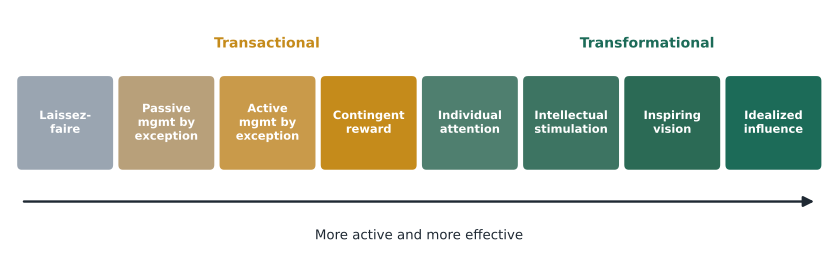
Bernard Bass, building on James MacGregor Burns, distinguished transactional from transformational leadership. Transactional leaders guide followers by clarifying roles and task requirements and exchanging rewards for performance (contingent reward) or by monitoring and correcting deviations (management by exception). Transformational leaders inspire followers to transcend their self-interest for the good of the organization. Bass described four components, often called the four Is: idealized influence (acting as a role model with high ethical standards), inspirational motivation (communicating an appealing vision), intellectual stimulation (encouraging followers to question assumptions and be creative) and individualized consideration (attending to each follower's needs and development).
The full range of leadership model places these behaviours on a continuum from laissez-faire, the absence of leadership, which is consistently harmful, through passive and active management by exception and contingent reward to the four transformational behaviours. Transformational leadership is built on top of transactional leadership rather than replacing it: followers still need clear expectations and fair rewards. Meta-analyses show that transformational leadership is associated with higher follower motivation, satisfaction and performance, though some of the measures overlap with general positive feelings about the leader.
Charismatic, authentic and ethical leadership
Charismatic leadership emphasizes leaders whom followers see as having extraordinary qualities: a compelling vision, willingness to take personal risks, sensitivity to followers' needs and unconventional behaviour. Charisma can energize organizations, especially in crises, but it carries risks. Charismatic leaders may pursue their own interests, surround themselves with uncritical followers and leave no successors. Some of the most notorious corporate collapses were led by highly charismatic executives.
Authentic leaders know who they are, what they believe in and act on those values openly and candidly; followers consider them ethical people. Ethical leadership involves demonstrating appropriate conduct through personal actions and relationships, and promoting such conduct to followers through two-way communication, reinforcement and decision-making. Research links ethical leadership to employees' ethical behaviour, willingness to report problems and trust. Trust, in turn, is a central outcome of leadership. People trust leaders whom they see as having integrity, competence, consistency, loyalty and openness, and trust is much easier to lose than to rebuild.
Servant and inclusive leadership
Servant leadership, a term coined by Robert Greenleaf in 1970, describes leaders who go beyond their own self-interest to focus on opportunities to help followers grow and develop. Servant leaders listen, empathize, persuade rather than command, practise stewardship and commit to the growth of others. Research associates servant leadership with higher citizenship, commitment, creativity and team performance. It is sometimes misunderstood as weak leadership, but servant leaders still set direction and hold people accountable; they simply see their role as serving the team's success rather than the reverse.
Inclusive leadership focuses on ensuring that all team members feel they belong and that their unique perspectives are valued. Inclusive leaders invite input from everyone, acknowledge their own biases and limits, share credit, address exclusionary behaviour and make decisions transparently. In diverse and hybrid teams, inclusive leadership helps counter faultlines (lesson 7) and the in-group effects of LMX. It also supports psychological safety, because people speak up when they believe their contributions will be welcomed.
| Approach | Central idea | Typical behaviours |
|---|---|---|
| Transformational | Inspire followers to exceed self-interest | Vision, role modelling, intellectual stimulation, individual attention |
| Authentic | Act consistently with one's values | Self-awareness, transparency, balanced processing of information |
| Ethical | Model and promote ethical conduct | Fair decisions, open discussion of ethics, discipline for violations |
| Servant | Serve followers' growth and the team's success | Listening, empathy, stewardship, developing others |
| Inclusive | Ensure all members belong and are heard | Inviting input, sharing credit, addressing exclusion |
The dark side of leadership
Not all leadership is beneficial. Abusive supervision, sustained hostile verbal and non-verbal behaviour such as ridicule, public criticism and the silent treatment, is linked to lower satisfaction, higher stress, more counterproductive behaviour and higher turnover among targets, and its effects spread to witnesses. Leaders high in Dark Triad traits (lesson 2) can emerge because they appear confident but may harm teams over time. Destructive leadership is often enabled by followers who comply and organizations that reward short-term results regardless of how they are achieved. Regular upward feedback, 360-degree reviews and clear consequences for abusive behaviour help organizations detect and address it.
Substitutes, followership and developing leaders
Sometimes leadership matters less than we think. Substitutes for leadership are characteristics of followers, tasks or organizations that make leader behaviour unnecessary: experienced, professional employees need less direction; intrinsically satisfying tasks need less supportive leadership; formal rules and cohesive teams can replace directive behaviour. Neutralizers, such as physical distance between leader and followers, can block a leader's influence. Followership also matters. Effective followers manage themselves, commit to purposes beyond themselves, build competence and have the courage to challenge leaders when necessary.
Leadership can be developed. Effective development combines challenging assignments (stretch roles, rotations and project leadership), developmental relationships (mentoring, coaching and sponsorship) and formal learning, with regular feedback through tools such as 360-degree assessments. People learn leadership mainly from experience, so organizations should deliberately give promising people early opportunities to lead and to reflect on what happened, and should make sure those opportunities are distributed fairly rather than following in-group lines.
Common mistakes
MistakeAssuming that effective leaders are born with special traits.
InsteadRecognize that traits predict emergence better than effectiveness and that leadership behaviours can be learned.
MistakeUsing one leadership style with everyone.
InsteadAdapt behaviour to followers' experience, the task and the environment.
MistakeInvesting only in a favoured in-group.
InsteadOffer high-quality relationships and development opportunities to every team member.
MistakeEquating charisma with good leadership.
InsteadLook for integrity, consistency and results; watch for self-serving or abusive behaviour behind charisma.
MistakeSkipping the transactional basics in pursuit of inspiration.
InsteadCombine a compelling vision with clear expectations, fair rewards and follow-through.
Summary and key terms
- Leadership is influencing a group toward goals; management produces order and consistency.
- Extraversion predicts leader emergence; traits predict emergence better than effectiveness.
- Initiating structure and consideration both matter, for performance and for satisfaction respectively.
- Contingency theories such as path–goal theory match leader behaviour to followers and tasks.
- LMX theory describes in-groups and out-groups; leaders should offer high-quality relationships to all.
- Transformational leadership builds on transactional leadership through the four Is; laissez-faire is consistently harmful.
- Authentic, ethical, servant and inclusive leadership emphasize values, service and belonging.
- Abusive supervision harms targets and witnesses; substitutes for leadership and good followership also shape outcomes.
- Leadership
- The ability to influence a group toward the achievement of a vision or set of goals.
- Initiating structure
- The extent to which a leader defines and structures roles and work.
- Consideration
- The extent to which a leader shows trust, respect and concern for followers.
- Path–goal theory
- A theory that leaders help followers reach goals by clarifying paths and removing obstacles.
- Leader–member exchange
- A theory describing the different quality relationships leaders form with different followers.
- Transactional leadership
- Leading by clarifying roles and exchanging rewards for performance.
- Transformational leadership
- Inspiring followers to transcend self-interest for the good of the organization.
- Servant leadership
- Leadership focused on serving followers' growth and development.
- Inclusive leadership
- Leadership that ensures all members feel they belong and are valued.
- Abusive supervision
- Sustained hostile verbal and non-verbal behaviour by a supervisor.
Practice problems
Work each problem on paper first, then reveal the answer to check.
Distinguish leadership from management.
Show answer
Leadership sets direction and drives change; management produces order through planning, organizing and control.
Which Big Five trait is most strongly linked to leader emergence?
Show answer
Extraversion.
Name the two Ohio State leadership dimensions.
Show answer
Initiating structure and consideration.
Which path–goal style fits an experienced team with an internal locus of control?
Show answer
Participative.
LMX scores for a team of five are 32, 31, 30, 19 and 18 out of 35. What pattern does this suggest?
Show answer
An in-group of three and an out-group of two.
Name the four Is of transformational leadership.
Show answer
Idealized influence, inspirational motivation, intellectual stimulation and individualized consideration.
What is laissez-faire leadership and how does it affect outcomes?
Show answer
The absence of leadership; it is consistently harmful.
Give two risks of charismatic leadership.
Show answer
Self-serving goals, uncritical followers, lack of successors.
What is a substitute for leadership?
Show answer
A follower, task or organizational characteristic that makes leader behaviour unnecessary.
Portfolio task: describe the best leader you have worked with using two theories from this lesson.
Show answer
Answers vary; a good answer links specific behaviours to theory components.
Lesson quiz · 5 questions
Score 60% or more to complete this lesson.
Create a free account to save your progress, take quizzes and earn a certificate.