
BUS-120 · Lesson 7 of 12 · 28 min
Business reports
Reports turn information into decisions. A sales report tells managers whether targets are being met; an incident report records what happened and why; a feasibility report says whether a project can work; a recommendation report tells decision-makers what to do. Reports range from a one-page progress update sent by email to a 60-page formal report with an executive summary, appendices and references. This lesson covers the kinds of reports, how to plan and organize them, how to write the parts readers rely on most, how to make recommendations with a transparent method, and the basics of citing sources in APA and Chicago styles.
Kinds of reports
Reports can be classified by purpose. Informational reports present facts without analysis or recommendations: progress reports, meeting minutes, monthly sales summaries, trip reports and incident reports. Analytical reports interpret the facts and draw conclusions, and many go on to recommend action: feasibility reports, justification reports, yardstick reports that compare options against criteria, and research reports. Reports can also be classified by length and formality. Informal reports are short (often under 10 pages) and written as memos, emails or letters. Formal reports are longer, with front matter, a body divided by headings and back matter.
| Report | Purpose | Typical format | Pattern |
|---|---|---|---|
| Progress report | Update on work completed, problems and next steps | Email or memo | Direct |
| Incident report | Record what happened, when, who was involved and immediate actions | Form or memo | Direct, chronological |
| Meeting minutes | Record decisions and action items | Memo or template | Direct, by agenda item |
| Feasibility report | Assess whether a proposed project is practical and worthwhile | Memo or formal report | Direct or indirect |
| Justification report | Argue for a purchase, change or investment | Memo | Direct, unless the reader is resistant |
| Yardstick report | Compare options against set criteria | Formal or informal report | Usually direct |
| Research report | Investigate a question in depth | Formal report | Indirect or direct |
Planning a report
Start with a problem statement and a purpose statement. The problem statement describes the situation that prompted the report ("Customer complaints about delivery times rose 40 % in the past year"). The purpose statement says what the report will do ("This report analyzes the causes of late deliveries and recommends changes to reduce average delivery time to under three days"). Next define the scope: what the report will and will not cover, and any limitations, such as time, budget or data available. Then plan the research, identify the criteria that will be used to judge options and build an outline.
Organize the body using a pattern that suits the content: by time (chronological), by component or location (by region, product or department), by importance, by criteria (each section evaluates options against one criterion) or by problem, causes and solutions. Use informative headings, called talking headings, that tell the reader the point of each section ("Late deliveries are concentrated in the Prairie region") rather than functional headings that only name the topic ("Regional analysis"). Functional headings suit formal reports read in sections; talking headings help busy readers grasp the argument from the headings alone.
Worked problem
Outlining a recommendation report
A mid-sized accounting firm wants to know whether to move from three offices to a hybrid model with one smaller downtown office. Draft an outline for an analytical report with talking headings.
Show solution
- 1. Executive summary: Moving to one hybrid office would save about $410,000 a year and is supported by most staff.
- 2. Introduction: problem (leases on two offices expire next year; offices are 45 % occupied on average); purpose; scope (costs, staff preferences, client service; not tax implications); methods (lease quotes, a staff survey with 118 responses, interviews with six clients).
- 3. Findings: 3.1 Office occupancy averages 45 % and peaks on Tuesdays and Wednesdays; 3.2 One hybrid office would cut occupancy costs by 38 %; 3.3 Most staff (71 %) prefer two or three office days a week; 3.4 Clients value in-person meetings for year-end work but accept video calls for routine matters.
- 4. Conclusions: the hybrid model is financially and practically feasible if meeting space is adequate.
- 5. Recommendations: sign a five-year lease for one downtown office with bookable desks and four meeting rooms; set Tuesday and Wednesday as team office days; review after 12 months.
- 6. References and appendices: survey questions, lease comparison, cost calculations.
Answer: Talking headings let a reader understand the argument from the outline alone, and the executive summary gives the answer first.
Parts of a formal report
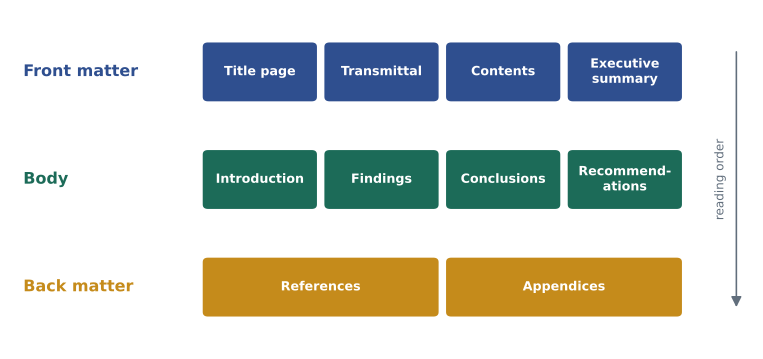
Formal reports have three groups of parts. Front matter includes a title page, a letter or memo of transmittal (which introduces the report to the person who requested it), a table of contents, a list of figures and an executive summary. The body includes the introduction, findings or discussion, conclusions and recommendations. Back matter includes references and appendices, which hold detailed data, survey instruments and calculations that support the body but would interrupt it.
The executive summary
The executive summary is the most read part of any formal report; many decision-makers read nothing else. It should stand alone, summarizing the purpose, methods, key findings, conclusions and recommendations, usually in about 10 % of the length of the report or less (often one page). Write it last, after the report is complete, and avoid introducing anything not in the report. Lead with the answer: if the report recommends an action, the executive summary should say so in its first paragraph.
Worked problem
Writing an executive summary
Using the hybrid office outline above, write a four-sentence executive summary.
Show solution
- Sentence 1 (purpose and answer): "This report assesses whether the firm should consolidate its three offices into one hybrid office and recommends that it do so when two leases expire next June."
- Sentence 2 (method): "The analysis is based on lease quotes from three landlords, a survey of 118 staff (a 79 % response rate) and interviews with six major clients."
- Sentence 3 (key findings): "Our offices are on average 45 % occupied; one office with bookable desks would cut occupancy costs by about $410,000 a year, or 38 %, and 71 % of staff prefer working in the office two or three days a week."
- Sentence 4 (recommendation): "We recommend a five-year lease on a downtown office with four meeting rooms, Tuesday and Wednesday team days and a review after 12 months."
Answer: Four sentences give the decision-maker the purpose, method, evidence and recommendation.
Findings, conclusions and recommendations
Keep three things distinct. Findings are facts and data: "Average delivery time in the Prairie region was 5.2 days." Conclusions interpret the findings: "The Prairie region's delays are caused mainly by the use of a single regional carrier." Recommendations propose action: "Add a second carrier for the Prairie region by March." Each conclusion should follow from the findings, and each recommendation from the conclusions. Recommendations should be specific, feasible and stated as actions, and often include who should act and by when.
Making recommendations transparent: the weighted decision matrix
When a report compares options, a weighted decision matrix makes the reasoning visible. List the criteria, assign each a weight reflecting its importance (weights summing to 100 %), score each option on each criterion (for example, from 1 to 5) and multiply. The option with the highest weighted total is preferred, although the report should also discuss the results and any close calls.
Worked problem
Choosing a project management tool
A team compares three project tools against four criteria: cost (weight 30 %), ease of use (25 %), integration with existing systems (25 %) and vendor support (20 %). Scores out of 5 are: Tool A 4, 3, 5, 3; Tool B 5, 4, 2, 4; Tool C 3, 5, 4, 5. Which tool scores highest?
Show solution
- Tool A = 0.30 × 4 + 0.25 × 3 + 0.25 × 5 + 0.20 × 3 = 1.20 + 0.75 + 1.25 + 0.60 = 3.80.
- Tool B = 0.30 × 5 + 0.25 × 4 + 0.25 × 2 + 0.20 × 4 = 1.50 + 1.00 + 0.50 + 0.80 = 3.80.
- Tool C = 0.30 × 3 + 0.25 × 5 + 0.25 × 4 + 0.20 × 5 = 0.90 + 1.25 + 1.00 + 1.00 = 4.15.
- Sensitivity check: even if the cost weight rose to 40 % (taking 10 points from support), Tool C would score 0.40 × 3 + 0.25 × 5 + 0.25 × 4 + 0.10 × 5 = 3.95, against 3.90 for both A and B, so the choice becomes close.
Answer: Tool C scores highest at 4.15. The report should present the matrix in a table and note that the result depends on how heavily cost is weighted.
| Criterion (weight) | Tool A | Tool B | Tool C |
|---|---|---|---|
| Cost (30 %) | 4 | 5 | 3 |
| Ease of use (25 %) | 3 | 4 | 5 |
| Integration (25 %) | 5 | 2 | 4 |
| Vendor support (20 %) | 3 | 4 | 5 |
| Weighted total | 3.80 | 3.80 | 4.15 |
Documenting sources: APA and Chicago basics
Business reports that use outside information must credit their sources, both to give credit and so readers can check the evidence. Two styles dominate. APA style (the Publication Manual of the American Psychological Association, 7th edition) is common in business, management and social science programs. It uses author-date in-text citations and a reference list. Chicago style (The Chicago Manual of Style, 18th edition, published in 2024) offers two systems: notes and bibliography, common in history and some business writing, and author-date, close to APA. Many organizations have their own house style; follow it when one exists.
The sources below are invented for illustration.
| Element | APA 7th edition | Chicago author-date | Chicago notes and bibliography |
|---|---|---|---|
| In-text citation | (Morales & Chen, 2025, p. 48) | (Morales and Chen 2025, 48) | A superscript number linked to a footnote |
| Journal article in the list | Morales, T., & Chen, L. (2025). Hybrid work and team performance. Journal of Workplace Studies, 18(2), 45–62. https://doi.org/10.0000/jws.2025.018 | Morales, Teresa, and Li Chen. 2025. "Hybrid Work and Team Performance." Journal of Workplace Studies 18 (2): 45–62. https://doi.org/10.0000/jws.2025.018. | Note: 1. Teresa Morales and Li Chen, "Hybrid Work and Team Performance," Journal of Workplace Studies 18, no. 2 (2025): 48. |
| Report by an organization | Northfield Research Institute. (2026). Office occupancy trends 2026. | Northfield Research Institute. 2026. Office Occupancy Trends 2026. | Note: 2. Northfield Research Institute, Office Occupancy Trends 2026 (2026), 12. |
| List title | References | References | Bibliography |
Whatever the style, cite direct quotations, paraphrased ideas, data, charts and images taken from others. Paraphrasing means expressing an idea in your own words and sentence structure, still with a citation; changing a few words of the original is not enough. Common knowledge ("Ottawa is the capital of Canada") does not need a citation. Reference-management tools such as Zotero can format citations automatically, but always check the output.
Portfolio task for lesson 7: write a short informal recommendation report (two to three pages) comparing three options for a decision you know (for example, a software tool, a supplier or an event venue). Include a problem and purpose statement, a weighted decision matrix, talking headings, an executive summary and at least three sources cited in APA or Chicago style.
Common mistakes
MistakeBurying the recommendation at the end of a long report.
InsteadState the main conclusion and recommendation in the executive summary and, for most readers, early in the report.
MistakeWriting the executive summary first.
InsteadWrite it last, once the report is complete, so it reflects what the report actually says.
MistakeMixing findings, conclusions and recommendations.
InsteadKeep facts, interpretations and proposed actions in separate sections.
MistakeUsing functional headings only.
InsteadUse talking headings that state the point of each section when readers will skim.
MistakePresenting a decision without showing the criteria.
InsteadUse a weighted decision matrix and discuss how sensitive the result is to the weights.
MistakeChanging a few words and calling it a paraphrase.
InsteadRewrite in your own words and structure, and cite the source.
Summary and key terms
- Informational reports present facts; analytical reports interpret them and often recommend action.
- Plan with a problem statement, purpose statement, scope and criteria.
- Organize by time, component, importance, criteria or problem-cause-solution; use talking headings for skimmers.
- Formal reports have front matter, a body and back matter.
- The executive summary stands alone, leads with the answer and is written last.
- Keep findings, conclusions and recommendations distinct; a weighted decision matrix makes comparisons transparent.
- APA 7th edition and Chicago 18th edition are the main citation styles; cite quotations, paraphrases, data and images.
- Informational report
- A report that presents facts without analysis or recommendations.
- Analytical report
- A report that interprets data and draws conclusions, often with recommendations.
- Purpose statement
- A sentence stating what a report will do.
- Scope
- The boundaries of what a report covers.
- Talking heading
- A heading that states the main point of a section.
- Letter of transmittal
- A letter or memo that introduces a report to its recipient.
- Executive summary
- A stand-alone summary of a report's purpose, findings, conclusions and recommendations.
- Weighted decision matrix
- A table scoring options against weighted criteria.
- Paraphrase
- A restatement of another's idea in your own words and structure, with a citation.
- Author-date citation
- An in-text citation giving the author's name and the year of publication.
Practice problems
Work each problem on paper first, then reveal the answer to check.
Classify a monthly sales summary: informational or analytical?
Show answer
Informational.
Rewrite the functional heading "Costs" as a talking heading.
Show answer
For example, "Consolidation would cut occupancy costs by 38 %".
Which part of a formal report introduces it to the person who requested it?
Show answer
The letter or memo of transmittal.
Label each: (a) "Turnover was 18 %"; (b) "Turnover is driven by low starting pay"; (c) "Raise starting pay by 6 %".
Show answer
(a) Finding; (b) conclusion; (c) recommendation.
Two options score 4 and 2 on cost (weight 60 %) and 3 and 5 on quality (weight 40 %). Find the weighted totals.
Show answer
Option 1: 2.4 + 1.2 = 3.6; option 2: 1.2 + 2.0 = 3.2.
How long should an executive summary typically be?
Show answer
About 10 % of the report or less, often one page.
Write an APA in-text citation for a 2026 report by Northfield Research Institute.
Show answer
(Northfield Research Institute, 2026).
What does Chicago notes and bibliography style use instead of author-date citations?
Show answer
Numbered footnotes or endnotes.
Does "Canada has ten provinces and three territories" need a citation?
Show answer
No; it is common knowledge.
What belongs in appendices?
Show answer
Detailed data, survey instruments, calculations and other supporting material that would interrupt the body.
Lesson quiz · 5 questions
Score 60% or more to complete this lesson.
Create a free account to save your progress, take quizzes and earn a certificate.