
BUS-101 · Lesson 3 of 12 · 28 min
Forms of business ownership in Canada
One of the first decisions any founder makes is the legal form of the business. The form decides who owns it, who is responsible if it cannot pay its debts, how its profit is taxed, how easily it can raise money and how much paperwork it needs. There is no single best form: a part-time freelance designer, a family restaurant and a technology start-up seeking investors need different structures. This lesson compares the main forms, works through the tax and liability differences with numbers, and ends with a way to choose.
The sole proprietorship
A sole proprietorship is a business owned by one person with no separate legal existence. The owner and the business are, in law, the same person. It is the simplest and cheapest form: you can start by simply doing business, though you must register a business name with your province if you trade under a name other than your own, obtain any municipal licence and register for GST/HST once your taxable sales pass $30,000 over four calendar quarters. Profit is added to the owner's other income on the personal T1 return using Form T2125 and taxed at personal rates. The owner also pays both halves of Canada Pension Plan contributions (Quebec Pension Plan in Quebec) on self-employment earnings.
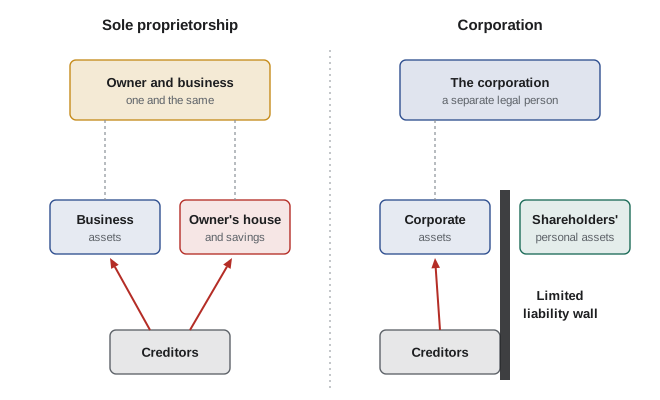
The big drawback is unlimited liability. If the business cannot pay a supplier, loses a lawsuit or defaults on a loan, creditors can go after the owner's personal savings, car and home. Insurance and careful contracts reduce the risk but do not remove it. A sole proprietorship also ends when the owner stops working or dies, and it can be hard to raise money because there are no shares to sell.
Partnerships
A partnership exists when two or more people carry on business together with a view to profit. It can arise without any paperwork, which surprises many friends who start a business together. In a general partnership, each partner is personally liable for all the partnership's debts, including debts created by another partner acting for the business. Profit is not taxed in the partnership; it is divided among the partners according to their agreement and each reports their share on their own return. Provinces also allow limited partnerships, where limited partners invest money and are liable only up to that amount provided they do not take part in management, and limited liability partnerships (LLPs), which are generally available only to certain professions such as lawyers and accountants.
Every partnership should have a written partnership agreement covering how much each partner contributes, how profits and losses are shared, who makes which decisions, what happens if a partner wants to leave or dies, and how disputes are resolved. Without one, provincial partnership law fills the gaps, often with rules nobody intended, such as equal sharing of profit regardless of effort or capital.
Corporations
A corporation is a separate legal person, created by filing articles of incorporation under the federal Canada Business Corporations Act or a provincial statute such as Ontario's Business Corporations Act. It can own property, sign contracts, sue and be sued in its own name. Its owners are shareholders, who elect a board of directors, who in turn appoint officers to manage the business. Shareholders' liability is limited to what they invested: if the corporation fails, creditors generally cannot take shareholders' personal assets. A corporation continues to exist when shareholders change or die, and it can raise money by selling shares.
A corporation files its own tax return (the T2) and pays corporate income tax. A Canadian-controlled private corporation (CCPC) can claim the small business deduction, which taxes the first $500,000 a year of active business income at a low combined rate: the federal rate is 9 %, and provincial small business rates add roughly 0 % to 3.2 %, so combined rates are typically about 9 % to 12 %. Income above that limit is taxed at the general rate, 15 % federally plus a provincial rate, for a combined rate of roughly 23 % to 31 %. When the corporation pays its after-tax profit to shareholders as dividends, the shareholders pay personal tax on them, reduced by the dividend tax credit. This design, called integration, aims to make total tax roughly the same whether income is earned personally or through a corporation; the main benefit of incorporating a small business is deferring personal tax on profit left in the corporation.
Corporations cost more to set up and run. They must keep a minute book, hold or document annual shareholder and director meetings, file annual returns with the government, keep separate bank accounts and file a separate tax return. Limited liability is also not absolute. Lenders often demand personal guarantees from owners of small corporations, directors can be personally liable for unpaid employee wages and unremitted payroll and sales taxes, and courts can 'pierce the corporate veil' if owners treat the corporation as their personal piggy bank.
Co-operatives
A co-operative is a corporation owned and democratically controlled by its members, who use its services. Each member typically has one vote regardless of how much they have invested, and surpluses are returned to members in proportion to how much they use the co-op, as patronage dividends. Co-operatives are common in agriculture, retail, housing and financial services, where credit unions and caisses populaires, such as the Desjardins Group in Quebec, serve millions of members. Co-ops are incorporated under federal or provincial co-operatives legislation and give members limited liability.
Comparing the forms
| Form | Liability of owners | Who pays income tax | Set-up and running cost | Raising money |
|---|---|---|---|---|
| Sole proprietorship | Unlimited | Owner, on the T1 (Form T2125) | Very low | Owner's savings and personal loans |
| General partnership | Unlimited, joint | Each partner on their own return | Low; agreement recommended | Partners' contributions and loans |
| Limited partnership | Limited for limited partners; unlimited for the general partner | Partners on their own returns | Moderate | Passive investors |
| Corporation (CCPC) | Limited to investment | Corporation on the T2; shareholders on dividends | Higher: filings, minute book, separate return | Selling shares; easier bank financing |
| Co-operative | Limited | Co-op, with deductions for patronage dividends | Moderate to high | Member shares and loans |
Worked problem
Tax deferral from incorporating
An Ontario consultant earns $200,000 of profit a year but needs only $110,000 to live on. As a sole proprietor, the extra $90,000 would be taxed at a personal marginal rate of about 43 %. In a CCPC, active business income under $500,000 is taxed at about 12.2 % in Ontario (9 % federal plus 3.2 % provincial). How much tax is deferred each year on the $90,000 left in the corporation?
Show solution
- Personal tax on $90,000 at 43 % = $38,700.
- Corporate tax on $90,000 at 12.2 % = $10,980.
- Tax deferred = $38,700 − $10,980 = $27,720.
- The corporation keeps $90,000 − $10,980 = $79,020 to invest or use in the business.
- When those funds are later paid out as dividends, personal tax is due, bringing the total close to what it would have been without the corporation; the benefit is the deferral and the flexibility of when to pay.
Answer: About $27,700 of personal tax is deferred each year. Incorporating mainly pays when the owner can leave substantial profit in the corporation; it costs extra in accounting and filings.
Worked problem
What limited liability is worth
A café owner has $60,000 of personal savings and equity in a home. A slip-and-fall lawsuit leads to a $250,000 judgment against the business, and insurance covers $150,000. The business itself has $30,000 of assets. How much could the owner personally lose as a sole proprietor and as the sole shareholder of a properly run corporation?
Show solution
- Uncovered amount = $250,000 − $150,000 = $100,000.
- Business assets can pay $30,000, leaving $70,000.
- As a sole proprietor, the owner is personally liable for the remaining $70,000, more than their savings, putting home equity at risk.
- As a shareholder of a corporation that has been run properly (separate accounts, records, no personal guarantee of this debt), the owner's loss is generally limited to the $30,000 already in the business.
- Note that an owner who personally caused the injury through their own negligence can still be sued personally, and lenders often require personal guarantees for loans.
Answer: Up to $70,000 of personal assets as a sole proprietor versus, generally, nothing beyond the business assets as a corporation, which is why limited liability and adequate insurance matter.
Franchises
A franchise is not a separate legal form but a business arrangement. The franchisor, such as a fast-food or hotel brand, licenses its name, systems and support to franchisees, who own and run individual locations, usually as corporations. In return, franchisees pay an initial fee and ongoing royalties, often 4 % to 8 % of sales, plus advertising fund contributions. Franchising lets owners start with a proven model and brand, at the cost of less independence and ongoing fees.
Franchising is regulated by provincial disclosure laws in Alberta, Ontario, Manitoba, New Brunswick, Prince Edward Island and British Columbia. They require franchisors to give prospective franchisees a disclosure document at least 14 days before signing an agreement or paying money, and give franchisees rights to cancel if disclosure is missing or seriously deficient.
Choosing a form
A practical way to choose is to ask five questions. How much personal risk does the business carry, from lawsuits, debts and contracts? How much profit will it make, and how much will the owner leave in the business rather than spend? Will it need outside investors, and what form do they expect? How much administration can the owner handle? And what are the plans for the future, such as bringing in partners, selling the business or passing it to family? Many businesses start as sole proprietorships and change form as they grow.
Worked problem
A weighted decision
Two friends opening a craft brewery score three options from 1 to 5 on four weighted criteria: liability protection (35 %), tax result (25 %), ease of administration (15 %) and ability to bring in investors (25 %). Scores: general partnership 1, 3, 4, 2; corporation 5, 4, 2, 5; limited partnership with a corporate general partner 4, 3, 2, 4. Which scores highest?
Show solution
- Partnership = 0.35 × 1 + 0.25 × 3 + 0.15 × 4 + 0.25 × 2 = 0.35 + 0.75 + 0.60 + 0.50 = 2.20.
- Corporation = 0.35 × 5 + 0.25 × 4 + 0.15 × 2 + 0.25 × 5 = 1.75 + 1.00 + 0.30 + 1.25 = 4.30.
- Limited partnership = 0.35 × 4 + 0.25 × 3 + 0.15 × 2 + 0.25 × 4 = 1.40 + 0.75 + 0.30 + 1.00 = 3.45.
- The corporation scores highest because the brewery needs equipment loans and investors and carries liability risk.
Answer: Incorporating scores 4.30, well ahead of the other options; the friends should still sign a shareholders' agreement covering what happens if one of them leaves.
Common mistakes
MistakeStarting a business with a friend without any written agreement.
InsteadSign a partnership, shareholders' or operating agreement covering money, decisions and exits.
MistakeAssuming a corporation protects owners from every claim.
InsteadExpect personal guarantees and personal liability for your own wrongdoing and some unpaid taxes; keep insurance.
MistakeTreating the low small business tax rate as a permanent saving.
InsteadUnderstand it as a deferral that pays off when profit is left in the corporation.
MistakeMixing personal and business money.
InsteadKeep separate accounts so records are clean and limited liability is respected.
MistakeChoosing a form because a friend did.
InsteadModel your own risk, profit, funding needs and plans with an accountant.
Summary and key terms
- The legal form decides liability, tax, funding and paperwork.
- Sole proprietorships are simple but give the owner unlimited liability.
- General partners are each liable for all partnership debts; write a partnership agreement.
- Corporations are separate legal persons whose shareholders have limited liability.
- CCPCs pay a low small business rate on the first $500,000 of active income; integration evens out total tax when profit is paid out.
- Co-operatives are owned and controlled by their members, one member one vote.
- Franchises license a brand and system to independent owners, with disclosure rules protecting franchisees.
- Sole proprietorship
- A business owned by one person with no separate legal existence.
- Unlimited liability
- Personal responsibility for all the debts of the business.
- General partnership
- Two or more people carrying on business together, each fully liable.
- Limited partner
- An investor whose liability is limited to the amount invested.
- Corporation
- A separate legal person owned by shareholders.
- CCPC
- A Canadian-controlled private corporation, eligible for the small business deduction.
- Small business deduction
- A reduced tax rate on the first $500,000 of a CCPC's active business income.
- Integration
- The principle that corporate and personal tax together should roughly equal personal tax alone.
- Co-operative
- A corporation owned and democratically controlled by its members.
- Franchise
- A licence to operate a business using another firm's brand and system.
Practice problems
Work each problem on paper first, then reveal the answer to check.
Which form gives the owner unlimited liability and no separate legal existence?
Show answer
A sole proprietorship.
Can a partnership exist without a written agreement?
Show answer
Yes; it arises when people carry on business together for profit.
What is the federal small business tax rate for a CCPC?
Show answer
9 % on the first $500,000 of active business income.
Profit of $50,000 is retained in a corporation taxed at 12 % instead of earned at a 40 % personal rate. How much tax is deferred?
Show answer
$14,000.
Give two situations in which a small corporation's owner may still be personally liable.
Show answer
Personal guarantees of loans; their own negligence; unremitted payroll or sales taxes.
How do co-ops return surpluses to members?
Show answer
As patronage dividends in proportion to use.
How many days before signing must a franchisor provide a disclosure document?
Show answer
14 days.
Weighted score: 0.4 × 5 + 0.3 × 2 + 0.3 × 4?
Show answer
3.8.
What document should partners sign?
Show answer
A partnership agreement.
Name two costs of incorporating.
Show answer
Incorporation fees, annual filings, a separate tax return, accounting and legal fees.
Lesson quiz · 5 questions
Score 60% or more to complete this lesson.
Create a free account to save your progress, take quizzes and earn a certificate.