
BLR-130 · Lesson 5 of 12 · 19 min
Shop geometry for layout
Most layout is geometry done with a tape, a square and a set of trammels: drawing a line at right angles to another, dividing a circle into equal parts, finding the centre of an arc, laying out an angle without a protractor, and checking a curve against a template. The geometry is the same as in a high school textbook, but on steel it has to work at full size, on plates several metres across, with tools that have their own errors. This lesson covers the constructions a layout hand uses most, the few formulas that go with them, and the checks that tell whether the result is right.
Right angles and the 3-4-5 triangle
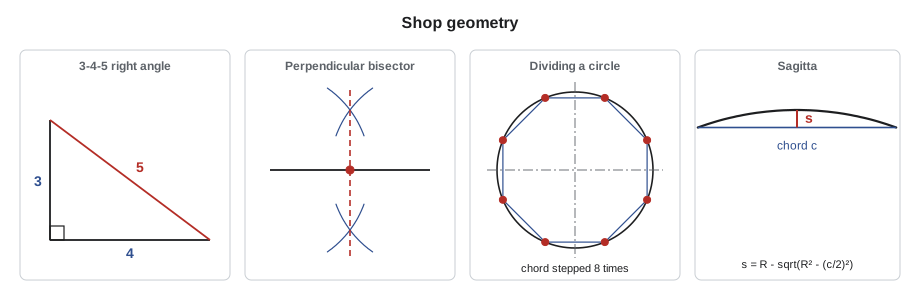
A square is only as long as its blade. To lay out a right angle across a large plate, layout hands use a triangle whose sides are in the ratio 3, 4 and 5. Because 3² + 4² = 5², the angle between the 3 and 4 sides is a right angle. On a plate, the layout hand marks a point on the base line, measures 4 units along the line and 3 units up an approximate perpendicular, and adjusts the second mark until the distance between the two far points is exactly 5 units. Any multiple works: 3, 4 and 5 m on a large plate, or 300, 400 and 500 mm on a small one. The larger the triangle, the smaller the angular error from a given error in measurement.
The same rule underlies the diagonal check of a rectangle. In a true rectangle, both diagonals are equal, and each equals the square root of the sum of the squares of the sides. If one diagonal is longer than the other, the shape is a parallelogram, not a rectangle, and the corners are not square. Lesson 6 uses this check on every plate.
Perpendiculars, bisectors and parallels
A perpendicular to a line through a point can be drawn with trammels alone. From the point, scribe two arcs crossing the line at equal distances on each side. From those two crossings, with the trammels set longer, scribe two arcs that cross each other above the line. The line from the original point through the crossing is perpendicular. The same construction, done from the two ends of a line, bisects it: the line through the two crossings of equal arcs drawn from each end cuts the line in half at right angles. Bisecting an angle works the same way, using equal arcs from the angle's two arms.
Parallel lines are drawn by marking two points at the same distance from a line, measured square to it, and joining them; on a long plate, three or four points are better than two. A fitter laying out the reference lines on a shell plate uses this constantly, because a reference line offset a fixed distance from a plate edge is easier to keep than the edge itself, which will be bevelled and welded.
Circles and arcs
A circle's circumference is π times its diameter, about 3.1416 times. Its arc length for an angle is the same fraction of the circumference as the angle is of 360 degrees. A chord is the straight line between two points on the circle; for the angle θ between those points, measured at the centre, the chord length is twice the radius times the sine of half the angle.
Dividing a circle into equal parts is one of the most frequent layout tasks: bolt holes on a flange or base ring, nozzles around a shell, tubes around a header. With dividers set to the chord length, the parts are stepped off around the circle; with the circumference known, they are measured as arc lengths along a rolled shell with a flexible tape. For a large bolt circle, it is more accurate to calculate the chord and step it off, then check that the last step lands on the first point; any error shows up in that last step, and is shared out by adjusting the dividers.
To find the centre of an arc, as when an old shell or a template has no centre marked, draw two chords on the arc and the perpendicular bisector of each; the bisectors cross at the centre. The radius is then the distance from the centre to the arc. A layout hand uses this to check the radius of a rolled plate or a tank shell from three points on it.
The sagitta
The rise of an arc above the middle of a chord is called the sagitta, from the Latin for arrow. It is the most useful number in checking curved work. A template cut to a chord of known length, with its edge curved to the right radius, should touch a rolled plate at both ends and in the middle. If the plate is not rolled tightly enough, the middle of the template stands off the plate; if it is rolled too tightly, the ends stand off. And if no template is available, a straightedge laid across the curve as a chord, with the gap at its middle measured, gives the sagitta directly, which can be compared with the calculated value.
The formula follows from the right triangle formed by the radius, half the chord, and the distance from the centre to the chord. For a small sagitta compared with the radius, an approximation is c² divided by 8R, which is close enough for a quick check in the field.
Kiera works out the sagittas she will need: a 600 mm template chord on the V-412 shell, checked both inside and outside, and a 2 m straightedge laid across a Tank 14 replacement plate, whose radius is about 30 m. She also calculates the chords and arc lengths for dividing the drum's 2,100 mm anchor bolt circle into 4, 8, 12 and 16 parts.
# Shop geometry: chord, arc and sagitta for checking curvature (metric)
from math import sqrt, sin, pi, radians
MODE = "mm"

def show(x):
    return f"{x:,.1f} mm" if MODE == "mm" else f"{x:,.3f} in"

cases = [("V-412 shell, inside", 900, 600), ("V-412 shell, outside", 916, 600), ("Tank 14 shell", 30_000, 2_000)]      # (name, radius of the curve, template chord)
for name, r, c in cases:
    s = r - sqrt(r * r - (c / 2) ** 2)          # rise of the arc above the chord
    print(f"{name}: radius {show(r)}, chord {show(c)} -> sagitta {show(s)}")

R = 1_050             # bolt circle radius
for n in (4, 8, 12, 16):
    chord = 2 * R * sin(pi / n)                 # straight distance between adjacent points
    arc = 2 * pi * R / n                        # distance around the circle
print(f"{n:>2} equal parts: chord {show(chord)}, arc {show(arc)}")V-412 shell, inside: radius 900.0 mm, chord 600.0 mm -> sagitta 51.5 mm V-412 shell, outside: radius 916.0 mm, chord 600.0 mm -> sagitta 50.5 mm Tank 14 shell: radius 30,000.0 mm, chord 2,000.0 mm -> sagitta 16.7 mm 4 equal parts: chord 1,484.9 mm, arc 1,649.3 mm 8 equal parts: chord 803.6 mm, arc 824.7 mm 12 equal parts: chord 543.5 mm, arc 549.8 mm 16 equal parts: chord 409.7 mm, arc 412.3 mm
For the drum, the template should stand about 51.5 mm proud of its chord on the inside of the shell. For Tank 14, the rise over a 2 m straightedge is only 16.7 mm, which is why tank plates are checked with long templates: a small error in rolling is a small fraction of a small number, and a short template would not show it. The bolt circle numbers also show why chords and arcs are not interchangeable: for eight holes, the chord is 803.6 mm, but the arc around the circle is 824.7 mm, more than 20 mm longer.
Angles without a protractor
Angles can be laid out by their tangents: for an angle θ, a line rising a height h over a run L, with h equal to L times the tangent of θ, makes the angle with the base. A layout hand who needs a 30-degree bevel line on a plate edge can mark a run of 100 mm and a rise of 57.7 mm, because the tangent of 30 degrees is 0.577. The same method lays out the slope of a brace or the angle of a mitre on a pipe. Digital protractors are faster, but the tangent method needs only a rule and works at any size.
| Angle | Tangent | Rise over a run of 100 mm |
|---|---|---|
| 15° | 0.268 | 26.8 mm |
| 22.5° | 0.414 | 41.4 mm |
| 30° | 0.577 | 57.7 mm |
| 37.5° | 0.767 | 76.7 mm |
| 45° | 1.000 | 100 mm |
| 60° | 1.732 | 173.2 mm |
Checking geometry on steel
Every construction can be checked by a second, independent measurement. A right angle laid out by 3-4-5 is checked by the diagonal of the finished rectangle. A divided circle is checked by the last step landing on the first point. A centre found by bisectors is checked by measuring the radius to three points on the arc. A sagitta is checked by laying the template at several points along the plate. The rule Joanne teaches is that a layout is not done until it has been checked by a method different from the one used to make it, because the same method repeats the same error.
Worked problem
Sagitta for a template
A shell has an inside radius of 1,200 mm. What is the sagitta of a 900 mm chord?
Show solution
- Half the chord: 450 mm.
- Distance from the centre to the chord: √(1,200² − 450²) = √1,237,500 = 1,112.4 mm.
- Sagitta: 1,200 − 1,112.4 = 87.6 mm.
Answer: About 87.6 mm.
Dividing a line into equal parts
A line can be divided into any number of equal parts without calculating, using a method from geometry that every layout hand learns. From one end of the line, draw a second line at any convenient angle. Along it, step off the required number of equal spaces with dividers set to any convenient size. Join the last step to the far end of the original line. Then draw lines parallel to that joining line through each of the other steps; where they cross the original line, they divide it into equal parts. The method is useful for spacing stiffeners or clips along a length that is not a round number, and for dividing an arc's chord when making a template.
Triangles and trigonometry in the shop
Most layout geometry comes down to right triangles. The three ratios a boilermaker uses are the sine, the opposite side over the hypotenuse; the cosine, the adjacent side over the hypotenuse; and the tangent, the opposite side over the adjacent side. With any two sides, or one side and an angle, the rest of the triangle can be found. A brace's length from its run and rise uses the Pythagorean rule; its angle uses the tangent; a bolt hole's coordinates from the bolt circle radius use the sine and the cosine. A layout hand who can draw the right triangle hidden in a problem can usually solve the problem.
Modern calculators and phone apps do the arithmetic, but they do not draw the triangle, and the errors Joanne sees most often are in setting the problem up, not in the arithmetic: the wrong side called the run, an angle measured from the wrong line, degrees mixed with radians on a calculator. Her rule is to sketch every triangle, label its sides with the actual dimensions, and estimate the answer before calculating it, so that a wrong answer looks wrong.
Kiera's notebook from the winter has a page of these sketches for every job: a triangle for each brace at Riverbend, a circle with its chord and sagitta for each template, and a small table of tangents for the bevel angles the shop uses most. By spring she does most of them in her head and uses the calculator only to confirm.
Common mistakes
MistakeLaying out a right angle with a small square on a large plate.
InsteadUse a large 3-4-5 triangle and check the diagonals.
MistakeTreating chord length and arc length as the same.
InsteadUse chords for dividers and arcs for a tape on a curved surface.
MistakeChecking a long, flat curve with a short template.
InsteadUse a template long enough for the sagitta to be measurable.
MistakeLetting dividing errors pile up in the last space.
InsteadAdjust the dividers and step again until the last step lands on the start.
MistakeChecking a layout with the same method that made it.
InsteadCheck it a different way, such as by diagonals or by measuring the radius.
Summary and key terms
- The 3-4-5 triangle lays out right angles at any size; larger triangles are more accurate.
- Equal-arc constructions give perpendiculars, bisectors and the centre of an arc.
- Circumference is πD; chord length is 2R sin(θ/2); arc and chord differ.
- The sagitta, R minus the square root of R² minus half the chord squared, checks curvature.
- Angles can be laid out by rise and run using the tangent.
- Check every layout by a different method from the one used to make it.
- Sagitta
- The rise of an arc above the middle of its chord.
- Chord
- A straight line joining two points on a circle.
- Perpendicular bisector
- A line through the middle of a segment at right angles to it.
- 3-4-5 triangle
- A right triangle with sides in the ratio 3:4:5, used to lay out right angles.
- Arc length
- The distance along a circle between two points.
- Tangent of an angle
- The ratio of rise to run for a line at that angle.
Practice problems
Work each problem on paper first, then reveal the answer to check.
What is the chord between two of six equal holes on a 1,000 mm bolt circle?
Show answer
2 × 500 × sin 30° = 500 mm.
What is the circumference of a 2,000 mm diameter circle?
Show answer
π × 2,000 = 6,283 mm.
What is the approximate sagitta of a 1,000 mm chord on a 10,000 mm radius?
Show answer
1,000² / (8 × 10,000) = 12.5 mm.
How do you find the centre of an arc?
Show answer
Draw two chords and their perpendicular bisectors; they cross at the centre.
Lesson quiz · 5 questions
Score 60% or more to complete this lesson.
Create a free account to save your progress, take quizzes and earn a certificate.