
BLR-130 · Lesson 10 of 12 · 19 min
Fitting techniques: tacking, wedges, dogs and strongbacks
Fitting is the craft of bringing cut and formed pieces together in exactly the right position and holding them there until they are welded. It sounds simple, and on a small bracket it is. On a vessel shell, a tank course or a boiler panel, it means moving tonnes of steel by fractions of a millimetre, closing gaps that the steel does not want to close, pulling plate edges into line, and tacking the joint so that it stays where it was put while the welder heats it. This lesson covers the fitter's tools and methods: clamps, dogs and wedges, strongbacks and spiders, spacers for root openings, and the size, spacing and sequence of tack welds.
What a good fit gives the welder
A welder can make a sound weld only in a joint that is fitted correctly. The root opening must be within the procedure's range, so that the root pass penetrates without burning through. The plates must be aligned at the root, so that the root pass ties into both. The bevel must be clean and its angle correct, so that the filler metal can reach the sidewalls. The joint must be held rigidly enough that it does not close up or open as the first passes are made. And the fitter must leave room for the welder to work: a joint fitted in a corner where the electrode cannot reach is not fitted at all. Every fitter on V-412 knows that the welder will be the first to tell them what was wrong with the fit.
Clamps, dogs and wedges
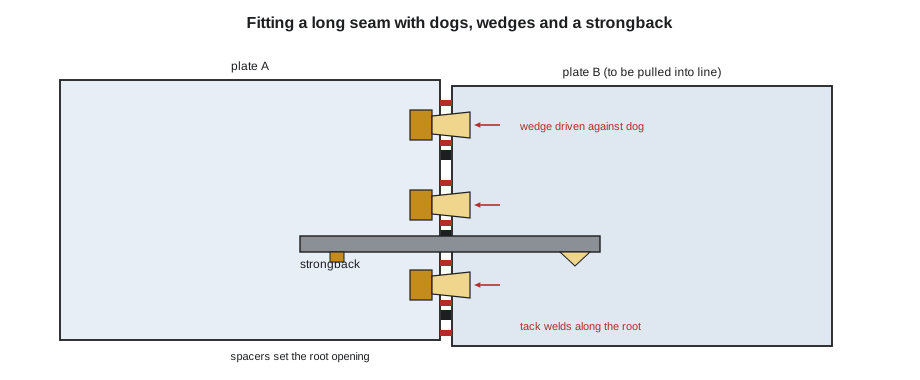
Small parts are held with C-clamps, locking pliers and bar clamps. Plate edges on larger work are moved and held with dogs and wedges. A dog is a short piece of plate or bar, usually with a slot or a hole, tacked to one plate near the joint. A tapered steel wedge driven between the dog and the adjacent plate pushes that plate into alignment. Dogs come in many shapes: a bridge dog straddles the joint and pulls one plate up or down; a U-dog or yoke lets a wedge push in two directions. On large tanks, special clamps called come-along plates and pull-lugs are used with bolts or hydraulic jacks instead of wedges.
Dogs are temporary attachments, and on pressure parts and some steels, temporary attachments have rules of their own. They must be welded with an approved procedure and qualified welder, like any weld on the part. They must be removed without damaging the base metal, usually by cutting or gouging off a little above the surface, never by knocking them off with a hammer, which can tear out a piece of the plate. The area is then ground smooth and examined, often by magnetic particle testing, to check that no crack was left. On V-412, every dog location is recorded so that the inspector can check each removal.
Strongbacks and spiders
A strongback is a stiff bar, often a piece of channel, angle or heavy flat bar, that bridges a seam to hold the plates in line. On a long seam, strongbacks hold the edges against peaking and offset while the root is welded; on a circumferential seam between courses, they hold the courses' edges flush. A strongback is tacked or clamped on one side of the seam and wedged on the other, so that the alignment can be adjusted before it is fixed. It is set back from the joint enough for the welder to work, and removed after the weld is complete, with the same care as a dog.
A spider is a set of adjustable arms radiating from a hub, placed inside a shell course to push it out to round. Rolled courses are often out of round when they come off the rolls, especially after the long seam is welded, and large ones sag under their own weight when laid on their side. The spider's arms, usually screw jacks, push the shell out at several points until its diameters are equal within the tolerance. A spider is left in place while the circumferential seam to the next course is fitted and tacked, and often until it is welded. On field-erected tanks, the same job is done by stiffening rings or temporary bracing.
Spacers and the root opening
The root opening is set with spacers: pieces of wire, rod or flat bar of the right thickness placed in the gap, or purpose-made gap gauges. The joint is closed onto the spacers, tacked, and the spacers are removed before the tack welds are made over the next section, or before the root pass reaches them. A fitter checks the opening with a gauge at every tack and between tacks, because a joint that is right at the tacks may be tight or wide between them. Where a backing strip is called for, it is fitted first and the root opening is set above it.
Long seams on shell courses tend to close up as they are tacked, because each tack shrinks a little as it cools. A fitter compensates by setting the opening slightly wider at the start, by tacking from one end toward the other in a planned order, and by checking the gap ahead of each tack. Circumferential seams tend to close more on one side than the other if they are tacked in order around the shell, which is why they are tacked in opposite pairs.
Tack welds
A tack weld is a short weld that holds the parts in position until the full weld is made. Tacks are part of the weld: on most joints, they are welded over and become part of the root pass, so they must be made with the right procedure, by a qualified welder, with the same preheat as the main weld. A tack that cracks, or is too small or too large, causes a defect in the finished weld. Tacks that will be incorporated into the weld are usually feathered, ground at their ends, so that the root pass ties in smoothly, and any cracked tack is ground out.
Tack size and spacing depend on the plate thickness and the forces trying to move the joint. A common guide is tacks a few times as long as the plate is thick, at a spacing of a few hundred millimetres or about a foot, closer near the ends of a seam and where the plates are under strain. The welding procedure or the shop's fitting standard sets the actual values. Some procedures call for bridge tacks, made on small pieces of plate bridging the joint rather than in the groove, which are removed before welding and leave the root clear.
| Joint | Typical tacking practice | Reason |
|---|---|---|
| Long seam of a shell course | Tacks from one end toward the other, with the gap checked ahead of each | Controls the gap as the seam pulls in |
| Circumferential seam | Tacks in opposite pairs: 0 and 180, then 90 and 270, then between | Keeps the course from being pulled to one side |
| Fillet weld on a clip | One tack at each end, more on long joints | Holds position without restraining the part too much |
| Boiler tube butt weld | Two to four small tacks around the tube, or bridge tacks | Holds alignment and leaves room for the root pass |
| Thick or high-strength plate | Larger tacks with full preheat | Small, cold tacks on thick plate crack |
Planning the tacks on V-412
Joanne has Kiera plan the tacks for the V-412 courses: the long seam of course 2, 2,440 mm long, and the circumferential seam between courses 1 and 2, around a mean diameter of 1,816 mm. The shop's fitting standard for this plate calls for tacks about 40 mm long at roughly 300 mm spacing. On the circumferential seam, the tacks should fall on the quarter lines and be made in opposite pairs.
# Tack plan for a shell course (metric)
from math import pi
MODE = "mm"

def show(x):
    return f"{x:,.0f} mm" if MODE == "mm" else f"{x:.1f} in"

height, Dm = 2_440, 1_816
spacing, tack = 300, 40

n_long = int(height // spacing) + 1                    # tacks along the long seam, one at each end
print(f"long seam {show(height)}: {n_long} tacks, each about {show(tack)} long")

C = pi * Dm
n_circ = max(8, int(round(C / spacing / 4)) * 4)        # a multiple of 4 so tacks fall on quadrants
print(f"circ seam {show(C)}: {n_circ} tacks at about {show(C / n_circ)} spacing")

# tacking order: quadrants first, then the eighths, then fill in opposite pairs
order = []
for f in (0, 1 / 2, 1 / 4, 3 / 4, 1 / 8, 5 / 8, 3 / 8, 7 / 8):
    j = round(f * n_circ) % n_circ
    if j not in order:
        order.append(j)
for j in range(n_circ // 2):
    for k in (j, j + n_circ // 2):
        if k not in order:
            order.append(k)
first = ", ".join(f"{360 * j / n_circ:.0f}" for j in order[:8])
print("first eight tacks at (deg):", first)
print("all", len(order), "positions covered:", sorted(order) == list(range(n_circ)))long seam 2,440 mm: 9 tacks, each about 40 mm long circ seam 5,705 mm: 20 tacks at about 285 mm spacing first eight tacks at (deg): 0, 180, 90, 270, 36, 216, 144, 324 all 20 positions covered: True
The long seam takes nine tacks, one at each end and seven between. The circumferential seam takes twenty, rounded to a multiple of four so that tacks fall on all four quarter lines, and the first eight go at 0, 180, 90 and 270 degrees and then at the points between, in opposite pairs, before the rest are filled in. Kiera marks each tack position on the course with paint before the fit begins, so that the welder making the tacks and the fitter driving the wedges work to the same plan.
Fitting a course to a course
Fitting one shell course to another, the circumferential seam, is the main fit of vessel work. In the V-412 shop, the courses are fitted lying on their sides on turning rolls, which rotate the shell so that the seam can be fitted and welded in the flat position. Course 1, already round and with a spider inside, sits on one set of rolls; course 2, with its own spider, is brought up on another and moved toward it. The quarter lines of the two courses are lined up, the long seams are checked to be at their planned positions, 120 degrees apart, and the gap is closed onto spacers.
Because no two courses are exactly the same circumference, the edges will not match perfectly all the way around. The difference, usually a few millimetres, is spread evenly around the seam rather than left in one place: the fitter works around the seam in quarters, using dogs, wedges and strongbacks to bring the edges flush at each tack, and checks the offset with a gauge at every tack. If the offset cannot be brought within tolerance, the cause is usually that one course is out of round, and the spider is adjusted before the fit continues. Lesson 11 shows the tolerances, and Kiera's first circumferential fit is in the capstone.
Safety matters at every step. Wedges fly when struck badly, so the fitter wears eye and face protection and keeps others out of line with the wedge. Turning rolls can draw hands and clothing in, and the shell must never be rotated while anyone is inside it. A spider's jacks store a great deal of force, and are released slowly. And a shell course resting on rolls can roll off them if it is pushed sideways, so the rolls are set to the course's diameter and chocked.
Worked problem
Tacks on a circumferential seam
A course has a mean circumference of 4,700 mm. The fitting standard calls for tacks at about 300 mm spacing, with a number that is a multiple of four. How many tacks, and what is the spacing?
Show solution
- Circumference over spacing: 4,700 / 300 = 15.7.
- Round to the nearest multiple of four: 16 tacks.
- Actual spacing: 4,700 / 16 = 294 mm.
Answer: Sixteen tacks at about 294 mm, placed first at the quarter lines in opposite pairs.
Common mistakes
MistakeKnocking off dogs with a hammer.
InsteadCut them off above the surface, grind smooth and examine the area.
MistakeMaking tacks without the weld procedure's preheat.
InsteadTacks are part of the weld; use the same procedure and preheat.
MistakeTacking a circumferential seam in order around the shell.
InsteadTack in opposite pairs to keep the course centred.
MistakeLeaving all the mismatch between two courses in one place.
InsteadSpread the difference evenly around the seam.
MistakeRotating a shell on turning rolls with someone inside.
InsteadClear the shell and lock out the rolls before entry.
Summary and key terms
- A good fit gives the welder the right root opening, alignment, clean bevels, rigid holding and access.
- Dogs and wedges move and hold plate edges; on pressure parts they are welded by procedure and removed with care.
- Strongbacks hold seams in line; spiders push shell courses out to round.
- Spacers set the root opening, checked at and between every tack.
- Tacks are part of the weld: same procedure, same preheat, correct size, feathered ends.
- Circumferential seams are tacked in opposite pairs, with mismatch spread evenly around the seam.
- Dog
- A short piece tacked near a joint as a fulcrum for a wedge.
- Strongback
- A stiff bar bridging a seam to hold the plates in line.
- Spider
- An adjustable set of arms used to push a shell course out to round.
- Tack weld
- A short weld that holds parts in position until the full weld is made.
- Bridge tack
- A tack on a small bridging piece instead of in the groove.
- Turning rolls
- Powered rollers that rotate a shell for fitting and welding.
Practice problems
Work each problem on paper first, then reveal the answer to check.
A 3,000 mm long seam is tacked at 300 mm spacing with a tack at each end. How many tacks?
Show answer
3,000 / 300 + 1 = 11 tacks.
Why are tacks feathered?
Show answer
So the root pass ties in smoothly over them.
What does a spider do?
Show answer
Pushes a shell course out to round, from the inside.
Why are dogs not knocked off with a hammer?
Show answer
It can tear the base metal and leave cracks.
Lesson quiz · 5 questions
Score 60% or more to complete this lesson.
Create a free account to save your progress, take quizzes and earn a certificate.