
BLR-130 · Lesson 1 of 12 · 20 min
Layout and fitting in the boilermaker trade
Every vessel, tank, stack and boiler a boilermaker erects starts as flat plate, structural shapes and tube on a shop floor or a laydown yard. Before anything is cut, someone has to transfer the drawing onto the steel: lines for cutting, marks for bending, centres for holes and nozzles, reference lines for fitting, and the identification that lets every piece be traced back to its drawing and its material certificate. That work is layout. After the pieces are cut and formed, someone has to bring them together in the right place, at the right gap, square and true, and hold them there until they are welded. That work is fitting. A good layout hand and a good fitter save a job days of rework; a careless one can scrap a plate worth thousands of dollars or build a vessel that will not pass inspection.
This course is the first of two on layout and fitting. It covers the skills that every boilermaker uses on flat plate, rolled shells, structural shapes, pipe and tube: reading drawings, using the tools, the shop geometry behind most layout, squaring and marking plate, rolling shells, laying out structural members, simple pipe and tube work, fitting techniques, and tolerances. Cones, transitions, intersections, nozzle openings and pattern development come in Layout and Fitting II.
The winter in the shop
After the fall turnaround at Northgate, Kiera Lafontaine spends the winter in Ironbridge Industrial's fabrication shop, in Nisku south of Edmonton on the Canadian side of the company and across the river from Baton Rouge in Port Allen on the American side. The shop builds pressure vessels, tank plates, duct and structural steel for the plants where Ironbridge's field crews work. Rosa Delgado, the general foreman Kiera worked under at Riverbend and Northgate, has moved her to the shop on purpose. "Out in the field you fit what somebody else laid out," Rosa tells her. "In here you learn why the marks are where they are. When you go back out, you will fix things in the field that other people cannot."
The shop's layout lead is Joanne Pellerin, who has laid out plate for twenty-five years and keeps a notebook of every trick she has learned. The shop superintendent is Lorne Ashby, and the quality control manager, who signs off every hold point under the shop's quality program, is Harjit Gill. Dale Whitford, Kiera's mentor from the field, comes in on the days when the shop needs an extra hand on the big fits. The first job on the board for the winter is a new knockout drum for Northgate, tagged V-412: a vertical vessel 1,800 mm inside diameter with a 16 mm shell, three shell courses tall, with two elliptical heads bought from a head maker and a skirt and base ring built in the shop.
Other work runs alongside it. Riverbend Generating Station wants new platform support steel and a set of boiler bank tube replacement pieces for the next outage. The tank terminal needs replacement shell plates for Tank 14, rolled to the tank's large radius. And the pulp mill has sent drawings for a set of small pipe spools. Each of these jobs gives Kiera a different kind of layout to learn.
What layout produces
Layout turns a drawing into marks on steel that tell the next trade what to do. The marks fall into a few kinds, and each has its own convention in the shop.
| Mark | What it tells the next person | How it is usually made |
|---|---|---|
| Cut line | Where to cut, and which side is scrap | Soapstone or paint line, with centre punch marks every so often; the scrap side is crossed |
| Bend or roll line | Where a brake or roll starts and stops forming | Punched line with the bend direction and angle written beside it |
| Centre mark | The centre of a hole, nozzle or bolt pattern | A centre punch mark, often circled |
| Reference line | A line used later for fitting, such as a centre line or a quarter line on a shell | Punched line, labelled, and kept clear of the weld |
| Bevel mark | Which edge is bevelled, which side and at what angle | Written along the edge with an arrow to the bevelled side |
| Identification | Piece mark, job number and the heat number of the plate | Paint marker or low-stress stamp, transferred to every piece cut from the plate |
The convention that matters most is consistency. If one shop marks the scrap side with crosses and another shades it, a fitter moving between them can cut on the wrong side of the line. Ironbridge's shop rules are written on a sheet beside Joanne's layout table, and every new hand reads them on the first day.
Material traceability
On pressure work, every plate, head, nozzle and fitting must be traceable to its material test report, the mill's certificate of the chemistry and mechanical properties for that heat of steel. The heat number is stamped or stencilled on the plate at the mill. When a layout hand cuts a plate into pieces, the heat number must be transferred to every piece before the plate is cut, and the transfer is checked by the quality control person. If a piece loses its identity, it cannot be used on a pressure part until its identity is re-established, which may mean testing it. On the V-412 drum, Harjit witnesses the heat number transfer on each shell plate before it goes to the burning table.
Structural steel and tank plate have their own rules, usually lighter, but the habit is the same: mark first, cut second. Kiera's first job on the shop floor is to record the heat numbers of the plates for V-412 against the material list and check them against the test reports.
The flow of work in a fabrication shop
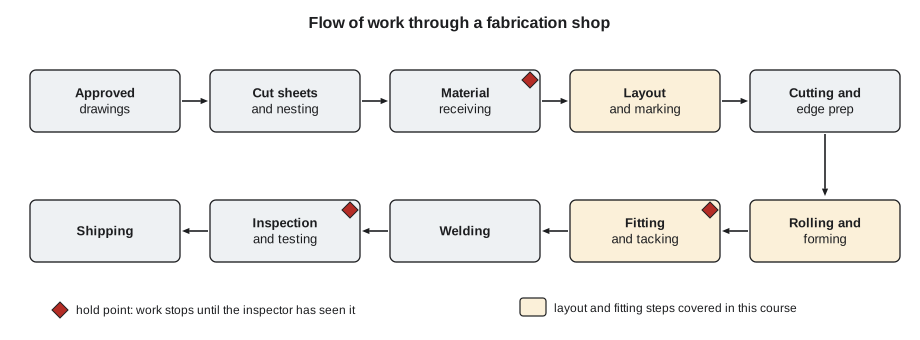
A vessel moves through the shop in a fairly fixed order. Drawings arrive from the engineering office, approved for construction. The shop's detailer or layout lead prepares cut sheets and nesting layouts that fit the pieces onto the available plate. Plate is received, checked against its test reports and stored. Layout marks the plate; it is cut on the burning table, by plasma or oxyfuel, or sheared; edges are bevelled; plates are rolled or formed; pieces are fitted and tacked; welds are made; the work is inspected; and the finished vessel is tested, painted and shipped. At several points the quality program sets hold points, steps the work cannot pass until an inspector has seen it. Fit-up of a pressure seam is almost always a hold point.
The shop takeoff
Before layout begins, Joanne has Kiera check the weights of the plates for the V-412 shell, skirt and base ring, both to confirm the material order and to plan which pieces the shop's 10 t bridge crane can move. A plate's weight is its volume multiplied by the density of steel, about 7,850 kg per cubic metre.
# Shop takeoff for the V-412 knockout drum shell (metric)
MODE = "mm"                      # "mm" or "in"
RHO = 7.85e-6                          # steel density: kg per mm3 x 1e6, or lb per cubic inch
CRANE = 10_000                      # shop bridge crane rating (kg)
parts = [  # mark, quantity, length, width, thickness
    ("S1", 3, 6000, 2440, 16),   # shell plates as bought
    ("BR1", 1, 2400, 2400, 25),  # base ring blank
    ("SK1", 1, 5760, 1800, 12),  # skirt plate
    ("RP1", 2, 900, 900, 16),    # nozzle reinforcing pads
]
total = 0
print(f"{'mark':<6}{'qty':>4}{'size':>26}{'each':>11}{'total':>11}")
for mark, qty, l, w, t in parts:
    each = l * w * t * RHO           # plate weight = volume x density
    total += qty * each
    size = f"{l:g} x {w:g} x {t:g}"
    print(f"{mark:<6}{qty:>4}{size:>26}{each:>11,.0f}{qty * each:>11,.0f}")
print(f"total plate weight: {total:,.0f} kg")
heavy = max(parts, key=lambda p: p[2] * p[3] * p[4])
hw = heavy[2] * heavy[3] * heavy[4] * RHO
print(f"heaviest single plate: {heavy[0]} at {hw:,.0f} kg = {100 * hw / CRANE:.0f} % of the shop crane")mark qty size each total S1 3 6000 x 2440 x 16 1,839 5,516 BR1 1 2400 x 2400 x 25 1,130 1,130 SK1 1 5760 x 1800 x 12 977 977 RP1 2 900 x 900 x 16 102 203 total plate weight: 7,827 kg heaviest single plate: S1 at 1,839 kg = 18 % of the shop crane
The three shell plates, as bought, weigh 1,839 kg each, which is well inside the shop crane's rating, and the whole set comes to about 7.8 t. The base ring blank is heavier per square metre because it is thicker; the finished ring, cut out of the blank, weighs far less, and the offcut from its centre goes back into the shop's plate stock for small parts.
Who does what in layout and fitting
In a large shop, layout may be a separate job done by a few specialists; in a small one, the fitter lays out his own work. On a field job, the boilermakers lay out and fit almost everything, from tank shell plates to replacement boiler tubes. The boilermaker trade standard expects a journeyperson to read fabrication drawings, lay out plate, shapes and pipe, fit components to tolerance and check them, and to know when a dimension on a drawing does not make sense. That last skill comes from experience, and the best way to get it is to understand where every number on a drawing comes from.
Layout and fitting also connect with other trades. Welders need joints that are fitted well, with the right root opening and alignment, or they cannot make a sound weld. Inspectors need reference marks to check dimensions. Riggers need the centre of gravity marked on large assemblies. And the engineers who designed the vessel need the shop to tell them when the drawing cannot be built as drawn, before the steel is cut.
Working safely at the layout table
Layout is quieter than most shop work, but it has its own hazards. Plate is moved with magnets, vacuum lifters and plate clamps; a plate clamp that is not locked, or a magnet on a plate with mill scale, can drop a plate. Layout hands work on their knees on large plates and need knee pads and good footwear. Soapstone and paint markers are harmless, but the burning table next to the layout area is not, and layout marks are made on plates that may still be hot from cutting. Sharp plate edges and slivers cause most of the hand injuries in a fab shop, and cut-resistant gloves are standard. And a layout hand who steps back to look at a large plate may step off its edge, so the floor around the plate is kept clear.
Worked problem
Checking a plate weight
A plate measures 3,000 × 1,500 × 20 mm. What does it weigh?
Show solution
- Volume: 3.0 × 1.5 × 0.020 = 0.090 m³.
- Weight: 0.090 × 7,850 = 707 kg.
Answer: About 707 kg, light enough for one plate clamp but heavy enough to need the crane.
Layout in the field
Field layout uses the same skills under harder conditions. On a tank repair, the layout hand marks replacement plates on the ground beside the tank, or marks the cut lines for removing old plates directly on the shell, working from a man-lift or a scaffold with the wind moving the chalk line. On a boiler outage, tube cut lines are marked inside a dark, cramped furnace by headlamp. There is rarely a layout table, and the references are often the existing equipment rather than a clean base line. The habits from the shop carry over: establish a reference, measure from it, check by a second method, and mark clearly enough that the next person cannot misread it. Rosa's reason for sending Kiera to the shop for a winter is that those habits are easier to learn on a flat plate under good light than on a curved shell forty metres up.
Field work also brings layout hands into contact with the owner's inspectors and engineers more directly. A field change, such as moving a replacement seam because the old steel is thinner than expected, must be approved before it is laid out, and the layout hand is often the first person to see that a change is needed.
Common mistakes
MistakeCutting a plate before the heat number is transferred to the pieces.
InsteadTransfer and check identification first; it cannot be recovered afterwards.
MistakeMarking the scrap side differently from the shop's convention.
InsteadFollow the shop's written marking rules every time.
MistakeTreating a drawing dimension that looks wrong as someone else's problem.
InsteadStop and ask before cutting; question the drawing, not the steel.
MistakeLeaving reference lines where the weld will cover them.
InsteadKeep reference lines a set distance back from the weld and label the offset.
MistakeLifting plate with a clamp that is not locked.
InsteadLock the clamp and check the lifter's rating and the plate's surface before lifting.
Summary and key terms
- Layout transfers a drawing onto steel as cut lines, bend lines, centres, reference lines, bevel marks and identification.
- Fitting brings the pieces together at the right gap and alignment and holds them until welding.
- On pressure work, every piece must stay traceable to its material test report through its heat number.
- Fit-up of a pressure seam is usually a hold point for inspection.
- Plate weight is volume times density, about 7,850 kg per cubic metre for steel.
- Good layout and fitting make good welds possible and save expensive rework.
- Layout
- Marking a drawing onto steel so that it can be cut, formed and fitted.
- Fitting
- Positioning pieces at the right gap and alignment and holding them for welding.
- Heat number
- The mill identification of a batch of steel, linking a plate to its test report.
- Material test report
- The mill's certificate of a heat's chemistry and mechanical properties.
- Hold point
- A step in fabrication that cannot be passed until an inspector has seen it.
- Nesting
- Arranging pieces on a plate to use as much of it as possible.
Practice problems
Work each problem on paper first, then reveal the answer to check.
A plate is 2,000 × 1,000 × 12 mm. What does it weigh?
Show answer
0.024 m³ × 7,850 = about 188 kg.
Why is the heat number transferred before the plate is cut?
Show answer
So every piece remains traceable to its material test report.
Name three kinds of layout mark.
Show answer
Cut lines, centre marks and reference lines (also bend lines, bevel marks, identification).
What is usually a hold point on pressure work?
Show answer
Fit-up of a pressure seam, along with material receiving and final testing.
Lesson quiz · 5 questions
Score 60% or more to complete this lesson.
Create a free account to save your progress, take quizzes and earn a certificate.