
AWS-113 · Lesson 5 of 12 · 18 min
Retrieval-augmented generation
▶ Video coming soon A video version of this lesson is on the way.
Jonah asked the model in the sandbox a simple question: "What is Cascade Ridge's late cancellation fee for surgery appointments?" The answer came back immediately and confidently. It named a fee, a notice period and an exception for emergencies. Every detail sounded plausible. None of it matched Cascade Ridge's actual policy, which the model had never seen.
"That is the most important demonstration in this course," Noor said. "The model is not lying. It is doing what it was trained to do: produce likely-sounding text. It knows what cancellation policies usually say. It does not know what ours says. If we want answers from our documents, we have to give it our documents."
Retrieval-augmented generation, usually shortened to RAG, does exactly that. Before the model answers, the application searches a collection of trusted documents for the passages most relevant to the question and adds them to the prompt. The model then answers from those passages. This lesson explains how RAG works, what it is good for, and its limits. Lesson 6 covers the storage and the managed service, Amazon Bedrock Knowledge Bases, that Cascade Ridge used to build it.
Why foundation models need retrieval
A foundation model's knowledge has three gaps that matter to a business.
- It is frozen in time. The model learned from data up to a cutoff date. A policy updated last month is unknown to it.
- It has never seen private information. Cascade Ridge's SOPs, price lists and procedures were never in any public training data.
- It cannot show its sources. Even when a model states something true, it cannot say where it learned it, so staff cannot check.
Retrieval fills all three gaps. The documents can be updated at any time without retraining anything; they can be private; and the application knows which passages it supplied, so it can cite them. RAG also reduces hallucination, because the model has real text to draw on, though it does not remove it entirely.
How RAG works
A RAG system has two pipelines. The first runs ahead of time, whenever documents change. The second runs every time someone asks a question.
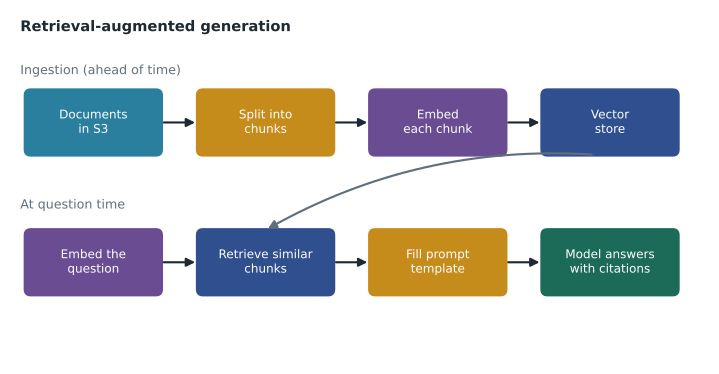
Ingestion prepares the documents:
- Load the source documents, such as the 140 SOP and policy files stored in an Amazon S3 bucket.
- Chunk them: split each document into passages of a manageable size, such as a few hundred tokens, often with a little overlap so a sentence split across two chunks is not lost.
- Embed each chunk: an embeddings model turns the text into a vector, a list of numbers that captures its meaning. AWS-112 introduced embeddings; lesson 6 shows how they are compared.
- Store the vectors, with the chunk text and metadata such as the document name, section and date, in a vector store.
Retrieval and generation answer a question:
- Embed the question with the same embeddings model.
- Search the vector store for the chunks whose vectors are closest to the question's vector. These are the passages most similar in meaning, even if they use different words.
- Augment the prompt: a template places the retrieved chunks and the question together, with instructions such as "Answer only from these passages."
- Generate: the foundation model writes the answer, and the application attaches citations to the passages used.
The word *augmented* is the key: the model's prompt is augmented with retrieved text. Nothing about the model itself changes.
Chunking in practice
Chunking sounds like a technical detail, but it has a large effect on answer quality. Chunks that are too large include irrelevant text and use up the context window; chunks that are too small lose the surrounding meaning, such as which policy a sentence belongs to. Jonah experimented with a short policy document to see how chunk size and overlap change the pieces.
policy = ("Late cancellation. Clients who cancel a routine appointment with less than 24 hours notice "
          "may be charged a fee. Surgery appointments need 48 hours notice. The fee is waived for "
          "emergencies and for a first late cancellation in any twelve months. Staff record the reason "
          "in the client file.")
words = policy.split()

def chunk(words, size, overlap):
    step = size - overlap
    return [" ".join(words[i:i + size]) for i in range(0, max(len(words) - overlap, 1), step)]

for size, overlap in [(20, 0), (20, 5)]:
    parts = chunk(words, size, overlap)
    print(f"size {size}, overlap {overlap}: {len(parts)} chunks")
    for p in parts:
print(" -", p)size 20, overlap 0: 3 chunks - Late cancellation. Clients who cancel a routine appointment with less than 24 hours notice may be charged a fee. Surgery - appointments need 48 hours notice. The fee is waived for emergencies and for a first late cancellation in any twelve - months. Staff record the reason in the client file. size 20, overlap 5: 3 chunks - Late cancellation. Clients who cancel a routine appointment with less than 24 hours notice may be charged a fee. Surgery - be charged a fee. Surgery appointments need 48 hours notice. The fee is waived for emergencies and for a first - emergencies and for a first late cancellation in any twelve months. Staff record the reason in the client file.
What this code does
It splits a short cancellation policy into chunks of 20 words, first with no overlap and then with each chunk starting 5 words before the previous one ended. It prints the chunks for both settings. Without overlap a sentence can be cut in half across two chunks; with overlap each chunk keeps more of the surrounding sentence, which helps retrieval find complete answers.
With no overlap, the second chunk begins in the middle of the surgery sentence, so a search for "surgery notice" might retrieve a chunk that no longer says what the notice period applies to. A small overlap keeps the sentence together in at least one chunk. Real systems also chunk by structure, splitting at headings or paragraphs, so each chunk is a meaningful unit. Amazon Bedrock Knowledge Bases offers several chunking strategies, including fixed-size chunks, hierarchical chunking that keeps small chunks linked to their larger parent sections, and semantic chunking that splits where the topic changes. For Cascade Ridge's SOPs, which were already written with clear headings, chunking at section boundaries worked best.
Business applications of RAG
RAG is the most common way businesses put foundation models to work on their own knowledge. Typical uses include:
- Internal question answering over policies, procedures and manuals, like Front Desk Helper.
- Customer support that answers from product documentation and help articles, with links to the source.
- Research assistants that find and summarize relevant passages from large collections of reports or contracts.
- Grounded drafting, such as writing a client letter that quotes the correct clinic hours and policy wording.
In each case the value comes from three properties: answers reflect current, private information; they can be checked against cited sources; and the content can be updated by updating documents, not models.
| Approach | How the model gets the knowledge | Update a policy | Shows sources |
|---|---|---|---|
| Prompt only | From training data | Not possible | No |
| Paste whole documents into the prompt | From the prompt, every time | Edit the pasted text | Possible, but long and costly |
| RAG | From retrieved passages | Re-ingest the changed document | Yes |
| Fine-tuning | From changes to the model's weights | Train again | No |
The limits of RAG
RAG is powerful, but it has failure points, and a practitioner should know where they are.
- Retrieval misses. If the right passage is not retrieved, the model cannot use it. A question phrased very differently from the document, or a poorly chunked document, can cause misses.
- Bad sources give bad answers. If an SOP is out of date or two documents contradict each other, RAG will faithfully reflect the problem. Cascade Ridge found three pairs of conflicting SOPs during ingestion and had the operations team resolve them.
- The model can still go beyond the passages. Instructions such as "answer only from the passages" and a contextual grounding check in Amazon Bedrock Guardrails help, but evaluation is still needed.
- Permissions must be respected. If some documents are for managers only, the retrieval step must not hand them to everyone. Knowledge bases support metadata filters, so a query can be limited to documents a user is allowed to see.
"RAG moves the hard part," Noor told Jonah. "Instead of hoping the model knows the answer, we have to make sure the right passage is found and the model sticks to it. Both of those are things we can measure."
Common mistakes
MistakeExpecting a model to know company policies without being given them.
InsteadUse RAG to supply current, private documents at question time.
MistakeThinking RAG changes or retrains the model.
InsteadRAG adds retrieved text to the prompt; the model is unchanged.
MistakeIgnoring the quality of the source documents.
InsteadReview and clean the documents; conflicting or outdated sources produce conflicting answers.
MistakeRetrieving restricted documents for every user.
InsteadUse metadata filters so retrieval respects who may see each document.
RAG compared with a long context window
Some foundation models accept very long prompts, enough to hold dozens of documents at once. Jonah asked whether that made retrieval unnecessary: why not paste every SOP into each request? Noor ran the numbers with him. The 140 documents came to roughly 210,000 tokens. Sending them with each of 400 daily questions would multiply input tokens, and therefore cost, by about a hundred compared with sending four retrieved passages, and every answer would take longer to start. Answers could also suffer, because models are better at using a few relevant passages than at finding one sentence in a very long prompt.
Long context windows are still useful: for summarizing a single long report, comparing two contracts, or answering questions about one document a user has just uploaded. The design question is the same as everywhere else in this course. Which approach gives good enough answers at acceptable cost and speed? For a large, changing document collection queried many times a day, retrieval almost always wins.
Grounding instructions
Retrieval only helps if the model uses what it is given. Three instructions in the prompt make a large difference: answer only from the provided passages; say clearly when the passages do not contain the answer; and cite the passage used. Front Desk Helper's template also told the model what to do when two passages disagreed: report both and suggest checking with the clinic manager. During testing this caught two of the three conflicting SOP pairs before the operations team had resolved them.
RAG also changed how the operations team thought about its documents. Because staff would now see the exact passage behind every answer, vague or outdated wording became visible in a way it never had been. Andre's team rewrote eleven SOPs during the prototype, mostly by adding clear headings, removing duplicated sections and putting the effective date at the top of each document. Better documents made better answers, and they also helped the staff who read the SOPs directly.
Worked problem
Tracing a RAG answer
A receptionist asks Front Desk Helper: "Do we charge a fee if a client cancels a spay surgery the day before?" Walk through what happens.
Show solution
- The question is turned into an embedding with the same embeddings model used at ingestion.
- The vector store returns the closest chunks, including the late cancellation section stating that surgery appointments need 48 hours notice and that the fee is waived for emergencies and a first late cancellation in twelve months.
- The template places those passages and the question in the prompt with the instruction to answer only from them and cite the source.
- The model answers that a fee may apply because less than 48 hours notice was given, unless it is the client's first late cancellation in twelve months or an emergency, and cites the policy name and section.
Answer: Retrieve the relevant policy passages, augment the prompt, generate a grounded answer and cite the source so staff can check it.
Summary and key terms
- Foundation models do not know recent, private or company-specific information and cannot cite where they learned things.
- Retrieval-augmented generation (RAG) solves this by retrieving relevant passages from trusted documents and adding them to the prompt.
- Ingestion loads documents, splits them into chunks, turns each chunk into an embedding and stores the vectors in a vector store.
- At question time the question is embedded, similar chunks are retrieved, a template augments the prompt, and the model generates an answer with citations.
- Chunk size, overlap and strategy strongly affect quality.
- RAG suits internal question answering, support, research and grounded drafting.
- Its limits include retrieval misses, poor or conflicting sources, answers that go beyond the passages, and the need to respect document permissions.
- Retrieval-augmented generation (RAG)
- Adding retrieved passages from trusted documents to a prompt so the model answers from them.
- Ingestion
- Preparing documents for retrieval: loading, chunking, embedding and storing them.
- Chunk
- A passage of a document stored and retrieved as one unit.
- Chunk overlap
- Shared text between neighbouring chunks so meaning is not lost at the boundaries.
- Embedding
- A vector of numbers that represents the meaning of text.
- Vector store
- A database that stores embeddings and finds the most similar ones to a query.
- Citation
- A reference to the source passage an answer came from.
Practice problems
Work each problem on paper first, then reveal the answer to check.
What does the "augmented" in RAG refer to?
Show answer
The prompt is augmented with retrieved passages.
How do you update a fact in a RAG system?
Show answer
Update the source document and re-ingest it; no retraining is needed.
Name two ways RAG can still go wrong.
Show answer
Any two of: the right passage is not retrieved, the source is wrong or conflicting, the model goes beyond the passages, restricted documents are retrieved.
Lesson quiz · 5 questions
Score 60% or more to complete this lesson.
Create a free account to save your progress, take quizzes and earn a certificate.