
AWS-111 · Lesson 1 of 12 · 19 min
AI, machine learning and deep learning
▶ Video coming soon A video version of this lesson is on the way.
On the first Tuesday of October 2026, Noor Siddiqui set up a laptop in the small boardroom above the Calgary emergency hospital and wrote one question on the whiteboard: "What would we actually let a computer decide?" Cascade Ridge Veterinary Partners had hired her for nine months to assess where artificial intelligence could help its 11 clinics and its 24-hour hospital. The board had read about AI in every newspaper. Dr. Simone Kaur, the medical director, had read about it too, and she arrived with a firm opinion: "Nothing that touches a diagnosis without a vet in the loop."
Jonah Petrakis, the client services and scheduling analyst, was the other person at the table. He builds the booking reports that tell clinic managers how many appointments were kept, cancelled or missed, and he plans to sit the AWS Certified AI Practitioner exam (AIF-C01) in April 2027. Noor agreed to teach a weekly "AI hour" that would serve both purposes: Jonah would learn the vocabulary the exam expects, and the company would get a clear-eyed list of AI uses worth trying. This course follows those sessions. It covers the first domain of the exam guide, the fundamentals of AI and machine learning, and the AWS services that apply them.
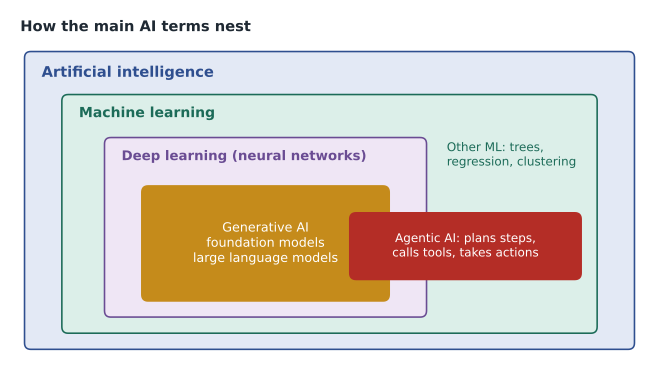
What artificial intelligence means
Artificial intelligence (AI) is the broad field of building computer systems that perform tasks we associate with human intelligence: recognizing speech, understanding text, spotting patterns in images, making predictions, planning steps toward a goal. The term is old and wide. A chess program written with hand-coded rules in the 1980s counts as AI, and so does a modern system that writes a summary of a phone call.
What matters for practitioners is not the label but how a system gets its behaviour. There are two broad ways. In a rules-based system, people write the logic explicitly: if a vaccine was given on this date, the next dose is due 12 months later. In a learned system, people supply examples and an algorithm finds the pattern itself. Both are useful, and lesson 11 returns to the important question of which to choose.
Machine learning
Machine learning (ML) is the part of AI in which a system learns patterns from data instead of following rules a person wrote. Three words carry most of the meaning, and the exam uses them precisely.
- An algorithm is the learning procedure: the recipe that looks at data and adjusts numbers to reduce mistakes. Linear regression, decision trees and neural networks are families of algorithms.
- A model is the result of running an algorithm on data. It is the trained artifact, a file of learned parameters, that takes new input and produces an output such as a prediction or a category.
- Training is the process of fitting the model to historical data. Inference is using the trained model on new data to get an answer.
Noor put it in clinic terms. "Three years of appointment history is the data. The algorithm is the method we use to look for patterns in who misses appointments. The model is what comes out: a calculator that, given tomorrow's bookings, estimates which ones are likely to be missed. Training happens occasionally, on a schedule we choose. Inference happens every evening when the reminder list is built."
A model's output is almost always a prediction, not a fact. It is an estimate based on patterns in past data, and it carries uncertainty. A model that says an appointment has a 0.3 chance of being missed is not saying the client will not come; it is saying that among appointments that looked like this one in the past, about 3 in 10 were missed. Keeping that distinction in mind prevents a whole class of mistakes.
Deep learning and neural networks
A neural network is a family of ML models loosely inspired by the brain. It is built from layers of simple units, often called neurons, each of which multiplies its inputs by learned weights, adds them up and passes the result through a simple function. Stacking many layers lets the network represent complicated relationships. Deep learning is machine learning with neural networks that have many layers.
Deep learning is what made modern computer vision, speech recognition and language models possible. It shines on unstructured data such as images, audio and free text, where the useful features are hard for people to describe in rules. Its costs are real: deep models usually need large amounts of data and computing power to train, and they are harder to explain than a simple model. For a table of appointment records, a simpler model is often just as accurate and much easier to justify.
Areas of AI you will meet
Several application areas appear repeatedly in the exam and in practice.
- Computer vision lets systems interpret images and video: detecting objects, reading text in a photo, judging whether a radiograph is in focus.
- Natural language processing (NLP) works with human language in text: classifying a review as positive or negative, extracting names and dates, translating a letter.
- Speech recognition converts spoken audio to text, and speech synthesis turns text into natural-sounding speech.
- Recommendation systems suggest items a person is likely to want, and forecasting predicts future values such as next month's appointment volume.
- Fraud and anomaly detection flags transactions or events that do not fit normal patterns.
Generative AI, foundation models and LLMs
Generative AI is a branch of deep learning in which models produce new content, such as text, images, audio or code, instead of only labelling or scoring existing data. Most generative systems today are built on foundation models (FMs): very large models trained on broad data that can be adapted to many tasks. A large language model (LLM) is a foundation model specialized in text: it predicts the next piece of text given what came before, and that simple objective, at enormous scale, yields the ability to summarize, answer questions and draft documents. AWS-112 covers how these models work; for now, the important point is where they sit. Generative AI is a kind of deep learning, which is a kind of machine learning, which is one way of building AI.
Agentic AI
The newest term in the exam guide is agentic AI. An AI agent is a system that does not just answer one request but pursues a goal over several steps: it plans, calls tools such as a booking system or a search service, observes the result and decides what to do next. A chatbot that answers "what are your hours?" is generative AI. A system that reads a client's message, checks the schedule, proposes three appointment slots and books the one the client picks is agentic. Agents raise the stakes because they take actions, not just produce text, so permissions and human review matter even more. AWS-113 covers agents and tool use in depth.
| Term | What it is | Cascade Ridge example |
|---|---|---|
| AI | Any system performing tasks associated with human intelligence | The whole AI assessment Noor is running |
| Machine learning | Systems that learn patterns from data | Predicting which appointments are likely to be missed |
| Deep learning | ML with many-layered neural networks | Checking radiograph image quality |
| Generative AI | Models that create new content | Drafting a summary of an after-hours call |
| Agentic AI | Systems that plan and take multi-step actions with tools | An assistant that finds and books an appointment slot |
Bias, fairness and fit: three words to watch
Three more terms from the exam guide appear in every later lesson, so Noor introduced them early. Bias has two meanings. In statistics, it is a model's systematic error, the tendency to be consistently wrong in one direction, which lesson 6 covers. In everyday use, and in responsible AI, it means outcomes that are systematically unfair to some group. Fairness is the goal of making a model's benefits and errors fall evenly across groups that should be treated alike. Fit describes how well a model's learned patterns match the data: a model can underfit, missing real patterns, or overfit, memorizing noise. All three are about the same underlying question: does the model's behaviour reflect reality, and reality for everyone it affects?
# Rules versus learning, in miniature.
# A rule: someone writes the logic.
def next_rabies_due(months_since_last):
    return "due" if months_since_last >= 12 else "not due"

# Learning: the "rule" (a threshold) is found from examples.
history = [(1, 0), (2, 0), (3, 0), (8, 1), (9, 1), (12, 1)]  # (days booked in advance, missed? 1=yes)

best_t, best_err = None, None
for t in range(1, 13):
    errors = sum((days >= t) != bool(missed) for days, missed in history)
    if best_err is None or errors < best_err:
        best_t, best_err = t, errors

print("rule says:", next_rabies_due(13))
print("learned threshold: booked", best_t, "or more days ahead -> higher miss risk; errors =", best_err)rule says: due learned threshold: booked 4 or more days ahead -> higher miss risk; errors = 0
What this code does
It contrasts a rule written by a person with a rule learned from data. The written rule says a rabies vaccine is due after 12 months. The learned part tries every cut-off from 1 to 12 days on six past bookings, counts how many bookings each cut-off would misjudge, and keeps the one with the fewest errors, finding that bookings made 4 or more days ahead are more likely to be missed.
The rule needed no data at all, and it is exactly right because vaccine schedules are set by protocol. The learned threshold came from examples, and it would change if the examples changed. That is the essential trade: learning can find patterns nobody wrote down, but it depends entirely on the data it was given.
Common mistakes
MistakeUsing AI, machine learning and generative AI as interchangeable words.
InsteadGenerative AI is a kind of deep learning, which is a kind of machine learning, which is one approach to AI.
MistakeTreating a model's output as a fact.
InsteadA model's output is a prediction based on past patterns and carries uncertainty.
MistakeAssuming deep learning is always the best choice.
InsteadDeep learning excels on images, audio and text; simpler models are often as accurate and easier to explain for tabular data.
MistakeThinking an AI agent only produces text.
InsteadAgents take actions through tools, so their permissions and oversight need extra care.
A very short history
The ideas are older than most people assume. Researchers coined the term artificial intelligence in the 1950s, and the first neural network designs date from the same decade. For decades progress came in bursts followed by long "AI winters", when early promises outran what computers could do. Three things changed in the 2010s: far more digital data, much cheaper computing power (especially graphics processors, which happen to be good at the arithmetic neural networks need), and better training methods. Deep learning models began to beat older approaches at recognizing images and speech. The transformer architecture, published in 2017, made it practical to train very large language models, and the generative AI tools that reached the public from late 2022 are built on it. Knowing this history helps Jonah read news coverage calmly: the tools are new, but most of the underlying ideas, and many of the old warnings about overpromising, are not.
Where AWS fits
AWS offers AI at three levels, and the rest of this course keeps returning to them. At the top are managed AI services that solve a specific task through a simple API, such as turning speech into text or translating a document; no ML expertise is needed. In the middle are generative AI services such as Amazon Bedrock, which give access to foundation models from several providers through one API. At the base is Amazon SageMaker AI, a platform for building, training and deploying your own models, for teams with data scientists. Noor's advice was to start each idea at the highest level that does the job and move down only when a real need forces it: "Every step down gives you more control and more work."
Worked problem
Classifying three ideas
At the first AI hour, three ideas came up: (a) automatically estimate tomorrow's likely no-shows from booking history; (b) write a draft summary of each after-hours phone call for the morning vet; (c) let software read a client's request, check the schedule and book an appointment. Which kind of AI is each?
Show solution
- Idea (a) learns a pattern from labelled historical records and produces a score for each booking: that is traditional machine learning, specifically supervised learning (lesson 2).
- Idea (b) creates new text from a transcript: that is generative AI using a large language model.
- Idea (c) plans steps and uses tools (the schedule and the booking system) to complete a goal: that is agentic AI.
Answer: (a) machine learning; (b) generative AI; (c) agentic AI. All three are AI; they differ in what the system produces and whether it acts.
Summary and key terms
- Artificial intelligence is the broad field of systems that perform tasks associated with human intelligence.
- Machine learning is the part of AI in which systems learn patterns from data; an algorithm is the learning procedure, a model is the trained result, training fits the model and inference uses it.
- Deep learning is ML with many-layered neural networks and is strongest on images, audio and text.
- Generative AI creates new content and is usually built on foundation models; large language models are foundation models for text.
- Agentic AI pursues goals over several steps using tools.
- Bias, fairness and fit describe whether a model's behaviour reflects reality for everyone it affects.
- Artificial intelligence (AI)
- The field of building systems that perform tasks associated with human intelligence.
- Machine learning (ML)
- AI in which systems learn patterns from data instead of following hand-written rules.
- Algorithm
- The learning procedure that adjusts a model to reduce errors on data.
- Model
- The trained artifact that turns new input into an output.
- Inference
- Using a trained model on new data to produce a prediction or other output.
- Deep learning
- Machine learning using neural networks with many layers.
- Foundation model (FM)
- A very large model trained on broad data and adaptable to many tasks.
- Agentic AI
- AI systems that plan and carry out multi-step tasks using tools.
Practice problems
Work each problem on paper first, then reveal the answer to check.
What is the difference between training and inference?
Show answer
Training fits a model to historical data; inference uses the trained model on new data.
Is generative AI a kind of machine learning?
Show answer
Yes. It is a kind of deep learning, which is a kind of machine learning.
What makes a system agentic?
Show answer
It pursues a goal over several steps, using tools and acting on the results.
Lesson quiz · 5 questions
Score 60% or more to complete this lesson.
Create a free account to save your progress, take quizzes and earn a certificate.