
AUTO-310 · Lesson 9 of 12 · 21 min
Driveshafts, CV axles and U-joints
Erik Lindqvist brings the family minivan in with a sound his children have named "the popcorn". It is a rapid clicking from the front left of the van, but only when he turns sharply, pulling out of a parking spot or making a tight right turn out of his driveway onto a hill. Kiran has learned enough in two weeks to make a guess, and Marty lets her make it out loud. "Outer CV joint on the left side," she says. "Clicking on tight turns under power is the classic sign." "Then prove it," says Marty, "and tell me why it fails before you tell me what to replace."
This lesson covers the shafts and joints that carry power from the transmission to the wheels: driveshafts with universal joints on rear-wheel-drive and four-wheel-drive vehicles, and half-shafts with constant-velocity joints on front-wheel-drive and independent-rear-suspension vehicles. It explains why universal joints cause speed fluctuations and how driveline angles cancel them, why constant-velocity joints do not, and how to diagnose and repair the vibrations, clunks and clicks they produce.
Driveshafts
On a rear-wheel-drive vehicle, the driveshaft connects the transmission or transfer case output to the rear axle's pinion. It is a thin-walled steel or aluminum tube, or on some vehicles a carbon fibre tube, with a universal joint at each end. Because the rear axle moves up and down with the suspension, the distance between the transmission and the axle changes slightly, so one end has a slip joint: a splined yoke that slides in and out of the transmission's tail shaft or a splined section in the shaft itself. Long vehicles such as Hal's high-roof vans use a two-piece driveshaft with a centre support bearing, a rubber-mounted bearing bolted to the body that holds the middle of the shaft. The reason is a property called critical speed.
Every shaft has a speed at which it begins to whip, bending into a bow as it turns, because its rotation matches its natural bending frequency. Run near that speed, it vibrates violently and can fail. Critical speed falls with the square of the shaft's length and rises with its diameter, so a long one-piece shaft in a van might reach its critical speed at highway speeds. Splitting it into two shorter pieces raises the critical speed far above anything the vehicle can reach.
# Driveshaft speed at highway speed against critical speed (steel tube, illustrative formula)
import math
def critical_rpm(length_in, od_in, id_in):
    return 4.705e6 * math.sqrt(od_in ** 2 + id_in ** 2) / length_in ** 2
tire_d_mm = 2 * 235 * 0.65 + 16 * 25.4
axle = 3.73
kmh = 120
wheel_rpm = kmh * 1000 / 60 / (math.pi * tire_d_mm / 1000)
shaft_rpm = wheel_rpm * axle
print(f"at {120} km/h the van's driveshaft turns {shaft_rpm:.0f} rpm")
od, wall = 3.5, 0.083
for name, length in (("one-piece shaft", 80), ("each half of a two-piece shaft", 40)):
    nc = critical_rpm(length, od, od - 2 * wall)
print(f"{name:<31} critical speed {nc:6.0f} rpm, margin {nc / shaft_rpm:4.1f} x")at 120 km/h the van's driveshaft turns 3336 rpm one-piece shaft critical speed 3554 rpm, margin 1.1 x each half of a two-piece shaft critical speed 14214 rpm, margin 4.3 x
Driveshafts are balanced at the factory with small weights welded to the tube, and an index mark or a specific spline position often matters when a shaft is removed and refitted, because the shaft was balanced together with its yoke. A shaft that has lost a balance weight, picked up mud or undercoating, been dented, or been refitted in the wrong position can vibrate at a frequency that matches the shaft's speed, the driveshaft's first order, which is one of the patterns Lesson 12 uses to find a vibration.
Universal joints and their speed fluctuation
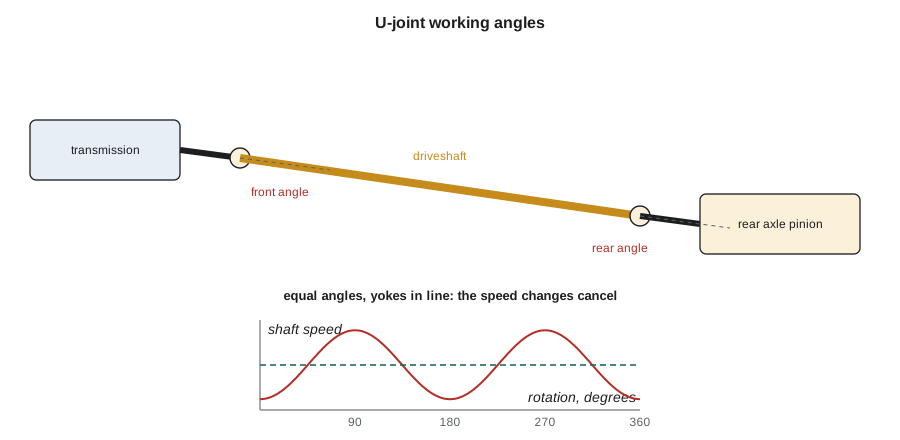
A universal joint, also called a Cardan joint, connects two shafts at an angle. Each yoke carries two opposite arms of a cross-shaped part, the cross or spider, which turns in needle bearings in the yoke ears. It is strong and simple, but it is not a constant-velocity joint. When a U-joint runs at an angle, the output yoke speeds up and slows down twice per revolution even if the input turns at a perfectly steady speed. The larger the angle, the larger the fluctuation.
In this equation β (beta) is the joint's working angle and θ (theta) is the input yoke's rotation angle. At 3 degrees, the fluctuation is small, about plus or minus a tenth of a percent; at 10 degrees it is about plus or minus one and a half percent, twice per revolution, enough to shake the vehicle. The solution has been used since the earliest cars: put a second joint at the other end of the shaft, at an equal and opposite working angle, with the two yokes on the shaft in line with each other, called in phase. The second joint's fluctuation then cancels the first, so the axle pinion turns at the same steady speed as the transmission output, even though the shaft between them speeds up and slows down slightly.
# U-joint speed fluctuation and how a second joint cancels it
import math
def speed_ratio(beta_deg, theta_deg):
    b, t = math.radians(beta_deg), math.radians(theta_deg)
    return math.cos(b) / (1 - math.sin(b) ** 2 * math.sin(t) ** 2)
for beta in (1, 3, 6, 10):
    ratios = [speed_ratio(beta, th) for th in range(0, 360, 2)]
    print(f"working angle {beta:2d} deg: shaft speed varies from {min(ratios):.4f} to {max(ratios):.4f} (+/-{50 * (max(ratios) - min(ratios)):.2f} %)")
def output_angle(beta1, beta2, theta):
    # joint 1 turns the shaft to phi (tan phi = tan theta / cos beta1); joint 2, in phase, turns the pinion back
    b1, b2, t = math.radians(beta1), math.radians(beta2), math.radians(theta)
    phi = math.atan(math.tan(t) / math.cos(b1))
    return math.degrees(math.atan(math.tan(phi) * math.cos(b2)))
for b1, b2 in ((3, 3), (3, 1)):
    errs = [abs(output_angle(b1, b2, th) - th) for th in range(0, 90)]
print(f"joints at {b1} and {b2} deg, in phase: largest output angle error {max(errs):.3f} deg")working angle 1 deg: shaft speed varies from 0.9998 to 1.0002 (+/-0.02 %) working angle 3 deg: shaft speed varies from 0.9986 to 1.0014 (+/-0.14 %) working angle 6 deg: shaft speed varies from 0.9945 to 1.0055 (+/-0.55 %) working angle 10 deg: shaft speed varies from 0.9848 to 1.0154 (+/-1.53 %) joints at 3 and 3 deg, in phase: largest output angle error 0.000 deg joints at 3 and 1 deg, in phase: largest output angle error 0.035 deg
Kiran sees why the rules for driveline angles exist. The two working angles must be nearly equal, within about half a degree on most vehicles, so that the cancellation works. They must not be too large, because the fluctuation and the load on the needle bearings grow with angle; about 3 degrees is a common practical limit at highway speeds. And they should not be zero: a U-joint that never runs at an angle does not rotate its needle bearings, which then wear grooves in the cross, called brinelling. Most makers want at least about half a degree. When an axle is moved or the vehicle is lifted, lowered or overloaded, the pinion angle changes and the cancellation is lost, which produces a vibration at twice driveshaft speed, the driveshaft's second order. That was the buzz in van 1 last spring, after pinion-angle shims were left out during a spring replacement.
# Driveline working angles from inclinometer readings (front of vehicle to the left, degrees down at the rear positive)
def working_angles(trans_out, shaft, pinion):
    front = abs(shaft - trans_out)
    rear = abs(shaft - pinion)
    return front, rear
for name, t, s, p in (("van 2, normal", 3.0, 4.6, 3.2), ("van 1 last spring, shims missing", 3.0, 4.6, 1.2)):
    f, r = working_angles(t, s, p)
    diff = abs(f - r)
    ok = diff <= 0.5 and 0.5 <= f <= 3.0 and 0.5 <= r <= 3.0
print(f"{name:<34} front {f:.1f} deg, rear {r:.1f} deg, difference {diff:.1f} -> {'OK' if ok else 'angles do not cancel: 2nd order vibration'}")van 2, normal front 1.6 deg, rear 1.4 deg, difference 0.2 -> OK van 1 last spring, shims missing front 1.6 deg, rear 3.4 deg, difference 1.8 -> angles do not cancel: 2nd order vibration
Constant-velocity joints
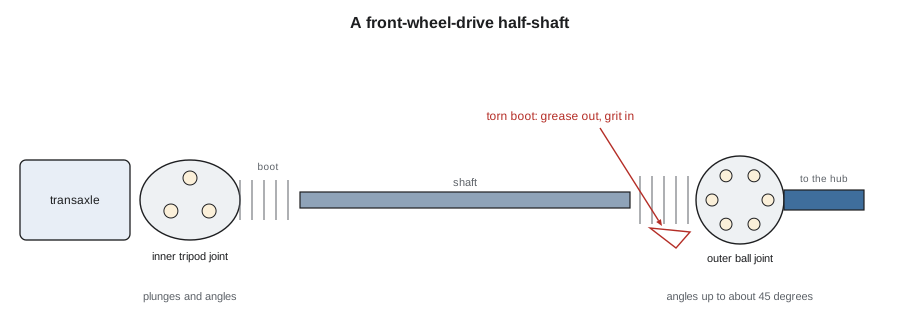
Front-wheel-drive half-shafts have to do more than a driveshaft. The outer joint must work at large angles, up to around 45 degrees, because the wheel steers; the inner joint must allow the shaft to change length as the suspension moves; and both must turn at exactly the same speed as the shaft at any angle, because there is no second joint to cancel a fluctuation and the vibration would be felt in the steering. Constant-velocity joints, CV joints for short, do this. The outer joint is usually a Rzeppa or ball type: six steel balls run in grooves between an inner race splined to the shaft and an outer race that forms the wheel's stub shaft, held in position by a cage. The geometry keeps the balls in a plane that bisects the angle between the shafts, which is what makes the speed constant. The inner joint is usually a tripod type, three rollers on a spider running in a housing with three long tracks, which allows plunge as well as angle, or a double-offset ball joint that also plunges.
CV joints are lubricated by special grease packed inside a flexible boot clamped to the joint and the shaft. The boot is the weak point. It is made of rubber or thermoplastic, flexes every time the wheel moves and steers, and is exposed to road salt, stones, heat from the exhaust and ozone. Once a boot cracks or tears, it flings grease out and lets water and grit in. The grit grinds the balls, races and cage, and the joint develops play between the balls and their grooves. On a tight turn under power, at a large angle, the worn balls snap from one side of their worn grooves to the other several times per revolution, which is the click.
The Lindqvists' popcorn
Kiran verifies the complaint in the lot: full lock right and gentle acceleration, and the clicking comes from the left front. On the hoist, the left outer boot is torn open at its largest pleat, with grease flung across the inside of the wheel, the brake shield and the suspension. The joint itself has noticeable rotational play when she rocks the hub against the shaft. The right side boots are intact but stiff and starting to crack in the folds. She also checks the inner joints for the symptoms that point to them: a shudder or side-to-side shake during acceleration, which often comes from a worn tripod inner joint, and a clunk on take-off. The van has neither.
Marty explains the repair choices. If a torn boot is found early, before water and grit have damaged the joint, a new boot and grease can save it; this one is too far gone, and grease covered in grit cannot be cleaned out reliably in the field. The economical repair on most cars is a complete replacement half-shaft, new or remanufactured, with both joints and boots. Kiran replaces the left half-shaft. She follows the rules for the job: support the lower control arm rather than letting the hub hang by the shaft; never let the inner joint hang or pull apart, since the tripod can come out of its housing; replace the axle nut if the maker specifies a single-use or staked nut; tighten it to specification with the vehicle's weight on the wheels or as the procedure states, since the nut also sets the wheel bearing preload on many designs; and check the transaxle seal and fluid level, because pulling the inner joint out often damages the seal lip.
She recommends the right-side boots be replaced at the next visit, before they tear, and notes the cracking on the repair order. Erik approves the repair and declines the recommendation for now. The popcorn is gone on the road test.
Inspecting driveshafts and U-joints
A worn U-joint usually announces itself as a clunk when the driver shifts into drive or reverse or changes from acceleration to coast, a squeak that follows driveshaft speed, or a vibration. Kiran inspects one by gripping the shaft near the joint and the yoke and trying to twist and lift them against each other: there should be no free play at all. She also checks for rust streaks or red dust at the bearing caps, a sign the seals have failed and the needles are corroding, and for joints that feel notchy or tight when the shaft is turned by hand with the vehicle in neutral. Some U-joints have grease fittings and need greasing at each oil change on trucks; most factory joints are sealed for life.
Driveshafts are also checked for runout with a dial indicator at the front, middle and rear of the tube, for dents, for missing balance weights, and for wear at the slip yoke splines and the transmission's tail shaft bushing, which lets the front of the shaft move and causes a vibration on acceleration. The centre support bearing on two-piece shafts is checked for a torn or collapsed rubber mount and a rough bearing. Before removing any driveshaft, Kiran marks the yoke and the flange so the shaft goes back in the same position, preserving its balance and phasing.
Worked problem
Is the shaft near its critical speed?
A pickup has an 1,830 mm (72 in) one-piece steel driveshaft with an 89 mm (3.5 in) outside diameter and 2.1 mm (0.083 in) wall. Its axle ratio is 3.73 and its wheels turn 690 rpm at 100 km/h. Is the shaft safe at 140 km/h?
Show solution
- At 140 km/h the wheels turn 690 × 1.4 ≈ 966 rpm, so the shaft turns 966 × 3.73 ≈ 3,600 rpm.
- Critical speed ≈ 4.705 × 10^6 × √(3.5² + 3.334²) ÷ 72² ≈ 4,390 rpm, using inches in the formula.
- The margin is only about 1.2.
Answer: Too close: makers aim for a large margin, which is why long shafts are split into two pieces or made larger in diameter.
Common mistakes
MistakeReplacing a CV joint for a vibration that only appears in a straight line.
InsteadClicking on turns points to the outer joint; shudder on acceleration points to the inner joint; check other causes for straight-line vibration.
MistakeRefitting a driveshaft in a different position.
InsteadMark it first; balance and phasing depend on its position.
MistakeLifting or lowering a truck without checking pinion angle.
InsteadChanged angles stop the U-joints cancelling and cause a second-order vibration.
MistakeLetting the half-shaft hang from the inner joint.
InsteadSupport it; a tripod joint can pull apart.
MistakeReusing a single-use axle nut.
InsteadReplace it and torque it to specification as the procedure requires.
Summary and key terms
- Driveshafts carry power to a rear axle; a slip joint allows length change, and long shafts are split to raise critical speed.
- A U-joint at an angle makes the shaft speed fluctuate twice per revolution.
- Equal working angles at the two joints, with yokes in phase, cancel the fluctuation.
- Working angles should be nearly equal, not too large, and not zero.
- CV joints turn at constant speed at any angle; outer ball joints handle steering angles, inner tripod joints allow plunge.
- Torn boots let grease out and grit in; worn outer joints click on tight turns under power.
- Inspect U-joints for play and rust, shafts for runout and balance, and mark shafts before removal.
- Universal joint
- A joint with a cross in needle bearings that connects two shafts at an angle.
- Working angle
- The angle between the two shafts at a universal joint.
- Phasing
- The alignment of the yokes at the two ends of a driveshaft.
- Critical speed
- The shaft speed at which bending whip begins.
- Support bearing
- A body-mounted centre bearing that supports the middle of a two-piece driveshaft.
- CV joint
- A constant-velocity joint that transmits steady speed at any angle.
- Tripod joint
- A plunging CV joint with three rollers on a spider running in a grooved housing.
Practice problems
Work each problem on paper first, then reveal the answer to check.
Why do U-joints need a small working angle rather than none?
Show answer
The needle bearings must rotate slightly or they wear grooves into the cross.
A truck vibrates at twice driveshaft speed after a lift kit was installed. What is the likely cause?
Show answer
Changed pinion angle, so the working angles no longer cancel.
A front-wheel-drive car shudders side to side only on hard acceleration. Which joint is suspect?
Show answer
The inner tripod joint.
Why are long vans fitted with two-piece driveshafts?
Show answer
Shorter pieces have a much higher critical speed.
Lesson quiz · 5 questions
Score 60% or more to complete this lesson.
Create a free account to save your progress, take quizzes and earn a certificate.