
AUTO-310 · Lesson 12 of 12 · 22 min
Capstone: diagnosing a shift complaint and a driveline vibration
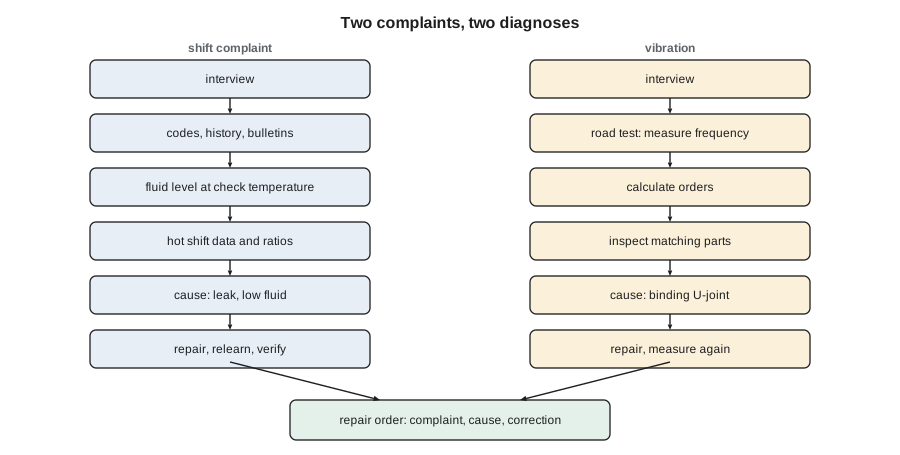
The last job of Kiran's drivetrain term arrives on a Friday afternoon, and Marty tells her she will run it from the write-up to the delivery while he only watches. Marcus Bell brings in van 1, the courier van whose rear springs were replaced in the spring. He has two complaints, and Simone writes them on the repair order as two separate lines, as Ridgeline always does. First: "Late in the day, when the van is hot, it sometimes slips going into fifth or sixth, the revs jump and then it bangs in." Second: "There's a vibration in the floor and the seat at highway speed, starting around 95 km/h (60 mph). It's been getting worse for a couple of weeks." Hal Osei wants the van back on the road Monday.
This capstone brings together the whole course: interviewing the driver, verifying each complaint with data, following a diagnostic order from the simplest causes to the most complex, using the gear ratios, speed sensors and vibration orders that earlier lessons explained, repairing the causes rather than the symptoms, and documenting the work as complaint, cause and correction. Two complaints on one vehicle also test something Marty cares about: whether they are related, and whether the technician keeps them apart until the evidence says otherwise.
The interview and the plan
Kiran asks Marcus the questions that narrow each complaint. The shift problem happens only after several hours of driving, on hot afternoons, when the van has been loaded and unloaded many times; never first thing in the morning. It happens on upshifts at moderate throttle, most often 4-5 and 5-6, and the downshifts feel normal. No warning lights have come on. The vibration is felt rather than heard, in the floor and the seat rather than the steering wheel; it starts around 95 km/h (60 mph), grows to about 110 km/h (68 mph), and it is the same whether he is accelerating, cruising or coasting with his foot off the pedal. It has nothing to do with braking.
She writes a short plan before touching the van, the way Marty taught her. For the shift complaint: check codes and history, check for bulletins and software, check the fluid level and condition correctly, record shift data hot, and compare the actual ratios and shift times with the specification. For the vibration: road test to measure the frequency and relate it to road speed, engine speed or driveshaft speed; inspect the parts that turn at the matching speed; measure before and after. And because a vibration felt in the seat that does not change with throttle sounds like a driveline order, she makes a note to check the driveline angles that were disturbed in the spring.
Complaint 1: the shift flare
The scan tool shows no active codes in the transmission computer, but there are two history records of a gear ratio error during 4-5 upshifts, logged at fluid temperatures above 95 °C (203 °F), and nothing at lower temperatures. The van's software is current and there is no bulletin that matches. Kiran checks the fluid level by the maker's procedure: van level on the hoist, engine running, fluid temperature within the specified window on the scan tool, check plug removed. No fluid runs out. She adds fluid through the fill port and it takes 1.1 litres (1.2 quarts) before fluid begins to drip from the check hole. The fluid itself is red and smells normal; it is low, not burnt.
A transmission that is low but not leaking visibly has to be inspected carefully, so Kiran cleans the transmission and the cooler lines, adds fluorescent dye, and runs the van. With an ultraviolet lamp she finds the leak at the rear cooler line fitting where it enters the transmission case: the fitting's O-ring is flattened and weeping, enough to leave a film on the line and the crossmember that the air stream spreads and dries, so there was never a puddle. A low level matters most when the fluid is hot. The fluid expands as it heats, which hides part of the shortfall, but it also becomes thinner, and on a ten-speed with its pump drawing fluid through a filter low in the pan, a low level lets the pump draw air when the fluid sloshes on acceleration. Air in the fluid makes the clutch apply pressure soft and slow, so the oncoming clutch on a 4-5 or 5-6 upshift fills late, the engine flares, and the clutch finally grabs with a bang.
# Hot shift data before the repair: actual ratio during the 4-5 upshift, 60 ms samples
gear4, gear5 = 1.769, 1.520
output_rpm = 1180
input_log = [2088, 2090, 2160, 2260, 2290, 2240, 2010, 1830, 1795, 1794]
before, after = output_rpm * gear4, output_rpm * gear5
flare = max(input_log) - before
for i, rpm in enumerate(input_log):
    ratio = rpm / output_rpm
    tag = "  <- above 4th gear speed: no element holding (flare)" if rpm > before + 40 else ""
    print(f"t = {i * 60:3d} ms  input {rpm} rpm  ratio {ratio:.3f}{tag}")
print(f"4th gear speed {before:.0f} rpm, 5th gear speed {after:.0f} rpm, flare {flare:.0f} rpm")t = 0 ms input 2088 rpm ratio 1.769 t = 60 ms input 2090 rpm ratio 1.771 t = 120 ms input 2160 rpm ratio 1.831 <- above 4th gear speed: no element holding (flare) t = 180 ms input 2260 rpm ratio 1.915 <- above 4th gear speed: no element holding (flare) t = 240 ms input 2290 rpm ratio 1.941 <- above 4th gear speed: no element holding (flare) t = 300 ms input 2240 rpm ratio 1.898 <- above 4th gear speed: no element holding (flare) t = 360 ms input 2010 rpm ratio 1.703 t = 420 ms input 1830 rpm ratio 1.551 t = 480 ms input 1795 rpm ratio 1.521 t = 540 ms input 1794 rpm ratio 1.520 4th gear speed 2087 rpm, 5th gear speed 1794 rpm, flare 203 rpm
The data agrees with the diagnosis. The input speed rises about 200 rpm above fourth-gear speed before fifth takes hold, the signature of an oncoming clutch that applies late. Kiran replaces the cooler line O-rings with the maker's parts, tightens the fitting to its specified torque, and resets the fluid level at the check plug in the temperature window. Because the transmission computer has been adapting to the soft, aerated apply for weeks, its learned values are now wrong for a transmission with a correct fluid level, so she resets the adaptive tables and performs the adaptive relearn drive from Lesson 6. Then she drives the van on the Stoney Trail loop for forty minutes, long enough to bring the fluid above 95 °C (203 °F), recording the shifts.
# How much the fluid level changes with temperature (why the check window matters)
volume = 11.5                      # total fluid in the transmission and cooler, L
expansion = 0.0007               # volume expansion per degree, illustrative for ATF
check_temp, hot_temp = 40, 100 # C
grow = volume * expansion * (hot_temp - check_temp)
print(f"from {check_temp} to {hot_temp} C the fluid grows by about {grow:.2f} L")
short = 1.1
print(f"checked hot, a transmission {short} L short would look only about {short - grow:.1f} L short,")
print("which is why only the specified check window gives a true reading")from 40 to 100 C the fluid grows by about 0.48 L checked hot, a transmission 1.1 L short would look only about 0.6 L short, which is why only the specified check window gives a true reading
Complaint 2: the vibration
Kiran measures the vibration on the same road test with the shop's vibration analyzer, its sensor taped to the floor under the driver's seat. At 105 km/h (65 mph) in tenth gear, it shows a strong peak at 48.7 cycles per second, hertz, and the peak's frequency rises and falls in proportion to road speed. It does not change when she shifts manually from tenth to ninth at the same road speed, which rules out anything turning at engine speed, and it stays when she lifts off the throttle, which makes an engine or converter cause less likely still. Then she calculates the orders: the frequencies of everything that turns at a speed related to road speed.
# Vibration orders at the test speed: which rotating part matches the measured frequency?
import math
tire_d_mm = 2 * 235 * 0.65 + 16 * 25.4
axle, tenth, ninth = 3.73, 0.636, 0.689
speed = 105                                  # km/h
kmh = speed * 1.0
tire_hz = kmh * 1000 / 3600 / (math.pi * tire_d_mm / 1000)
shaft_hz = tire_hz * axle
measured = 48.7
orders = {
    "tire/wheel 1st order": tire_hz,
    "tire/wheel 2nd order": 2 * tire_hz,
    "driveshaft 1st order": shaft_hz,
    "driveshaft 2nd order": 2 * shaft_hz,
    "engine firing (V6, 3rd order) in 10th": shaft_hz * tenth * 3,
    "engine firing (V6, 3rd order) in 9th": shaft_hz * ninth * 3,
}
for name, hz in orders.items():
    match = "  <- MATCH" if abs(hz - measured) / measured < 0.03 else ""
print(f"{name:<38} {hz:6.1f} Hz{match}")tire/wheel 1st order 13.0 Hz tire/wheel 2nd order 26.1 Hz driveshaft 1st order 48.6 Hz <- MATCH driveshaft 2nd order 97.3 Hz engine firing (V6, 3rd order) in 10th 92.8 Hz engine firing (V6, 3rd order) in 9th 100.5 Hz
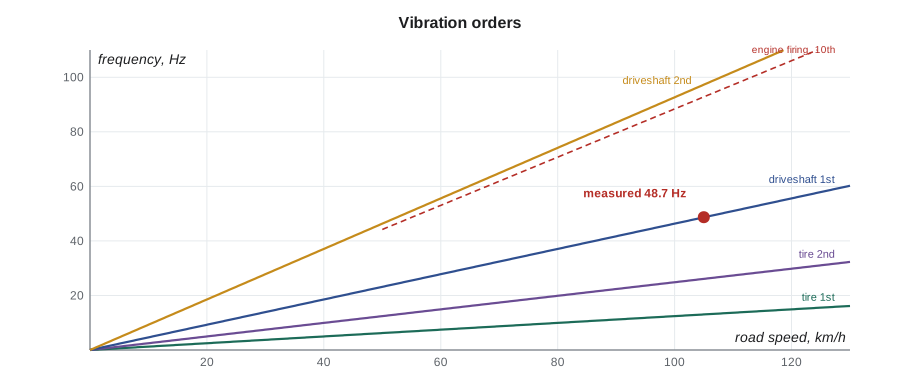
The measured 48.7 Hz matches the driveshaft's first order: something on the driveshaft is out of balance or running eccentric, once per revolution. A second-order vibration would have pointed to unequal U-joint angles, as in the spring. A first order points to imbalance, runout, a damaged tube, a lost balance weight, a worn centre support bearing that lets the shaft move off centre, or a worn or seized U-joint that makes the shaft run off its centre line. On the hoist, Kiran marks both driveshaft sections against their flanges and the centre bearing, and inspects. There are no missing weights and no dents; the centre bearing's rubber is sound and the bearing turns smoothly. But the rear U-joint, at the axle pinion, has a torn seal on one bearing cap, rust-coloured dust around it, and when she turns the shaft by hand it binds and releases at one point in each revolution. She measures runout at the rear of the shaft with a dial indicator: 0.9 mm (0.035 in), against a limit of 0.5 mm (0.020 in).
Marty asks her the question he always asks: why did it fail? The service history answers it. For several weeks last spring, before the pinion-angle shims were found missing and refitted, this joint ran at a working angle more than twice what it was designed for, loading its needle bearings heavily and flexing its seals on every revolution. Water and grit then entered through the damaged seal. The joint's binding point pushes the shaft off centre once per turn, which is the first-order vibration. Kiran replaces both U-joints in the rear section, since the front joint in that section shows the start of the same wear, measures the runout again at 0.2 mm (0.008 in), reinstalls the shaft to its marks, and measures the driveline working angles, which are now within specification, to confirm that the spring repair is still correct.
# Before and after: vibration amplitude at the driveshaft first order and runout
readings = {
    "before repair": {"amplitude_g": 0.092, "runout": 0.9},
    "after repair":  {"amplitude_g": 0.011, "runout": 0.2},
}
limit_runout = 0.5
for name, r in readings.items():
    ok = r["runout"] <= limit_runout
    print(f"{name:<14} 1st order {r['amplitude_g']:.3f} g, runout {r['runout']} mm ({'OK' if ok else 'over limit'})")
drop = 100 * (1 - readings["after repair"]["amplitude_g"] / readings["before repair"]["amplitude_g"])
print(f"vibration reduced by {drop:.0f} %")before repair 1st order 0.092 g, runout 0.9 mm (over limit) after repair 1st order 0.011 g, runout 0.2 mm (OK) vibration reduced by 88 %
Were the complaints related?
With both causes found, Kiran considers whether they were connected. They were not: the shift flare came from a low fluid level caused by a cooler line O-ring, and the vibration from a U-joint damaged by last spring's angle problem. The only connection is that both had been developing quietly, and both were found because the driver described them carefully. Marty points out how easily they could have been confused. A driveline vibration is easy to blame on a transmission, and a transmission that slips and bangs makes drivers suspect everything behind it. Keeping two complaints separate until the evidence joins them avoids replacing the wrong part.
Her verification drive, the next morning, covers both complaints. With the fluid hot, every upshift from 3-4 to 9-10 completes without flare and with shift times close to the ones she recorded on the other vans. The ratio errors do not return. The vibration analyzer shows the driveshaft first-order peak down to a small fraction of its earlier size, and Marcus, who comes along for the last part of the drive, says the floor feels like it did when the van was new.
Writing it up
The repair order is the shop's record of what was found and done, the customer's explanation of the bill, and, for a fleet like Hal's, part of the van's maintenance history. Ridgeline writes every repair as complaint, cause and correction, in plain words, with the measurements that prove the diagnosis. Kiran writes both lines, and Marty reads them before Simone prints the invoice.
# Repair order: complaint, cause, correction for both lines
lines = [
    ("Slips and bangs into 5th and 6th when hot.",
     "Fluid low by 1.1 L at the check plug; rear cooler line O-ring leaking at the case. Hot 4-5 flare about 200 rpm with ratio error history.",
     "Replaced cooler line O-rings, torqued fitting, set level at check plug in temperature window, reset adapts, relearn drive. Hot shifts verified, no flare."),
    ("Vibration in floor and seat from 95 km/h.",
     "Driveshaft 1st order vibration (48.7 Hz at 105 km/h). Rear U-joint seal torn, joint binding; rear shaft runout 0.9 mm (limit 0.5 mm). Joint wear traced to spring angle error.",
     "Replaced both rear-section U-joints, runout now 0.2 mm, refitted to marks, driveline angles checked in specification. Road tested: vibration reduced 88 %."),
]
for n, (complaint, cause, correction) in enumerate(lines, 1):
    print(f"Line {n}")
    print(f"  Complaint:  {complaint}")
    print(f"  Cause:      {cause}")
print(f" Correction: {correction}")Line 1 Complaint: Slips and bangs into 5th and 6th when hot. Cause: Fluid low by 1.1 L at the check plug; rear cooler line O-ring leaking at the case. Hot 4-5 flare about 200 rpm with ratio error history. Correction: Replaced cooler line O-rings, torqued fitting, set level at check plug in temperature window, reset adapts, relearn drive. Hot shifts verified, no flare. Line 2 Complaint: Vibration in floor and seat from 95 km/h. Cause: Driveshaft 1st order vibration (48.7 Hz at 105 km/h). Rear U-joint seal torn, joint binding; rear shaft runout 0.9 mm (limit 0.5 mm). Joint wear traced to spring angle error. Correction: Replaced both rear-section U-joints, runout now 0.2 mm, refitted to marks, driveline angles checked in specification. Road tested: vibration reduced 88 %.
Simone adds Ridgeline's recommendations for the fleet. The other two vans should have their cooler line fittings and fluid levels checked at their next services, since they share the same design and the same hard use, and their rear U-joints inspected for the same seal damage, although only van 1 had the angle problem. Hal approves the inspections for both vans the following week. When Bev reviews the job on Monday, she asks Kiran what she would tell a new apprentice about drivetrains. Kiran thinks about the whole term: Gord's overheated fluid, Theo's clutch and synchronizer, the vans' adapts, Jess's judder, Marcus's dual clutch, the Lindqvists' popcorn, the pinion seal, Harold's tire. "Measure the speeds," she says. "Every part in a drivetrain turns at a speed you can calculate. If you know what it should be, the data will tell you which part isn't doing it."
Worked problem
Order arithmetic at a different speed
At 90 km/h, what would van 1's driveshaft first-order frequency have been?
Show solution
- At 105 km/h the driveshaft first order is about 48.6 Hz.
- Orders scale in direct proportion to road speed.
- 48.6 × 90 ÷ 105 ≈ 41.7 Hz.
Answer: About 41.7 Hz: a vibration analyzer reading that tracks this line as the speed changes confirms a driveshaft cause.
Common mistakes
MistakeCombining two complaints into one diagnosis too early.
InsteadDiagnose each separately until the evidence connects them.
MistakeTopping up a low transmission without finding the leak.
InsteadFind the leak; a film without a puddle is still a leak.
MistakeSkipping the relearn after correcting a fluid level.
InsteadThe computer adapted to the fault and must relearn.
MistakeReplacing a driveshaft part without measuring the vibration frequency.
InsteadMatch the frequency to an order first.
MistakeWriting 'replaced U-joints' as the cause.
InsteadThe cause is what failed and why; the correction is what was done.
Summary and key terms
- Interview the driver for when, where and how each complaint occurs, and write a plan before testing.
- Verify shift complaints with codes, history, bulletins, a correct fluid check and hot shift data.
- A low fluid level can cause hot flare and harsh engagement as the pump draws air.
- Fix the leak, set the level in the check window, and relearn the adaptive values.
- Measure vibration frequency and match it to tire, driveshaft or engine orders.
- A first-order driveshaft vibration points to imbalance, runout or a binding U-joint; a second order points to angles.
- Verify both repairs and document each line as complaint, cause and correction.
- Vibration order
- A vibration frequency that is a multiple of a rotating part’s speed.
- First order
- A vibration that occurs once per revolution of the part.
- Vibration analyzer
- An instrument that measures vibration frequency and amplitude, usually with a sensor on the floor or seat.
- Runout
- The amount a rotating part wobbles off its true centre line, measured with a dial indicator.
- Ratio error
- A recorded difference between the actual and commanded gear ratio.
- Repair order
- The written record of the complaint, cause and correction for each line of work.
- Verification drive
- A road test under the original conditions to confirm the repair.
Practice problems
Work each problem on paper first, then reveal the answer to check.
A vibration rises in frequency with road speed and does not change when the transmission shifts. What does that rule out?
Show answer
Anything that turns at engine speed, including the engine and converter.
The measured frequency matches the driveshaft second order. What is the likely cause?
Show answer
Unequal U-joint working angles.
Why must the adaptive values be relearned after fixing a low fluid level?
Show answer
The computer had adapted to slow, soft applies caused by the low level.
What are the three parts of each repair order line at Ridgeline?
Show answer
Complaint, cause and correction.
Lesson quiz · 5 questions
Score 60% or more to complete this lesson.
Create a free account to save your progress, take quizzes and earn a certificate.