
AUTO-310 · Lesson 8 of 12 · 22 min
CVTs and dual-clutch transmissions
Theo's partner Jess, whose compact SUV Kiran inspected before she bought it in the spring, brings it in with a complaint of her own. "When I'm pulling away gently, around 30 to 50 km/h, it shakes," she says. "Not a noise, a shake through the seat. And the engine sometimes sounds like it's racing without going anywhere." The SUV has a continuously variable transmission. The same week, Marcus Bell, who drives Hal Osei's van 1, asks Kiran about his own car, a small European hatchback with a seven-speed dual-clutch transmission that shudders when he creeps along in traffic. Two transmissions without conventional planetary gear sets, and two shudders.
This lesson explains how a belt or chain continuously variable transmission works, how a hybrid's power-split transmission behaves like one using a planetary gear set and electric motors, and how dual-clutch transmissions combine the efficiency of a manual with automatic shifting. It covers what goes wrong with each and how they are serviced and diagnosed.
The continuously variable transmission
A belt-type continuously variable transmission, or CVT, replaces fixed gears with two variable-diameter pulleys connected by a steel belt or chain. Each pulley is made of two cone-shaped halves, called sheaves, one fixed and one that slides along the shaft under hydraulic pressure. When the movable sheave is pushed toward the fixed one, the V-shaped gap between them narrows and the belt is forced to ride higher, at a larger radius. When it is allowed to move away, the belt drops to a smaller radius. The primary or drive pulley is connected to the engine, usually through a torque converter or a start clutch, and the secondary or driven pulley drives the final drive. Because the belt's length is fixed, as one pulley's working radius grows the other's shrinks, and the ratio is the secondary radius divided by the primary radius.
The belt in most car CVTs is a push belt: several hundred thin steel elements, shaped like small blocks with V-shaped sides, threaded on two bands of thin steel rings. Unlike a rubber belt, it transmits power by pushing the elements against each other between the pulleys, held in place by the rings. Some CVTs use a chain of steel links and pins instead. Either way, the belt grips the pulleys only by friction between its steel sides and the steel sheaves through a thin film of fluid, so the transmission must clamp the belt very hard, with high hydraulic pressure, and the special CVT fluid must provide exactly the right steel-on-steel friction. If clamping falls or the fluid is wrong or degraded, the belt slips, the engine races without the car accelerating, and the sheave surfaces are scored, often beyond repair.
# CVT ratio from the working radii of the pulleys, and engine speed at a steady road speed
import math
final = 5.7                  # final drive ratio of this CVT; pulley working radii below are primary, secondary
tire_d = 2 * 225 * 0.65 + 17 * 25.4    # 225/65R17 tire diameter
def engine_rpm(speed_kmh, ratio):
    wheel_rpm = speed_kmh * 1000 / 60 / (math.pi * tire_d / 1000)
    return wheel_rpm * ratio * final
for name, r_primary, r_secondary, speed in (("launch", 30, 72, 20), ("mid", 48, 52, 50), ("cruise", 70, 32, 100)):
    ratio = r_secondary / r_primary
    rpm = engine_rpm(speed * 1.0, ratio)
    print(f"{name:<7} radii {r_primary} and {r_secondary} -> ratio {ratio:.2f}:1, at {speed} km/h engine {rpm:5.0f} rpm")
print(f"ratio spread {(72 / 30) / (32 / 70):.1f}")launch radii 30 and 72 -> ratio 2.40:1, at 20 km/h engine 2004 rpm mid radii 48 and 52 -> ratio 1.08:1, at 50 km/h engine 2261 rpm cruise radii 70 and 32 -> ratio 0.46:1, at 100 km/h engine 1909 rpm ratio spread 5.2
A CVT's advantage is that the computer can choose any ratio between its limits, typically from about 2.4:1 to 0.4:1 or a little wider, and change it smoothly with no shift shock. It can hold the engine at its most efficient speed while the car accelerates gently, or at its peak power speed for full acceleration. Drivers sometimes dislike the result, the engine speed staying constant while the car speeds up, the effect Jess describes as racing without going anywhere, so most modern CVTs imitate stepped gears under heavy acceleration and in manual mode. Some newer CVTs add a fixed gear for launching from rest, so that the belt handles only the higher speeds where its losses are smallest.
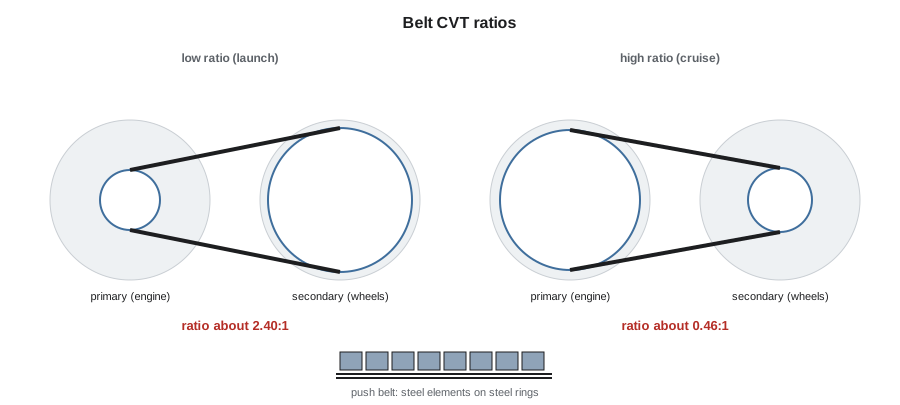
Jess's judder
Kiran road tests Jess's SUV with the scan tool recording. At light throttle from about 30 to 50 km/h (20 to 30 mph), exactly as described, the vehicle judders, and the data shows the torque converter clutch being applied in controlled slip, with the slip swinging rapidly, the same stick-slip pattern she saw on Gord's truck. The CVT fluid temperature is normal. The scan tool also shows a fluid deterioration value, which some CVT computers calculate from the time spent at each temperature, at a level the maker says calls for a fluid change. The SUV has 136,000 km (84,500 miles) on it, and the fluid has never been changed.
There is a bulletin for exactly this symptom on this model: replace the CVT fluid with the current specification fluid, update the transmission computer's software, which changes how the converter clutch is applied at low speed, and reset the fluid deterioration counter and the learned values. The bulletin also warns that the CVT fluid level must be set by the maker's procedure at a specified temperature, and that no other fluid may be used. Kiran follows it. After the update and a relearn drive, the judder is gone. She notes on the repair order that the maker's maintenance schedule calls for CVT fluid replacement at a set interval under severe conditions, which include frequent short trips and hilly driving, both of which describe Jess's use.
Marty adds context that matters when Jess asks whether she bought a bad transmission. Belt CVTs have a mixed reputation. Some makers' CVTs, including several popular models from the 2010s, were the subject of extended warranties and class actions in both countries for judder, overheating and belt failures, while others have been reliable. Most CVT problems that are caught early, judder, flare, a whine, respond to the correct fluid and software; a CVT that has slipped badly enough to damage its belt or sheaves usually needs replacement, because the pulleys and belt are a matched set and are not normally serviced in the field. The lesson is to keep the fluid fresh and correct and to respond to the first symptoms.
The power-split hybrid transmission
Ines Moreau's hybrid has what its maker calls an electronic CVT, but there is no belt inside. Its transaxle contains a planetary gear set and two motor-generators. The engine drives the planet carrier. The first motor-generator, the smaller one, is connected to the sun gear. The ring gear drives the wheels through a reduction gear and the differential, and the second, larger motor-generator also drives the ring, either directly or through its own reduction. Because the three members of a planetary set must always satisfy the Willis equation from Lesson 5, when the wheels and therefore the ring turn at a given speed, the engine's speed is set by the speed at which the computer turns the sun gear motor. Turning the sun faster raises the engine speed; slowing it, or turning it backward, lowers the engine speed. The engine can therefore run at its most efficient speed while the car's speed changes freely, exactly like a CVT.
The sun gear motor-generator usually acts as a generator, absorbing part of the engine's power and turning it into electricity that drives the second motor or charges the battery, so power flows to the wheels along two paths: mechanically through the gears and electrically through the motors. That is why it is called power-split. With the engine stopped, the second motor alone can drive the car, and the sun gear simply spins backward as the ring turns. There is no clutch, no torque converter and no shifting, and the transaxle's only service is its fluid. Its high-voltage parts are covered in AUTO-410; here what matters is how the gear set lets the computer choose the engine speed.
# Power-split hybrid: sun gear (motor-generator 1) speed needed for a chosen engine speed
S, R = 30, 78      # sun and ring teeth; engine on the carrier, ring connected to the wheels
def sun_speed(engine_rpm, ring_rpm):
    return (engine_rpm * (S + R) - ring_rpm * R) / S
cases = (("pulling away, engine charging", 1800, 0),
         ("light cruise", 1800, 2500),
         ("hard acceleration at speed", 2200, 4200),
         ("highway, engine slow", 1200, 5200),
         ("electric only, engine stopped", 0, 3000))
for name, eng, ring in cases:
print(f"{name:<31} engine {eng:4d} rpm, ring {ring:4d} rpm -> sun motor {sun_speed(eng, ring):6.0f} rpm")pulling away, engine charging engine 1800 rpm, ring 0 rpm -> sun motor 6480 rpm light cruise engine 1800 rpm, ring 2500 rpm -> sun motor -20 rpm hard acceleration at speed engine 2200 rpm, ring 4200 rpm -> sun motor -3000 rpm highway, engine slow engine 1200 rpm, ring 5200 rpm -> sun motor -9200 rpm electric only, engine stopped engine 0 rpm, ring 3000 rpm -> sun motor -7800 rpm
The dual-clutch transmission
A dual-clutch transmission is mechanically two manual gearboxes in one case, each with its own clutch. One input shaft carries the odd gears, first, third, fifth and seventh, and the other, a hollow shaft around it, carries the even gears and usually reverse. Both shafts feed common output shafts. While the car accelerates in first, with clutch 1 engaged, the computer has already engaged second gear on the other shaft with its synchronizer, but clutch 2 is open, so second is not yet carrying any torque. The shift itself is simply a handover between clutches: clutch 1 opens as clutch 2 closes, in a few hundredths of a second, with no interruption of drive. Then the computer preselects third on the first shaft, ready for the next shift. On a downshift it preselects the lower gear instead.
The result combines the efficiency of a manual transmission, with no torque converter slip and gears that mesh directly, with very quick automatic shifts. Dual-clutch transmissions come in two kinds. Wet types run their multi-plate clutches in oil, which cools them and lets them handle high torque and lots of slipping, and are used in larger and higher-performance cars. Dry types use two single dry clutches like a manual car's, which are more efficient and cheaper but heat up quickly when they slip, and are used in smaller cars. Both are controlled by a mechatronic unit, a combined hydraulic or electric actuator and computer, that operates the clutches and the shift forks. Several makers that used dry dual-clutch transmissions in small mass-market cars have since moved away from them, partly because of the problem Marcus describes.
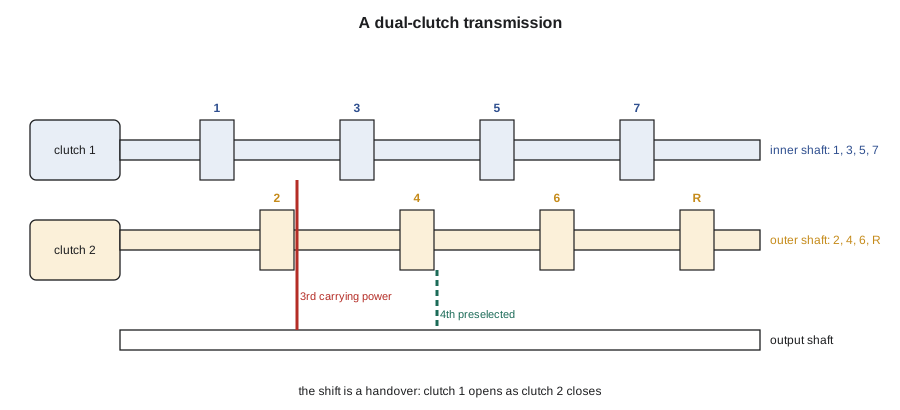
Marcus's shudder: a dry clutch in traffic
Creeping in stop-and-go traffic is the hardest job a dry dual-clutch transmission does. There is no torque converter, so to move the car at walking pace the computer must slip clutch 1 continuously, and a dry clutch has no oil to carry the heat away. As the clutch heats, its friction changes, the computer's learned engagement point, often called the kiss point or touch point, drifts, and the clutch begins to grab and slip, a shudder. Wear makes it worse. The scan tool on Marcus's car shows the learned kiss-point positions for both clutches and a wear reserve figure, how far the actuator can still travel to compensate for facing wear.
# Dry dual-clutch: learned kiss points and wear reserve against limits (illustrative values)
clutches = {
    "clutch 1 (odd gears)":  {"kiss_new": 9.0, "kiss_now": 11.6, "reserve": 2.8},
    "clutch 2 (even gears)": {"kiss_new": 9.2, "kiss_now": 9.9, "reserve": 4.1},
}
reserve_limit = 1.5
for name, c in clutches.items():
    drift = c["kiss_now"] - c["kiss_new"]
    if c["reserve"] < reserve_limit:
        verdict = "worn: clutch replacement due"
    elif drift > 2.0:
        verdict = "large drift: perform the clutch adaptation procedure"
    else:
        verdict = "OK"
print(f"{name:<22} kiss point moved {drift:.1f} mm, wear reserve {c['reserve']:.1f} mm -> {verdict}")clutch 1 (odd gears) kiss point moved 2.6 mm, wear reserve 2.8 mm -> large drift: perform the clutch adaptation procedure clutch 2 (even gears) kiss point moved 0.7 mm, wear reserve 4.1 mm -> OK
Clutch 1, which does all the creeping and launching, has moved much further than clutch 2 but still has wear reserve. Kiran checks for bulletins and software updates, then runs the maker's clutch adaptation routine with the scan tool, which makes the computer find and learn the kiss points again under controlled conditions, followed by a specified drive. The shudder is reduced. Marty gives Marcus the advice dry dual-clutch owners need: in slow traffic leave a gap and roll forward in bursts rather than creeping continuously, do not hold the car on a hill with the throttle instead of the brake, and use the hill-hold feature. If the shudder returns or the wear reserve falls below the limit, the clutch pair will need replacing, and the procedure afterward again includes the adaptation.
Servicing CVTs and dual-clutch transmissions
All of these transmissions depend on their fluid and their software more than older automatics did. CVT fluid and dual-clutch fluid are specific to the transmission; a wet dual-clutch's fluid has to give the right friction for its clutches and protect its gears, and some dual-clutch transmissions have a separate fluid for the mechatronic unit or the gear section. Service intervals vary widely, from lifetime fills to every few tens of thousands of kilometres, and severe-service schedules are much shorter. Level checking follows the maker's procedure, usually at a check plug at a specified temperature. After fluid service, software updates, clutch replacement or a mechatronic unit replacement, most of them need a scan tool learn or adaptation procedure before they will shift or engage correctly, and some need a specific drive cycle afterward. Kiran adds a line to her notes that Marty underlines: for these transmissions, the service information and a capable scan tool are not optional.
Worked problem
CVT engine speed at cruise
Jess's CVT has a highest ratio of 0.40:1 and a 5.7:1 final drive, and her tires turn 439 times per kilometre. What is the lowest possible engine speed at 100 km/h?
Show solution
- At 100 km/h the wheels turn 439 × 100 ÷ 60 ≈ 732 rpm.
- In the highest ratio, overall ratio = 0.40 × 5.7 = 2.28.
- Engine speed = 732 × 2.28 ≈ 1,669 rpm.
Answer: About 1,670 rpm, similar to a conventional automatic in its top gear; the computer will often choose a slightly lower ratio to keep some power in reserve.
Common mistakes
MistakeUsing a general ATF in a CVT.
InsteadCVTs need their specific fluid to give the right steel-belt friction.
MistakeAssuming an engine that stays at one speed while accelerating is a fault.
InsteadThat is normal CVT behaviour; check data before diagnosing.
MistakeTreating a hybrid's power-split transaxle like a belt CVT.
InsteadIt has a planetary set and motor-generators, no belt.
MistakeSkipping the clutch adaptation after dual-clutch service.
InsteadThe computer must relearn the engagement points.
MistakeCreeping continuously in traffic with a dry dual-clutch.
InsteadRoll forward in bursts to keep the clutch from overheating.
Summary and key terms
- A belt CVT changes ratio by moving pulley sheaves; the steel belt grips by friction under high clamping force.
- CVTs need their specific fluid and correct clamping; belt slip damages the belt and pulleys.
- CVT judder at light throttle is often a converter clutch and fluid problem with a software fix.
- A power-split hybrid uses a planetary set and two motor-generators to set engine speed independently of road speed.
- A dual-clutch transmission preselects the next gear on the other shaft and shifts by handing over between clutches.
- Dry dual clutches overheat with continuous slipping in traffic; kiss points and wear reserve are read with a scan tool.
- After service, CVTs and dual-clutch transmissions usually need learn or adaptation procedures.
- Continuously variable transmission
- A transmission that can select any ratio between its limits, usually with pulleys and a belt.
- Sheave
- One cone-shaped half of a CVT pulley.
- Push belt
- A CVT belt of steel elements on steel rings that transmits power by pushing.
- Power-split transmission
- A hybrid transaxle in which a planetary set divides engine power between mechanical and electrical paths.
- Dual-clutch transmission
- A transmission with two clutches and two input shafts for odd and even gears.
- Preselection
- Engaging the next gear on the idle shaft before the clutch handover.
- Kiss point
- The clutch actuator position at which the clutch just begins to transmit torque.
Practice problems
Work each problem on paper first, then reveal the answer to check.
A CVT's secondary pulley radius is 60 mm and its primary 40 mm. What is the ratio?
Show answer
60 ÷ 40 = 1.5:1.
In a power-split hybrid, what happens to the sun gear when the car drives on electricity alone with the engine stopped?
Show answer
It turns backward as the ring turns.
Why does a dual-clutch transmission shift without interrupting drive?
Show answer
The next gear is already engaged; the shift is a handover from one clutch to the other.
What advice reduces dry dual-clutch shudder in traffic?
Show answer
Leave a gap and move in bursts instead of creeping, and use the brake, not the throttle, to hold on hills.
Lesson quiz · 5 questions
Score 60% or more to complete this lesson.
Create a free account to save your progress, take quizzes and earn a certificate.