
AUTO-110 · Lesson 8 of 12 · 21 min
Fluids, filters and lubrication service
The job Kiran will do more often than any other in her first year is the oil and filter change, usually combined with an inspection. It looks simple, and that is the danger. Theo, who has done thousands, shows her the three oil-change mistakes that cost shops the most: a drain plug left loose or cross-threaded, an old filter gasket left stuck to the engine under the new filter, and the wrong oil or the wrong amount. Any of them can destroy an engine within minutes of the customer driving away. “Do it the same way every time,” he says, “and check it before the car leaves the bay.”
Vehicles depend on many fluids and filters, each with its own specification and service interval. This lesson covers engine oil and the lubrication service, the other fluids a technician checks and changes, the main filters, and the handling of used fluids.
What engine oil does
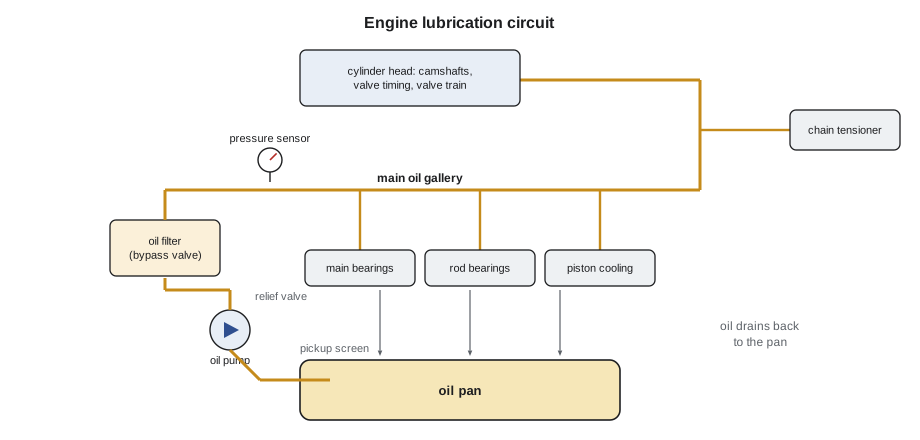
Engine oil lubricates the moving parts, keeping a thin film between surfaces such as crankshaft journals and their bearings so that metal does not touch metal. It also cools parts that coolant cannot reach, such as the pistons and bearings; it cleans, carrying soot, combustion by-products and wear particles to the filter and holding fine particles in suspension; it seals the gap between the piston rings and the cylinder walls; it protects against corrosion; and on many engines it is the hydraulic fluid that operates variable valve timing and chain tensioners. When oil is old, low or the wrong type, all of these functions suffer.
Oil specifications
Two specifications define the oil an engine needs. The viscosity grade, set by SAE J300, describes how thick the oil is. A multigrade oil such as 5W-30 behaves like a thin oil when cold, shown by the number before the W, for winter, and like a thicker oil at operating temperature, shown by the second number. A lower winter number means the oil flows more easily in a cold start, which matters in a Calgary winter (Denver winter) because most engine wear happens in the first seconds after starting. Many current engines specify very thin oils such as 0W-20 or 0W-16 to reduce friction and improve fuel economy, and using a thicker oil than specified can affect variable valve timing and set fault codes.
The performance specification describes what the oil must protect against. For most gasoline engines in North America it is set by the American Petroleum Institute, whose service categories begin with S, and by the International Lubricant Standardization and Approval Committee, ILSAC. The current categories, API SQ and ILSAC GF-7, were introduced in 2025 and replace API SP and ILSAC GF-6; they improve protection against low-speed pre-ignition in small turbocharged engines, timing chain wear and deposits. Diesel engine oils have API categories beginning with C. Many manufacturers also have their own approvals, such as a specification number printed in the owner's manual, and some engines, especially European ones, require an oil with that approval. The correct oil for each vehicle is in the service information and the owner's manual, and it is the only one used.
| Marking | Meaning | Example |
|---|---|---|
| 0W-20 | SAE viscosity grade: flows like a 0W oil cold, like a 20 grade hot | Ines Moreau's hybrid |
| 5W-30 | Flows like a 5W oil cold, like a 30 grade hot | Gord Haney's pickup |
| API SQ | Current API gasoline engine category (2025) | Most gasoline engines |
| ILSAC GF-7 | Current ILSAC category, adds fuel economy requirements | Shown in the API starburst symbol |
| API CK-4 | Diesel engine category | Light-duty diesel pickups |
| Manufacturer approval | The vehicle maker's own specification number | Some European and newer engines |
Change intervals and oil life monitors
Manufacturers set oil change intervals by distance and time, whichever comes first, because oil degrades with use and also with age, moisture and short trips. Many vehicles have an oil life monitor that calculates the oil's remaining life from engine revolutions, temperature, trip length and other data and tells the driver when service is due; it does not measure the oil itself. Most schedules have a normal and a severe service interval. Severe service includes frequent short trips, extreme heat or cold, dusty roads, towing, heavy loads, extended idling and commercial use such as delivery or rideshare driving, which is how the Prairie Parcel vans and Ines's hybrid are used. Lesson 10 shows how a shop schedules maintenance by time, distance and service conditions.
The oil and filter change
Ridgeline's oil service procedure is the same on every vehicle. Confirm the oil type, quantity and filter part number from the service information, not from memory or the last sticker. Warm the engine briefly if it is cold, so the oil drains well, but beware of hot oil and exhaust. Raise the vehicle safely, place the drain pan, and remove the drain plug, keeping a hand clear of the hot stream. Inspect the drain plug threads and replace its gasket or crush washer every time. While the oil drains, remove the filter, check that the old filter's gasket came off with it, and wipe the mounting surface clean. Lightly oil the new filter's gasket, or on a cartridge filter install the new O-rings, and tighten the filter by hand as the filter or service information directs, usually three-quarters of a turn after the gasket contacts, or to a torque specified for the housing.
Reinstall the drain plug by hand and tighten it to its specified torque; aluminium oil pans strip easily. Lower the vehicle, fill with the specified oil to slightly below the full quantity, start the engine and let it idle until the oil pressure lamp goes out, then shut it off, wait a few minutes and check the level on the dipstick, topping up to the full mark. On engines without a dipstick, the level is checked through the instrument cluster or with a scan tool by the manufacturer's procedure. Check under the vehicle for leaks at the plug and filter. Reset the oil life monitor, fill in the service sticker or electronic reminder, and record the oil type, quantity and odometer reading on the repair order.
# Oil service: how much oil to put in, and a quick cost check (illustrative capacities)
vehicles = [("Gord's pickup, 5W-30", 7.6), ("Lindqvists' minivan, 0W-20", 5.7), ("Ines's hybrid, 0W-16", 4.4)]
price = 9.50          # CAD per L of bulk oil
for name, capacity in vehicles:
    first_fill = capacity - 0.5        # hold back a little, then top up after checking the dipstick
    print(f"{name:<28} capacity {capacity:4.1f} L: pour {first_fill:4.1f}, check, top up; oil cost {capacity * price:6.2f} CAD")
print(f"for comparison, 7.6 L = {7.6 / 0.94635:.1f} US quarts")Gord's pickup, 5W-30 capacity 7.6 L: pour 7.1, check, top up; oil cost 72.20 CAD Lindqvists' minivan, 0W-20 capacity 5.7 L: pour 5.2, check, top up; oil cost 54.15 CAD Ines's hybrid, 0W-16 capacity 4.4 L: pour 3.9, check, top up; oil cost 41.80 CAD for comparison, 7.6 L = 8.0 US quarts
The amounts are typical for vehicles of these types; the exact capacity for each comes from the service information, and it is always the dipstick or the manufacturer's level check, not the capacity figure, that decides the final level. An overfilled engine can foam its oil as the crankshaft whips it, which reduces lubrication, and can push oil into the emission control system.
Coolant
Engine coolant is a mixture of water and antifreeze, usually ethylene glycol, with corrosion inhibitors. The glycol lowers the freezing point and raises the boiling point; the inhibitors protect the aluminium, cast iron, copper, brass and solder in the engine, radiator and heater core. Different manufacturers use different inhibitor technologies, such as organic acid technology and hybrid formulas, with different colours that are not reliable guides to type. The correct coolant is the one the manufacturer specifies, and mixing types can shorten the life of the inhibitors. Most coolants are mixed about half and half with distilled or deionized water; premixed coolant avoids mixing errors.
The coolant's freeze protection is checked with a refractometer, which reads the glycol concentration from a drop of coolant, or with test strips, which also check the inhibitors' condition. A 50 percent mixture protects to about −37°C (−34°F); a 60 percent mixture to about −52°C (−62°F), which is about the practical limit, because more glycol than that raises the freezing point again and reduces the coolant's ability to carry heat. Never open a hot cooling system: the coolant is under pressure above its normal boiling point, and removing the cap releases a burst of scalding coolant and steam. Coolant is checked in the reservoir with the engine cold.
# Freeze protection of ethylene glycol coolant by concentration (approximate published values)
table = [(0, 0.0), (30, -15.6), (40, -24.4), (50, -36.7), (60, -52.2)]   # percent glycol, degrees C
def freeze_point(pct):
    for (p1, t1), (p2, t2) in zip(table, table[1:]):
        if p1 <= pct <= p2:
            return t1 + (t2 - t1) * (pct - p1) / (p2 - p1)
for reading in (35, 45, 50, 55):
    c = freeze_point(reading)
print(f"refractometer {reading} % glycol -> protected to about {c:5.1f} C")refractometer 35 % glycol -> protected to about -20.0 C refractometer 45 % glycol -> protected to about -30.6 C refractometer 50 % glycol -> protected to about -36.7 C refractometer 55 % glycol -> protected to about -44.5 C
The table stops at 60 percent, because stronger mixtures give no more protection and carry heat less well; it is used for checking normal mixtures. Calgary winters can reach −30°C (−20°F) or colder, so Ridgeline aims for the protection the manufacturer specifies, usually the half-and-half mixture.
Brake fluid
Most brake fluids are glycol-based, classified by the US Department of Transportation as DOT 3, DOT 4 or DOT 5.1, with increasing boiling points; DOT 5 is a silicone fluid that does not mix with the others and is rarely used in passenger vehicles. Glycol-based fluid is hygroscopic: it absorbs moisture from the air over time, through hoses and seals, which lowers its boiling point and corrodes internal parts of the calipers, wheel cylinders and ABS unit. Many manufacturers specify replacing it every two or three years. The fluid's condition is checked with a test strip that measures its copper content, which rises as the corrosion inhibitors are used up, or with a tester that measures its boiling point. Brake fluid damages paint, so spills are washed off immediately with water. Only fluid from a sealed container is used.
Other fluids
Automatic transmission fluid is specific to each transmission: modern transmissions use fluids with particular friction properties, and the wrong one can cause shudder or slipping. Many transmissions have no dipstick and are checked through a fill plug at a specified fluid temperature, using a scan tool to read the temperature. Continuously variable and dual-clutch transmissions use their own fluids. Manual transmissions, transfer cases and differentials use gear oils with specific viscosity grades such as 75W-90 and API GL categories, and limited-slip differentials may need a friction modifier. Power steering fluid, on vehicles with hydraulic steering, may be a specific fluid or automatic transmission fluid, as specified.
Windshield washer fluid in winter must be rated for the cold; a summer fluid can freeze in the lines and on the windshield. Diesel vehicles with selective catalytic reduction use diesel exhaust fluid, a solution of urea in water, from a separate tank, and they lose power or refuse to restart if it runs out. Electric vehicles use coolant for their battery, motor and electronics, sometimes a special low-conductivity coolant, and a refrigerant system that also cools the battery; Lesson 11 explains why these are left to trained technicians.
Filters
The engine air filter cleans the air entering the engine; a clogged filter reduces power on older engines and can affect the air flow sensor reading on newer ones. It is inspected at each service and replaced at the scheduled interval or sooner in dusty conditions. The cabin air filter cleans the air entering the passenger compartment; a clogged one reduces air flow and causes odours and window fogging. Fuel filters on many modern vehicles are inside the fuel tank and are replaced only as part of the fuel pump assembly; external fuel filters are replaced at their interval with the fuel system depressurized as the service information directs. Automatic transmissions have internal filters replaced during some fluid services.
# Fluid and filter check list for one vehicle, with the interval each item is due (illustrative)
items = [("engine oil and filter", 8000), ("engine air filter", 48000), ("cabin air filter", 24000),
         ("brake fluid", None), ("coolant", 240000)]
odometer = 148350
for name, interval in items:
    if interval is None:
        print(f"{name:<24} by time: every 3 years, or when the test strip fails")
        continue
    next_due = (odometer // interval + 1) * interval
print(f"{name:<24} every {interval:>7,} km; next at {next_due:>8,} km")engine oil and filter every 8,000 km; next at 152,000 km engine air filter every 48,000 km; next at 192,000 km cabin air filter every 24,000 km; next at 168,000 km brake fluid by time: every 3 years, or when the test strip fails coolant every 240,000 km; next at 240,000 km
The intervals in the code are illustrative of a typical minivan's schedule; the real ones come from the service information. Lesson 10 builds this idea into a full maintenance scheduler that also handles time and severe service.
Handling used fluids
Used oil, coolant, brake fluid, transmission fluid and filters are collected separately, as Lesson 2 explained, and recycled through licensed collectors. Used oil filters are punctured or crushed and drained, hot, for at least the time the shop's procedure requires, then placed in the filter drum. Drain pans are emptied promptly so they do not overflow onto the floor. Brake fluid, which absorbs moisture, is never poured back into a container. Spilled coolant is cleaned up at once because its sweet taste attracts animals. Each fluid's safety data sheet gives its first aid and disposal information, and nitrile gloves are worn throughout.
Worked problem
Checking the work before delivery
Kiran has finished the oil service on Gord Haney's pickup. Before Dale will release the truck, what does she check?
Show solution
- Oil level on the dipstick at the full mark, after running the engine and waiting.
- No leaks at the drain plug or filter, checked under the truck with the engine running and again after it is stopped.
- Drain plug torqued, with a new washer, and the filter tightened as specified; tools and the drain pan removed from under the truck.
- Oil life monitor reset and the reminder sticker filled in.
- Oil type, quantity, filter part number and odometer recorded on the repair order; the oil filler cap and dipstick are in place.
Answer: Level, leaks, torque, tools, reset, record and the filler cap: every time, on every vehicle.
Common mistakes
MistakeUsing the oil from the last service sticker.
InsteadLook up the specified viscosity and performance category or manufacturer approval for this vehicle.
MistakeLeaving the old filter gasket on the engine.
InsteadCheck that it came off with the old filter; a double gasket leaks oil within minutes.
MistakeReusing the drain plug washer.
InsteadReplace it every time and torque the plug.
MistakeOpening a hot radiator cap.
InsteadCheck coolant cold at the reservoir; a hot system can spray scalding coolant.
MistakeMixing coolant types by colour.
InsteadColour is not a reliable guide; use the type the manufacturer specifies.
MistakeTopping up brake fluid from an opened bottle left on the shelf.
InsteadUse fluid from a sealed container; open fluid absorbs moisture.
Summary and key terms
- Engine oil lubricates, cools, cleans, seals, protects and operates hydraulic components.
- Use the specified viscosity grade and performance category, currently API SQ and ILSAC GF-7, or the manufacturer's approval.
- Oil change intervals are by distance or time, with severe service intervals for hard use.
- Do the oil service the same way every time and check level, leaks, torque and records before delivery.
- Coolant, brake fluid, transmission fluid, gear oil and other fluids each have their own specification and check method.
- Filters are inspected and replaced at their intervals, and used fluids are recycled separately.
- Viscosity grade
- The SAE rating of an oil’s thickness, such as 5W-30.
- API service category
- The American Petroleum Institute’s performance rating for engine oil, such as SQ.
- Severe service
- Operating conditions that call for shorter maintenance intervals.
- Refractometer
- An instrument that reads coolant glycol concentration from a drop of fluid.
- Hygroscopic
- Absorbing moisture from the air, as glycol brake fluid does.
- Oil life monitor
- A system that estimates remaining oil life from operating conditions.
Practice problems
Work each problem on paper first, then reveal the answer to check.
What does the W in 5W-30 stand for?
Show answer
Winter; it describes the oil's flow when cold.
Why is brake fluid replaced by time even if the vehicle is driven little?
Show answer
It absorbs moisture over time, lowering its boiling point and causing corrosion.
A refractometer shows 50 percent glycol. About what freeze protection does that give?
Show answer
About −37°C (−34°F).
Name three things checked before an oil-changed vehicle is delivered.
Show answer
Oil level, leaks, drain plug torque, reset of the monitor, records (any three).
Lesson quiz · 5 questions
Score 60% or more to complete this lesson.
Create a free account to save your progress, take quizzes and earn a certificate.