
AUTO-110 · Lesson 6 of 12 · 20 min
Service information and repair orders
On a busy Thursday, Simone hands Kiran a repair order for the Lindqvists' minivan. The customer's concern reads: “Squeal from front when braking, worse in the morning. Also check engine light came on last week.” Below it Simone has written the mileage, the VIN and the customer's phone number, and Mrs. Lindqvist has signed to authorize an inspection and diagnosis up to one hour of labour. Marty takes the repair order, looks at Kiran and says, “Before you touch the van, what are the first three things you do?” Kiran has learned the answer: read the whole repair order, check the vehicle's history and look up the service information.
A technician cannot know the specifications, procedures and wiring of every vehicle; there are thousands of models, each changing from year to year. The trade depends on service information, and on the repair order that connects the customer, the vehicle and the work. This lesson explains how to identify a vehicle, find and use service information, and write a repair order that is clear, accurate and legally sound.
Identifying the vehicle
Every road vehicle built for North America since 1981 has a 17-character vehicle identification number, or VIN. It is stamped on a plate visible through the lower corner of the windshield on the driver's side, printed on a label in the driver's door opening, and stored in the engine control module, where a scan tool can read it. The VIN identifies the manufacturer, the vehicle type, the model, the engine and other attributes, the model year, the assembly plant and the serial number. Service information systems decode it automatically, so the first step on any job is to enter the VIN, not to pick a model from a menu, because two vehicles that look the same can have different engines, brakes or wiring.
The first three characters are the world manufacturer identifier; the first character shows the country or region, such as 1, 4 or 5 for the United States, 2 for Canada and 3 for Mexico. Characters 4 to 8 describe the vehicle. Character 9 is a check digit, calculated from all the others, that catches errors in copying the VIN. Character 10 shows the model year by a letter or number in a fixed cycle: for example, L for 2020, M for 2021, N for 2022, P for 2023, R for 2024, S for 2025 and T for 2026. Character 11 shows the plant, and characters 12 to 17 are the serial number. The letters I, O and Q are never used, because they are too easily confused with 1 and 0.
# Check a VIN's check digit and decode its model year (North American VIN rules)
values = {**{str(d): d for d in range(10)},
          **dict(zip("ABCDEFGH", range(1, 9))), **dict(zip("JKLMN", range(1, 6))), "P": 7, "R": 9,
          **dict(zip("STUVWXYZ", range(2, 10)))}
weights = [8, 7, 6, 5, 4, 3, 2, 10, 0, 9, 8, 7, 6, 5, 4, 3, 2]
years = dict(zip("ABCDEFGHJKLMNPRSTVWXY123456789", range(2010, 2040)))
def check(vin):
    total = sum(values[c] * w for c, w in zip(vin, weights))
    r = total % 11
    expected = "X" if r == 10 else str(r)
    return expected, vin[8] == expected
for vin in ("1HGBH41JXMN109186", "2C4RC1BG6HR512345", "2C4RC1BG6HR512354"):
    exp, ok = check(vin)
    year = years.get(vin[9], "unknown")
print(f"{vin}: check digit {vin[8]}, expected {exp} -> {'valid' if ok else 'typing error'}; model year code {vin[9]} = {year}")1HGBH41JXMN109186: check digit X, expected X -> valid; model year code M = 2021 2C4RC1BG6HR512345: check digit 6, expected 6 -> valid; model year code H = 2017 2C4RC1BG6HR512354: check digit 6, expected 7 -> typing error; model year code H = 2017
The model year table repeats every thirty years, so a 1987 vehicle and a 2017 vehicle both carry H, and the first VIN, a well-known textbook example, decodes as 2021 although it was issued for a 1991 car; the rest of the VIN and the vehicle itself make the difference obvious. The third VIN in the output is the Lindqvists' with two digits of the serial number swapped, which is exactly the kind of error the check digit catches. Kiran checks the VIN on the vehicle against the repair order every time; a wrong VIN on a repair order can mean ordering the wrong parts or looking up the wrong wiring diagram.
Other labels matter too. The tire and loading information placard on the driver's door pillar gives the original tire size and the recommended cold inflation pressures. An emission control information label under the hood identifies the engine family and emission equipment. Paint and trim codes, axle ratios and option codes may be on the door label or in the VIN decoding. Lesson 9 returns to the tire placard.
Kinds of service information
Manufacturers publish service information for their own vehicles, and independent shops get it either directly from manufacturer websites, by subscription for a day, a month or a year, or through aftermarket information systems that gather information for many makes in one place. Ridgeline subscribes to an aftermarket system for most work and buys short-term manufacturer access when a job needs a factory procedure or software update. The main types of information are:
- Specifications: torque values, fluid types and capacities, clearances, electrical values and tire pressures.
- Repair procedures: step-by-step instructions for removing, installing, adjusting and testing components, with special tools, warnings and one-time-use parts identified.
- Diagnostic information: diagnostic trouble code descriptions, the conditions that set each code, and the test steps, often in a flow chart, to find the cause.
- Wiring diagrams and connector views: circuits, wire colours, connector pin numbers and the locations of components, grounds and splices.
- Maintenance schedules: what to do and when, by time and distance, with separate schedules for normal and severe service.
- Technical service bulletins: notices from the manufacturer about known problems, revised procedures, updated parts and software, issued after the vehicle went on sale.
- Labour time guides: the standard times for jobs, used to estimate and bill labour.
Kiran is taught to read the whole procedure before starting a job, not just the step she thinks she needs. Procedures include cautions, such as a part that must be replaced rather than reused, a fastener that is torque-to-yield, a module that must be relearned after a battery disconnection, or an airbag precaution, that are easy to miss if she skips to the middle.
Technical service bulletins and recalls
A technical service bulletin describes a known problem and its fix, such as a revised brake pad that cures a squeal, or a software update that corrects a shifting complaint. Bulletins do not by themselves mean the repair is free; whether the manufacturer pays depends on the warranty. Checking bulletins early in a diagnosis can save hours: if the Lindqvists' squeal matches a bulletin for that model, the fix is already known.
A safety recall is different. When a manufacturer or the government finds a defect that affects safety, such as an airbag inflator, a fuel leak or a seat belt fault, the manufacturer must notify owners and fix the defect free of charge. In Canada, recalls are made under the Motor Vehicle Safety Act and can be searched by make, model and year in Transport Canada's motor vehicle safety recalls database. Ridgeline checks open recalls on every vehicle it services and tells the customer about any it finds; recall repairs themselves are done by the manufacturer's dealers.
The repair order
The repair order is the shop's contract with the customer and the permanent record of the work. It identifies the customer and the vehicle, including the VIN, licence plate and odometer reading in; states the customer's concerns in their own words; records the authorization for diagnosis and repair, with an estimate; and, when the job is done, lists the parts used, the labour, any fees and taxes, and the technician's description of the work. It is also used for warranty claims and to defend the shop if a dispute or an accident follows a repair, so it must be accurate and complete.
Technicians are taught to write the work in three parts, often called the three Cs. The concern states what the customer noticed. The cause states what the technician found, with the test results that prove it. The correction states what was done to fix it, and the test that confirmed the fix. A vague entry such as “fixed brakes” is useless; a good entry tells the next person exactly what was found and done.
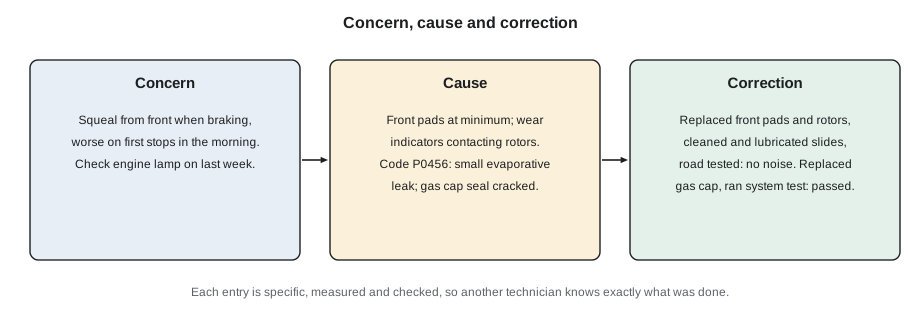
Kiran's first written cause line reads “brakes worn.” Marty sends it back. Her second reads: “Front pads measured 2 mm (2/32 in) inner and outer, both sides (minimum 3 mm (3/32 in)). Wear indicators contacting rotors, causing squeal. Rotors near minimum thickness with 0.07 mm (0.003 in) thickness variation.” That one he signs.
Estimates and authorization
Customers must authorize work before it is done, and the authorization must be recorded. In Alberta, automotive repair businesses are licensed by the Alberta Motor Vehicle Industry Council, AMVIC, and the consumer protection rules for them require an estimate when the customer asks for one and the customer's consent before the shop charges significantly more than the estimate. When a technician finds additional work needed, the advisor calls the customer, explains it, gives a new estimate and records the approval with the time, the person who approved it and the amount.
# Does the final bill need the customer's further approval? (Ridgeline's own policy in Alberta: any increase over 5 percent or 20 CAD is re-approved)
def needs_approval(estimate, final):
    over = final - estimate
    allowed = min(estimate * 0.05, 20.00)
    return over > allowed, allowed
for estimate, final in ((480.00, 495.00), (480.00, 512.00), (1650.00, 1690.00)):
    flag, allowed = needs_approval(estimate, final)
    print(f"estimate {estimate:8.2f} CAD, final {final:8.2f} CAD, allowed over {allowed:6.2f}: "
f"{'call the customer first' if flag else 'within the limit'}")estimate 480.00 CAD, final 495.00 CAD, allowed over 20.00: within the limit estimate 480.00 CAD, final 512.00 CAD, allowed over 20.00: call the customer first estimate 1650.00 CAD, final 1690.00 CAD, allowed over 20.00: call the customer first
In practice, Ridgeline calls for approval before any increase at all, because customers trust a shop that never surprises them. Simone also asks customers whether they want their old parts returned, notes the answer on the repair order, and keeps replaced parts until the vehicle is picked up.
Talking to customers
Technicians do not always speak to customers, but when they do, and when they write the notes the advisor reads aloud, they need to communicate clearly. A good customer interview gets the details that make diagnosis faster: when the problem happens, whether the engine is hot or cold, at what speed, over what kind of road, how long it has been happening, whether anything was done recently, and whether a warning lamp is on. Simone uses a checklist for intermittent problems so nothing is missed.
When explaining work, the technician or advisor uses plain language, avoids jargon, separates what is needed for safety from what is recommended soon and what can wait, and gives the customer the information to decide. Marty's advice to Kiran is to show rather than tell: a worn pad next to a new one, or a photo of a leaking seal, explains more than any description. He also reminds her that the customer owns the vehicle and makes the decisions; the shop's job is to give honest, accurate advice.
| Concern as first written | Better questions to ask | Better concern line |
|---|---|---|
| Noise from front | When? Braking, turning, over bumps? Speed? Hot or cold? | Squeal from front when braking, worse on first stops in the morning |
| Car won't start sometimes | Clicks, cranks slowly or cranks normally? Weather? After sitting how long? | Cranks normally but does not start after sitting overnight, about twice a week |
| Shakes | At what speed? Braking or cruising? In the steering wheel or the seat? | Steering wheel vibrates at 100 to 110 km/h (60 to 70 mph) on smooth highway, not while braking |
Worked problem
Writing up an additional repair
During the inspection of the Lindqvists' minivan, Kiran finds the left front sway bar link loose with a torn boot. The repair order authorized brake inspection and check engine diagnosis only. What must happen before the link is replaced?
Show solution
- Record the finding with a measurement or observation: “Left front sway bar link ball joint has visible play and torn boot; clunk on bounce test.”
- Look up the labour time and part price and give them to Simone.
- Simone calls Mrs. Lindqvist, explains the finding and its effect (a clunk over bumps, and eventually a link that could separate), and gives the estimate.
- If approved, Simone records the time, the name of the person who approved and the amount; if declined, she records that the customer declined, so the shop has a record that it advised the repair.
- Only then does Kiran replace the link.
Answer: Find, document, estimate, get and record the approval, then do the work. A declined recommendation is recorded too.
Common mistakes
MistakeSelecting the model from a menu instead of entering the VIN.
InsteadEnter or scan the VIN so the system finds the exact vehicle configuration.
MistakeReading only the step of the procedure you need.
InsteadRead the whole procedure; cautions and one-time-use parts are easy to miss.
MistakeWriting “fixed” or “checked” on the repair order.
InsteadWrite concern, cause with test results, and correction with the confirming test.
MistakeDoing extra work because it is obviously needed.
InsteadGet and record the customer's authorization first.
MistakeAssuming a technical service bulletin means a free repair.
InsteadA bulletin describes a fix; warranty decides who pays. Recalls are free.
MistakeFailing to record a declined recommendation.
InsteadRecord it; it protects the customer and the shop.
Summary and key terms
- The 17-character VIN identifies the vehicle exactly; character 10 is the model year and character 9 is the check digit.
- Service information includes specifications, procedures, diagnostics, wiring diagrams, maintenance schedules, bulletins and labour times.
- Technical service bulletins describe known fixes; safety recalls are free repairs required by law.
- The repair order is the contract and the record; write concern, cause and correction specifically.
- Customers authorize work before it is done; AMVIC's rules require consent before charging significantly more than the estimate.
- Good customer communication gathers precise details and explains work in plain language.
- VIN
- The 17-character vehicle identification number.
- Check digit
- The ninth VIN character, calculated from the others to detect errors.
- Technical service bulletin
- A manufacturer notice about a known problem and its repair.
- Recall
- A required, free repair of a safety-related defect.
- Three Cs
- Concern, cause and correction, the structure for recording work on a repair order.
- Authorization
- The customer’s recorded approval of work and its estimated cost.
Practice problems
Work each problem on paper first, then reveal the answer to check.
Which VIN character gives the model year?
Show answer
The tenth.
Why are the letters I, O and Q never used in a VIN?
Show answer
They are easily confused with 1 and 0.
Rewrite “checked noise, OK” as a proper cause line.
Show answer
For example: “Road tested 15 km (9 mi) with customer; noise not reproduced at any speed or braking condition. Inspected suspension and brakes: no wear or looseness found.”
A customer declines a recommended repair. What do you record?
Show answer
The finding, the recommendation, the estimate and that the customer declined, with the date.
Lesson quiz · 5 questions
Score 60% or more to complete this lesson.
Create a free account to save your progress, take quizzes and earn a certificate.