
AUTO-110 · Lesson 11 of 12 · 22 min
Hybrid and EV awareness for the general shop
Ines Moreau's hybrid comes in for its oil service, and Theo asks Kiran to pull it into bay 6. She gets in, presses the start button, sees a green READY light on the dash and hears nothing at all. She presses the brake, shifts into drive and the car glides silently forward into the bay. Theo is waiting with the lesson. “That car was running the moment the READY light came on,” he says. “If the battery gets low, the engine will start by itself, with your hand in the belt. And under the floor there's a battery at a couple of hundred volts. Before you touch one of these, you learn the rules.”
Hybrids and electric vehicles are now a regular part of every general shop's work. Most of their routine service, such as tires, brakes, wipers, cabin filters, 12 V batteries and inspections, is like that of any other vehicle, but they carry high-voltage systems that can kill, and their electric drive changes some basic procedures. This lesson gives the awareness every technician in a general shop needs, so that they can do routine work safely and recognize where it ends. It does not teach high-voltage work. Disabling, testing and repairing high-voltage systems is done only by technicians with specific training and equipment, and AUTO-410 covers it.
Types of electrified vehicles
A mild hybrid uses a small electric motor-generator, often in place of the alternator, and a battery of about 48 V to help the engine, restart it quickly in start-stop driving and recover some braking energy. It cannot drive on electricity alone. A full hybrid, like Ines's, has a larger motor and a high-voltage battery, typically a few hundred volts, and can drive short distances on electricity alone at low speed; the engine and motor share the work, and the battery is charged by the engine and by regenerative braking. A plug-in hybrid has a larger battery that can also be charged from the grid, and it can drive tens of kilometres on electricity before the engine is needed. A battery electric vehicle, like Dr. Singh's, has no engine: a large high-voltage battery, usually 350 to 800 V, powers one or more motors.
Electrified vehicles make up a growing share of new vehicle sales, and every technician will meet more of them each year. Canada had set a federal standard requiring a rising share of new light vehicles to be zero-emission, starting with the 2026 model year, but the government paused the 2026 target in September 2025 and began a review. Sales vary widely by province, with the highest shares in British Columbia and Quebec. Whatever the policy, the vehicles already on the road will be in shops for many years.
The high-voltage system
The high-voltage system includes the high-voltage battery, made of many lithium-ion or, in some older hybrids, nickel-metal hydride cells; the battery management system that monitors and protects it; contactors, heavy relays that connect the battery to the rest of the system when the vehicle is on; the inverter, which converts the battery's direct current into the alternating current that drives the motors and back again during regenerative braking; the motor-generators; the DC-to-DC converter, which charges the 12 V battery and supplies the low-voltage system; the electric air conditioning compressor and cabin heater; and, on plug-in vehicles, the onboard charger and charging port. High-voltage cables are coloured orange, a convention used by manufacturers worldwide, and high-voltage components carry warning labels.
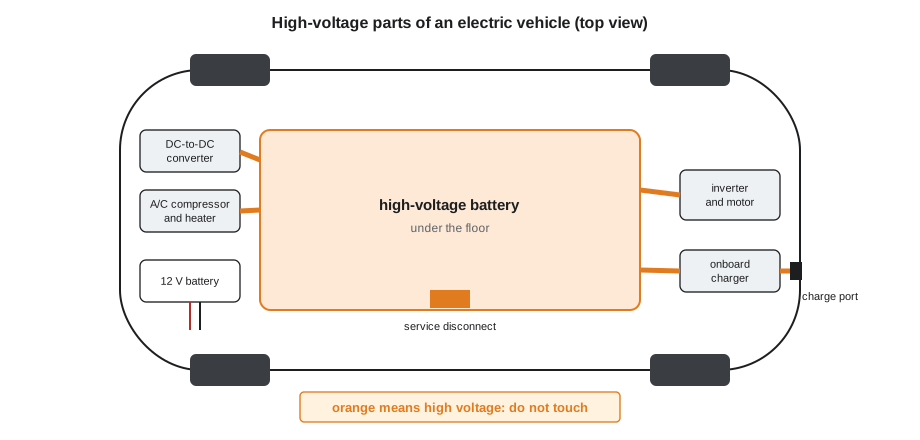
The voltages involved are far above anything in the 12 V system. Direct current at a few hundred volts can drive a dangerous current through the body, and it does not release its grip the way a brief alternating shock may. The battery also stores enormous energy, so a short circuit can cause an arc flash that burns and blinds. Unlike a 12 V system, the high-voltage system is isolated from the vehicle's body, and a monitoring circuit checks continuously that the isolation is intact, so a single fault does not normally make the body live; two faults can. Capacitors in the inverter can stay charged for a short time after the system is switched off.
# Compare the 12 V system with the high-voltage systems Kiran will meet (illustrative values)
# hand-to-hand body resistance falls as voltage rises, because the skin breaks down (rough values, ohms)
systems = [("12 V battery", 12.6, 0.6, 15000), ("mild hybrid", 48, 0.5, 2900), ("Ines's hybrid", 202, 1.3, 1400),
           ("Dr. Singh's EV", 360, 64.0, 1250), ("large 800 V EV", 800, 100.0, 1100)]
for name, volts, kwh, body_r in systems:
    ma = volts / body_r * 1000
    effect = ("not felt" if ma < 1 else "felt" if ma < 10 else "cannot let go" if ma < 50 else "can be fatal")
    print(f"{name:<16} {volts:>5g} V, {kwh:6.1f} kWh: body current about {ma:5.0f} mA -> {effect}")
print(f"Dr. Singh's battery stores as much energy as about {64.0 / 0.6:.0f} 12 V starting batteries")12 V battery 12.6 V, 0.6 kWh: body current about 1 mA -> not felt mild hybrid 48 V, 0.5 kWh: body current about 17 mA -> cannot let go Ines's hybrid 202 V, 1.3 kWh: body current about 144 mA -> can be fatal Dr. Singh's EV 360 V, 64.0 kWh: body current about 288 mA -> can be fatal large 800 V EV 800 V, 100.0 kWh: body current about 727 mA -> can be fatal Dr. Singh's battery stores as much energy as about 107 12 V starting batteries
The body resistances and thresholds in the code are rough figures, but the result is clear: the 12 V system cannot push a dangerous current through the body, a 48 V system can give a shock that makes it hard to let go, and every high-voltage system can kill. This is why the rules that follow are not optional.
Ready mode and unexpected movement
An electrified vehicle can be switched on and ready to drive while making no sound. The instrument cluster shows a READY indicator or a similar message. In that state, a hybrid's engine can start without warning whenever the battery needs charging, the cabin needs heat or the system needs to warm the catalytic converter, and an electric vehicle can move as soon as it is shifted into gear. Ridgeline's rules for any electrified vehicle are posted on each lift: before working on it, switch it off, confirm the READY indicator is out, put the vehicle in park with the parking brake set, and take the key or key fob at least the distance from the vehicle the manufacturer specifies, often several metres, so the vehicle cannot be switched on by a passing key. Some technicians put the fob in a shielded pouch. A hybrid is never left in ready mode with its hood open and hands near the engine.
Electric vehicles also roll silently in the shop and the parking lot. They are driven at walking speed with someone watching, and Ridgeline does not allow them to be left in ready mode unattended.
What a general technician may and may not do
Ridgeline's policy, which follows the manufacturers' service information and the shop's own high-voltage safety program, divides the work on electrified vehicles into three groups. The first is routine service that does not involve the high-voltage system: tires and wheels, brake pads and fluid, wiper blades, cabin filters, lights, the 12 V battery, inspections, suspension and steering parts away from orange cables, and, on hybrids, engine oil and filter changes and other engine maintenance with the vehicle switched off and the key away. A technician who has completed the shop's awareness training, as Kiran now has, may do these jobs.
The second group is work near the high-voltage system, such as removing a component that sits next to an orange cable, replacing a radiator on a hybrid, or servicing the coolant loop that cools the battery or inverter. It requires following the service information's procedure, which may include disabling the high-voltage system first, and it is done only by a technician trained for it. The third group is work on the high-voltage system itself: disabling it, verifying zero voltage, and testing or replacing high-voltage components, cables and batteries. That is done only by a qualified high-voltage technician, who in Ridgeline's case is Marty, with rated insulating gloves and leather protectors, an insulated tool set, a meter rated for the voltage and category, and the manufacturer's procedure.
| Work | Example | Who may do it at Ridgeline |
|---|---|---|
| Routine, away from high voltage | Tires, brake pads, cabin filter, 12 V battery, hybrid oil change | Any technician with awareness training |
| Near high voltage | Hybrid radiator, inverter coolant, parts next to orange cables | Trained technician, following the procedure, often after disabling |
| On high voltage | Disabling and verifying zero voltage, cables, battery, inverter, motor | Qualified high-voltage technician only |
Disabling the high-voltage system follows the manufacturer's procedure exactly: switching off, removing the key, disconnecting the 12 V battery, which opens the contactors, removing the service disconnect or cutting a first-responder loop if the procedure requires, waiting the specified time for the capacitors to discharge, and verifying the absence of voltage with a properly rated meter that is itself tested before and after. Insulating gloves for this work are rated for the voltage, inspected and air-tested before each use and periodically retested, as electrical safety standards such as CSA Z462 require. These skills are taught in AUTO-410.
Routine service with a difference
Several routine jobs need extra care on electrified vehicles. Lifting: the battery pack fills much of the floor between the axles, so the lifting points must be found in the service information and the pads placed exactly; a pad on the battery case can crack it, damage cells and, at worst, start a fire. Some electric vehicles have lifting-point adapters that fit sockets in the body. Brakes: regenerative braking does much of the stopping, so the friction brakes are used less, and rotors and calipers may rust or seize from lack of use, especially where roads are salted. Many electrified vehicles also have an electric brake booster or brake-by-wire system that can apply the calipers with high pressure on its own when a door is opened or the vehicle is woken up, so the service information's procedure to put the brake system in maintenance mode, often with a scan tool, is followed before the pads are touched.
Tires: electric vehicles are heavy and deliver strong torque instantly, so they wear tires faster than similar cars and often use tires with higher load ratings and special foam linings for noise; replacements must match the specification. Coolant: many electrified vehicles have several coolant loops, and some use a special low-conductivity coolant for the battery and power electronics; only the specified coolant is used, and filling and bleeding often need a scan tool. Towing and moving: most electric vehicles and many hybrids must not be towed with their drive wheels on the ground, which can drive the motor as a generator and damage the inverter; they are moved on a flatbed or with wheel dollies, and the owner's manual explains how to put them in a towing or neutral mode for moving short distances in the shop.
The 12 V battery matters on these vehicles too. If it is flat, an electrified vehicle cannot close its contactors and will not switch on, even with a full high-voltage battery. Jump-starting it uses the 12 V jump points the manufacturer specifies; it is never attempted on the high-voltage system, and a hybrid or electric vehicle is never used to jump-start another vehicle unless its manufacturer allows it.
Damaged vehicles and battery fires
A lithium-ion battery that has been crushed, punctured, overheated or submerged can go into thermal runaway: a cell overheats, ignites its neighbours, and the fire spreads through the pack, releasing toxic and flammable gases. Such a fire is very hard to put out and can reignite hours or days later. A vehicle with a damaged battery, a battery warning, smoke, hissing, popping or a sweet chemical smell is not brought into the shop. It is left outside, well away from buildings and other vehicles, the fire department is called if there are signs of fire, and the manufacturer's emergency response guide is consulted. Ridgeline marks a quarantine area at the back of the lot for damaged electrified vehicles.
Charging
Electric vehicles and plug-in hybrids are charged in three ways. Level 1 charging uses an ordinary 120 V household outlet and adds only a few kilometres of range per hour. Level 2 charging uses a 208 or 240 V supply and a wall-mounted charger, the most common arrangement at homes and businesses. DC fast charging uses a large off-board charger that supplies direct current straight to the battery at high power. Ridgeline has a Level 2 charger in the yard so that customers' electric vehicles can be charged before they are returned if service work used up range. The charging cable and connector are inspected before use and never used if damaged, and the shop does not use extension cords with portable chargers.
# How long does a charge take? (illustrative, ignoring charging losses and taper)
battery_kwh = 64.0
start, target = 0.20, 0.80                     # state of charge
needed = battery_kwh * (target - start)
for name, kw in (("Level 1, 120 V 12 A", 1.4), ("Level 2, 240 V 32 A", 7.7), ("DC fast", 75.0)):
    hours = needed / kw
    print(f"{name:<20} {kw:5.1f} kW: {needed:4.1f} kWh in {hours:5.1f} h ({hours * 60:4.0f} min)")
consumption = 17.0                           # energy per 100 km, kWh
print(f"{needed:.1f} kWh adds about {needed / consumption * 100:.0f} km of range")Level 1, 120 V 12 A 1.4 kW: 38.4 kWh in 27.4 h (1646 min) Level 2, 240 V 32 A 7.7 kW: 38.4 kWh in 5.0 h ( 299 min) DC fast 75.0 kW: 38.4 kWh in 0.5 h ( 31 min) 38.4 kWh adds about 226 km of range
Worked problem
Rotating the tires on Dr. Singh's EV
Dr. Singh's electric hatchback is booked for a tire rotation, brake inspection and cabin filter. What must Kiran do differently from a gasoline car?
Show solution
- Switch the vehicle off, confirm READY is out, set park and the parking brake, and keep the key fob the specified distance away.
- Look up the lifting points and place the pads exactly, clear of the battery pack; use the manufacturer's lift adapters if specified.
- Before touching the brakes, follow the service information to put the electric brake system in its maintenance mode, if required.
- Check the rotors and caliper slides carefully for rust and sticking, since regenerative braking means the friction brakes are used less.
- Rotate the tires in the specified pattern, torque the wheels, and relearn the TPMS if required.
- Leave every orange cable and high-voltage component alone, and report anything damaged to Marty.
Answer: Make the vehicle safe, lift at the correct points, use the brake maintenance mode, and stay away from the high-voltage system.
Common mistakes
MistakeAssuming a silent vehicle is switched off.
InsteadCheck the READY indicator; a hybrid's engine can start by itself.
MistakeLeaving the key fob in the vehicle during service.
InsteadKeep it the specified distance away so the vehicle cannot be switched on.
MistakePlacing lift pads on the battery pack.
InsteadUse only the manufacturer's lifting points or adapters.
MistakeTouching orange cables or high-voltage parts without training.
InsteadOnly qualified high-voltage technicians work on the high-voltage system.
MistakeTowing an electric vehicle with its drive wheels on the ground.
InsteadUse a flatbed or dollies, or the manufacturer's towing mode.
MistakeBringing a vehicle with a damaged battery into the shop.
InsteadQuarantine it outside and follow the emergency response guide.
Summary and key terms
- Mild hybrids, full hybrids, plug-in hybrids and battery electric vehicles carry increasingly large high-voltage systems.
- High-voltage cables are orange; the system includes the battery, contactors, inverter, motors, DC-to-DC converter and charger.
- A vehicle in ready mode may move or start its engine silently; switch it off and keep the key away.
- Routine service is done with awareness training; work on the high-voltage system is for qualified technicians only.
- Lifting points, brake maintenance modes, tires, coolant and towing need extra care on electrified vehicles.
- Damaged lithium-ion batteries can burn and reignite; quarantine such vehicles outside.
- Ready mode
- The state in which an electrified vehicle is switched on and can move or start its engine.
- Inverter
- The unit that converts battery direct current into alternating current for the motors.
- Contactor
- A heavy relay that connects the high-voltage battery to the rest of the system.
- Regenerative braking
- Using the motor as a generator to slow the vehicle and recharge the battery.
- Thermal runaway
- A self-sustaining overheating of battery cells that can lead to fire.
- Service disconnect
- A removable plug or switch that breaks the high-voltage battery circuit.
Practice problems
Work each problem on paper first, then reveal the answer to check.
What colour are high-voltage cables?
Show answer
Orange.
Why must the key fob be kept away from a hybrid during service?
Show answer
The vehicle could be switched on and its engine could start, or it could move.
Name two routine jobs on an electric vehicle that need extra care.
Show answer
Lifting, brakes, tires, coolant, towing (any two).
Why will an electric vehicle with a flat 12 V battery not switch on?
Show answer
The 12 V system powers the controls that close the high-voltage contactors.
Lesson quiz · 5 questions
Score 60% or more to complete this lesson.
Create a free account to save your progress, take quizzes and earn a certificate.