
ACCT-499 · Lesson 11 of 12 · 25 min
Writing the final report: structure, evidence, skepticism and ethics
The report is the engagement's main product. Months of analysis reach the client only through what the team writes, and a director who reads ten pages will form a view of Bluestem, and of the team, from them. Professional reports are read in a particular way: busy readers start with the executive summary, skim headings, look at a chart or two, and read in detail only the sections that concern them. This lesson covers how to write for that reader: structure, evidence, tone, exhibits, professional skepticism, ethics and documentation. It applies the case-writing skills of ACCT-480 to a longer, real-world document.
The structure of the report
Bluestem's report follows a structure common in advisory work. Each part has one job.
| Part | Purpose | Typical length |
|---|---|---|
| Cover letter | Addresses the client, states the purpose, scope and limitations, and refers to the engagement letter | 1 page |
| Executive summary | States the main conclusions and top recommendations so a reader who stops here knows what matters | 1 to 2 pages |
| Background and scope | Describes the organization, the questions and the work done, including what was not done | 1 to 2 pages |
| Findings by theme | Presents each finding with evidence and significance, grouped by theme rather than by workstream | 8 to 12 pages |
| Recommendations and roadmap | Sets out prioritized, sequenced recommendations with owners, costs and measures | 3 to 4 pages |
| Appendices | Holds detailed analysis, ratio tables, methods, the data used and the list of interviews | As needed |
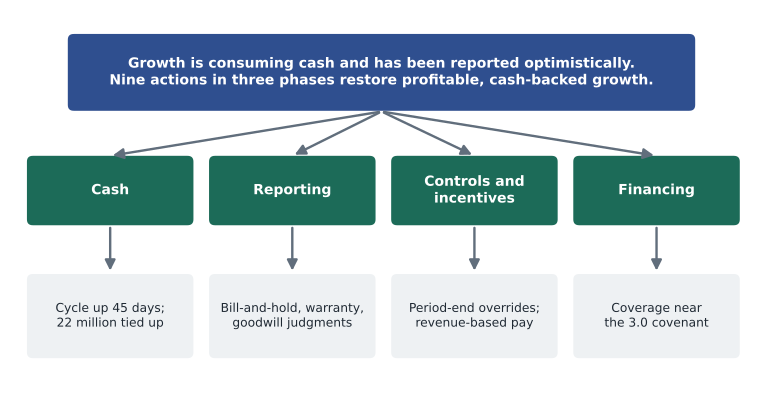
Grouping findings by theme rather than by workstream is a deliberate choice. A report organized by workstream reads like five separate reports stapled together. A report organized by theme tells a story: Bluestem's growth is consuming cash (financial analysis); some of the growth was recognized too early or measured optimistically (reporting issues); controls did not stop it (controls and analytics); incentives encouraged it (performance); and the consequences reach the company's financing (tax and finance). Each theme draws on several workstreams, which is the integration the capstone is meant to demonstrate.
The pyramid principle
Barbara Minto's pyramid principle, widely taught in consulting, says to start with the answer and then support it. The executive summary opens with the main conclusion, followed by the three or four key points that support it, each with its evidence. The same structure applies within each section and each paragraph: the first sentence states the point, the rest support it. Readers can stop at any level and still have the essential message. Academic writing often works the other way, building from evidence to conclusion; professional readers do not have time for that.
Writing the executive summary
Amara drafts the executive summary and the team revises it four times. It must be clear to a director who is not an accountant, so it avoids jargon, uses short sentences and gives numbers in round terms. The program checks the readability of the first paragraph using the Flesch reading ease score, a rough but useful measure based on sentence length and syllables per word.
# Lesson 11: readability check of the draft executive summary (Flesch reading ease, simple syllable count).
import re
draft = ("Bluestem is growing quickly, but its profits and cash are not keeping up. Revenue rose 27% over two years, "
         "while operating margin fell from 10.3% to 7.4% and cash from operations fell to 5.8 million. "
         "Most of the gap is cash tied up in receivables and inventory. We found three accounting issues that would reduce "
         "2026 profit, and control weaknesses in revenue cut-off and system access. We recommend nine actions in three phases. "
         "The first three can be completed before the 2027 interim reports and carry little cost.")
def syl(w):
    w = w.lower().strip('.,;:')
    groups = re.findall(r'[aeiouy]+', w)
    n = len(groups) - (1 if w.endswith('e') and len(groups) > 1 else 0)
    return max(1, n)
sents = [s for s in re.split(r'(?<=[.!?])\s+', draft) if s]
words = re.findall(r"[A-Za-z0-9.']+", draft)
words = [w for w in words if re.search('[A-Za-z0-9]', w)]
sy = sum(syl(w) for w in words)
fre = 206.835 - 1.015 * len(words) / len(sents) - 84.6 * sy / len(words)
print(f"Sentences {len(sents)}, words {len(words)}, average {len(words) / len(sents):.1f} words per sentence")
print(f"Flesch reading ease {fre:.0f} (60-70 is plain English; board papers often score 30-50)")
long = [s for s in sents if len(s.split()) > 25]
print(f"Sentences over 25 words: {len(long)}")Sentences 6, words 89, average 14.8 words per sentence Flesch reading ease 66 (60-70 is plain English; board papers often score 30-50) Sentences over 25 words: 0
The draft scores about 66, in the plain-English range, with an average of about 15 words per sentence. No sentence runs over 25 words; an earlier version had two, and the team split them. A readability score is not a substitute for judgment, and technical terms such as "impairment" are sometimes necessary, but checking keeps the team honest. Many board papers score far lower, and directors notice the difference.
The final executive summary has four paragraphs: the main message; the three most important findings with their numbers; the top recommendations with timing; and a short statement of scope and limitations. It does not hedge every sentence. Where the evidence is strong, as with the bill-and-hold sale, it says so plainly. Where the conclusion depends on judgment, as with the goodwill impairment, it explains the judgment in one sentence. A summary that qualifies everything is as unhelpful as one that overstates.
Evidence and exhibits
Every factual statement in the report must be traceable to evidence in the working papers: a document, a calculation, an interview note or a data extract. Before the draft goes to the client, a team member who did not write a section checks each number in it against the working papers. This tick-and-tie review catches more errors than any other step, and it is standard practice in professional firms. In Bluestem's draft it found three errors, including a days-sales figure calculated on average rather than year-end receivables, inconsistent with the rest of the report.
Exhibits carry much of a report's message. A good exhibit has a title that states its point ("Receivables have grown much faster than revenue" rather than "Receivables and revenue, 2024 to 2026"), a clear source, consistent units and no decoration. Each exhibit is referred to in the text, and the text says what the reader should see in it. The team uses a small number of charts for trends and comparisons, and tables for precise figures, following the visualization principles from ACCT-341: start bar axes at zero, label directly, use colour sparingly and consistently.
Tone and wording
Tone matters because the report criticizes the work of people who will read it. The team writes about processes and evidence, not personalities: "finance approval was bypassed" rather than "the sales director ignored the rules." It acknowledges what works well, such as the company's strong customer relationships and its high subscription margins. It distinguishes facts from opinions and opinions from recommendations. And it uses language that matches its role as an advisory team: "we recommend", "management should consider", "based on the information we reviewed". The goal is a report that the people criticized can accept as fair, even if they disagree with parts of it.
Professional skepticism
Professional skepticism, a questioning mind and a critical assessment of evidence, is a requirement for auditors under Canadian Auditing Standards (CAS) and a habit every accountant needs. In an advisory engagement, skepticism means not accepting management's explanations at face value, seeking corroborating evidence, and being alert to information that contradicts the team's emerging conclusions as well as management's. The team applied skepticism to management's warranty assumption, which the claims data contradicted, and to the goodwill forecast. It also applied it to its own work: when the first journal extract looked clean, it asked why it was smaller than expected and found 1,200 missing entries.
Skepticism also guards against biases that affect every team. Confirmation bias leads teams to look for evidence that supports a conclusion they have already reached; the team's habit of listing alternative explanations before analysing, from Lesson 3, is a defence. Anchoring leads teams to adjust too little from management's numbers; rebuilding forecasts from source data, as with the goodwill test, is a defence. Overconfidence leads teams to present judgments as facts; showing sensitivity ranges is a defence.
Ethical issues in the report
Two ethical issues arose as the team wrote. First, the chief executive asked, after seeing the interim findings, whether the team could "soften" the goodwill finding because the company was about to present at an investor conference. Amara discussed the request with Professor Adeyemi. The team's obligations to integrity and objectivity mean it cannot change a finding to suit the client's communications. It can make sure the finding is fair, with the uncertainty explained, and it can respect the client's control over its own disclosures; the report is confidential and the company decides what to say publicly. The team kept the finding, added a sentence on the range of reasonable outcomes, and noted the request in its working papers.
Second, while testing payments, Priya found that one vendor's bank account matched the personal account of a buyer's spouse. The match might be innocent, but it might indicate a conflict of interest or fraud. The team's confidentiality obligations do not allow it to discuss the matter outside the engagement, and its role does not include investigating individuals. It reported the match privately to Ms. Marsh and the audit committee chair, as the engagement letter provides for matters suggesting possible fraud, and left the investigation to them. It did not name the employee in the report, which records only that a matter was referred to the audit committee.
Documentation
The working papers support the report and record the team's work. They include the engagement letter, the plan, the document request list and responses, interview notes, analysis files and scripts, the tick-and-tie review, the supervisor's review notes and their resolution, and the final report. Good documentation lets someone who was not on the team understand what was done and why. It protects the team if its conclusions are later questioned, and it is how professional firms demonstrate quality. At the end of the term, client data are returned or destroyed as the engagement letter requires, and the team confirms this in writing.
Worked problem
Rewriting a finding for tone
Draft: "The CFO failed to supervise the year-end journals and personally posted a fraudulent 4.8-million-dollar revenue entry." Rewrite it to be accurate and fair.
Show solution
- Remove words that imply intent or wrongdoing the evidence does not establish, such as "failed" and "fraudulent".
- Describe the facts: a manual entry, its amount, timing and user account.
- State the explanation obtained and the control weakness it reveals.
- Link to the recommendation.
Answer: "A manual journal entry of 4.8 million was posted to revenue at 11 p.m. on December 31 using the chief financial officer's account, at the sales director's request, without the finance review the policy requires. We recommend that the ERP workflow prevent such entries without documented approval."
Common mistakes
MistakeOrganizing findings by workstream.
InsteadOrganize findings by theme so the report tells an integrated story.
MistakeBuilding up to the conclusion at the end.
InsteadStart with the answer and support it (the pyramid principle).
MistakeLeaving numbers unchecked against working papers.
InsteadHave a second team member tick and tie every figure.
MistakeSoftening a finding at the client's request.
InsteadKeep findings objective; ensure fairness by explaining uncertainty.
MistakeWriting about people rather than processes.
InsteadDescribe facts, processes and evidence; avoid language implying intent.
Summary and key terms
- The report is structured for busy readers: cover letter, executive summary, background, findings by theme, recommendations, appendices.
- Use the pyramid principle: answer first, then support.
- Check readability, and tick and tie every number to the working papers.
- Write about processes and evidence, acknowledge strengths and match the language to the advisory role.
- Apply professional skepticism to management's evidence and to the team's own work.
- Handle ethical pressures and possible fraud through integrity, confidentiality and the agreed reporting channel.
- Executive summary
- A short opening section that states the main conclusions and recommendations.
- Pyramid principle
- A structure that starts with the main message and then gives supporting points and evidence.
- Tick and tie
- Checking each figure in a report against its supporting working paper.
- Professional skepticism
- A questioning mind and critical assessment of evidence.
- Working papers
- The documentation of the work performed, evidence obtained and conclusions reached.
- Confirmation bias
- The tendency to seek and favour evidence that supports an existing belief.
Practice problems
Work each problem on paper first, then reveal the answer to check.
Why organize findings by theme rather than workstream?
Show answer
To tell an integrated story that draws on several workstreams.
State the pyramid principle in one sentence.
Show answer
Start with the main message, then give the supporting points, then the evidence.
What Flesch score did the draft summary achieve, and what does it indicate?
Show answer
About 66, in the plain-English range.
What did the tick-and-tie review find?
Show answer
Three errors, including a DSO figure inconsistent with the rest of the report.
Give an example of an exhibit title that states its point.
Show answer
"Receivables have grown much faster than revenue."
How should the team respond to a request to soften a finding?
Show answer
Keep it, ensure it is fair with uncertainty explained, and document the request.
What did the team do about the vendor and spouse bank account match?
Show answer
Reported it privately to the CFO and audit committee chair and left the investigation to them.
Name two biases that skepticism helps guard against.
Show answer
Confirmation bias and anchoring (or overconfidence).
List four items in the working papers.
Show answer
Any four of: engagement letter, plan, document requests, interview notes, analysis files and scripts, tick-and-tie review, review notes, final report.
What happens to client data at the end of the term?
Show answer
It is returned or destroyed as the engagement letter requires, confirmed in writing.
Lesson quiz · 5 questions
Score 60% or more to complete this lesson.
Create a free account to save your progress, take quizzes and earn a certificate.