
WLD-320 · Lesson 8 of 12 · 17 min
Pipe positions: 1G, 2G, 5G and 6G
A plate welder's positions are fixed for the whole joint: a vertical plate stays vertical. A pipe welder's position changes as the arc moves around the joint, and the position named for the test is really a description of how the pipe is held. Lucia Ferreira pins a chart of the pipe test positions on the booth wall the week Devon starts fixed-position work and tells him that by the end of the month he must be able to explain, for any position, what the arc is doing at every clock position, and what the test in that position qualifies him to weld. This lesson covers the four pipe groove positions, the restricted 6G test, how welders practice each one, and how the positions and other variables on a test set the range a welder is qualified for.
The four pipe groove positions
The positions are named by a number and a letter. G means a groove weld, and the number describes how the pipe is held. The same system is used in ASME Section IX, AWS and CSA documents, with small differences in the wording of each.
| Position | How the pipe is held | What the welder does | Weld positions around the joint |
|---|---|---|---|
| 1G | Horizontal, rolled | Welds on top while the pipe turns | Flat only |
| 2G | Vertical, fixed | Welds around a horizontal joint | Horizontal all the way round |
| 5G | Horizontal, fixed | Welds up (or down) both sides | Overhead at the bottom, vertical on the sides, flat at the top |
| 6G | Inclined at 45 degrees, fixed | Welds up both sides of an inclined joint | All positions, constantly changing |
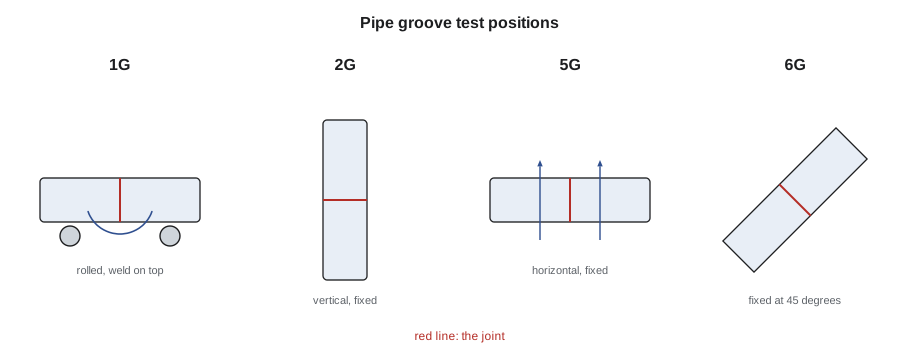
In the 1G position, the welder stays at the top of the pipe, at about eleven to one o'clock, and the pipe is rotated toward him as he welds, either by hand between electrodes or on powered rollers. Rolled welding is fast and easy to do well, and it is how most shop spool welds are made.
In the 2G position, the pipe is vertical and the weld runs around it horizontally. The welder walks around the pipe, or welds part of the joint from each side. Gravity pulls the pool down onto the lower pipe, so the beads are run as stringers stacked from the bottom of the groove to the top, with the electrode angled slightly up. The bottom bevel, which faces up, is easy to wet; the top bevel, which faces down, is where undercut and lack of fusion form.
In the 5G position, the pipe is horizontal and fixed. The welder works from the bottom of the joint up each side to the top, passing through overhead, vertical and flat in one half of the joint. 5G is the position most field welds on horizontal lines are made in, and it is the position where most fixed-joint skills are learned.
In the 6G position, the pipe is inclined at 45 degrees, plus or minus 5, and fixed. The weld is still run up each side, but the joint is tilted, so the bevel faces at the top and bottom change angle all the way around, and every point on the joint is at a mix of horizontal and vertical. 6G is the hardest pipe position and is the one used for most all-position pipe tests.
The restricted 6G test
Some owners and pipeline companies use a 6G test with a restriction ring, a plate or ring welded or clamped around the pipe close to the joint, often about 1/2 in from it, that blocks the welder's access on one side. The test is often called 6GR. It imitates the tight places of field work, where a structure or another pipe is in the way, and some codes use it for T, K and Y connections in tubular structures. Hartwell's Unit 4 work does not need it, but the refinery's own maintenance welders take it, and Rob Haldane shows Devon one he took years ago, with the scars of the restriction ring still on the pipe.
Practicing each position
Marta has Devon practice the positions in order of difficulty: 1G to settle his root and fill technique, 2G to learn horizontal stringers around a curve, 5G to learn the change from overhead to flat, and then 6G, which mixes the skills of 2G and 5G. On each, he welds the joint in sections with a different body position for each, because no one can reach all the way around a pipe from one place.
Body position matters more on pipe than on any other work. On a 5G joint at waist height, the welder starts the bottom kneeling or sitting under the pipe with the electrode pointing up, moves to a crouch for the side, and stands for the top. On a 6G joint, the angle of the pipe means the welder must lean into the joint on the low side and reach over it on the high side. Pipe welders plan their body position for each section before they strike an arc, and many make a dry run, moving the electrode holder around the joint without welding, to check they can see and reach every part. A welder who runs out of reach halfway through a section and stops leaves an unplanned restart, and that is where defects form.
| Section of a 6G joint | Typical body position | What to watch |
|---|---|---|
| Bottom, about 5:00 to 7:00 | Below the joint, looking up, arm braced | Sag of the root; seeing the low bevel |
| Sides, about 7:00 to 10:00 and 2:00 to 5:00 | Beside the joint, wrist turning | Keeping the angle to the inclined bevels |
| Top, about 10:00 to 2:00 | Above the joint, looking down | Overheating; the high bevel on the uphill side |
What a test qualifies
A welder's qualification test does not just prove that he can weld that coupon. It qualifies him to weld a range of production joints, set by the essential variables in the code. For welder performance qualification under ASME Section IX, the main variables are the process, the type of joint and whether backing is used, the filler metal group, the position, the pipe diameter, and the thickness of weld metal deposited.
Position is the first range Devon learns. Under Section IX, a 1G pipe test qualifies flat groove welds; 2G qualifies flat and horizontal; 5G qualifies flat, vertical and overhead; and 6G qualifies all positions. A welder who passes both a 2G and a 5G test is also qualified in all positions. Groove tests also qualify fillet welds in the same and easier positions. The details are in the code's position tables, and the edition on the job governs.
Diameter is the second. Small pipe is harder to weld than large pipe because the curve is tighter, so a test on small pipe qualifies a wide range of larger pipe, and a test on large pipe does not qualify small pipe. Under Section IX, a test on pipe of 2 7/8 in outside diameter or more qualifies pipe of that size and larger; a test on pipe between 1 in and 2 7/8 in qualifies 1 in and larger; and a test below 1 in qualifies the size tested and larger.
Thickness is the third. The range depends on the thickness of weld metal the welder deposited with each process, not on the wall of the coupon. A deposit thinner than 1/2 in qualifies up to twice the deposit; a deposit of 1/2 in or more, made with at least three layers, qualifies any thickness the procedure allows. On a combination test, each process gets its own range from what it deposited.
# Welder qualification ranges from a pipe test (simplified from ASME IX tables; the code edition governs)
def ranges(position, od, deposits):
    pos = {'1G': 'flat', '2G': 'flat, horizontal', '5G': 'flat, vertical, overhead', '6G': 'all'}[position]
    if od >= 2.875:
        dia = f"{2.875} in OD and larger"
    elif od >= 1.0:
        dia = f"{1.0} in OD and larger"
    else:
        dia = f"{od} in OD and larger"
    print(f"test {position} on {od} in OD: groove positions qualified: {pos}; diameter: {dia}")
    for process, t, layers in deposits:
        if t >= 0.5 and layers >= 3:
            rng = 'up to the maximum the procedure allows'
        else:
            rng = f"up to {2 * t:.3f} in of weld metal"
        print(f"  {process}: deposited {t} in in {layers} layers -> {rng}")
ranges('6G', 6.625, [('GTAW', 0.19, 2), ('SMAW', 0.242, 4)])
ranges('2G', 2.375, [('SMAW', 0.218, 3)])test 6G on 6.625 in OD: groove positions qualified: all; diameter: 2.875 in OD and larger GTAW: deposited 0.19 in in 2 layers -> up to 0.380 in of weld metal SMAW: deposited 0.242 in in 4 layers -> up to 0.484 in of weld metal test 2G on 2.375 in OD: groove positions qualified: flat, horizontal; diameter: 1.0 in OD and larger SMAW: deposited 0.218 in in 3 layers -> up to 0.436 in of weld metal
For Devon's planned 6G test on NPS 6 schedule 80 with a GTAW root and SMAW fill and cap, the code example shows the shape of the result: all positions, pipe of 2 7/8 in and larger, and a thickness range for each process of twice what it deposited. Lucia points out that his test does not qualify him for small-bore pipe below 2 7/8 in, which several Unit 4 lines are. He will need a second, smaller test, which the refinery accepts as a 2G on NPS 2 if he also passes the 6G on NPS 6. Elena Marchetti, who wrote the procedures, checks every line of the range before the test plan is final.
Other variables
Several other changes need a new test. Changing from a test with backing to welding without backing does, which is why Devon's backed plate qualification from the SMAW course does not let him weld open roots. A change of process, of the filler metal group, such as from a cellulosic to a low-hydrogen electrode group, or of the progression, from uphill to downhill, can also require a new test, depending on the code. The welder must also keep his qualification active: under Section IX, a welder who has not used a process for six months loses his qualification for it until he requalifies, and most employers record each welder's use of each process to show continuity.
In Texas there is no state welder certification for process piping, so the record that matters is the employer's: the welder's test record, the range it qualifies and the log that shows continuity. Refinery owners audit those records before a contractor's welders are allowed on their units. Hartwell's quality manual sets out how each welder's tests, qualification cards and continuity are recorded, and Lucia keeps the file.
What changes with position for the fill and cap
The root gets most of the attention on a pipe test, but the fill and cap show position skills just as clearly. On 2G, the stringers must be stacked so that each one wets into the bead below and the top bevel, without undercut along the top edge of the cap. On 5G, the overhead section at the bottom must be filled without sagging, and the cap must be the same height at six o'clock as at twelve. On 6G, every pass crosses from a horizontal-like position at the top and bottom of the incline to a vertical-like position on the sides, so the welder changes from stringers to a slight weave and back as he goes. A good 6G cap shows no sign of where the changes were.
Setting up a practice coupon
Practice coupons for fixed positions are mounted on a stand that holds the pipe rigidly at the right height and angle. The coupon is tacked to an arm or clamped in a positioner that will not move, because a coupon that shifts while the welder works changes the position and the test. For 6G, the angle is checked with a level and an angle finder, and the top of the coupon is marked. The height is set so that the welder can weld the bottom of the joint from a comfortable crouch or kneel and reach the top without standing on tiptoe; a coupon set too low or too high tires the welder and spoils the welding.
Marta sets Devon's stand at about chest height for 5G and a little lower for 6G, and moves it to a corner of the booth where he can reach all the way around. She has him practice the most difficult part of each position on its own: the bottom quarter of the 5G and the low side of the 6G, where the inclined bevel faces up and away from him. Only when those sections are consistent does she have him weld complete joints. Over three weeks he welds twenty-four 6G coupons, and she cuts every one into bend specimens or saw sections so that he can see inside every weld he makes.
Common mistakes
MistakeAssuming a backed plate test qualifies open-root pipe.
InsteadRemoving backing needs a separate test.
MistakeAssuming a large-pipe test covers small-bore lines.
InsteadCheck the diameter range; small pipe usually needs its own test.
MistakeStarting a section without checking reach.
InsteadMake a dry run and plan body position for each section.
MistakeLetting a qualification lapse by not using the process.
InsteadKeep continuity records and requalify after six months without use.
MistakeTreating 6G as two 5G halves.
InsteadAccount for the inclined bevels and change technique around the joint.
Summary and key terms
- 1G is rolled, 2G vertical, 5G horizontal fixed, and 6G inclined at 45 degrees fixed.
- 6GR adds a restriction ring to imitate tight field access.
- 6G, or 2G plus 5G, qualifies all positions under Section IX.
- A test on 2 7/8 in OD or more does not qualify smaller pipe.
- Thickness ranges come from the weld metal each process deposited.
- Removing backing, changing filler group or lapsing continuity can require a new test.
- 1G
- Pipe horizontal and rolled; the welder welds flat on top.
- 2G
- Pipe vertical and fixed; the weld is horizontal around it.
- 5G
- Pipe horizontal and fixed; the welder welds up or down both sides.
- 6G
- Pipe inclined at 45 degrees and fixed; all positions.
- Continuity
- Evidence that a welder has used a process often enough to keep the qualification active.
Practice problems
Work each problem on paper first, then reveal the answer to check.
A welder passes 2G and 5G tests on NPS 6. Which groove positions is he qualified for?
Show answer
All positions.
What diameter range does a test on 2.375 in OD pipe qualify?
Show answer
1 in OD and larger.
A welder deposited 1/4 in of SMAW in four layers. What thickness does SMAW qualify?
Show answer
Up to 1/2 in.
Lesson quiz · 5 questions
Score 60% or more to complete this lesson.
Create a free account to save your progress, take quizzes and earn a certificate.