
WLD-320 · Lesson 10 of 12 · 16 min
Small-bore and socket welds
For every large line in a process unit there are dozens of small ones: vents and drains, instrument connections, sample points, chemical injection, steam tracing and lines to pressure gauges. Most are NPS 2 and smaller, called small-bore piping, and most are joined with socket welds or threaded connections rather than butt welds. They are easy to overlook because each weld is small, but small-bore connections cause a large share of leaks and failures in operating plants, often from vibration fatigue at a poorly made socket weld. The Unit 4 package has 64 socket welds, and Glen gives them to Devon for a week before his test, partly because they need doing and partly because, as he puts it, nobody should leave this shop thinking small means simple.
Joining small-bore pipe
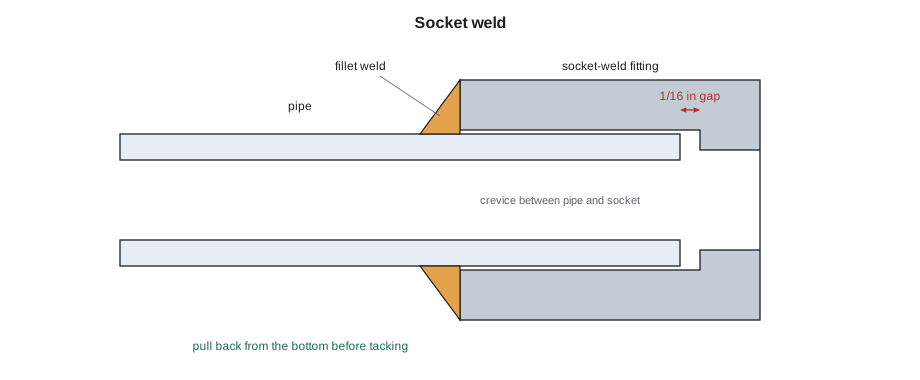
Small-bore pipe can be joined in three ways. Threaded connections screw together with a sealant on the threads and are used on low-pressure and non-hazardous services, often with a seal weld over the threads where the owner requires it. Butt welds are used where the owner wants a full-penetration joint, for example on severe cyclic service or where crevices are not allowed. Socket welds, the most common, join pipe to fittings with a fillet weld. The fitting has a socket, a bore slightly larger than the pipe's outside diameter, and the pipe is pushed into it and fillet welded around the outside where the pipe enters the fitting.
Socket welds are popular because they are easy to fit and align, the socket holds the pipe square, and there is no root to penetrate. They have two weaknesses. The joint leaves a small crevice between the pipe and the inside of the socket, which can trap fluid and start crevice corrosion, so some services forbid them. And the fillet weld concentrates stress at its toe and root, which makes it sensitive to vibration; a socket weld on a small line that shakes with a pump or compressor can crack through in months. Many owners now require a larger fillet, a 2 to 1 profile with a longer leg along the pipe, or a butt weld on vibrating small-bore lines.
The gap at the bottom of the socket
The most important rule for socket welds is the gap. The pipe must not be bottomed out in the socket when it is welded. When the fillet weld cools, it shrinks and pulls the pipe further into the socket; and when the line heats up in service, the pipe expands. If the pipe end is already against the bottom of the socket, the shrinkage and expansion have nowhere to go, and the stress cracks the weld at its root. The piping codes require a gap of about 1/16 in between the pipe end and the bottom of the socket before welding.
The fitter makes the gap by pushing the pipe fully into the socket, marking the pipe at the face of the fitting, pulling it back by the gap, and tacking it. Some fitters use a gap ring, a small split ring of wire or a dissolvable spacer placed in the bottom of the socket, which holds the gap and is left in place or flushed away. A second mark further back along the pipe, at a set distance from the first, lets the inspector check after welding that the pipe did not slide in. Lucia checks socket gaps on small-bore fit-ups the way she checks hi-lo on butt welds, and a socket weld without a visible gap mark is not accepted.
Fillet size and profile
The fillet on a socket weld must meet a minimum size related to the pipe's wall thickness, which the piping code gives in a figure and the job specification states. It is measured as the leg length along the pipe and the fitting. Hartwell's Unit 4 specification sets the minimum leg at 1.25 times the nominal pipe wall, and for vibrating lines a leg along the pipe twice as long as the leg on the fitting. The weld must not be undersized, but it must not be oversized either; a huge fillet on a small socket puts extra heat into a thin pipe wall and can distort the fitting.
# Socket weld fillet sizes and weld time for a small-bore list (Hartwell specification: leg >= 1.25 x wall)
import math
OD = {0.75: 1.05, 1: 1.315, 1.5: 1.9, 2: 2.375}
WALL80 = {0.75: 0.154, 1: 0.179, 1.5: 0.2, 2: 0.218}
welds = [(0.75, 18), (1, 26), (1.5, 12), (2, 8)]       # (NPS, number of socket welds), schedule 80
speed = 2.4                                           # GTAW fillet travel, in/min
total = 0
for nps, n in welds:
    leg = 1.25 * WALL80[nps]
    length = math.pi * (OD[nps] + leg)                     # weld length around the pipe at the leg
    t = n * (length / speed + 12)                    # minutes including fit and handling
    total += t
    print(f"NPS {nps:<4} x {n:>2}: minimum leg {leg:.3f} in, weld length {length:.1f} in, {t:5.0f} min")
print(f"total about {total / 60:.1f} hours for {sum(n for _, n in welds)} socket welds")NPS 0.75 x 18: minimum leg 0.193 in, weld length 3.9 in, 245 min NPS 1 x 26: minimum leg 0.224 in, weld length 4.8 in, 364 min NPS 1.5 x 12: minimum leg 0.250 in, weld length 6.8 in, 178 min NPS 2 x 8: minimum leg 0.273 in, weld length 8.3 in, 124 min total about 15.2 hours for 64 socket welds
The weld itself is quick; it is the fitting, gapping and handling that take the time. Glen's estimate for the 64 socket welds is about 15 hours, and Devon finishes them in 16.
Welding socket welds
Socket welds on carbon steel small-bore are usually welded with GTAW, which gives a neat, controllable fillet on thin pipe, or with small SMAW electrodes, 3/32 in or 1/8 in, where the procedure allows. Most socket welds are made in two passes: a root pass that fuses into the corner between the pipe and the fitting face, and a cap pass that brings the fillet up to size and blends it into the pipe. A single large pass on a thin pipe overheats it and can burn through the pipe wall just outside the socket.
On a fixed socket weld, the weld is run around the pipe in two halves, like a butt weld, starting at the bottom and finishing at the top. Because the fillet is small and the pipe is small, the position changes very quickly, and the welder must turn his wrist through a full half circle in a few seconds. Welding small-bore well is a test of torch control. Devon finds the NPS 3/4 drains the hardest: the pipe is so small that the cup almost touches the fitting all the way round, and he has to use a short cup and a stubby collet body to get the tungsten into the corner.
| Defect | Cause | Prevention |
|---|---|---|
| Root crack at the bottom of the socket | Pipe bottomed out, no gap | Pull back and mark the gap before tacking |
| Undercut on the pipe | Too much heat on the thin pipe wall | Aim the arc more at the fitting; lower current |
| Lack of fusion at the root of the fillet | Too little heat in the corner | Point the arc into the corner on the root pass |
| Undersized or unequal legs | Uneven filler or torch angle | Gauge the legs; follow the profile in the specification |
| Burn-through of the pipe | Single heavy pass | Use two passes and keep the heat down |
Branch connections on small-bore
Many small-bore lines start at a branch off a larger line. The branch can be a forged branch outlet fitting, such as a weld-on outlet for butt-welded branches, a socket-weld outlet or a threaded outlet. The outlet is set over a hole cut in the run pipe and welded to it with a groove weld that is finished with a fillet, all around a saddle-shaped joint whose position changes continuously. The hole must be cut to the size the fitting's maker specifies, usually the bore of the branch, and cleaned of slag and burrs, because a small drain whose hole was cut undersize or not cleaned will clog the first time it is used.
Branch outlet welds are among the hardest small welds a pipe welder makes, because the joint is a curve on a curve. At the sides of the run pipe, the outlet sits with a deep groove; at the top and bottom, the groove is shallow. The welder must change the number of passes and the weave around the joint to fill it evenly. Lucia examines every one Devon makes with a magnifier and a flashlight, looking for undercut on the run pipe and lack of fusion at the toe of the outlet.
Seal welds and threaded joints
Some owners require threaded joints on hazardous services to be seal welded: a small fillet over the threads to stop leaks. Seal welding has strict rules. The threads must be clean of sealant and tape, because burning sealant causes porosity, and the weld must cover all the exposed threads. A seal weld adds no strength credit to the joint under most codes; its job is only to stop leakage. Threaded joints that have been in service with a sealant are hard to seal weld well, and the usual practice is to replace the fitting rather than weld over contaminated threads.
Vibration and small-bore failures
Plants inspect small-bore connections because they fail. The classic failure is a fatigue crack that starts at the root of a socket weld on a small line cantilevered off a vibrating main line, with a heavy valve on its end. The crack grows with each cycle of vibration until the line breaks off. Good welding helps, through a sound root, a correct gap and a smooth fillet profile, but the main defenses are design ones: short, braced small-bore lines, light valves and supports. Rob tells Devon about a gauge line he once replaced three times in a year on a compressor discharge, until an engineer moved it and added a brace.
On the Unit 4 job, Raj has flagged eleven small-bore connections on the compressor discharge lines as vibration-sensitive. Their specification calls for the 2 to 1 fillet profile and a magnetic particle test of every weld. Devon welds them last, after he has had a week's practice on the others, and all eleven pass.
Checking a socket weld
A socket weld is checked in several steps. Before welding, the inspector checks the gap mark and the fit-up. After welding, the weld is examined visually for size, profile, undercut and cracks, and the fillet legs are measured with a fillet gauge at several places around the pipe. The weld must reach its minimum leg all the way round, including at the bottom of a fixed joint, where the pool tends to sag away from the fitting and leave the leg on the fitting short. Socket welds cannot be radiographed in a useful way to check root fusion, because the geometry of the socket confuses the image, so many specifications require magnetic particle or dye penetrant testing of the surface instead, especially on vibrating or hazardous lines.
Some plants also check the gap after welding by radiography. A radiograph shot across a socket weld shows whether the pipe end is still clear of the bottom of the socket, which proves the gap survived the welding. Hartwell's Unit 4 specification calls for this on a sample of the socket welds on the compressor discharge lines, and all eleven of Devon's flagged welds show a clear gap on the film.
Small-bore materials and procedures
Small-bore lines are often made of different materials from the main line. A carbon steel process line may have stainless instrument tubing, chrome-moly drains on a hot line, or a low-temperature carbon steel vent. Each connection is welded to the procedure for its materials, and where a small-bore fitting joins two different materials, the procedure covers the dissimilar joint and specifies the filler. Devon checks the material marking on every small fitting before he welds it, because forged fittings of different materials can look identical, and a carbon steel socket fitting welded into a stainless line will rust out in months. Two of the Unit 4 drains are on a chrome-moly steam line, and Marta welds those to their own procedure with preheat.
Common mistakes
MistakeBottoming the pipe in the socket.
InsteadPull it back about 1/16 in and mark the gap before tacking.
MistakeWelding a socket weld in one heavy pass on thin pipe.
InsteadUse a root pass and a cap pass to control heat.
MistakeSeal welding over thread sealant.
InsteadClean the threads completely, or replace the fitting.
MistakeCutting a branch hole undersize and leaving slag in it.
InsteadCut the hole to the fitting maker's size and clean it.
MistakeTreating small-bore welds as unimportant.
InsteadSmall-bore connections cause many leaks; weld and inspect them with care.
Summary and key terms
- Small-bore piping is usually NPS 2 and smaller, joined by socket welds, threads or butt welds.
- Socket welds need a gap of about 1/16 in at the bottom of the socket to prevent root cracks.
- Fillet size follows the code and the job specification, often with a longer leg on vibrating lines.
- Weld socket welds in two passes and control heat on thin pipe.
- Branch outlets are saddle-shaped joints that need changing technique around the joint.
- Vibration fatigue is a major cause of small-bore failures.
- Small-bore
- Piping of small size, usually NPS 2 and smaller.
- Socket weld
- A fillet-welded joint in which the pipe fits into a socket in the fitting.
- Gap ring
- A spacer placed in the bottom of a socket to hold the expansion gap.
- Branch outlet fitting
- A forged fitting welded over a hole in a run pipe to make a branch.
- Seal weld
- A small weld over a threaded joint whose only purpose is to stop leakage.
Practice problems
Work each problem on paper first, then reveal the answer to check.
What is the minimum socket weld leg on NPS 1 schedule 80 with a 0.179 in wall under Hartwell's rule?
Show answer
1.25 x 0.179 = 0.224 in.
How long is a socket weld around 1.315 in pipe with a 0.224 in leg?
Show answer
pi x (1.315 + 0.224) = about 4.8 in.
Why must the pipe be pulled back before welding?
Show answer
So the weld's shrinkage and the pipe's expansion do not crack the root.
Lesson quiz · 5 questions
Score 60% or more to complete this lesson.
Create a free account to save your progress, take quizzes and earn a certificate.