
VIS-210 · Lesson 6 of 12 · 27 min
Modernism and straight photography
Between about 1915 and 1940, photographers turned away from pictorialism's imitation of painting and embraced the qualities that only a camera could deliver: sharp detail, a full range of tones, the precise rendering of texture and the ability to capture an instant. In the United States this approach was called straight photography. In Europe, the New Vision explored unusual angles, close-ups, photograms and photomontage inspired by avant-garde art and the Bauhaus. Both movements defined modern photography, and their ideas still shape how photographs are taught, judged and collected. This lesson follows modernism's arguments, key figures and institutions, and the ways it reached Canada.
The straight turn
The shift began within pictorialism itself. Alfred Stieglitz, after years of promoting soft-focus work, became increasingly interested in direct images of city life and in modern art. His photograph The Steerage, made in 1907 on a ship sailing from New York to Europe, is often cited as a turning point: a sharply observed arrangement of decks, gangways and crowded passengers, whose interlocking shapes Stieglitz later said he saw as a composition of forms. The final issue of Camera Work in 1917 featured Paul Strand's photographs of street portraits, abstracted bowls and fences, and he wrote that photography's power lay in "absolute unqualified objectivity", rejecting manipulation.
Straight photography meant photographs made with a sharp lens, printed on glossy or smooth paper without hand manipulation and usually uncropped or minimally cropped. The emphasis was on seeing: choosing the subject, vantage point, light and moment so precisely that the photograph needed no further intervention. Its advocates argued that this was what made photography distinct from painting and therefore an art in its own right.
Edward Weston and Group f/64
In California, Edward Weston, who had begun as a pictorialist portraitist, developed a rigorous straight style in the 1920s. Using a large 8 by 10 inch view camera and contact printing his negatives, he photographed peppers, shells, cabbages, nudes, sand dunes and rocks with extraordinary clarity, revealing sculptural forms in ordinary things. Weston kept detailed daybooks in which he described his aim to show "the thing itself".
In 1932 a group of San Francisco Bay Area photographers including Weston, Ansel Adams, Imogen Cunningham, Willard Van Dyke and others formed Group f/64. The name referred to the smallest aperture on many large-format lenses, which gave maximum depth of field and sharpness. Their manifesto declared that they would exhibit only "pure" photographs, defined as having no qualities of technique, composition or idea derived from any other art form. The group lasted only a few years but became a symbol of modernist purity.
Worked problem
Depth of field at f/64 with a large-format camera
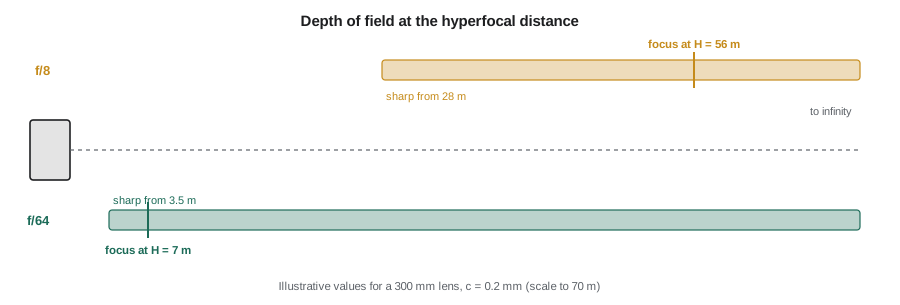
A Group f/64 photographer uses a 300 mm lens on an 8 by 10 inch camera at f/64, with a circle of confusion of 0.2 mm, appropriate for a contact print viewed at normal distance. Estimate the hyperfocal distance.
Show solution
- Use \( H \approx f^2 / (N c) \), with all values in millimeters.
- \( H \approx 300^2 / (64 \times 0.2) = 90{,}000 / 12.8 \approx 7{,}031 \) mm.
- That is about 7 m. Focusing at 7 m gives sharpness from about 3.5 m to infinity.
Answer: The hyperfocal distance is about 7 m, so a landscape could be sharp from a few meters to the horizon, which is why f/64 became a symbol of complete clarity.
Ansel Adams later developed the Zone System with Fred Archer around 1940, a method of placing tones in a scene onto zones of a printed gray scale by controlling exposure and development. It turned the straight photograph into a precisely planned print, and Adams's grand landscapes of the American West, made with environmental advocacy for the Sierra Club, became among the most famous photographs of the century.
Imogen Cunningham, a founding member of Group f/64, photographed plants, especially magnolias and calla lilies, with sculptural precision, as well as portraits and nudes. Her long career, from pictorialism in the 1900s to her nineties in the 1970s, shows that modernism was one phase in a varied practice.
The New Vision in Europe
In Europe, modernist photography drew on the radical art movements of the period: Cubism, Futurism, Constructivism, Dada and Surrealism. The Hungarian artist László Moholy-Nagy, who taught at the Bauhaus from 1923 to 1928, argued in his book Painting, Photography, Film (1925) that the camera could create a "new vision" that extended human sight. He experimented with photograms, made by placing objects directly on photographic paper, with dramatic high and low viewpoints, extreme close-ups, negative prints and photomontage.
In the Soviet Union, Alexander Rodchenko photographed buildings, workers and athletes from steep upward or downward angles, believing that such unfamiliar views would jolt viewers out of habitual, bourgeois ways of seeing. In Germany, Albert Renger-Patzsch's book The World Is Beautiful (1928) presented plants, machines and industrial objects with cool, objective precision, part of a movement called New Objectivity. August Sander's ambitious project People of the Twentieth Century photographed Germans of all classes and professions in a systematic, typological way. The 1929 exhibition Film und Foto in Stuttgart brought these tendencies together and included American work selected by Weston and Steichen.
| Feature | Straight photography (US) | New Vision (Europe) |
|---|---|---|
| Key figures | Stieglitz, Strand, Weston, Adams, Cunningham | Moholy-Nagy, Rodchenko, Renger-Patzsch, Sander |
| Typical camera | large-format view camera | hand-held cameras such as the Leica as well as view cameras |
| Viewpoint | usually eye level, frontal or carefully chosen | steep diagonals, bird's-eye and worm's-eye views |
| sharp contact prints, full tonal scale | sharp prints, photograms, negatives, montage | |
| Goal | reveal the essence of things through pure seeing | renew perception, serve modern society and design |
Small cameras and the instant
The Leica, introduced in 1925 and using 35 mm cinema film, made it possible to photograph quickly and discreetly. Photographers such as André Kertész, who moved from Hungary to Paris and later New York, and Henri Cartier-Bresson, who began photographing in the early 1930s, used small cameras to capture fleeting, poetic moments in the street. Cartier-Bresson later described the "decisive moment" as the instant when form and meaning come together in a fraction of a second. Small cameras also transformed photojournalism, discussed in lesson 8.
Modernism in museums and collecting
Modernism brought photography into art museums. In 1937 the Museum of Modern Art in New York held the exhibition Photography 1839–1937, curated by Beaumont Newhall, which told the story of photography as a history of technical and aesthetic progress leading to modernism. In 1940 MoMA created a department of photography, the first in a major art museum. Newhall's history, published as a book and revised many times, shaped the canon for decades. Later historians criticized its emphasis on fine-art photography and its neglect of vernacular, commercial and non-Western photography, but its influence is undeniable.
In the United States, modernist photography found a home in New York galleries, magazines and museums. Stieglitz's later galleries, the Intimate Gallery and An American Place, showed photographs alongside painting by artists such as Georgia O'Keeffe, his wife, whom he photographed in a long series of portraits. On the West Coast, Weston, Adams and Cunningham built careers through exhibitions, teaching and publishing. MoMA's department of photography, led successively by Newhall, Edward Steichen and later John Szarkowski, made New York the center of the American photography canon.
Commercial modernism
Modernist ideas spread rapidly into advertising and magazine design. Photographers such as Paul Outerbridge, Margaret Bourke-White and Edward Steichen applied sharp focus, dramatic lighting and geometric composition to products, fashion and industry. Bourke-White's photographs of steel mills and machinery for Fortune magazine, founded in 1930, celebrated industrial power. The line between art and commerce was porous, and many modernists earned their living from commercial work while exhibiting personal projects in galleries.
Critiques of modernism
Modernist photography has been criticized on several fronts. Its insistence on purity and medium specificity could exclude photographs made for other purposes, such as family snapshots, scientific images and popular press photographs. Its formal emphasis could make social content secondary: a beautifully composed photograph of industrial forms might hide the conditions of the workers inside. The Group f/64 ideal of photographs without any reference to other arts was, critics noted, itself a style with its own conventions. Feminist and postcolonial historians have pointed out how few women and photographers of color were included in the modernist canon, despite figures such as Cunningham, Watkins, Tina Modotti in Mexico and the Black American photographer James Van Der Zee, who documented Harlem life in studio portraits from the 1910s to the 1940s.
Worked problem
Applying the f/64 principle with a modern camera
A student with a full-frame camera, a 50 mm lens and a circle of confusion of 0.03 mm wants to emulate Group f/64's total sharpness. At f/16, what is the hyperfocal distance, and why do modern photographers rarely stop down to f/64 on small formats?
Show solution
- \( H \approx 50^2 / (16 \times 0.03) = 2{,}500 / 0.48 \approx 5{,}208 \) mm, about 5.2 m.
- Focusing at about 5 m gives sharpness from about 2.6 m to infinity, similar to the large-format example.
- On a small sensor, very small apertures such as f/32 or f/64 cause diffraction softening that reduces overall sharpness, so the f/64 ideal translates to about f/11 to f/16.
Answer: The hyperfocal distance at f/16 is about 5.2 m; diffraction makes extreme stopping down counterproductive on small formats.
Diffraction is a reminder that photographic ideals are tied to specific technologies. Group f/64's philosophy of total clarity made sense with large negatives and contact prints; translating it to other formats requires understanding the physics, not just copying settings.
Practice: seeing like a modernist
Spend an afternoon photographing ordinary objects and structures in two modernist modes. First, follow Weston and Strand: choose a single object, such as a pepper, a shell, a kitchen tool or a fence, and photograph it so closely and clearly that its form becomes sculptural, using window light and a small aperture. Second, follow Moholy-Nagy and Rodchenko: photograph buildings, stairs or crowds from steep angles, looking straight up or straight down, and notice how familiar places become strange and graphic.
Compare your results with the historical work and write a short note on what each approach reveals and conceals. A close study of a pepper may reveal unexpected beauty but tell you nothing about who grew it; a dramatic upward view of a tower may celebrate modern architecture while hiding the people inside. These limits are not reasons to avoid modernist approaches, which remain powerful, but they are reasons to use them knowingly and to combine them with context when your subject has social meaning.
Common mistakes
MistakeThinking straight photography means no decisions
InsteadStraight photographers made precise choices of subject, viewpoint, light, moment and printing
MistakeBelieving modernism was only American
InsteadThe European New Vision, New Objectivity and Soviet photography were equally important
MistakeAssuming f/64 is always the sharpest setting
InsteadDiffraction limits small apertures, especially on small formats
MistakeTreating modernism as purely artistic
InsteadModernist styles were used extensively in advertising and industry
MistakeForgetting excluded photographers
InsteadWomen and photographers of color such as Watkins, Modotti and Van Der Zee were often left out of early histories
Summary and key terms
- Straight photography emphasized sharp focus, full tonal range and unmanipulated prints.
- Stieglitz's turn and Strand's 1917 photographs marked the shift from pictorialism.
- Weston, Adams, Cunningham and Group f/64 (1932) championed pure photographic seeing.
- The European New Vision explored unusual angles, photograms, montage and typologies.
- The Leica made quick, discreet street photography possible.
- MoMA's 1937 exhibition and 1940 department established photography in art museums.
- Canadian modernism included Vanderpant and Watkins, and modernism has been criticized for exclusions and formalism.
- Straight photography
- Sharply focused, unmanipulated photography that emphasizes the camera's own qualities
- Group f/64
- A California group founded in 1932 to promote pure, sharp photography
- Hyperfocal distance
- The focus distance that gives maximum depth of field to infinity
- Zone System
- A method for controlling exposure and development to place tones on a gray scale
- New Vision
- The European modernist approach using new angles, close-ups, photograms and montage
- Photogram
- A camera-less image made by placing objects on photographic paper
- New Objectivity
- A German movement of cool, precise, objective representation in the 1920s
- Typology
- A systematic series of similar subjects photographed in the same way for comparison
- Decisive moment
- Cartier-Bresson's idea of the instant when form and meaning coincide
- Medium specificity
- The idea that each art should use the qualities unique to its medium
Practice problems
Work each problem on paper first, then reveal the answer to check.
What did Strand praise as photography's power in 1917?
Show answer
Absolute unqualified objectivity, rejecting manipulation.
What does the name Group f/64 refer to?
Show answer
The small aperture f/64, which gives maximum depth of field and sharpness.
Using the lesson's numbers, what is the hyperfocal distance at f/64 with a 300 mm lens and 0.2 mm circle of confusion?
Show answer
About 7 m.
What did Moholy-Nagy mean by the "new vision"?
Show answer
The camera's capacity to extend human sight through new viewpoints and techniques.
Why did Rodchenko use steep angles?
Show answer
To jolt viewers out of habitual ways of seeing.
What was August Sander's project?
Show answer
A systematic typological portrait of Germans of all classes and professions.
What camera made quick 35 mm street photography practical?
Show answer
The Leica, introduced in 1925.
What exhibition did Beaumont Newhall curate in 1937?
Show answer
Photography 1839–1937 at MoMA.
Name a Canadian modernist photographer.
Show answer
John Vanderpant or Margaret Watkins.
Why do modern photographers avoid f/64 on small formats?
Show answer
Diffraction softens the image at very small apertures.
Lesson quiz · 5 questions
Score 60% or more to complete this lesson.
Create a free account to save your progress, take quizzes and earn a certificate.