
VIS-210 · Lesson 3 of 12 · 27 min
Early processes and the commercial portrait studio
Within two decades of 1839, photography had become an industry. Studios opened on the main streets of cities and towns, traveling photographers carried darkroom wagons to villages, and ordinary families could afford to have their likenesses made for the first time. Each new process changed the look of photographs, the speed of making them, their price and the way people collected and displayed them. This lesson surveys the processes of the 1840s to the 1880s and the commercial studio culture they created. PHOT-240 covers the chemistry and safety of historical processes in the darkroom; here the focus is on how the processes shaped what photographs looked like and what they meant to people.
The daguerreotype era
From 1839 to the mid-1850s, the daguerreotype dominated portrait photography, especially in France and the United States. The image sat on a polished silvered plate, so fragile that a touch could wipe it away. Studios therefore sealed it under glass behind a decorative brass mat and placed it in a hinged case lined with velvet. Holding a cased daguerreotype is an intimate experience: you open it like a small book, tilt it until the mirror-like surface shows a positive rather than a negative, and see an image of remarkable detail.
Because the image was laterally reversed, sitters' left and right were swapped unless a mirror or prism was used in the camera. Exposure times of tens of seconds in the 1840s required sitters to stay very still. Studios used head braces, hidden stands that held the back of the head, which explains the stiff postures and serious expressions of many early portraits. Smiling for so long was difficult, and many sitters treated the portrait as a solemn occasion that might be the only image ever made of them.

The calotype and paper photography
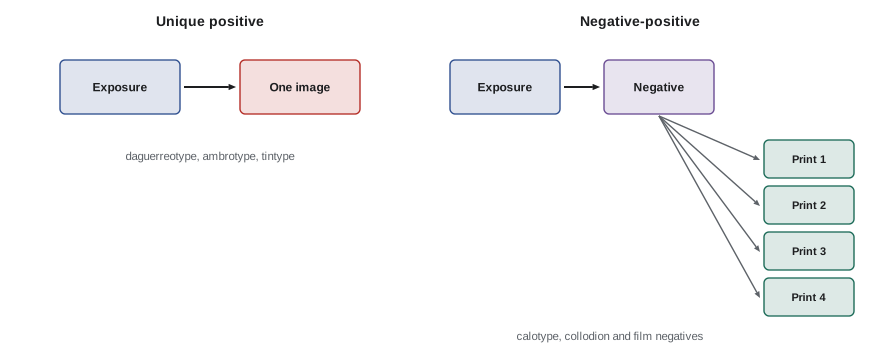
Talbot's calotype produced softer images because paper fibers in the negative scattered light and broke up fine detail. Some saw this as a weakness. Others valued the broad masses of light and shade, which recalled drawings and etchings. In Scotland in the 1840s, the painter David Octavius Hill and the engineer Robert Adamson made hundreds of calotype portraits and views, including studies of fishing communities in Newhaven, that are still admired for their sensitivity and composition. In France, photographers improved paper negatives with waxed paper processes that gave sharper results and were popular for architectural and travel photography in the 1850s.
Worked problem
How many prints can one negative produce?
A calotypist in 1845 makes one paper negative of a building. Each salted paper print needs about 20 minutes of sunlight exposure in a printing frame, and on a clear day the photographer can expose prints for about six hours. If the photographer has four printing frames and only one copy of the negative, how many prints can be made in one day? How would making three duplicate negatives change this?
Show solution
- With one negative, only one frame can be used at a time: \( 6 \times 60 \div 20 = 18 \) prints.
- With four negatives (the original plus three duplicates), all four frames work at once: \( 18 \times 4 = 72 \) prints.
- The daguerreotype, by contrast, produced one image per exposure, with no prints at all.
Answer: About 18 prints from one negative, or about 72 with four negatives, showing why the negative-positive principle transformed reproduction even before mass printing.
Wet collodion: speed and sharpness
In 1851 the English sculptor Frederick Scott Archer published the wet collodion process. A glass plate was coated with collodion, a syrupy solution of cellulose nitrate in ether and alcohol containing iodide salts, then dipped in silver nitrate to sensitize it. The plate had to be exposed and developed while still wet, within about ten to fifteen minutes. The results combined the sharpness of the daguerreotype with the reproducibility of a negative, and exposures in good light were just a few seconds. Archer did not patent the process, and within a few years it replaced both the daguerreotype and the calotype.
The catch was that photographers needed a darkroom wherever they worked. Landscape and war photographers traveled with darkroom tents, wagons and crates of glass plates and chemicals. The chemistry was dangerous: ether is highly flammable, and potassium cyanide was often used for fixing.
Worked problem
Planning a wet-plate session in the field
A wet-plate photographer in 1865 needs about 3 minutes to coat and sensitize a plate, has to finish exposure and development within 12 minutes of coating, and must walk 4 minutes from the darkroom wagon to the camera position and 4 minutes back. Exposure takes 10 seconds and development about 1 minute. Can the photographer work from the wagon to this position, and how long is the spare margin?
Show solution
- Time from coating complete to development: walk out 4 minutes, expose about 0.2 minutes, walk back 4 minutes, start development, about 8.2 minutes.
- The limit is 12 minutes from coating, so the margin is about \( 12 - 8.2 = 3.8 \) minutes.
- The sensitizing time of 3 minutes happens before this clock starts, so it does not reduce the margin, but delays such as wind moving the camera or a passing cloud could quickly use up the spare time.
Answer: Yes, with about 3.8 minutes to spare, which is why photographers parked their darkrooms as close as possible to the camera and often worked within a short walk.
Ambrotypes and tintypes
Two cheap variants of wet collodion made photography affordable for working people. The ambrotype, popular from about 1854, was an underexposed collodion negative on glass backed with black varnish, paper or cloth, so that it appeared as a positive. It was cased like a daguerreotype but easier to see and much cheaper.
The tintype, or ferrotype, patented in the United States in 1856, used a thin sheet of iron coated with dark lacquer or enamel instead of glass. Tintypes were inexpensive, robust and quick, often delivered within minutes. Itinerant photographers made them at fairs, beaches and military camps, and they became especially popular in the United States during the Civil War, when soldiers sent portraits home. Tintypes are often less formal than earlier portraits, and they recorded many people, including working-class and Black Americans, whose likenesses had rarely been made before.
The carte de visite and the photographic album
In 1854 the Parisian photographer André-Adolphe-Eugène Disdéri patented a camera with several lenses that could make eight or more small exposures on one plate. The prints, mounted on cards about the size of a calling card, became known as cartes de visite. They were cheap, easy to exchange and perfect for collecting. A craze known as "cartomania" swept Europe and North America in the early 1860s. People traded portraits of family and friends and bought cartes of celebrities, royalty, politicians, actors and soldiers.
Families arranged their cartes in purpose-made albums with cut-out windows, which became treasured objects in Victorian parlours. Albums mixed relatives and famous people, creating a personal narrative of belonging and status. Later, the larger cabinet card, introduced in the 1860s, became the standard studio format for the rest of the century.
| Process or format | Introduced | Support | Reproducible? | Typical use |
|---|---|---|---|---|
| Daguerreotype | 1839 | silvered copper | no, unique | formal cased portraits |
| Calotype | 1841 | paper negative | yes | portraits, views, architecture |
| Wet collodion negative | 1851 | glass | yes | portraits, landscape, war, survey |
| Ambrotype | about 1854 | glass with dark backing | no, unique | cheap cased portraits |
| Tintype | 1856 | lacquered iron | no, unique | very cheap, informal portraits |
| Carte de visite | 1854 | albumen print on card | yes, many | collectible portraits |
| Albumen print | 1850 | paper coated with egg white | yes | the main print type until the 1890s |
The commercial portrait studio
The successful nineteenth-century studio was a business with a reception room, a skylit studio on the top floor, a darkroom and a printing room where prints were exposed in sunlight on the roof. Studios employed camera operators, printers, retouchers who painted out blemishes on negatives, colorists who tinted prints, and receptionists. Painted backdrops, balustrades, columns and potted plants created an illusion of wealth and taste. Sitters were posed according to conventions borrowed from painted portraiture, with hands resting on books or chairs to signal education and respectability.
Studio portraits were therefore constructed images, not neutral records. They show how people wanted to be seen, and how studios told them they should look. Historians read them for evidence about fashion, family structure, class aspirations and the conventions of self-presentation.
In the United States, Mathew Brady opened a daguerreotype studio in New York in 1844 and became the most famous portraitist of his time, photographing presidents, politicians, writers and celebrities. Brady's "Gallery of Illustrious Americans" turned photographic portraits into a form of national memory. As his eyesight weakened, Brady relied increasingly on employees, and many photographs credited to "Brady" were made by camera operators such as Alexander Gardner and Timothy O'Sullivan. Brady's studio records and negatives, now partly at the Library of Congress and the National Archives, show how a celebrity studio worked.
Retouching and the question of truth
Retouching began almost immediately. Daguerreotypists added color with powdered pigments, and later studios painted directly on negatives with pencils and dyes to smooth skin, slim waists and remove wrinkles. Composite printing combined several negatives into one image, and the British photographer Oscar Rejlander's "The Two Ways of Life" of 1857 used more than thirty negatives. By the 1860s, critics and the public knew that photographs could be altered. The belief that early photographs were pure, untouched records is a myth; manipulation is as old as the medium.
Photography and identity
The cheapness of the tintype and carte de visite meant that, for the first time, ordinary people controlled how they were pictured. Formerly enslaved people in the United States, immigrants arriving in Canada and the United States, and working families commissioned portraits that presented them with dignity. The abolitionist Frederick Douglass, one of the most photographed Americans of the nineteenth century, deliberately used photographic portraits to counter racist caricatures and argued in lectures that photography could democratize representation.
At the same time, photography was used to classify and control. Police and prisons began photographing suspects and inmates, scientists made "type" photographs of racial groups, and colonial authorities photographed Indigenous peoples as specimens. The same technology could empower or dominate depending on who controlled it, a theme the next lesson explores in depth.
Common mistakes
MistakeCalling every old photograph a daguerreotype
InsteadTintypes, ambrotypes, albumen prints and cartes de visite are different processes and formats
MistakeThinking studio portraits were candid records
InsteadStudios constructed poses, props, backdrops and retouched negatives
MistakeAssuming manipulation began with digital editing
InsteadRetouching, hand tinting and composite printing date from the 1840s and 1850s
MistakeForgetting that wet collodion required a portable darkroom
InsteadPlates had to be coated, exposed and developed while wet
MistakeOverlooking who could afford photographs
InsteadCheap tintypes and cartes de visite let working people and marginalized groups commission portraits
Summary and key terms
- Daguerreotypes were unique, fragile, cased portraits that required long, still poses.
- The calotype gave softer, reproducible paper images valued by artists such as Hill and Adamson.
- Wet collodion (1851) combined sharpness and reproducibility but required a darkroom on location.
- Ambrotypes and tintypes made cheap portraits available to working people.
- The carte de visite created a collecting craze and the family album.
- Commercial studios such as Notman's in Montreal and Brady's in New York constructed images of status and identity.
- Retouching and composite printing show that manipulation is as old as photography.
- Ambrotype
- A collodion negative on glass backed with dark material so it appears positive
- Tintype
- A cheap collodion positive on lacquered iron, also called a ferrotype
- Wet collodion
- A process in which a glass plate is coated, sensitized, exposed and developed while wet
- Albumen print
- A paper print coated with egg white and silver salts, the dominant print type from the 1850s to the 1890s
- Carte de visite
- A small mounted photographic portrait popular in the 1860s
- Cabinet card
- A larger mounted studio portrait format introduced in the 1860s
- Composite photograph
- An image made by combining several photographs into one
- Retouching
- Altering a negative or print to change the image
- Head brace
- A hidden stand used to keep a sitter's head still during long exposures
- Printing frame
- A frame holding a negative against sensitized paper for exposure in sunlight
Practice problems
Work each problem on paper first, then reveal the answer to check.
Why were daguerreotypes sealed under glass in cases?
Show answer
The image surface was extremely fragile and could be wiped away by a touch.
What gave calotypes their softer look?
Show answer
Paper fibers in the negative scattered light.
Why did wet collodion photographers travel with darkrooms?
Show answer
Plates had to be exposed and developed while still wet, within minutes.
How does an ambrotype appear positive?
Show answer
It is an underexposed negative on glass backed with dark material.
What made the tintype popular?
Show answer
It was cheap, robust and quick to deliver.
What was cartomania?
Show answer
The 1860s craze for collecting and exchanging cartes de visite.
What did Notman's studio do to create scenes impossible to photograph directly?
Show answer
It made composite photographs from cut-out portraits on painted backgrounds.
Using the lesson's example, how many prints could one negative yield in six hours at 20 minutes each?
Show answer
18 prints.
Name one way photography empowered marginalized people in the nineteenth century.
Show answer
Cheap portraits let them present themselves with dignity, as Frederick Douglass argued.
Name one way photography was used to control people.
Show answer
Police mug shots, prison records, scientific type photographs or colonial classification.
Lesson quiz · 5 questions
Score 60% or more to complete this lesson.
Create a free account to save your progress, take quizzes and earn a certificate.